Showing posts with label The Masters. Show all posts

Friday, March 23, 2012

Comics and Superheroes

I am pretty selective about the comics I read. I've got eleven long boxes full of comics, and in going through them I've noticed something. I don't like superhero comics.

In fact, I don't like superheroes at all.

The difference between a auperhero and a regular hero is that the superhero is born with their difference from the rest of humanity. They were born special, and often the book is about using that specialness in a non-selfish fashion. But you can't aspire to be Superman. No one was born on Krypton, so no matter how hard you try, you can't fly. Even if you wear the cape.

The comics I have read tend to have more human. Grimjack, Hellblazer, Bone, Castle Waiting, Grendel and Jonah Hex. All of these feature protagonsts who are normal, but not average, humans.

There are exceptions, of course. I've got Mage, Swamp Thing, Hellboy, Girl Genius, and the occasional Batman trade. You don't think Batman was born with powers beyond that or mere mortals? Where would he be without Wayne Enterprises? WOuld Batman be half as effective if he was not ridiculously wealthy and able to afford the Batwing, the Batmobile, and all those other gadgets?

But when I look at patterns, especially in myself, I wonder about the exceptions. Despite the above sentence, Batman is often closer to being a hero than a superhero. When he is being written as the Darknight Detective and investgating crimes, I'm a lot more interested.

But what about Hellboy attracts me? Alan Moore's Swamp Thing and Phil Foglio's Girl Genius are both brilliantly written, transcending the usual tropes of the superhero genre, and Mage is a rather tasty modernization of the Arthur stories, which I've long enjoyed.

So why Hellboy?
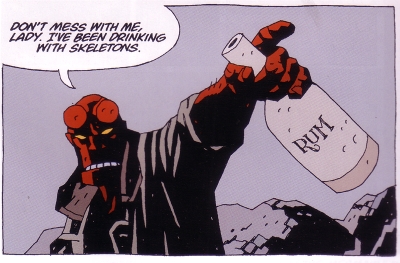

The short answer is because it's awesome.

Hellboy is an exception to the usual superhero tropes. Yes, he's stronger and tougher than the average human, but it's important to note that he was born to destroy the world. Think about that for a moment. He was born to bring about the death of everyone he knows, to split the world and open the way for the apocalypse. That's kind of heavy.

What makes Hellboy such a good character is that as he becomes aware of his "birthright," he intensifies his fight against it. He will not be defined by his birth. He will be himself, not play the role that someone else handed him. The underlying thrust of the series, shot through with stories of killing Nazis, dragons, and trolls, is the growung realization that he is defying his so-called desting and taking his own path. That journey, the personal one, is worth more of my time than a hundred pages of beating up supervillains.

Monday, March 19, 2012

Tim Powers: Master of the Craft, Builder of Worlds

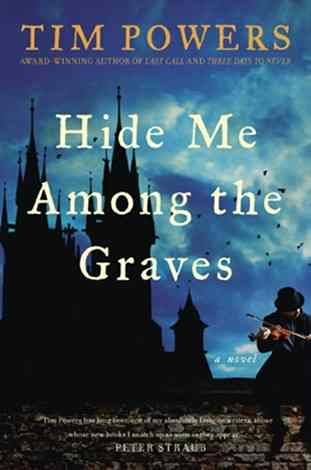
Last week Tim Powers latest book came out. There's two people I buy the hardcover of, and Powers is one of them. Hide Me Among the Graves, is next on my reading list (when the Queen of Science is done).

Tim Powers is the guy who ruined Harry Pottter for me. He is one of the pre-emminent world-builders working in fiction today. When he creates magic, or magical effects, they are strange and quirky, but they follow a consistent set of rules. There is no magic of convenience, something that the characters can do because it makes the plot easier, or worse, make the plot happen. Even Charles Stross can't avoid a little magic of convenience; it makes the plotting a little bit easier, covers up gaps the writer doesn't want to explore.

Powers is a master of prose, but he's also the real father of the mashup novel. In his books, the most unlikely things collide, and as you progress further into the book, it all begins to makse sense. His novel Last Call is a wonderful, frightening wreck in which the train of King Arthur mythology rams headlong into the gaudily-decorated van that is Las Vegas. And I couldn't look away.

And how completely MAD is it to combine bitter cold war John Lecarre spying with Arabic genies? But Powers takes this conceit, james it in a blender with the life of Kim Philby, and builds up all these very strange connections into a real slam-you-out-of-nowhere climax that works because you understand how the magic works. Powers has sucked you into his world, and you begin to see things through what he describes as his 'paranoid hat.'

What makes Powers books so compelling is that it has weird little implications his magic system provides. Magic is not simple, but it is goverened by rules, and the exploration if the implications of those rules is fascinating. Humans are, by nature, rules-gamers. We will try to get away with what we can within whatever rule set we establish. Watch politics and business interact some day and you'll see what I mean. So it stands to reason that humans who discover that there is magic in the world will try to push its boundaries, just to see how far they can go.

So it's not just that Tim Powers writes brilliant prose with compelling characters. His work is pretty much unique in its world-building and his exploration of the strangeness of his rules of magic. And it's brilliant.

Meeting Tim Powers was a major contributing factor to me writing. He a brilliant conversationalist. I thought "I want a job where my co-workers are like him." There are three ways to have frequent encounters with writers; be wealthy, be a publisher, or be a writer. I opted for number three, and I have met an enormous number of wonderful writers. Thank you, Mr. Powers, for openning two worlds to me.