Showing posts with label Anguirus. Show all posts

Thursday, January 1, 2015

Kaiju Blender: Godzilla: Final Wars

With the reduced revenues from Godzilla Against Mechagodzilla and Tokyo SOS, Toho decided it was once again to retire the franchise. But they would celebrate Godzilla's fiftieth birthday with a big bang, a more expensive Godzilla film than they had ever before produced, directed by maverick film maker Ryûhei Kitamura. The approach had worked with the excellent and well-regarded Godzilla, Mothra, King Ghidorah, Giant Monsters All-Out Attack. But it should be pointed out that director Shûsuke Kaneko had directed three well-received Gamera films before being asked to work on Godzilla. Kitamura had no such experience.

You really want to do this?

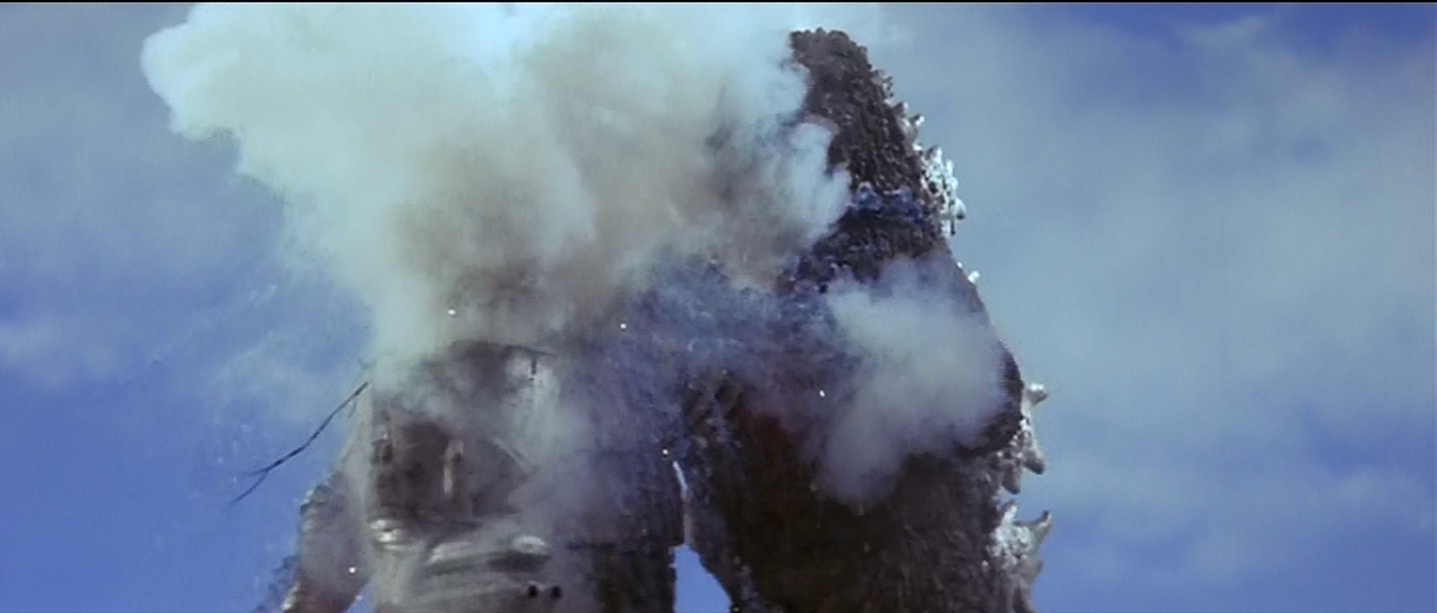
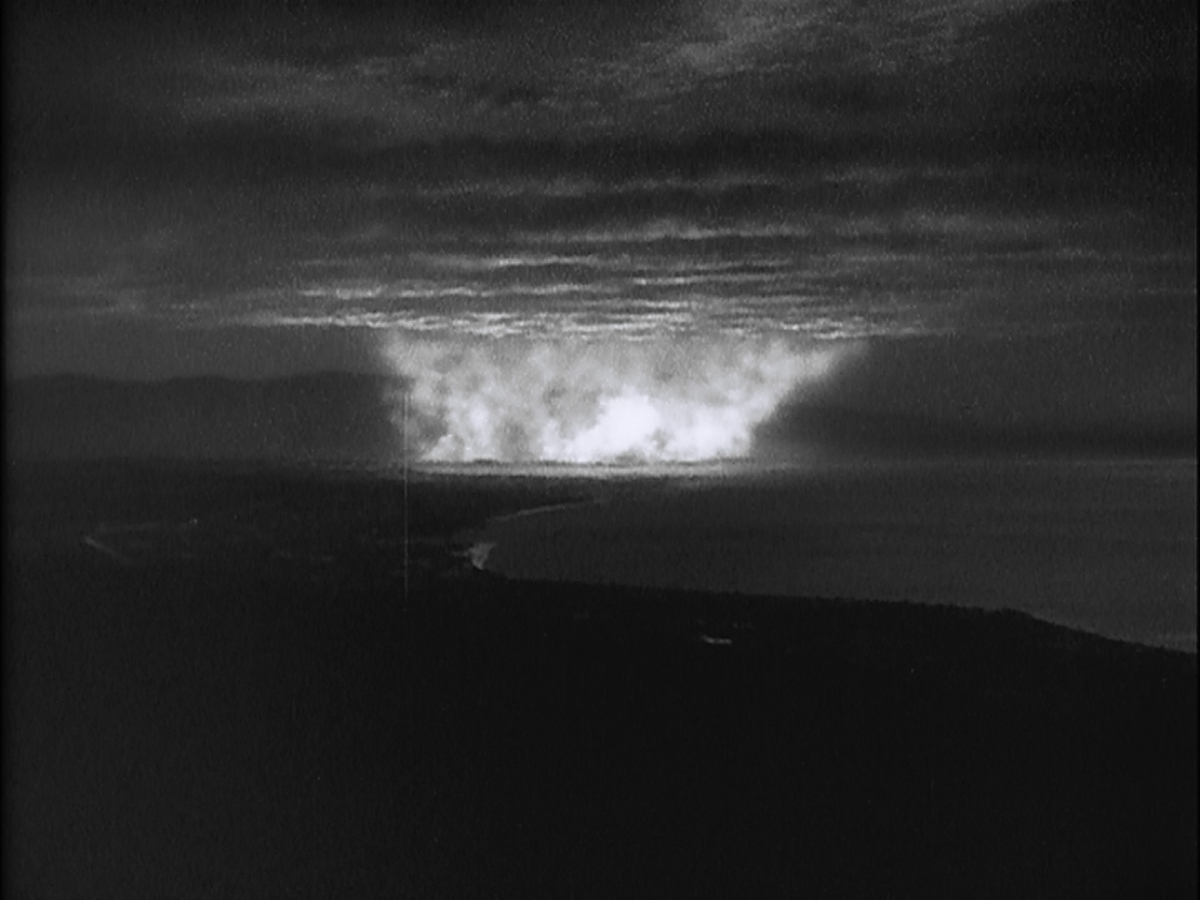
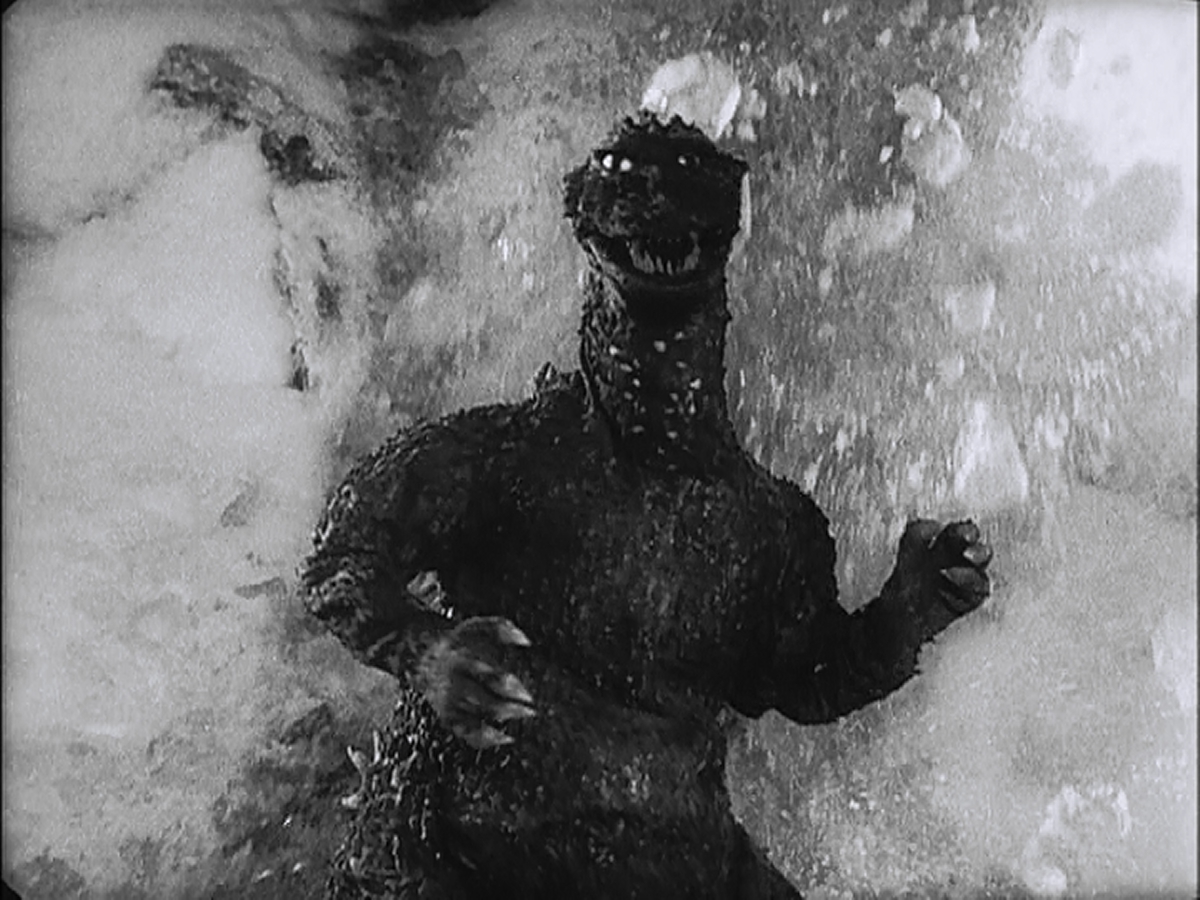
The first sequence is Godzilla being attacked by a flying submarine of the Atragon style. Godzilla falls into a crack in the Antarctic ice, freezing him, in a nod to Godzilla Raids Again. The gunner screams as he unleashes missiles to bring tons of ice down on Godzilla and in that moment, I knew exactly what kind of movie this is going to be.
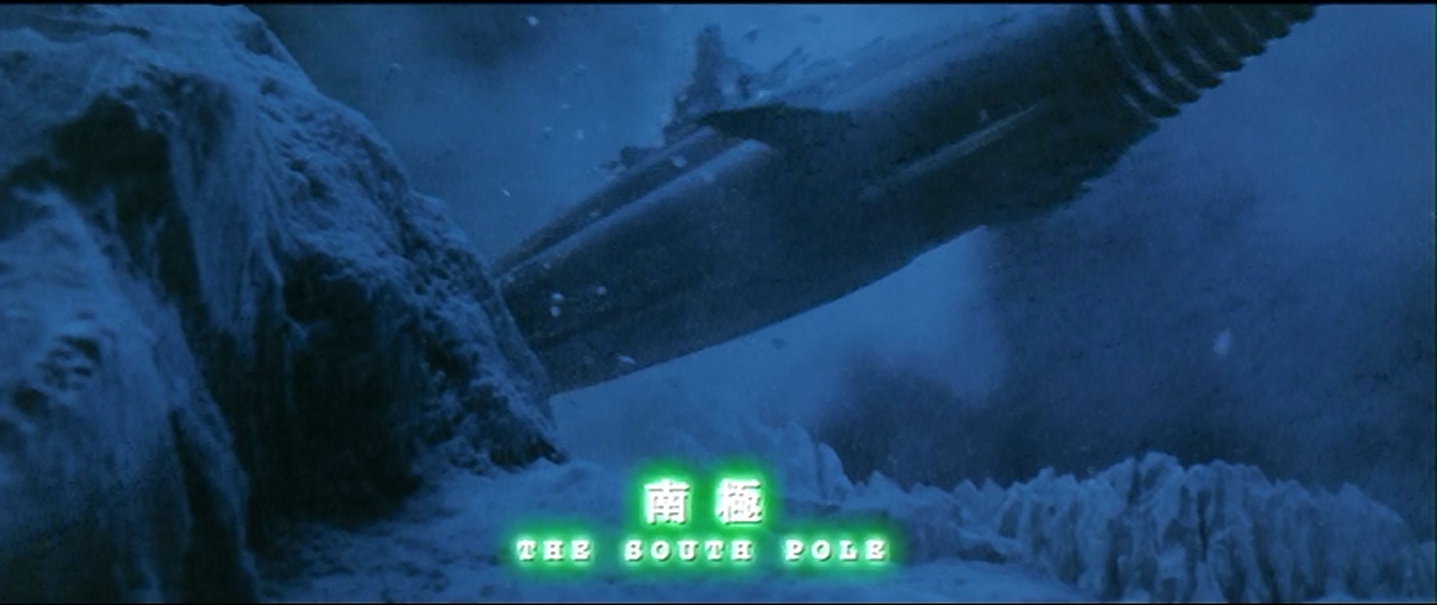
The Original Gotengo

In the narrative flashback, the audience is shown Varan, the squid from Space Amoeba, Titanosaurus, Gaira, Baragon, and Megaguirus. These kaiju do not appear in anything but stock footage, but it sets the tone. We are going to see a lot of monsters in this film.
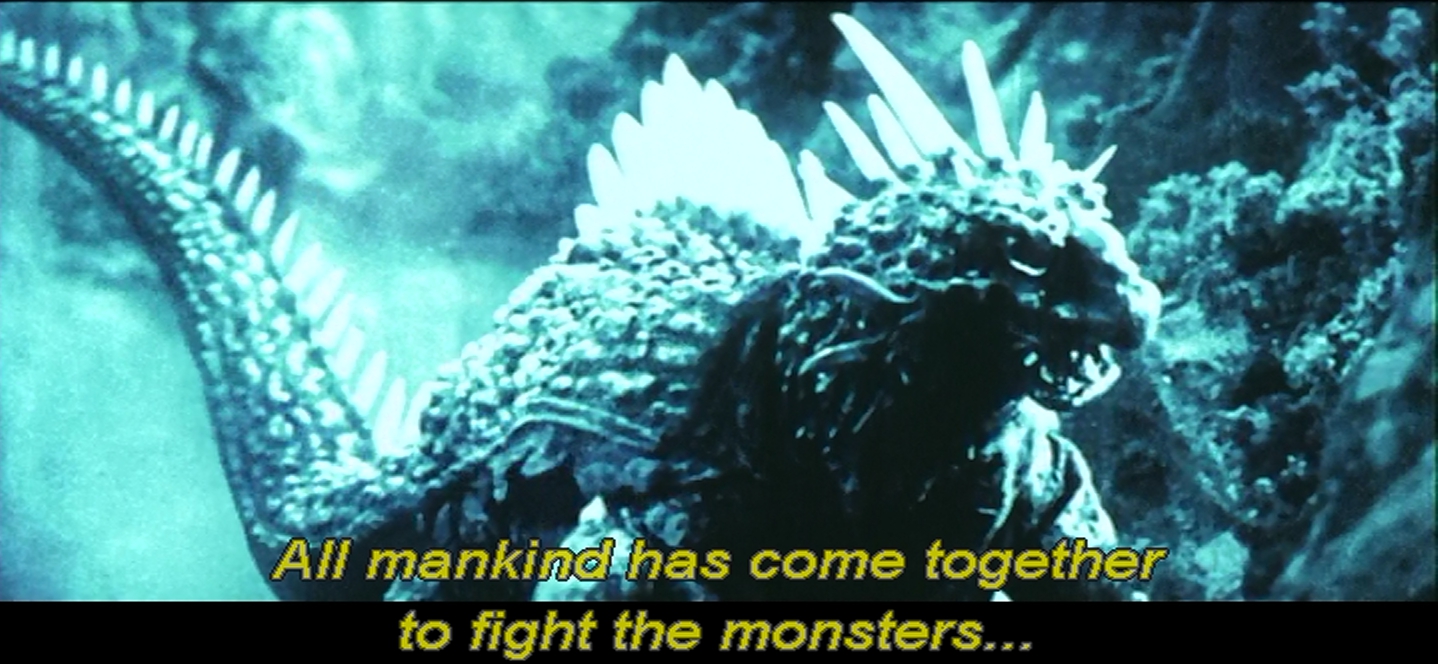
Guest appearance by Varan

We are also introduced to the mutants that protect us from the kaiju. A new race of superman and women have emerged from humanity, better, stronger, faster, and more psychically powerful. They, along with superb purely human specimens such as Captain Gordon, form the Earth Defence Force. After the title sequence, one of the supersubs defeats Manda. Gordon is emblemic of the film itself, big, physically powerful, and only speaking English, while everyone around hinm speaks Japanese, but somehow they understand each other anyway. As with Atragon, the sub fires its Absolute Zero gun, freezing and then destroying Manda. This introductory sequence lets us know how the Earth Defence Forces work.
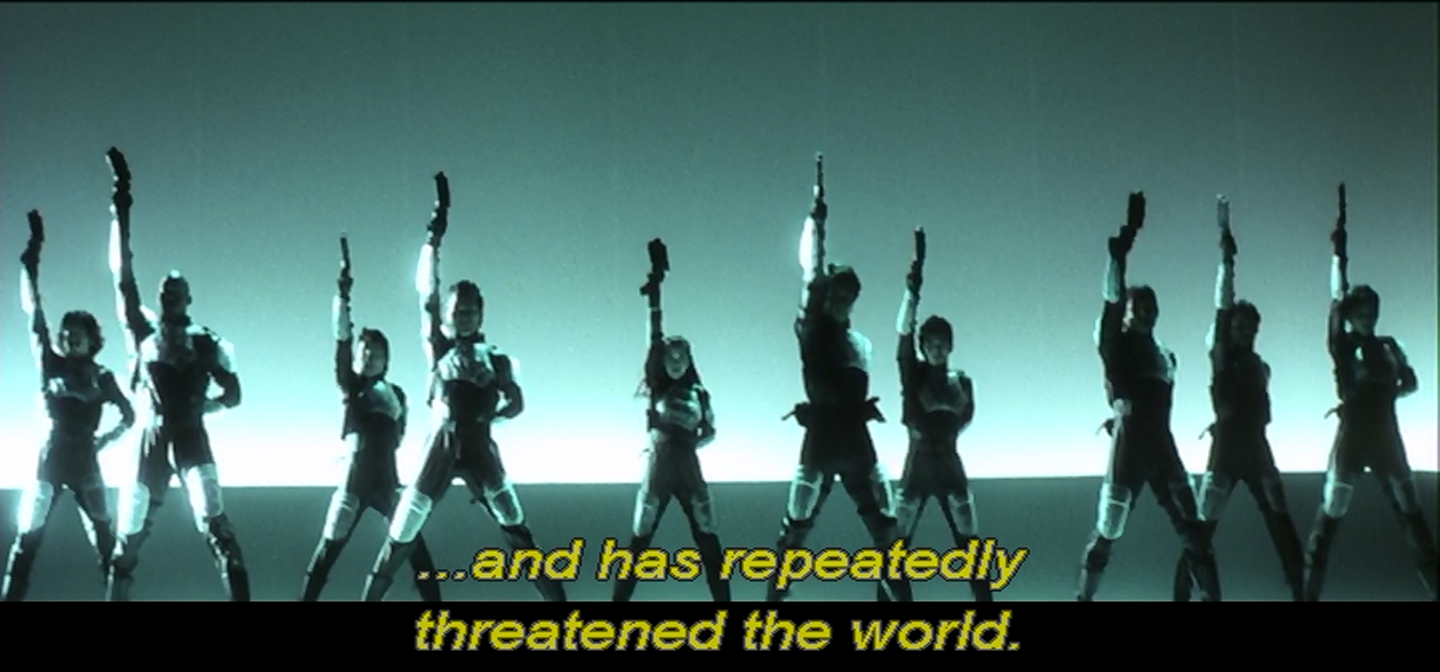
But not us. We've got guns but we're totally not a threat.

The Earth Defence Force higher-ups, for reasons that will become clear, have rather Nazi-esque unforms; a grey overcoat with a belt with a black arm band. The Mutants, a scientist tells us, share a certain biological link with the kaiju. The best way to defeat monsters, it seems, is to use them against themselves. The Shobijin, Mothra's fairy communicators show up, and give us a bit of back story. They also tell out Mutant protagonist that he has some kaiju in him (now confirmed by science and mysticism), but that he has a choice, which is very Matrix: Revolutions, and badly presented in that film, as well.
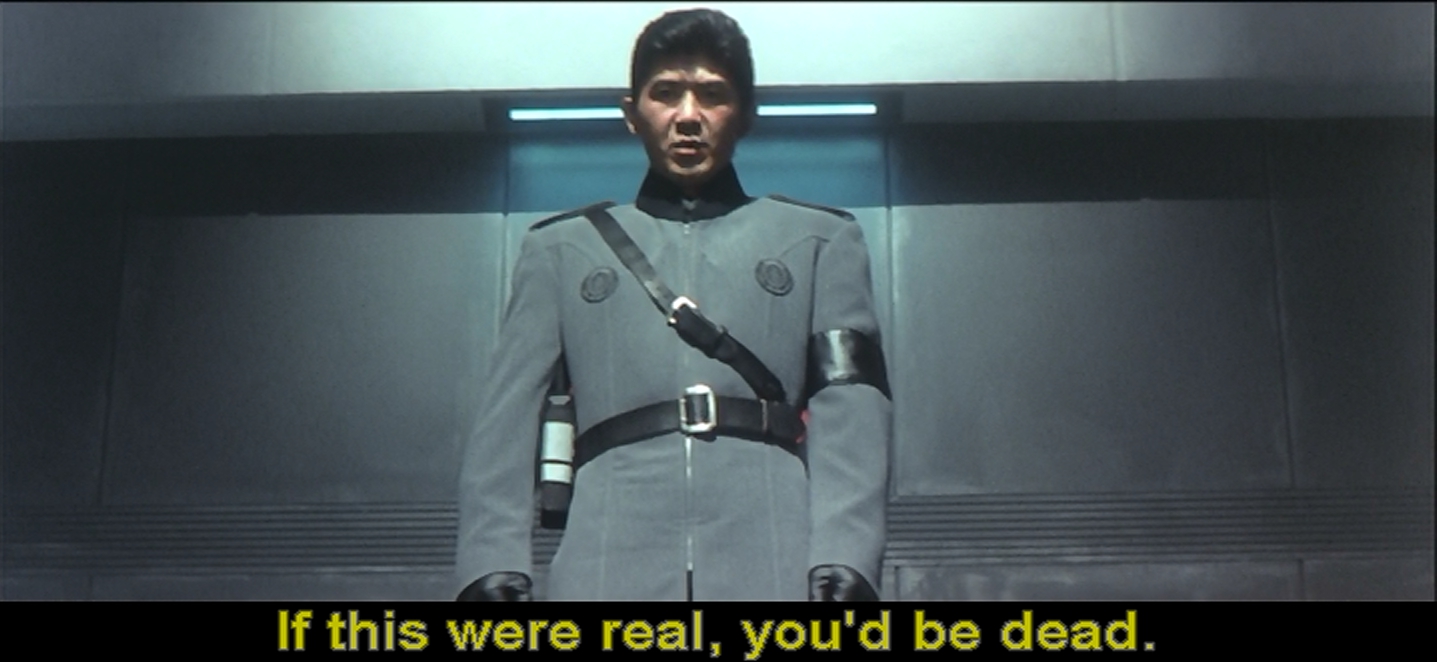
Yeah, so not a Nazi

Kaiju begin to wreck cities across the globe, with a similarity to the Kilaak invasion Destroy All Monsters. Anguirus, Rodan, King Caesar, Kamacuras, Kumonga, and even American Godzilla stomp on cities. Zilla, American Godzilla, is a weird sort of nod to the much-reviled 1998 film. Creature designer Patrick Tautopolis was gratified to be included in the Toho Godzilla canon, even though his creation was treated with a certain amount of contempt. Kitamura was determined to embrace as many films in the Toho library as possible, leaving out only Megalon, Destroyah, and King Kong.
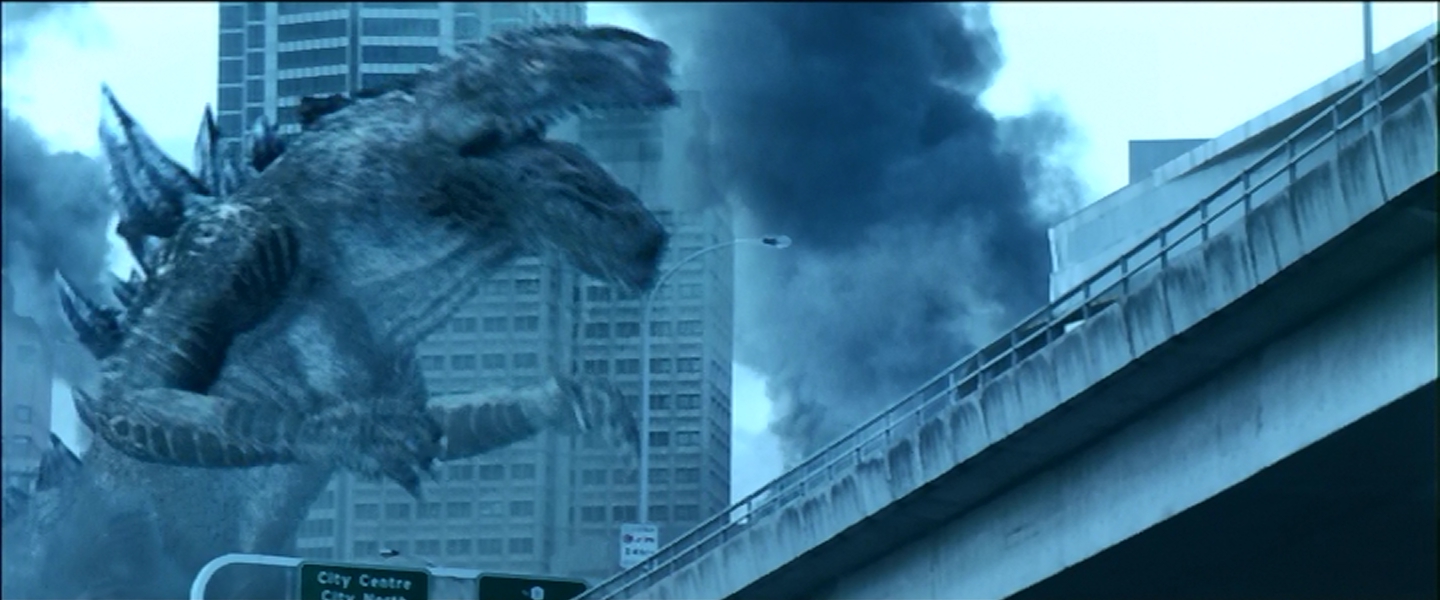
OK, a lower-grade Zilla

Kitamura goes so far as to have an obnoxious, chocolate-mouthed American child call his turtle toy (which looks suspiciously like a Tirtouga Pokemon) a loser, attempting to compare itself favorably to the Gamera franchise. We've seen this behavior before: in 1999 Yonggary, Kraa the Sea Monster, and Gamera, Super-Monster. All these films have the same thing in common: they aren't particularly good, and they only demonstrate their own insecurity by calling other films and franchises names.
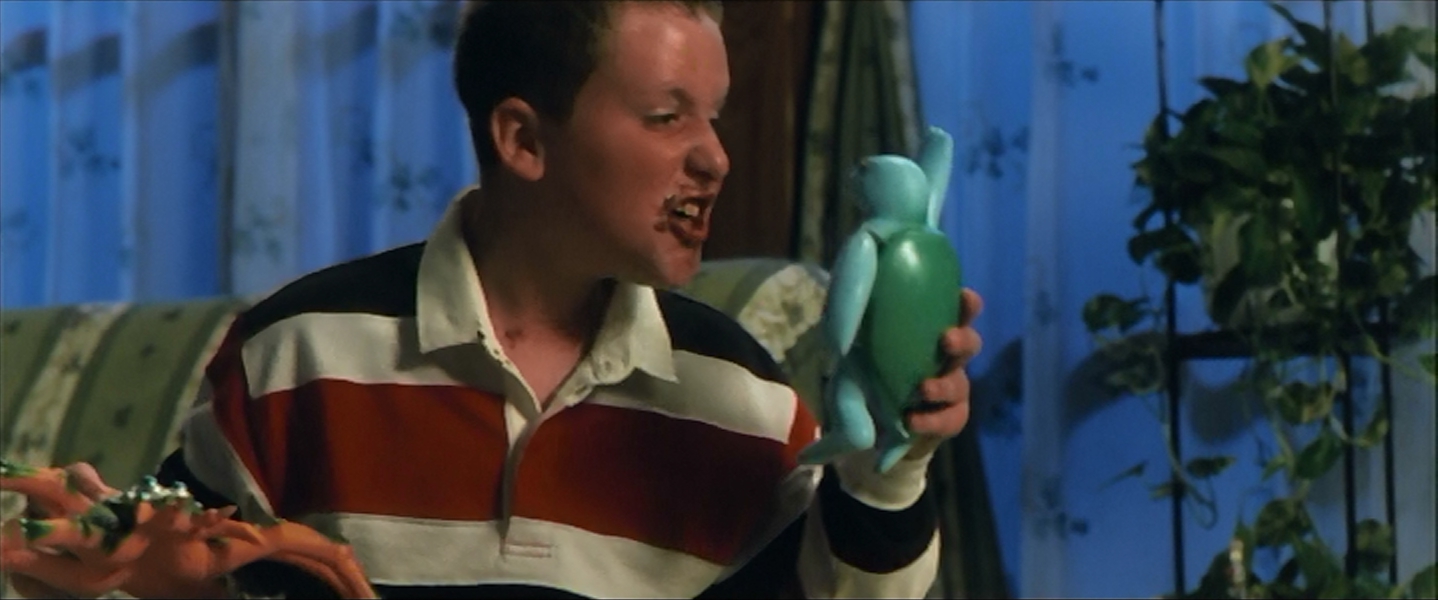
Really? You didn't have enough time for longer kaiju fights, but you had time to leave this in?

The M-Squad is deployed to take down Ebirah, the giant lobster we haven't seen since stock footage in the 1969 All Monsters Attack. Six mutants are deployed with shoulder weapons. There are a lot of pointless explosions, when the team are running, or standing still, or firing theit weapons. It's like each one is a John McClain, and their passing just causes things to explode in their wake. There's a lot of wirework which is well integrated into the miniature work, but it just feels like the director is trying too hard to be exciting, confusing motion with progress. There's a lot going on on-screen, but it doesn't engage me. A cinematic fight should be a story in itself, with a beginning, a middle, and an end. There is no progression here, nothing learned. Just weapons deployed, running, firing, and then it's all over except for the quip.
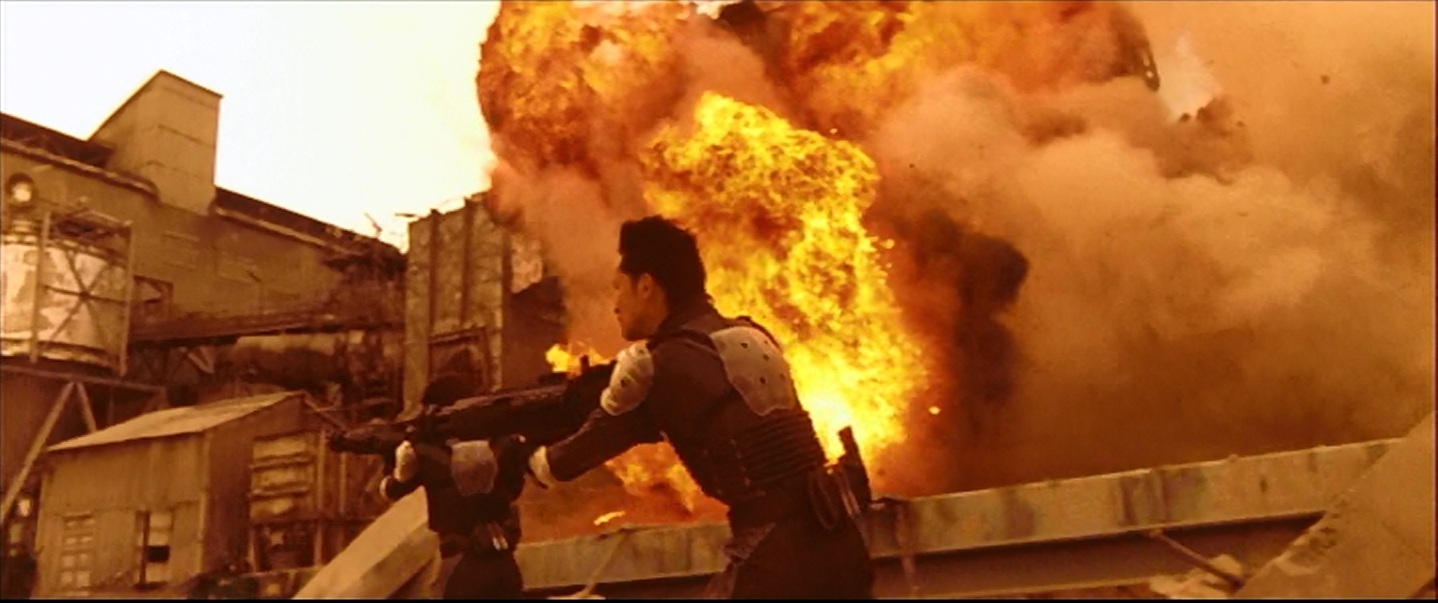
Explosions! Running!

The monsters, it turns out, are being controlled by aliens, the Xilians from Invasion of Astro-Monster to be precise. They tried to be subtle, in the Japanese alien invasion thing, trying to be friendly, returning the UN secretary to humans. When he doesn't recognize his own dog, the jig is up. Subcommander X shoots the mission commander, promoting himself. The aliens, he announces, are there to make humanity their supply of mitochondria.
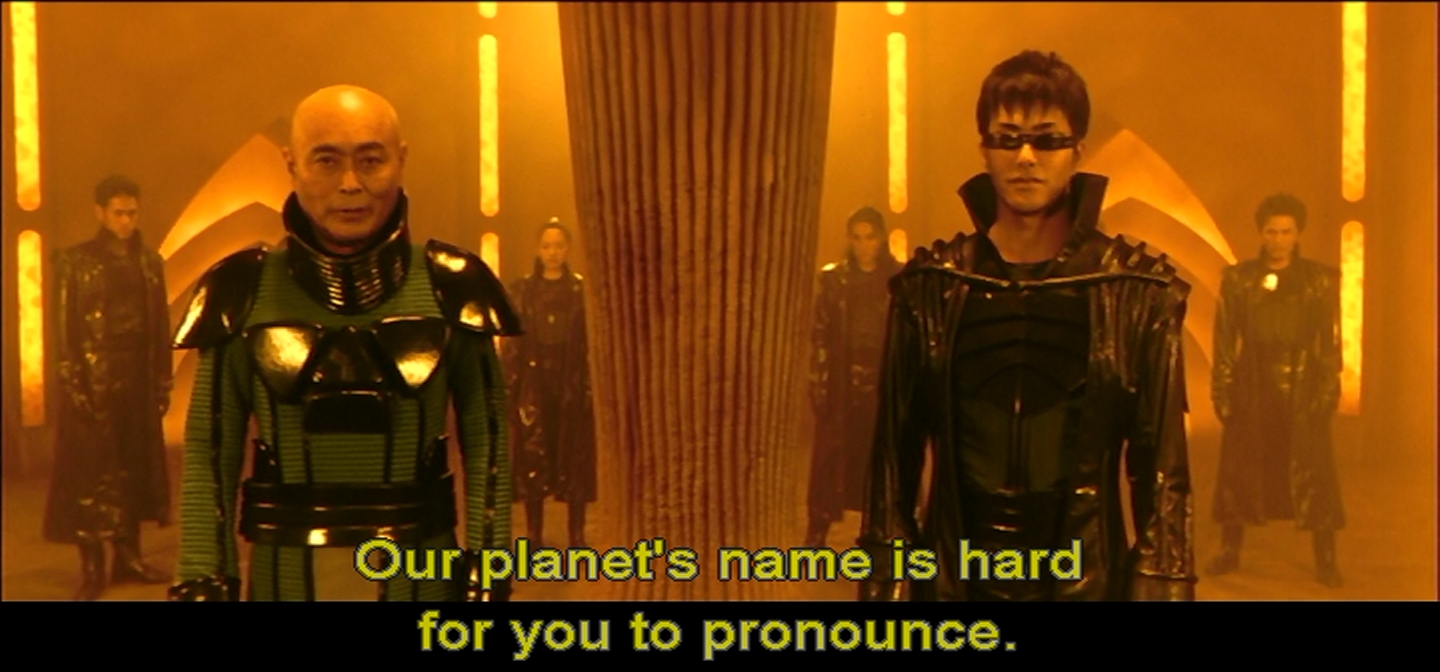
Alien commander on the left, future alien commander on the right.

X is best described as a tantrum-throwing child, who will literally spazz out every time one of his monsters is defeated. He's an angry, drama-addicted, short attention-span sort of guy, exactly the sort to blow all his advantages and screw up an invasion.
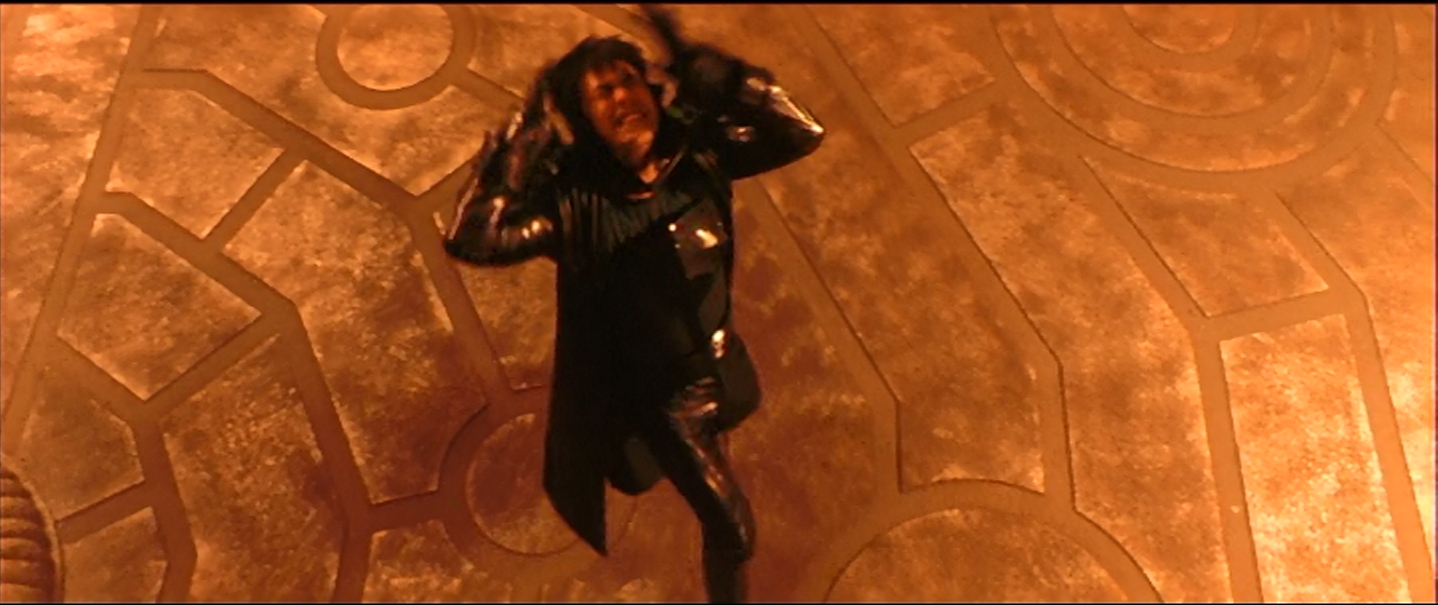
Mission Commander has a spaz fit.

The remains of humanity's defense rests with Captain Gordon and the Gotengo. Gordon decided the situation is desperate enough that he's going to unleash Godzilla, giving the TV Trope of the Godzilla Threshold its name. Godzilla then spends the last half of the film having very brief fights with all the world's monsters. Which is a pity. The technology was available to make these much more engaging and interesting fights, but because Godzilla had to get through so many opponents, each one is truncated.
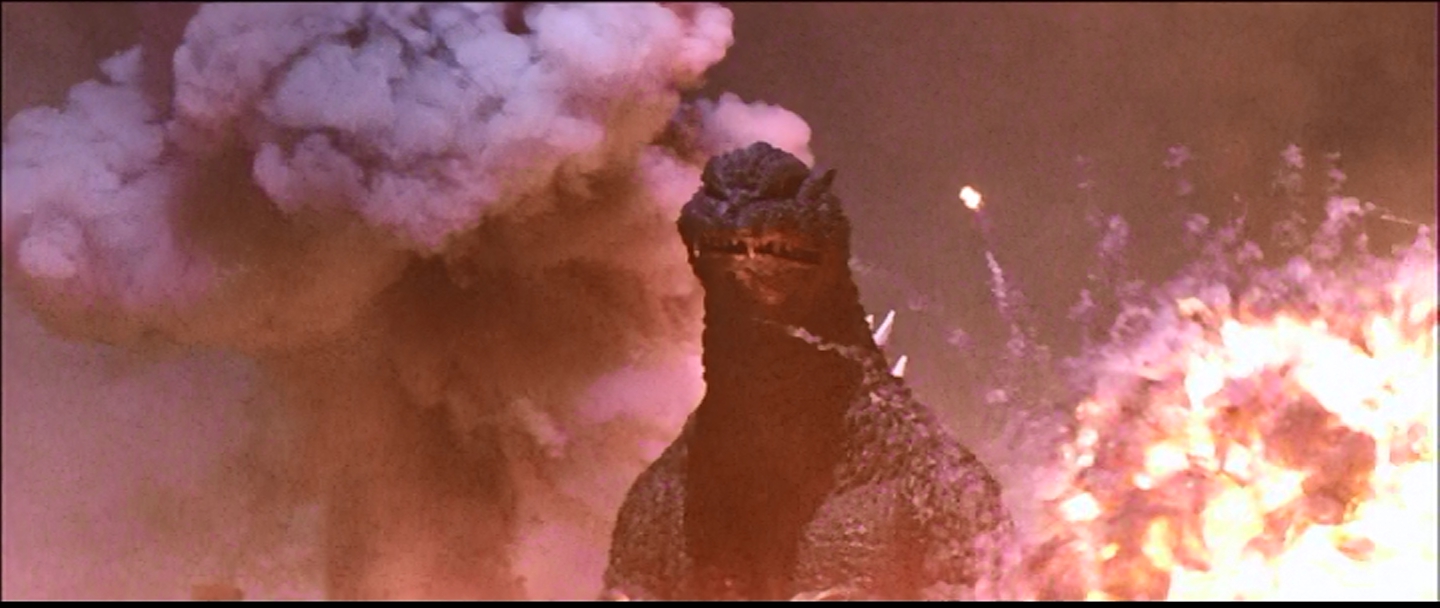
Godzilla, walking through explosions

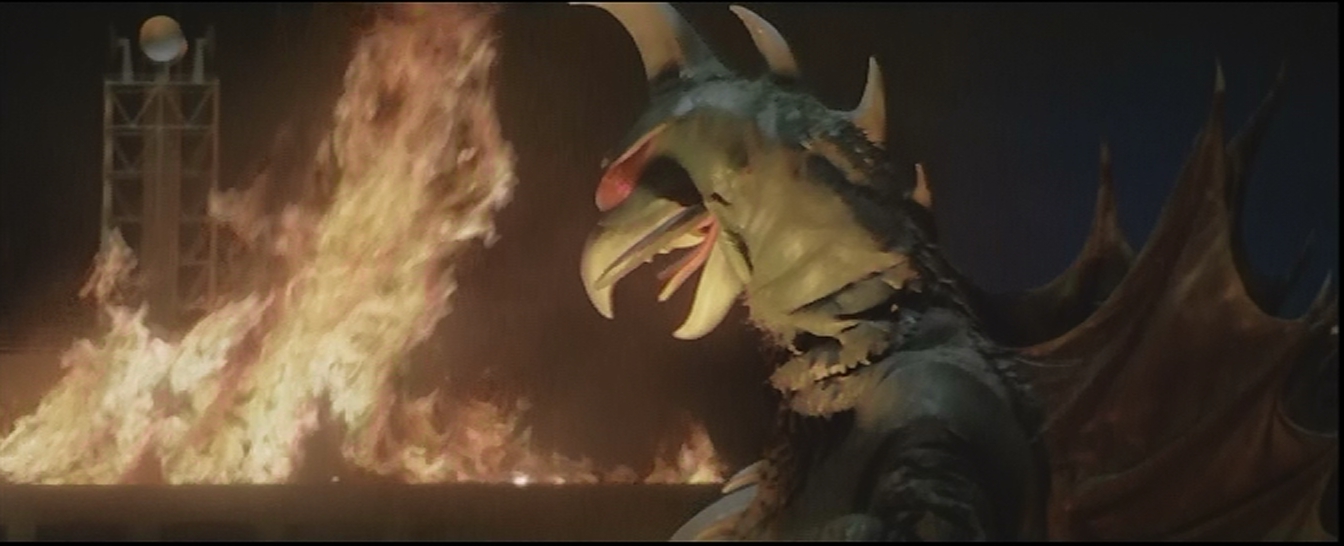
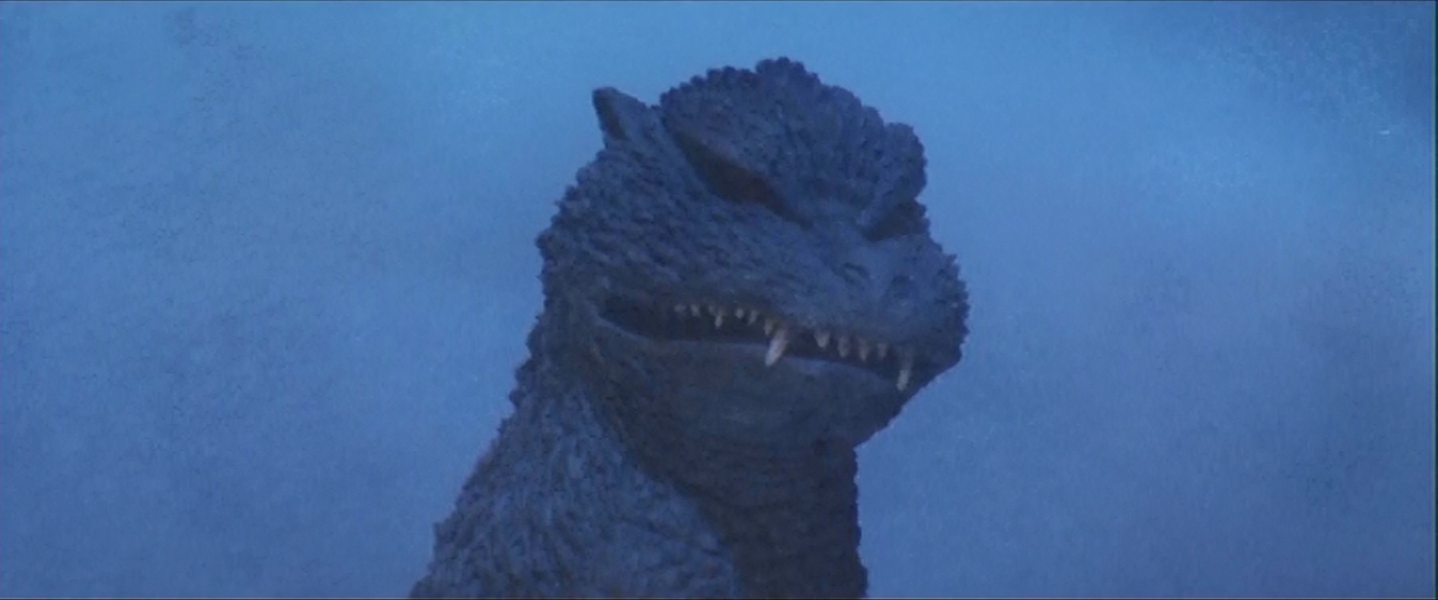
Only the final fight has any sort of length. Godzilla, having knocked down six different kaiju, now comes up against Monster X. Monster X is an odd creature we haven't seen before, humanoid, with a head beam that also comes out of its shoulders. Now where have we seen a kaiju that has three breath weapons before? After he initial clash, each gets reinforcements, and Mothra faces down an upgraded Gigan.
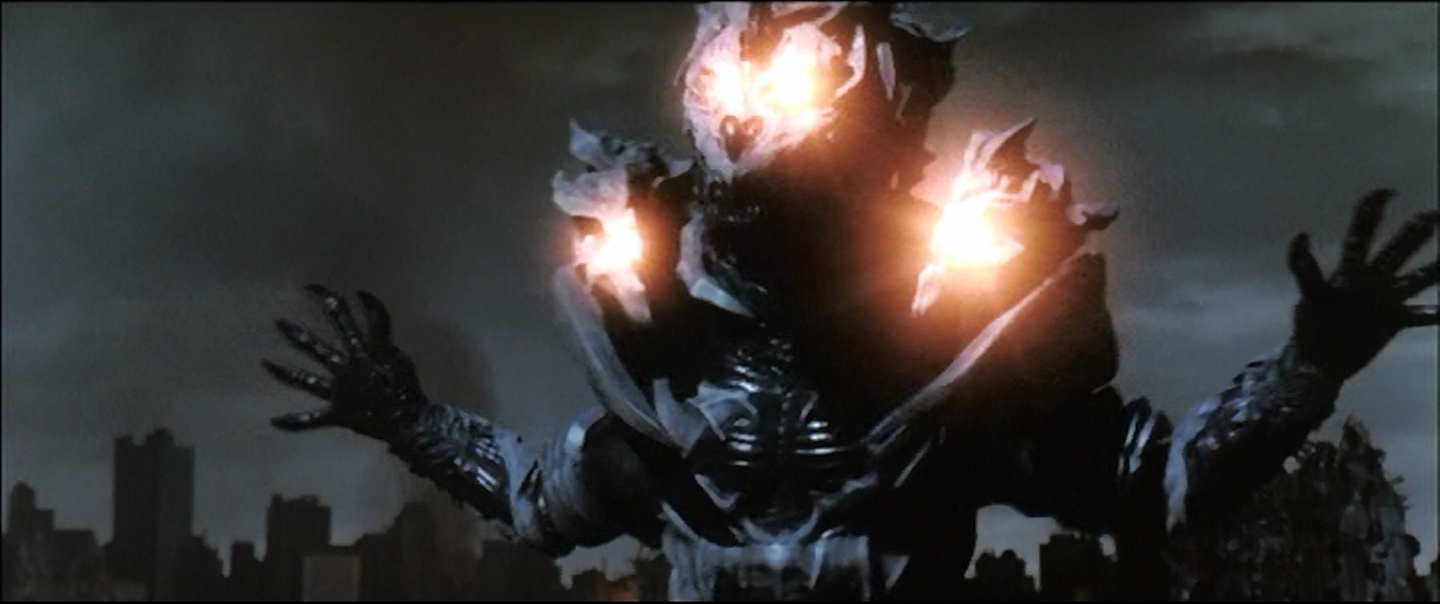
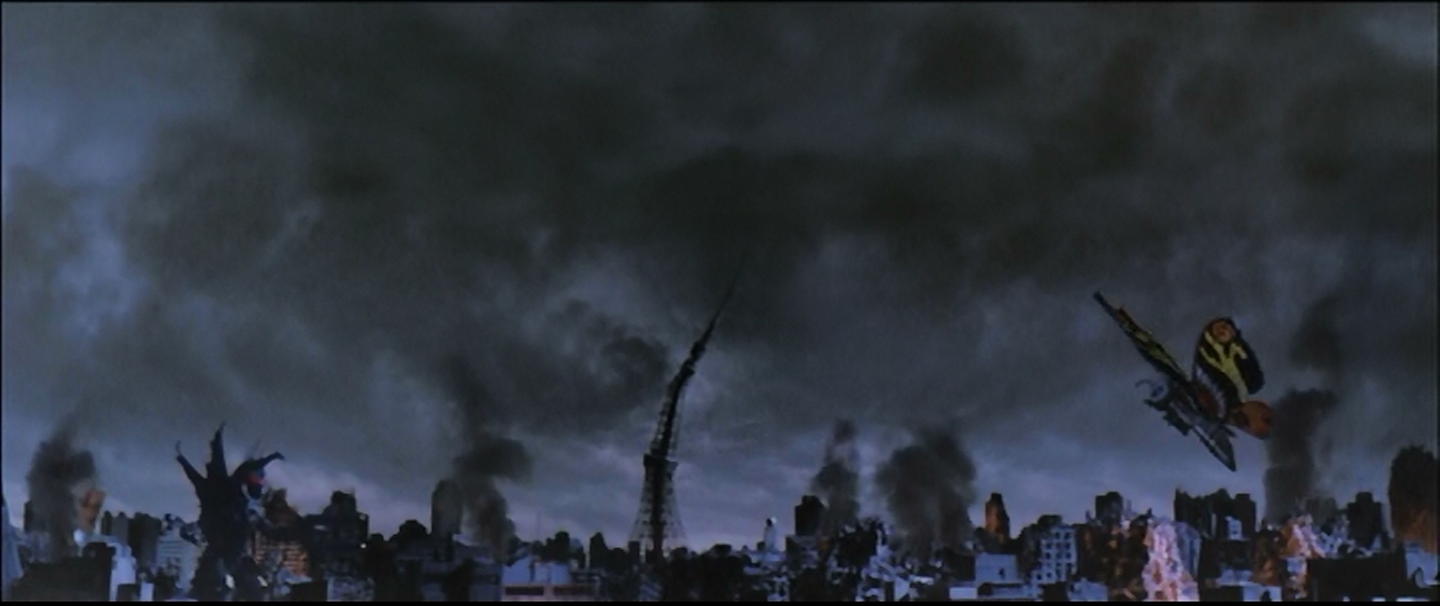
Monster X

Mothra and Gigan face off

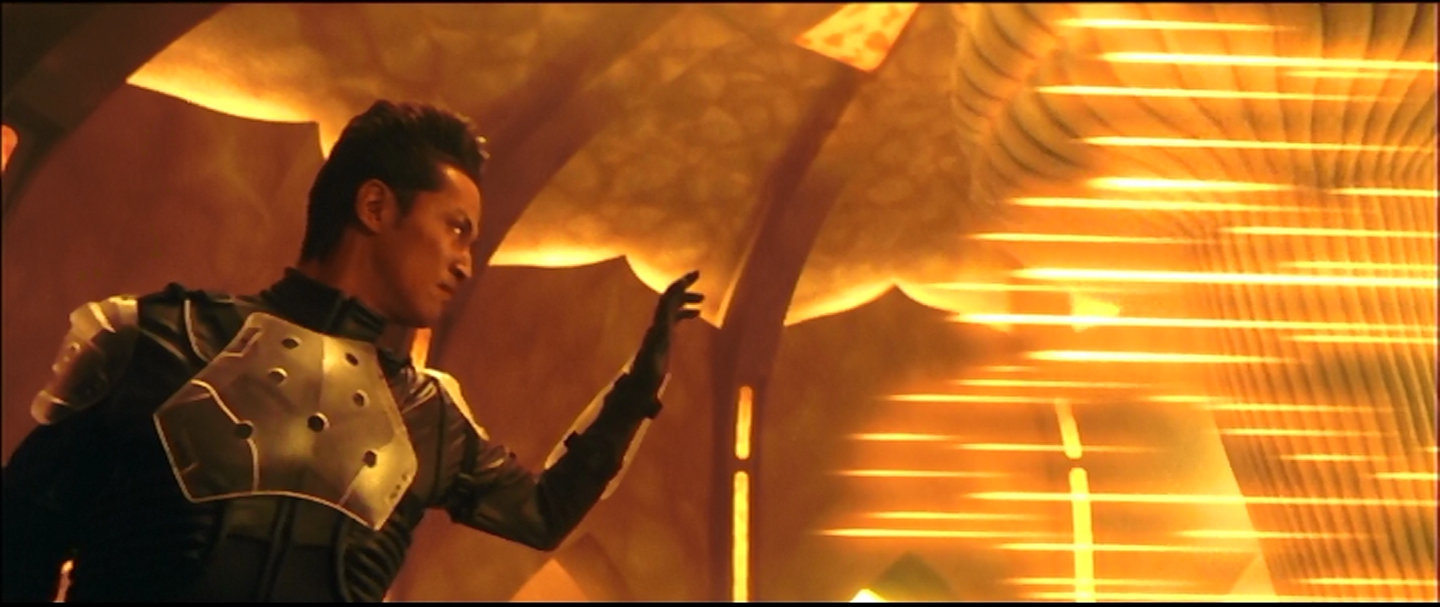
Meanwhile, X monologues about Keisers, a mutation that happens to one in a million mutants, making them the most powerful creatures like ever. X is one, and so is our mutant protagonist. What a coincidence! Once awakened, he finds his inner Neo, stopping yellow bolts of light, burning with power, and declaiming about choice.
OK, a lower-grade Zilla

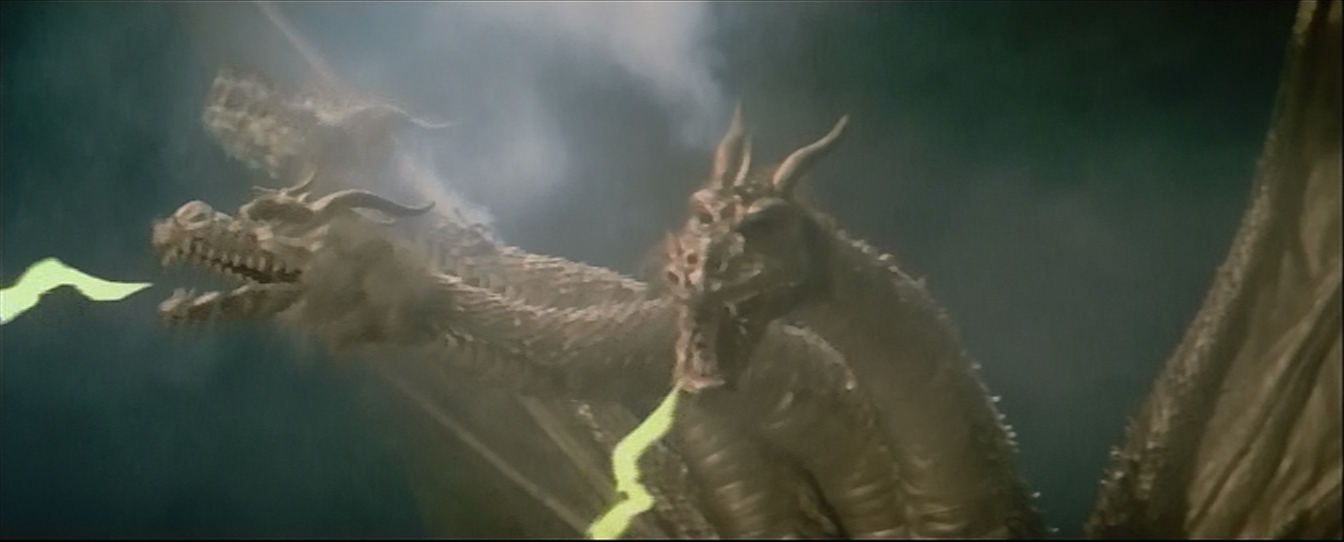
He defeats X, and this causes the alien ship to self-destruct. Monster X grows two new heads, and is revealed to be Keiser Ghidorah, with some very delicate blue among the golden scales. For the first time since the first Rebirth of Mothra Ghidorah has four feet. It no longer has any of the previous Ghidorah cries, and instead, some sort of strangled scream similar to Destroyah's. Other than that, the creature design is likely the best in the film.
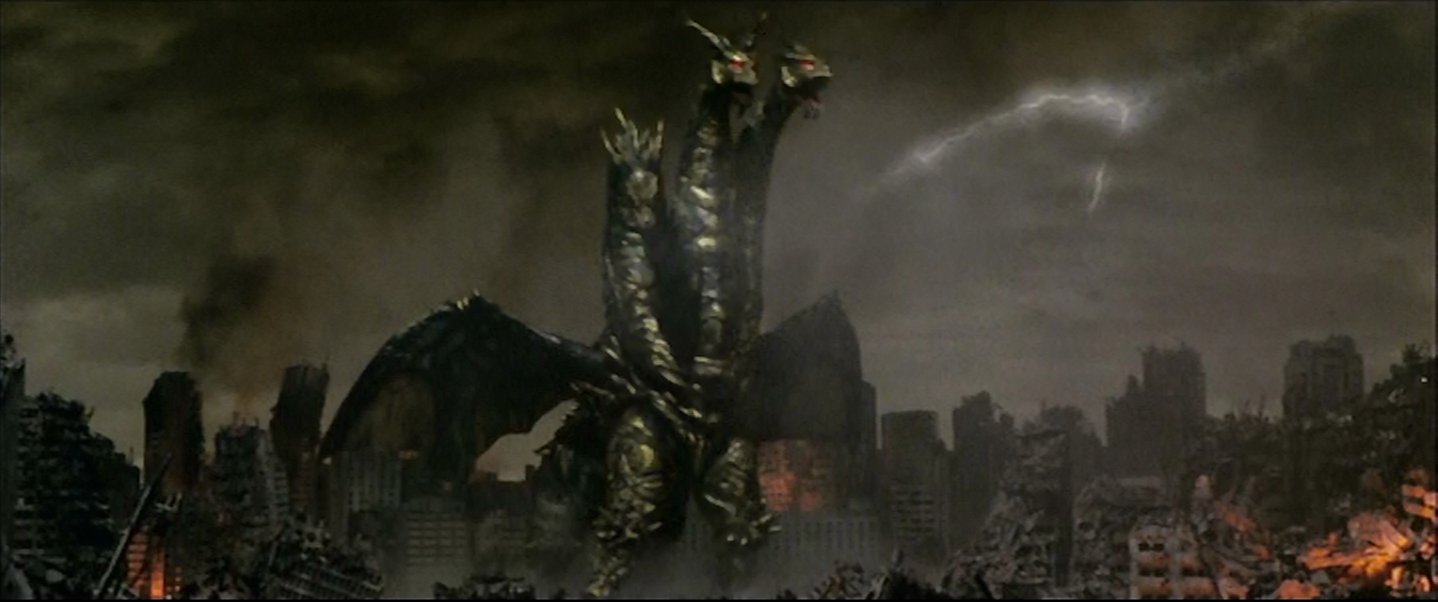
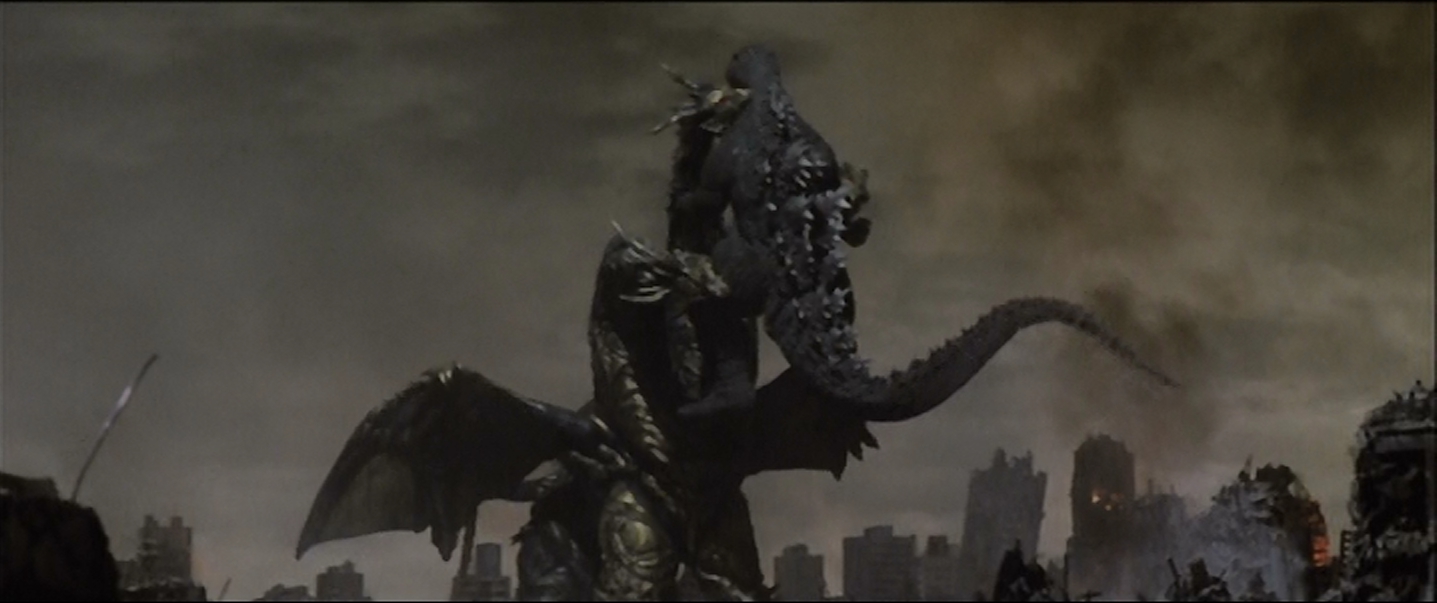
New Keiser Ghidorah

That's going to leave a mark

It is immensely powerful, stronger than its last form, and Godzilla isn't doing so well until out mutant buddy focusses his psychic energy through the Gotengo, Godzilla receiving it through his spines. With the extra power, Godzilla smashes Ghidorah. He is not a grateful victor, however, and immediately uses his atomic ray on Gotengo. The upcoming massacre is forestalled by Minilla's arrival. Only children can stop the cycle of violence. Godzilla walks away through the devastation that was Tokyo, his offspring following.
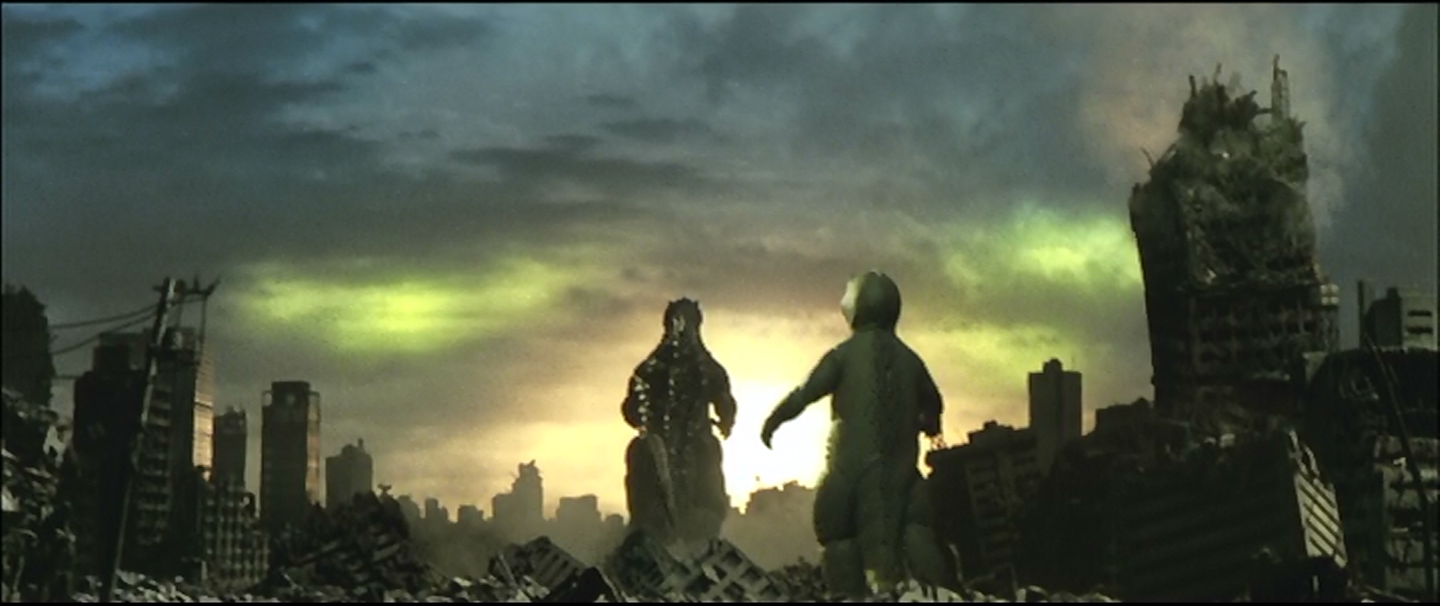
Well that was a thing that happened

The military is treated very differently from other Godzilla films. They are not incompetent, or lionized, but actually working against humanity. The Mutants who make up the Defence Force are actively working against mankind, and only those who choose to do so, mavericks and rogues, stand with humanity. The flying sub commanders who stabnd against the alien invasion are outlandish types, with dreadlocks, long blonde hair, or Captain Gordon.

Eschewing the traditional orchestral soundtrack, the rock sondtrack feels out of place and occasionally intrusive. It does not do the film any favors.

The experience of Godzilla Final Wars is something akin to watching Destroy All Monsters while watching The Matrix on the same screen. Gone is the traditional mystery story structure, in which the humans investigate and uncover and eventually solve the plot problem (in this case, an alien invasion). Instead, we have a group of superhumans who defend the Earth against the kaiju fighting. Drawing from a lot of anime, Kitamura manages to jam a lot of anime cliches into a number of overblown kaiju cliches and nods to previous films. The result feels like he jammed a bunch of movies in a blender, then reassembled it from whatever pieces he could salvage.
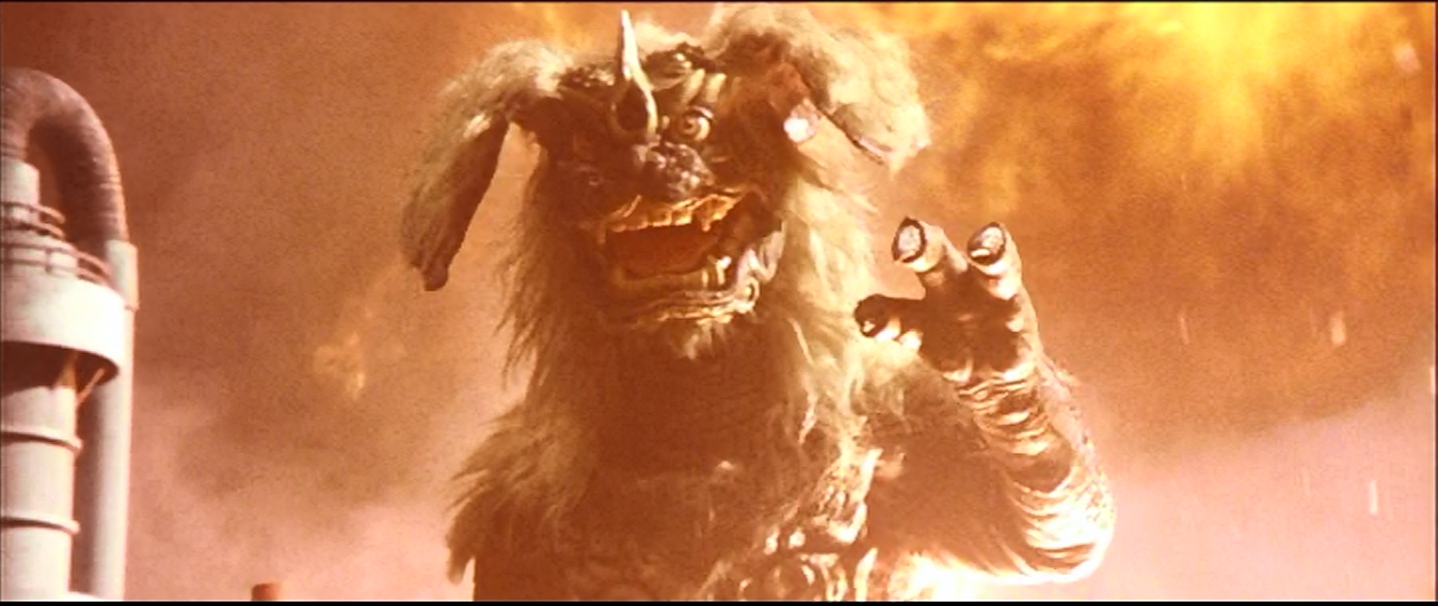
A good look at King Caesar

Next up, Peter Jackson's take on the Big Ape. All two hundred minutes of it.

Thursday, March 20, 2014

James Bond, Cornelius the Ape, and Giant Monsters: Godzilla vs Mechagodzilla.

Godzilla vs Mechagodzilla (1974) was produced as Godzilla's 20th anniversary film. It had a larger budget than Godzilla vs Megalon, and it shows. Jun Fukuda manages good action, both with the monsters and the humans. No stock footage is used. And the results are head and shoulders above the previous films.

This is the final film for scriptwriter Shin'ichi Sekizawa and director Jun Fukuda. Sekizawa had entered the Kaiju fray with his clever script for 1958's Daikaiju Baran, and wrote some of the Showa franchse's best scripts: King Kong vs Godzilla, Ghidorah the Three-Headed Moinster, and Mothra vs Godzilla. He was prolific, writing some fifty-seven screenplays in twenty-one years. Godzilla vs Mechagodzilla would be his last. Jun Fukuda was the also-ran of the Godzilla franchise, creating films that were overshadowed by most of Ishiro Honda's work. I consider his work competent, and if he didn't create some of the greatest Godzilla films, he didn't drop the ball, either.

Mr. Handsome from Godzilla 1954

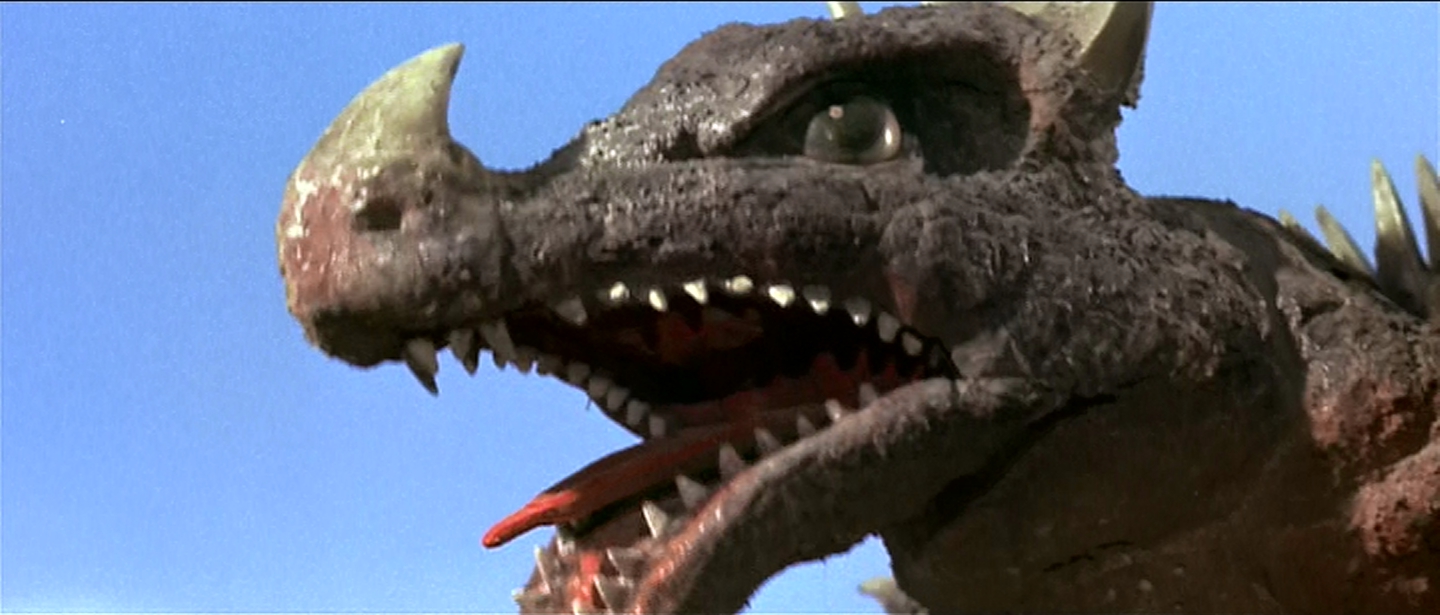
It is also the last time we will see Anguirus, the first monster to fight Godzilla all the way back in Godzilla Raids Again, brought he returned as an ally in Destroy All Monsters. We will not see him again until Godzilla: Final Wars.

And a sad farewell to Anguirus

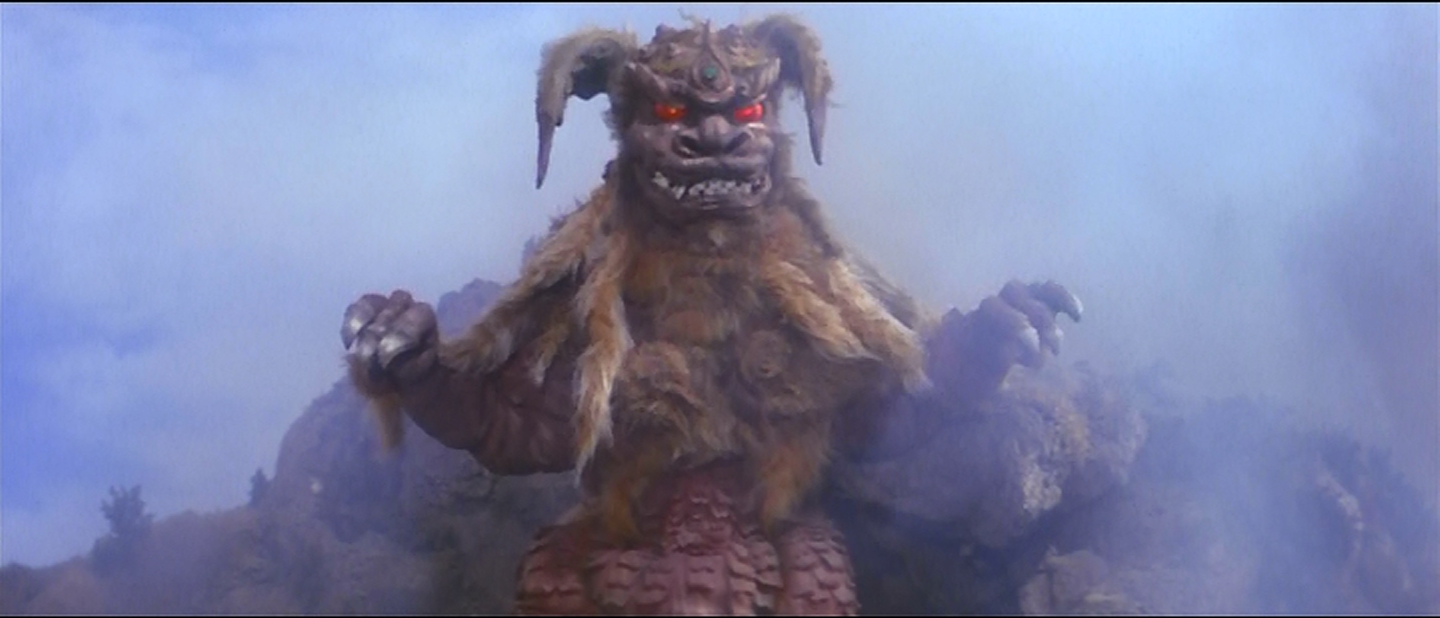
Like many of Sekizawa's scripts, this intersperses a mystical or religious element in with the science fiction. Although the (predictable) invaders are from the third planet from the black hole, the plot begins with a priestess and a prophecy. King Caesar, an kaiju-sized Okinawan shisha, a guardian spirit, will return and destroy a terrible foe. King Caesar is furred, something of an oddity among the Toho Kaiju. He's not exactly cute, but he's certainly more friendly-looking than most kaiju. The suit actor who plays him does so with an amazing speed. He is one of the swiftest kaiju erver committed to screen. Although he doesn't have an energy weapon himself, he can reflect the beams of Mechagodzilla, emphasizing his role as a guardian. Unfortunately, he cannot reflect rockets, and Mechagodzilla's metal skin make it impossible for him to damage the robot.

Who's a big, floppy-eared monster?

Sparking off the theme of doubles and mistaken identities from Godzilla vs Gigan, Mechagodzilla's first appearance is in a Godzilla suit. The main clues that Godzilla is not in fact Godzilla is the difference in his foley, Mechagodzilla has a high-pitched scream, rather than Godzilla's deeper roar. His footsteps also have a metallic sound to them. Mechagodzilla, in various incarnations, becomes Godzilla's most dangerous foe, crippling and nearly killing him in its Heisei incarnation, fighting him to a standstill in the Millennium series.

Mechagodzilla, still in hiding.

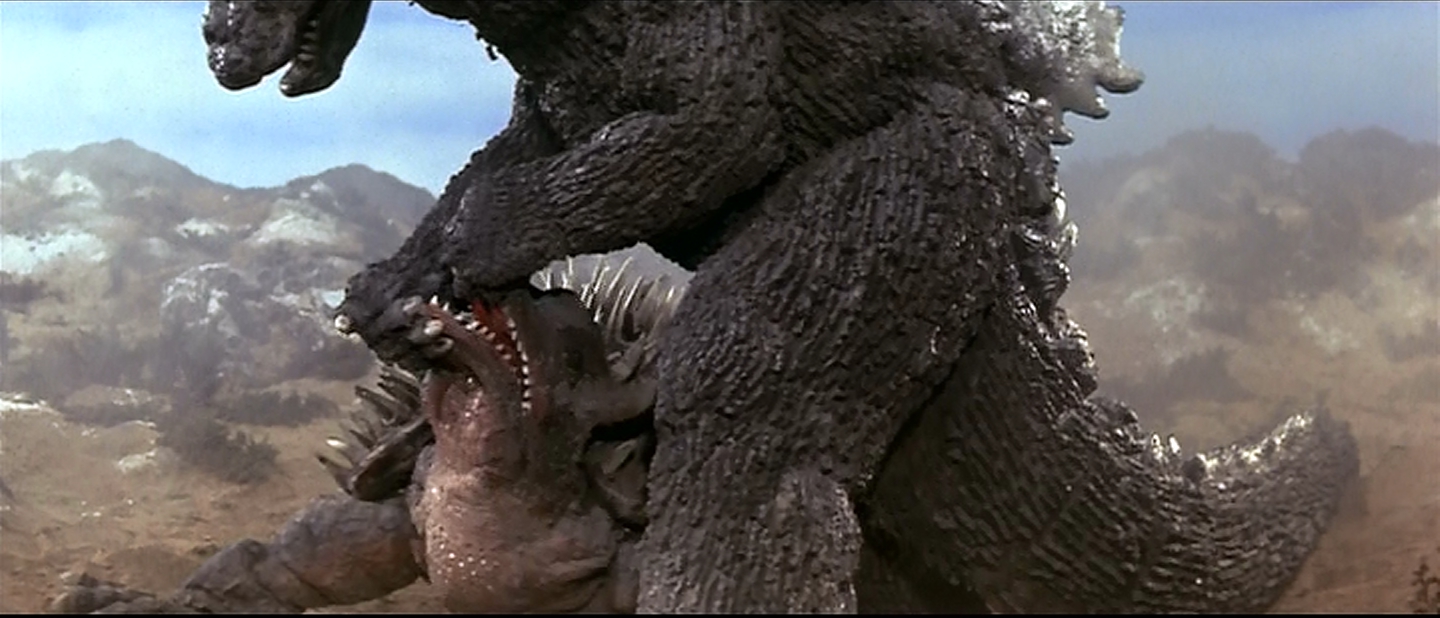
Although the humans are fooled initially, Anguirus is not. Godzilla's former ally attacks the imposter, and is completely overmatched by Mechagodzilla. Then, in one of the most brutal scenes in the franchise, Mechagodzilla breaks Anguirus's jaw.

That's just picking on Anguirus.

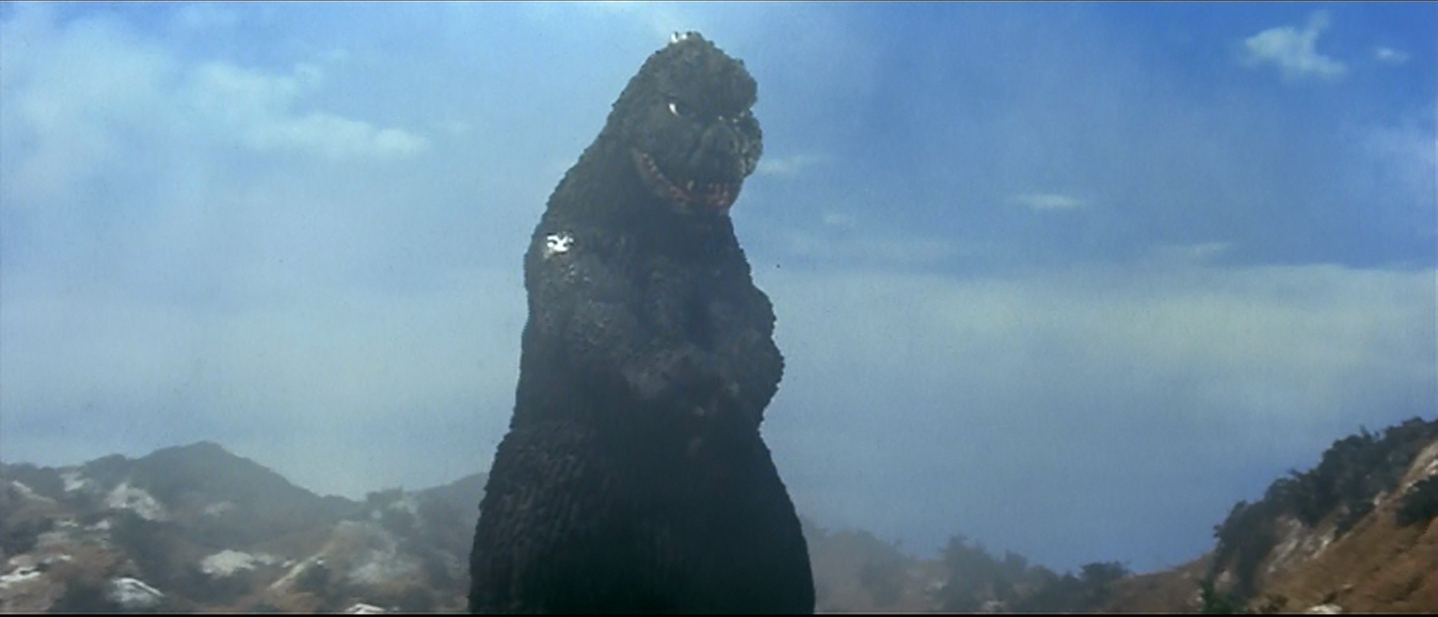
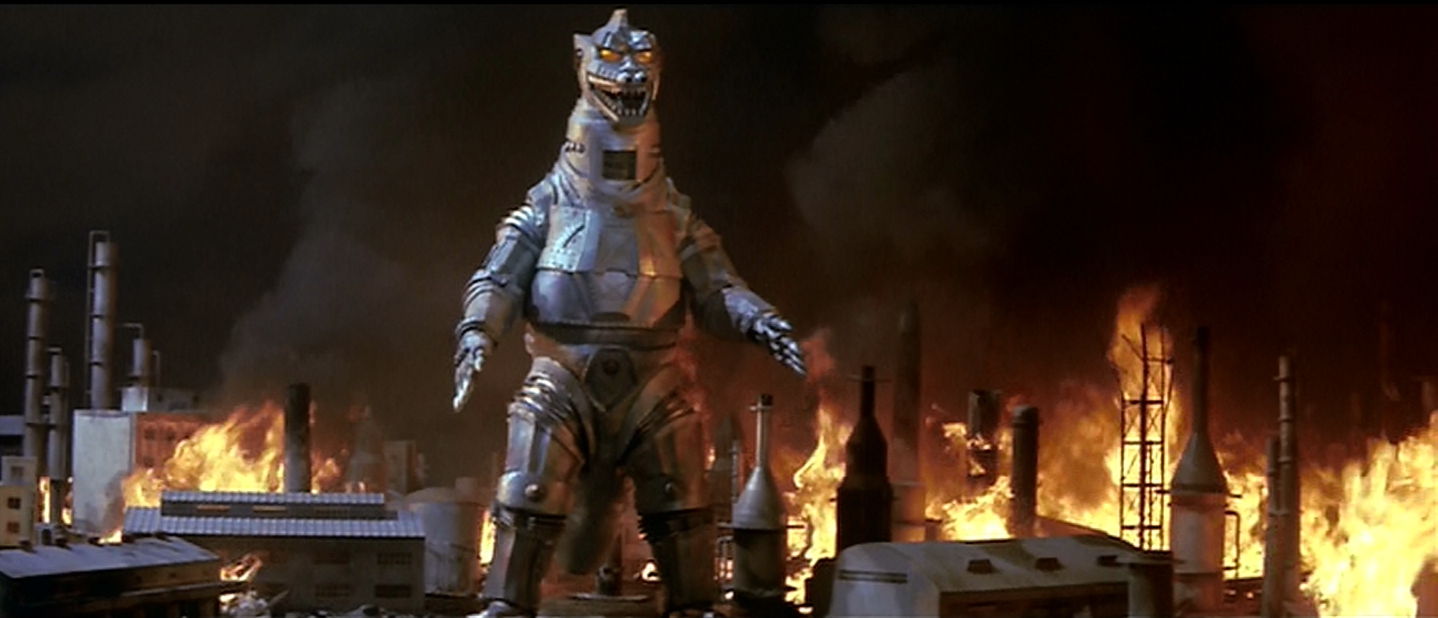
Of course, the original has to show up, and Godzilla's entrance in this film is unique. Mehcagodzilla is blowing up an oil refinery, and Godzilla erupts out of a large building. This is the first time since Mothra vs Godzilla that Godzilla doesn't come from the sea. The two fight. And Godzilla's atomic heat ray burns off great amounts of the Mechagodzilla's outer skin, revealing the gigantic robot for what it really is. Unlike the more natural monsters Godzilla had been fighting, like King Ghidorah or Ebirah, Mechagodzilla is full of ordinance, able to put a lot of firepower downrange. Mechagodzilla clearly wins the first fight against Godzilla.

Shiny, evil Godzilla robot!

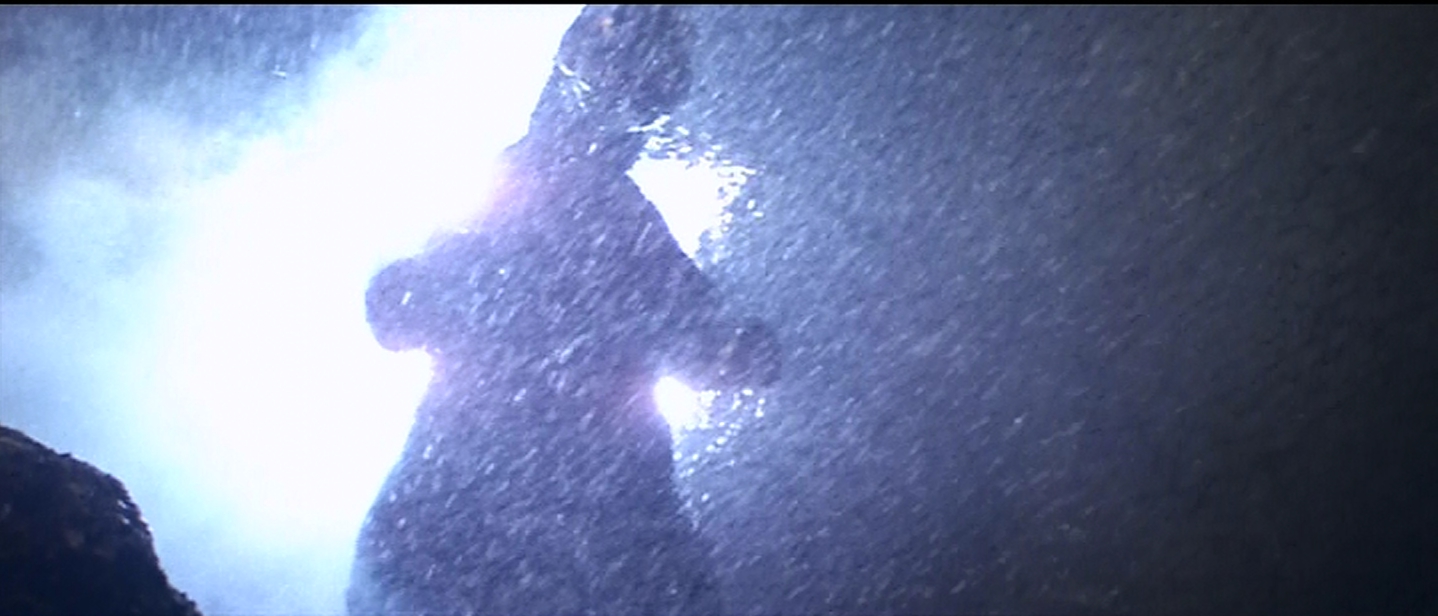
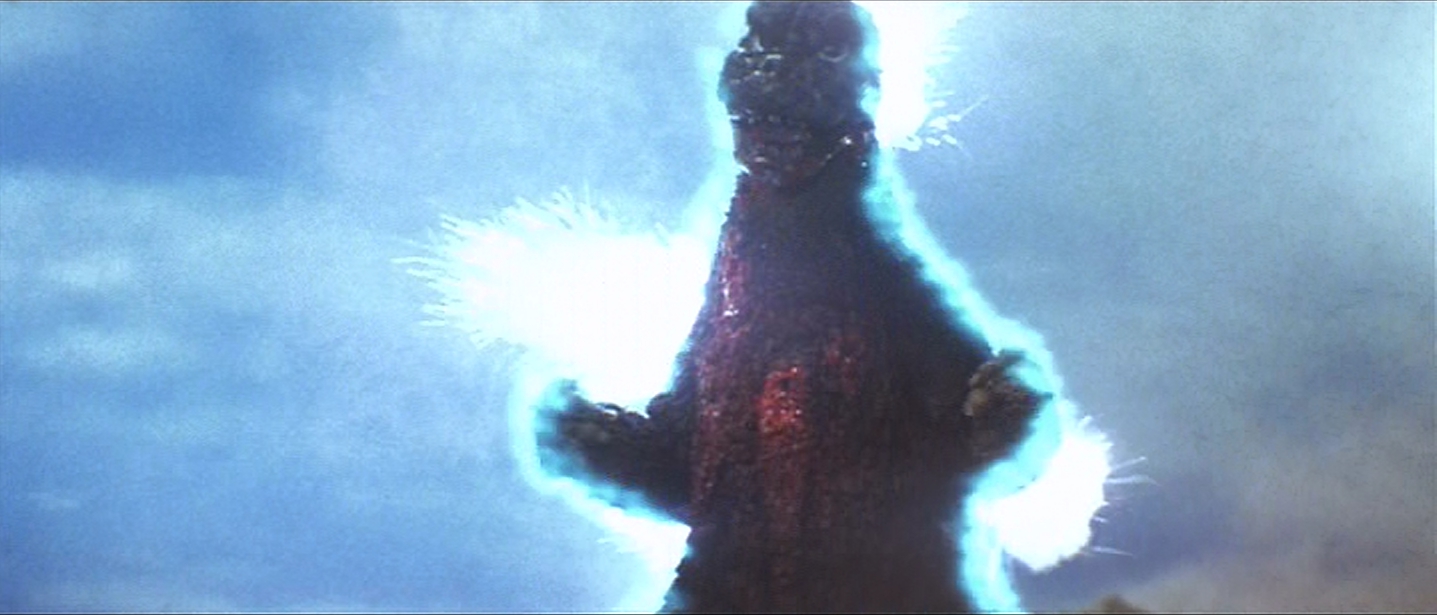
After the inital encounter, Godzilla stands in a storm and absorbs some lightning. Apparently, this makes him stronger, or heals him. But this is an aspect we haven't seen since lightning woke him up in Jun Fukuda's Ebirah, Horror of the Deep. In this, after taking more than a dozen lightning strikes, Godzilla becomes so engorged with power his back fins spark with power.

Godzilla POWERS UP!

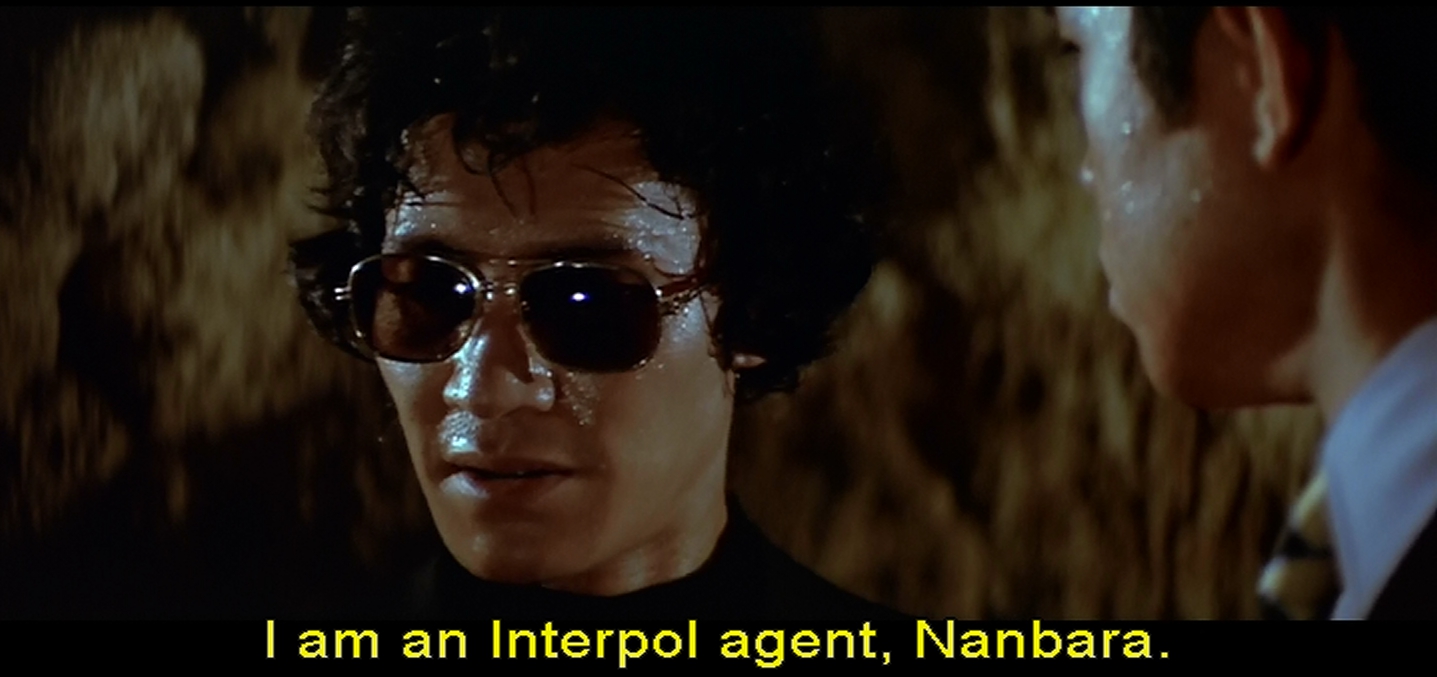
As becomes common in the Heisei series, there are a number of elements borrowed from popular Western movie franchises. The fights, spy work, and slow death trap all echo the popular James Bond franchise, which was going quite strong.

Bond, James Bond. Sorry. Interpol.

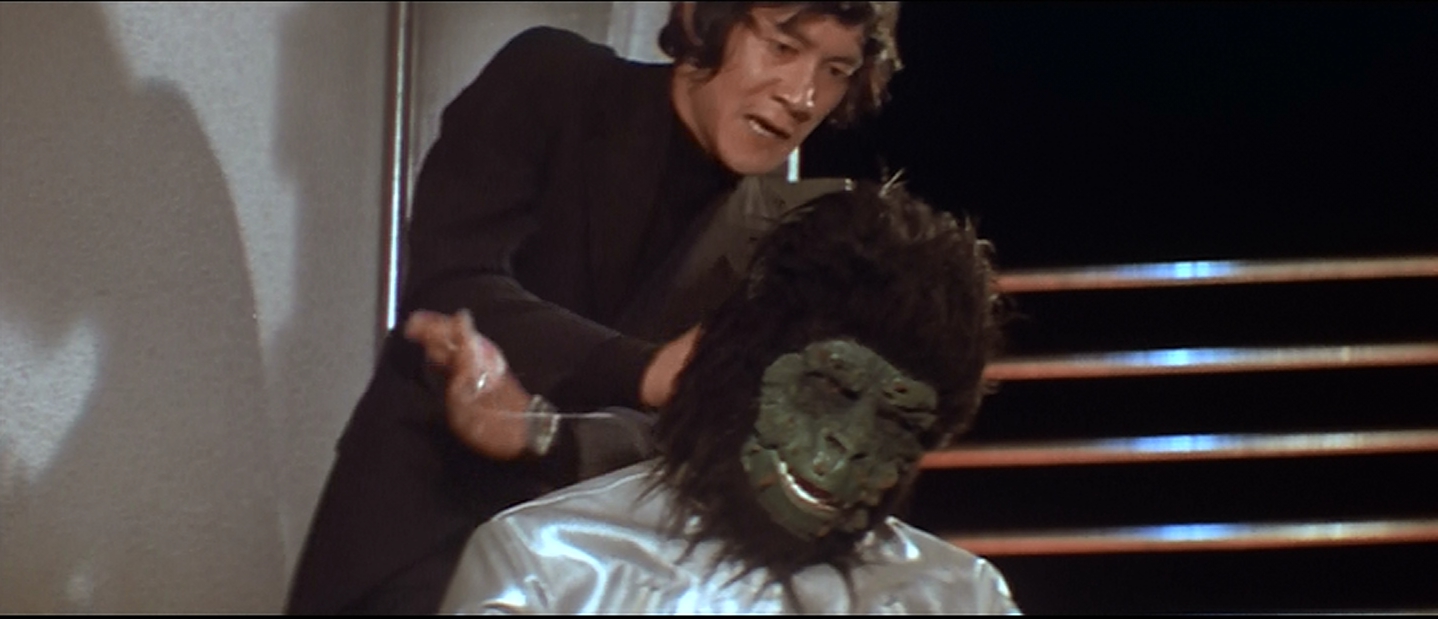
When injured or killed, the invading aliens reveal an ape-like true form, which feels like it was borrowed from the Planet of the Apes franchise.

Mr. Secret Agent Strangles an... ape alien?

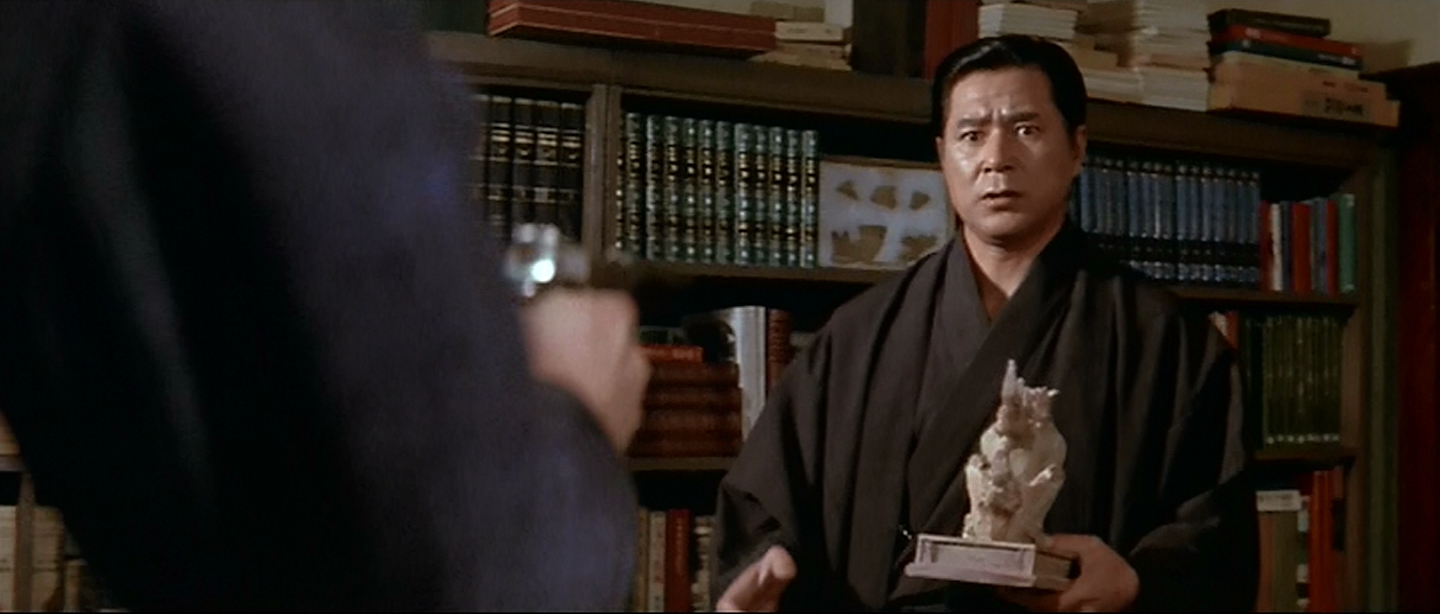
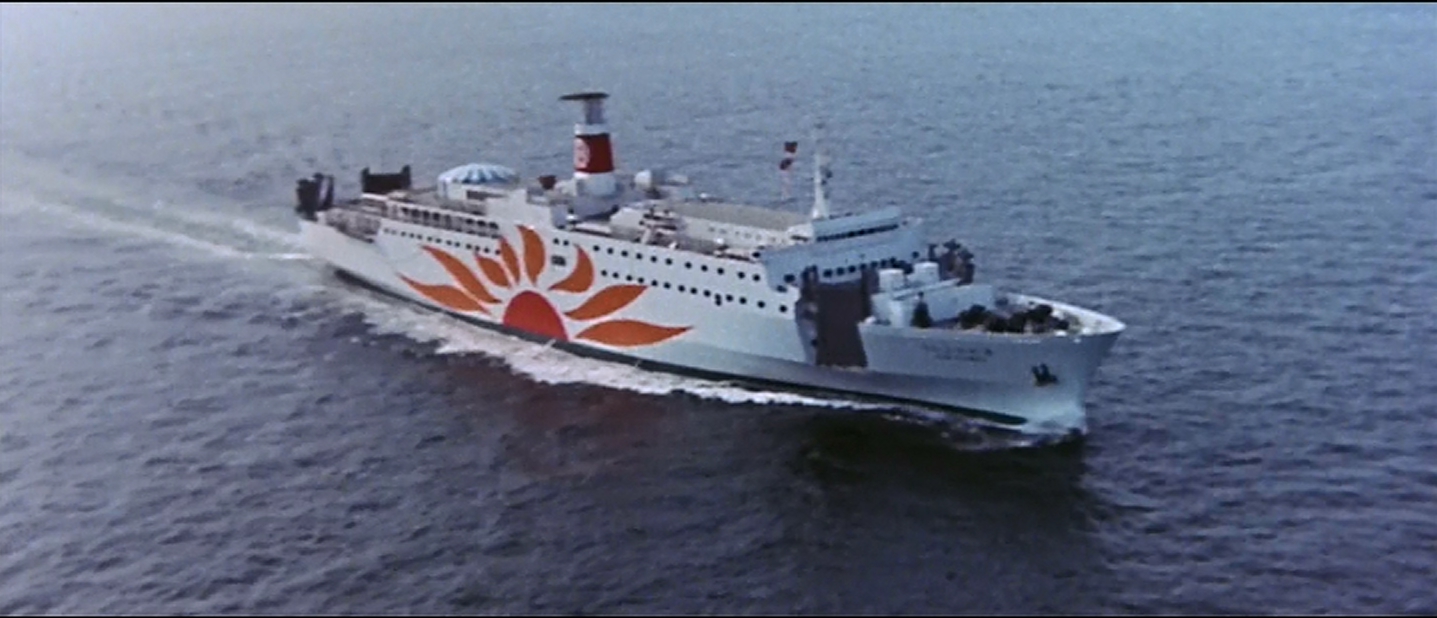
The film spends a fair amount of time in the Gyokusendo caves on Okinawa, which were recently discovered at that point. Also, given the loving scenes given to the Coral Queen cruise ship that goes from Japan to Okinawa, I wonder if part of the film wasn't underwritten by the cruise line. Especially when a plot point has the mystical statue carried overboard by an ape alien, but it is revealed to have been a copy, the original kept in the Captain's safe, emphasizing the safety of the line.

Who's a big, floppy-eared monster?

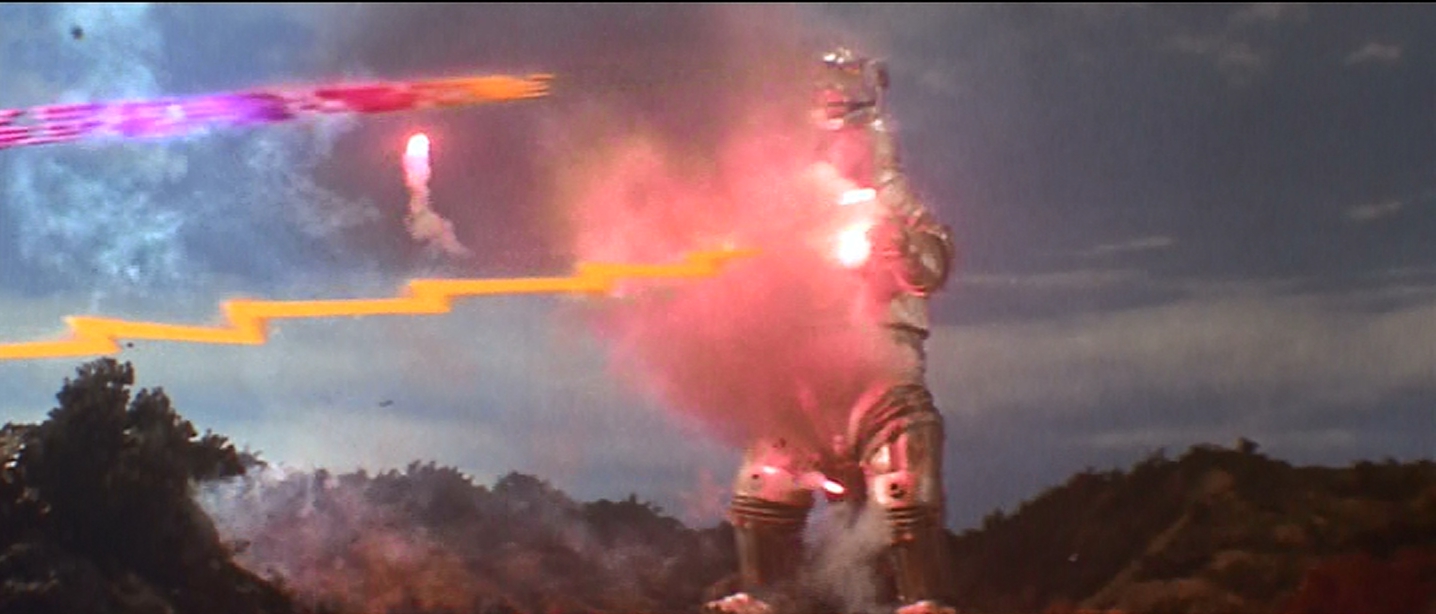
The final fight is pretty satisfying. There's no stock footage, and no goofy drop kicks by Godzilla. Mechagodzilla has some excellent moves--shioting toe missiles at Godzilla while eye-beaming King Caesar in the opposite direction. It can create a force field that is impervious to Godzilla's heat ray and Godzilla himself. And it's got fantastic battery life, able to pour out powerful destruction uninterrupted.

Mechagodzilla pours out the destruction.

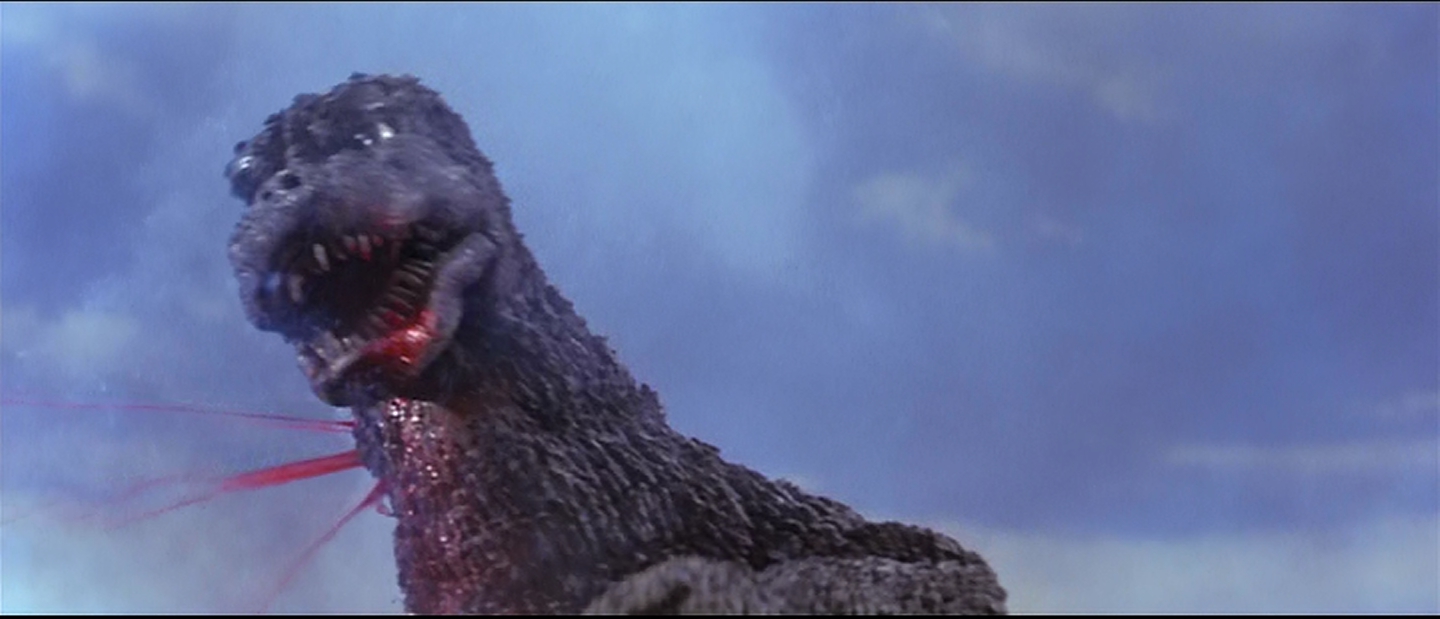
In a sign of the changing times, Godzilla bleeds gouts of blood when he's hit. In the middle fo the fight, Godzilla is a bloody mess, more like Gamera than the usual bloodless Godzilla fight.

Mechagodzilla pours out the destruction.

But Godzilla uses that extra power he got from the lightning to push the grenades out, and repower and magentize himself. His electromagnetic power is so great that even Mechagodzilla can't get away from him. This is a new power for Godzilla, and sort of like the Nuclear Pulse he will display through the Heisei series.

Godzilla begomes magnetic.

The fight ends with Godzilla twists Mechagodzilla's head off.

Shoulda put in exra servos.

After that, all there is to do is show the alien base blow up, watch Godzilla retreat into the sea, and King Caesar reburies himself in his sacred mountain.

I like Godzilla vs Mechagodzilla. Despite the imitative nature of the spy plot and the gorilla-like aliens, it's a relief after Gigan and Megalon. It breaks some new ground for Godzilla territory, introduces a new and deadly monster for Godzilla to fight, one that comes pretty close to cleanng Godzilla's clock. But it should be noted that this is the only time Mechagodzilla is an alien. Every subsequent Mechagodzilla was built by humans as a defense against Godzilla.

Next: More Mechagodzilla! And this time, he's got a friend!

Thursday, February 20, 2014

Stupid? Or Advanced? Godzilla vs Gigan

Godzilla vs Hedorah was considered an artistic failure by Toho, even though it sold a quarter of a million more tickets. To re-establish the status quo, Toho brought Jun Fukuda in again. Fukuda's Gigan was much less expensive than Hedorah.

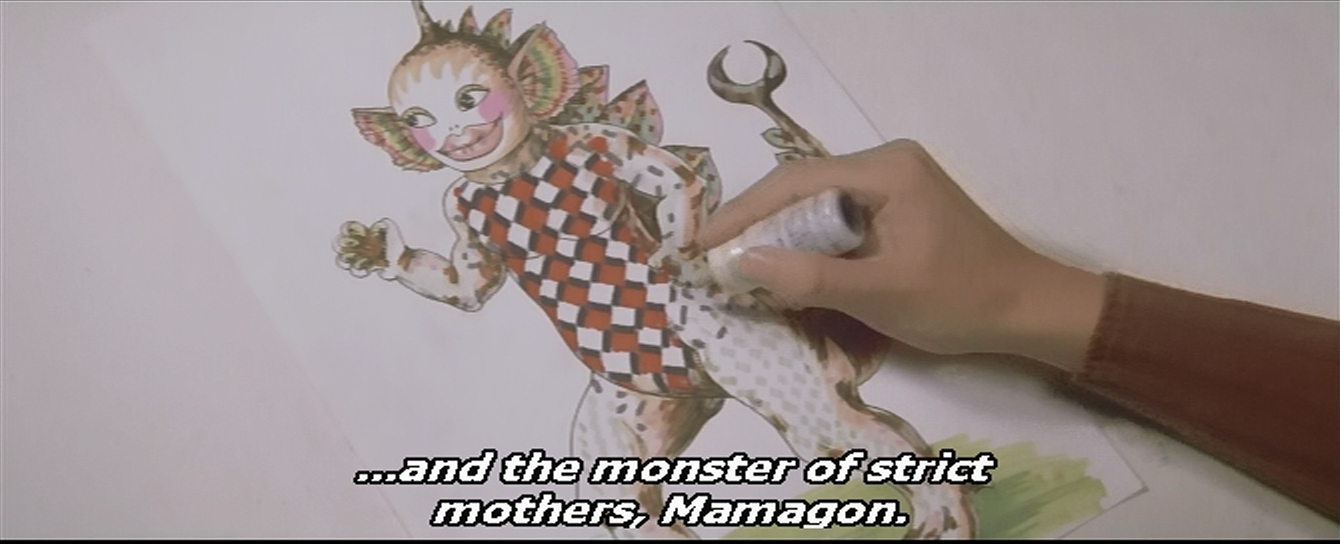
Godzilla vs Gigan acknowledges the rise of manga sequential art. If there's two things Americans know about Japan, it's Godzilla and manga. The main character is a struggling artist, the first scenes are of him trying to sell a concept to an editor. It's an interesting way to create metafiction; Gengo is creating monsters as symbols, something that the Godzilla films no longer do. The editor he's trying to sell to tells him that kids are too sophisticated for something as simple as a monster made of homework. Although metaphorical on one level, it's too superficial, too one-dimensional. The original Godzilla film works not just as a monster film, but as a film that allows the viewer to dig multiple interpretations out of it, should they try. Something as simple as a monster based on the fear of homework is unlayered, understood the first time around. That said, it sounds suspiciously like a Pokemon.

So looks like a Pokemon

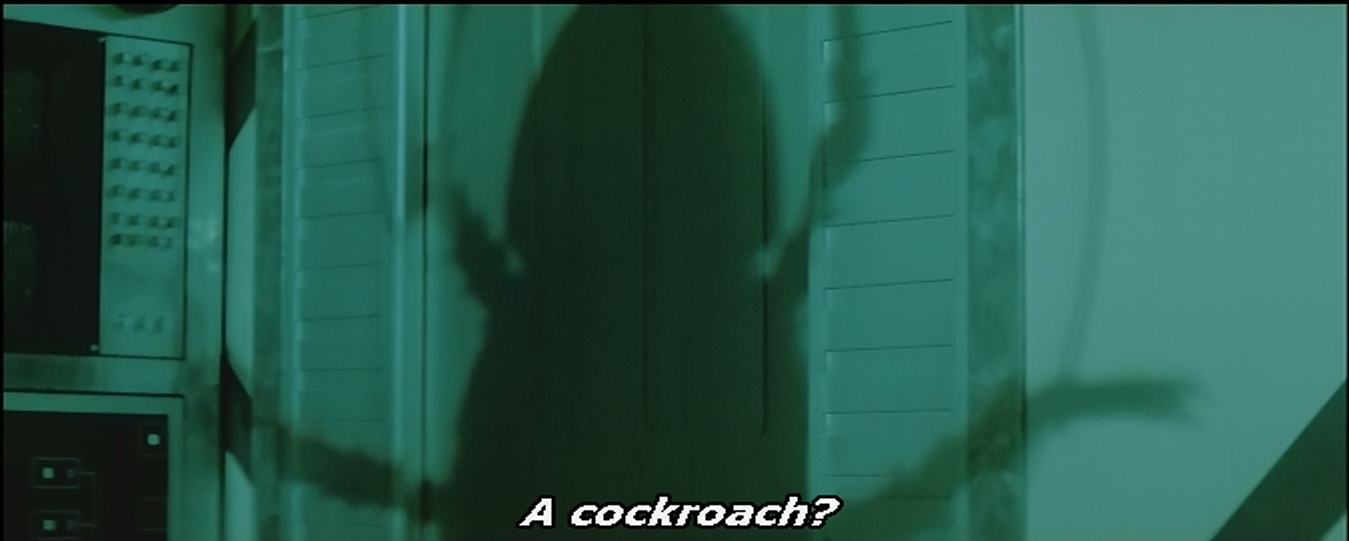
Of course, the aliens buy Gondo's one-dimensional monsters. They don't have the media savvy humans do. And of course the aliens are intent on taking over the Earth. They're from something called the M-Space Hunter Nebula, which seems like a long and ominous name for a celestial object. For all that this film is a rejection of Hedorah, it has a similar theme, and even pinches some footage from it. The M-Space Hunter Nebula Aliens (hereafter referred to as The Roaches because it's easier to type) have come from another planet that got polluted, and as a result, they're looking for another home. Like Earth. But the Roaches were not the species that polluted M-Space Hunter Nebula Planet. The humanoids all died, leaving the roach-like creatures to inherit the planet, and then go seeking a better one.
A terrifying roach's shadow.

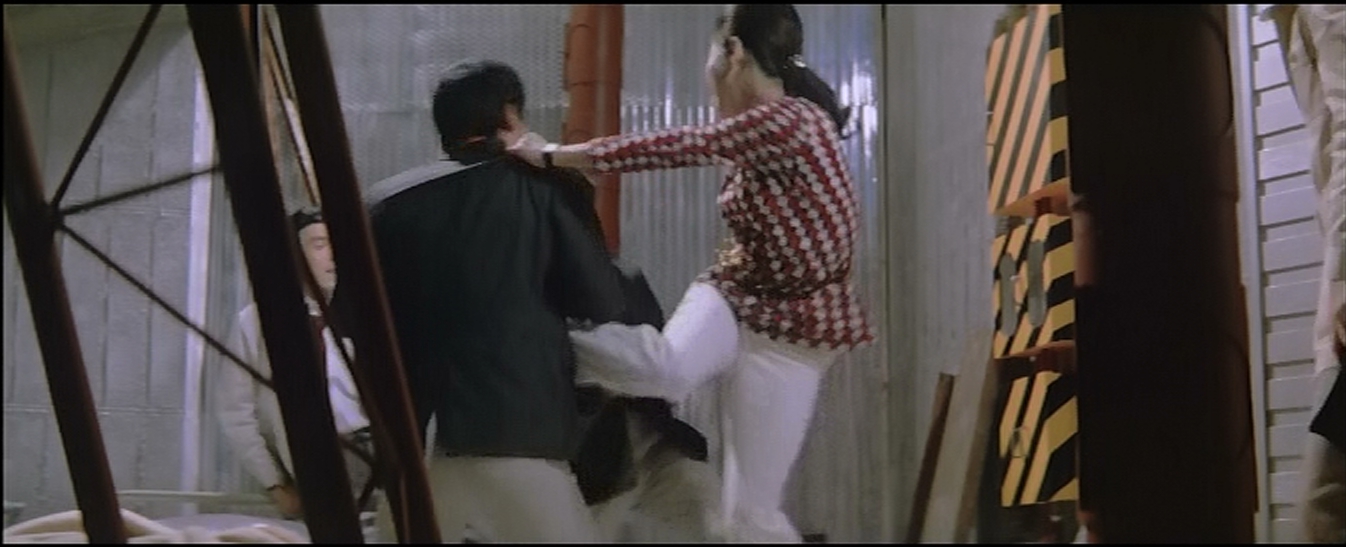
Another change in this film is the character of Tomoko Tomoe. She's pretty, and although in a subordinate role to Gondo, who hired her, a martial artist and an 'assistant' who keeps Gondo focussed. Despite being the muscle of the party, she's the one who screams and nearly faints when the Roachs' true form is revealed. And while she takes out bad guys in two scenes, she doesn't actually do much else. Like so many other women in Godzilla films, she fades into the background. But I'm grateful she at least got to beat up some bad guys.

Tomoko kicks some ass.

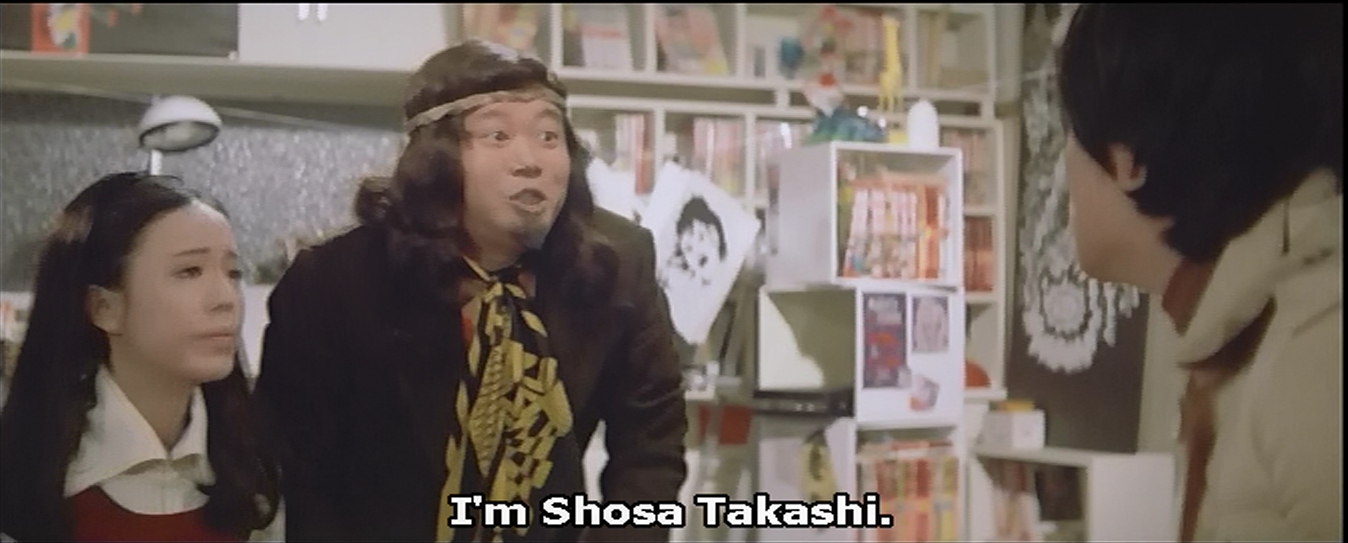
Echoing a lot of the turmoil of the seventies, Gengo gets mixed up with a strange pair, Michiko and her weird hippy buddy Shosa. They're convinced that World Children's Land is something evil. They look like the desperately sincere college students cum fashion victims who latch onto causes. So the two of them team up with Gendo and Tomoko, forming a serviceable Scooby Gang.

Your terrible clothing should keep monsters away.

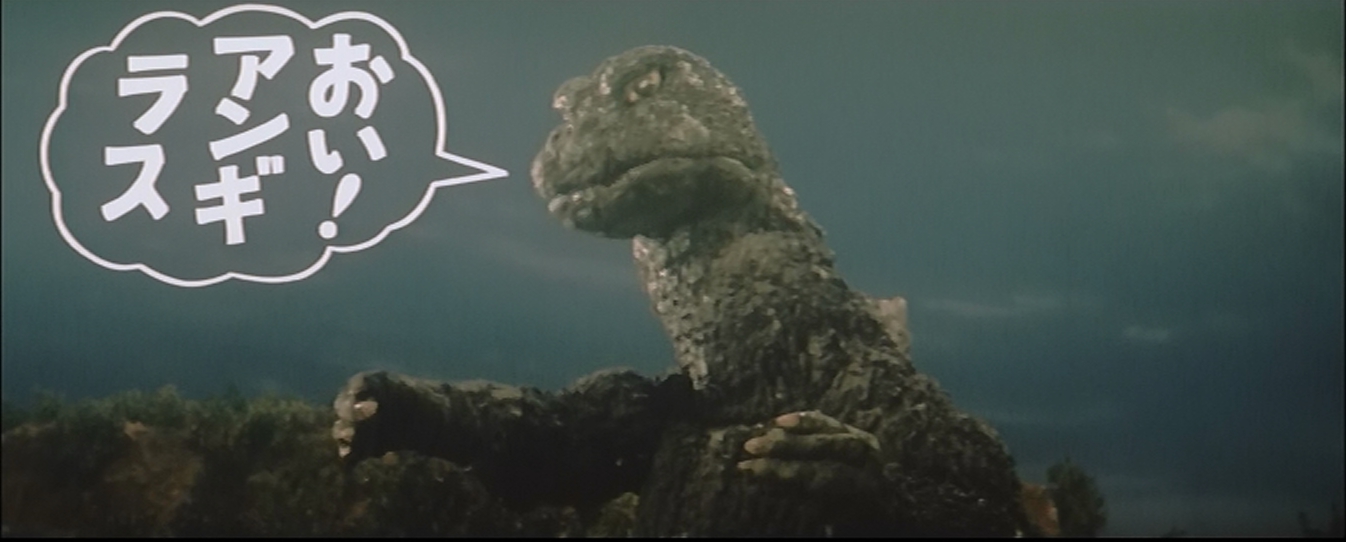
Gigan is also famous for having Godzilla and Anguirus talk to each other. Monsters have talked with each other before. In Ghidorah, the Three-Headed Monster, the shobijin translate a conversation between Godzilla, Rodan, and Mothra. They're clearly using language. Here, each monster is provided with a cartoon-like speech bubble. In the American, version, each monster has a distorted voice. It's awful. But again, this ties in with the manga theme.

Really, he's telling Anguirus to get stuffed

The use of stock footage in this film is much more competent than in the Gamera films or in previous Godzilla films. Instead of inserting entire sequences, Fukuda uses snippets, which allows him to draw from several films, and hide the fact that he's using it. Although there is a sequence taken from Ghidorah the Three-Headed Monster that is carefully edited around Mothra, and Rodan.

This is not a good film for Ghodorah. I like Ghidorah. At his best, he's a wild dragon hammering away at everything in sight, chaos and destruction incarnate. In this, he is surprisingly immobile. The Ghidorah suit has some sort of beard or whiskers, and this serves mainly to show the attentive audience member when stock footage is being used.

Maybe it's some sort of space fungus.

Gigan is the first really weird monster to show up from Toho. Godzilla, Anguirus, even Ghidorah are all of a whole; gigantic creatures. Gigan seems to be a melding of technology and creature. It has large metal hooks instead of hands, and a buzzsaw in its belly. We are shown it using its belly-saw to cut into a building, but it's a giant monster. Why not just knowck the damn building down? Like many monsters, Gigan doesn't have an origin. Perhaps it was constructed or modified by the Roaches? Whatever, it's the first monster that really looks designed.

Gigan.

Godzilla spends a lot, and I mean a lot of time swimming. He is coming from Monster Island, and the film occasionally vuts from the destruction of Tokyo to Godzilla and Anguirus swimming. It's a bit of a waste, but i remember it being worse in Godzilla vs Megalon. The fight scenes are shot in such a way that they include more explosions than actual monster action. How the fight is actually going is a bit of a mystery, since the cinematography is so murky. This is a common way to shoot around actors who don't look good in fights.

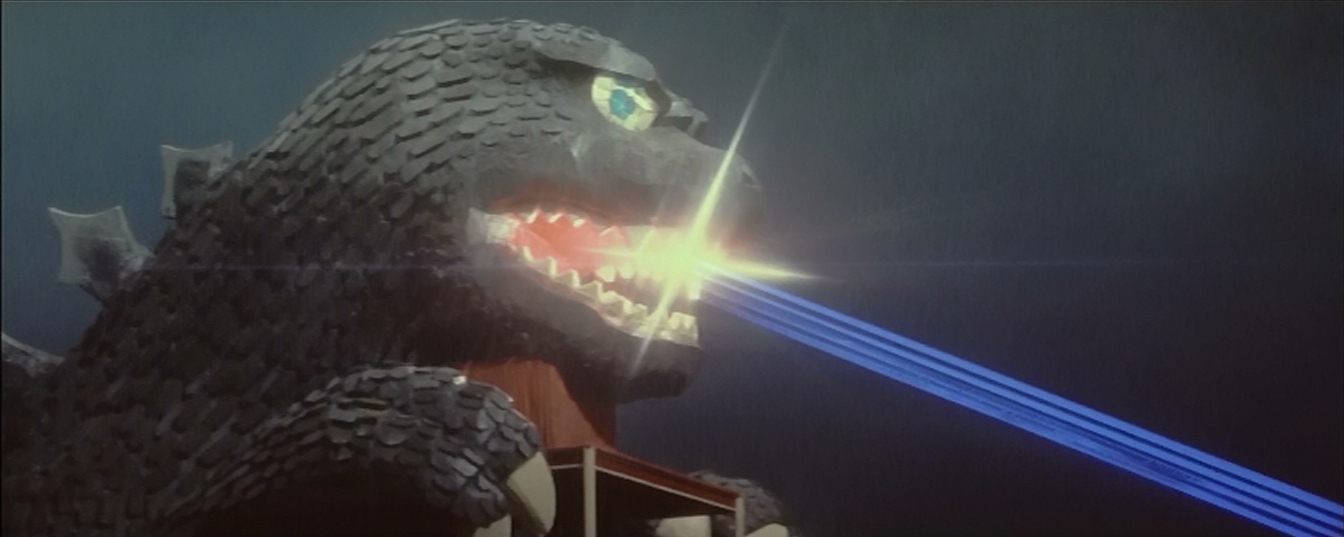
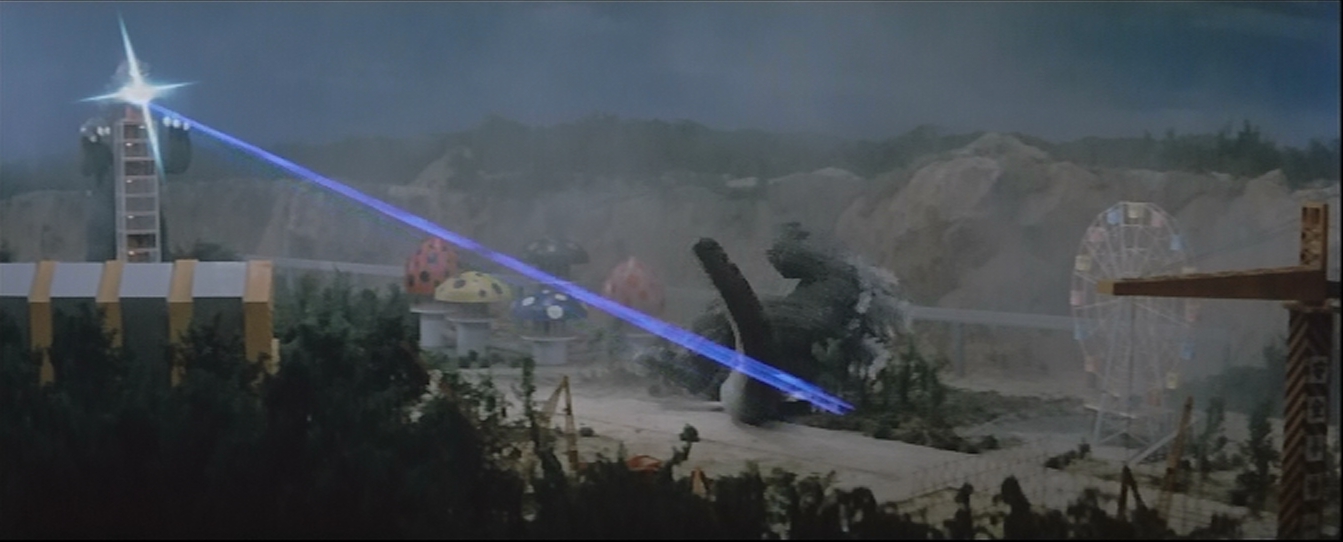
The Godzilla tower is the center of the action, but only in the last half an hour is it revealed that it has lasers in its mouth. This feels like the beginning of the idea, or perhaps a branch off the idea, that leads to Godzilla vs Mechagodzilla, in which Godzilla is confronted with a duplicate of itself.

I have laser breath, too!

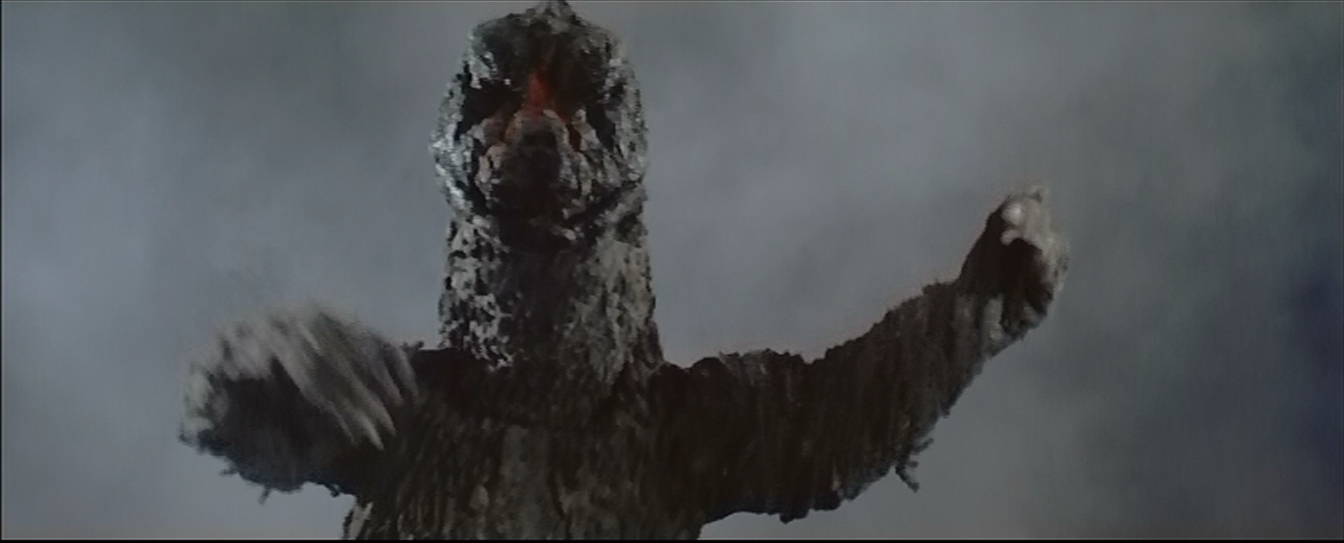
The fight is primarily between Gigan, Godzilla, the Godzilla tower, and Aguirus. Ghidorah stands in the background, playibng goalie, perhaps. But the Godzilla Tower does a great job of keeping Godzilla down until the Scooby Gang, with the help of the military, blow the tower up. Even after that, he's pretty passive. Gigan picks him up and begins smashing him in the head with those hook arms of his. Godzilla doesn't get a second wind until his double, the Godzilla Tower, is destroyed.

Godzilla having his ass kicked by a building. Ironic as all hell.

In order to save money, the Godzilla suit is the same one that was used in Destroy All Monsters, All Monsters Attack, and Godzilla vs Hedorah. At the end of this film, bits are literally flying off the suit as the actor moves around in it.

I have laser breath, too!

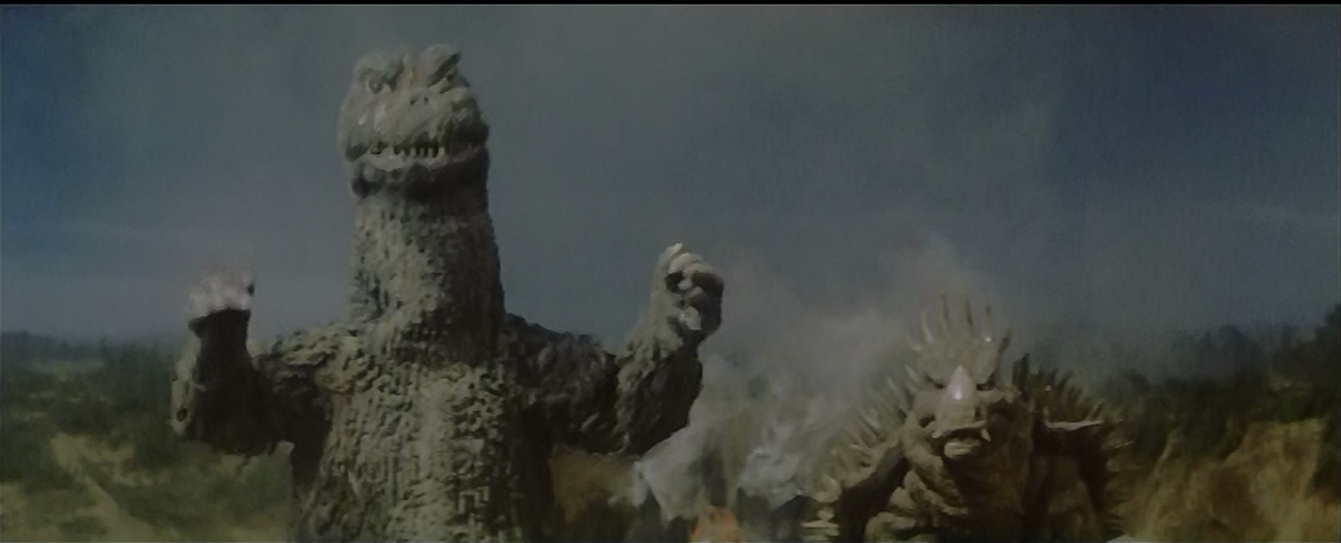
Anguirus cements his reputation of Showa Godzilla's best buddy. They stand against Gigan, Ghidorah, and the Godzilla tower, much as he did in Destroy All Monsters. His new trick (never repeated outside of this film) is to fling himself backwards, smashing his opponent with his spiky back. It's not a convincing attack, but at least it gives the monster something more than just claws and bite to attack with.

So a buddy-monster film

The two evil monsters fly off, the Roaches are dead. All in all, it's a happy ending for the film. There's some interesting ideas underlying Godzilla vs Gigan, but the execution just doesn't keep my attention. The majority of the human action is dull, and the monster fight murky. It's not the best film, but the budget being what it was, this is understandable. But not all that re-watchable.

Next up, Tsuburaya celebrates ten years. And it's kind of weird.

Thursday, December 26, 2013

WHAM! POW! BASH! DESTROY ALL MONSTERS

Despite the massive number of kaiju films released in 1967, most of them aren't particularly memorable. Many were new entrants into the field by studios that had never endeavored to make a giant monster film before. Even Toho's franchise was running out of steam, with the disappointing performance of Son of Godzilla, as well as the flooded market. Godzilla just wasn't as special as he had been. To celebrate the 15th anniversary of the Godzilla franchise in 1968, Toho decided to get the band back together.

And with immaculate timing, my DVD player has decided it no longer likes my copy. Pictures will come later, sadly.

Destroy all Monsters is the last film with the five original artists from Godzilla; Ishiro Honda, Eiji Tsuburaya (although only in an honorary fashion, he was very ill as this time), Tomoyuki Tanaka as producer, Haruo Nakajima in the suit, and Akira Ifukube writing the music. Some call this the end of an era, but to my mind, it's a Hercluean effort before economic and social forces turned the kaiju film into a cheap and poorly thought-out spectacle.

The year is 1999, and as in several previous films, Japan (or, really UNSC) has a space program. They have also managed to confine all the monsters to a location, Monster Land. The space program trope fades a bit after the excitement of the space race cooled off, but the Monster Island idea is one that stuck with the franchise until the end of the Shōwa era. Moonlight SY-3 is a stylish, almost art deco spacecraft, combining attributes of a high-tech jet as well as a rocket.

Ogasawara Island, called Monster Land, is the culmination of several ideas previous films, such as Mothra vs Godzilla and Ebirah, Horror of the Deep. Although the monsters are not under human control, they are at least confined. If Godzilla and the other monsters are still seen as a metaphor for nuclear testing, this may coincide with the rise of nuclear power in Japan, with the Mihama Nuclear Power Plant beginning construction outside Tokyo in February of 1967. On the other hand, this is the ultimate expression of Dr. Serizawa's desire to study the monsters. Now that they are controlled, they can be understood.

The Kilaaks, the alien antagonists, can control the monsters. Japan can never do so, merely containing the monsters, but alien invaders and terrorist corporations such as the Red Bamboo seek to control the giant monsters for their own ends. Ghidorah is, again, the puppet of an alien intelligence just as he was for the Xiliens and the Futurans. They are all female, all Japanese-looking (despite the more international bent of the film) but this is a disguise. They really look like slugs, and are made of 'living metal.' It turns out that they can control humans just as easily as they can monsters. This creates a paranoia in the film similar to the 1956 film Invasion of the Body Snatchers. Anyone could be a Kilaak agent (until they discover the transmitters which allow the Kilaaks to control humans and monsters).

Strangely, Mothra has shed her unique status as protector of Infant Island, and has been confined in the same way that the other monsters have. Also gone from this film are her twins, the Shobijin, Mothra's interface with humanity. She's just another destructive monster. She's also back in larval form. It's possible (pardon me while I fan-theory) that this is the other larva that hatched in Godzilla vs Mothra and didn't become the Mothra we saw in Ebirah, Horror of the Deep, which I assume is the peacemaker from Ghidorah, the Three-Headed Monster.

The film is very much a retread of the tropes and ideas from Ghidorah. Alien invaders, all the monsters ultimately ganging up against Ghidorah, Godzilla pulling a turn from implacable enemy to unstoppable hero. But where Ghidorah has three monsters attacking the three-headed monster, some seven attack him here. More spectacular, sure, but not as challenging a fight. But more than any previous film, Destroy All Monsters takes a look at the international problem of monsters. Rodan attacks Moscow. Gorasaursus, unseen since King Kong Escapes stands in for Baragon, who was on loan to Tsubaraya's Ultraman. Which is why it is misidentified, as well as shows some rather unlikely tunneling abilities. We are told that Mothra attacks Beijing, and that Manda attacks London, but we don't see these. We do see Godzilla show up in New York harbor and blast the United Nations building with his radioactive breath. 1998 Godzilla is not the first time the big guy took a bite out of the Big Apple.

In the middle of the film (XXX minutes), we have a beautiful miniature of 1999 Tokyo. Small card move along her streets, an elevated train trundles along tracks. The set is large and took a lot of attention to detail. Ironic, really that the construction boom made Tokyo so much more impressive thirty years later. The destruction of Tokyo by Godzilla, Rodan, Manda, and Mothra is beautiful in its mayhem.

For the first time since Godzilla Raids Again, the camera pans over the charred and ruined city. This was one of the most effective shots of the original Godzilla film, and it's a reminder that these films aren't completely fun and games. But it's brief, and the devastation isn't as total as it was in 1954.

Part of the bigger budget for this film shows in the miniatures. The military vehicles are a bit more fanciful, including tanks with missiles on their turrets and strange-looking radar antennae. It's as ineffective as the military always is, but it's a pleasure to see some fantasy deigns come from Tsubaraya's studio. There is also the implication, and a prescient one, that the tanks are drones.

The last battle happens, again like Ghidorah, in front of Mount Fuji, where the Kilaak base is. This is our only glimpse of Baragon in the fight, mostly through a thicket. We get a better shot of him in the farewell section, however. But you have to wonder what the Kilaaks were thinking when they deployed Ghidorah. Godzilla, Rodan, and Mothra got rid of him last time, now Gorosaurus, Anguirus, Manda, Baragon, Varan and Kumonga (I'm not counting Minilla as a threat) are added to the team. It makes for a more impressive fight, but the outcome is pretty inevitable. Godzilla and Anguirus do most of the heavy lifting (the footage of Ghidorah flying with Anguirus firmly attached to one of its necks will be repeated a few times in later films) in the fight.

Once the fight is over, the Kilaaks deploy their Fire Dragon, a flying saucer burning with energy. Even though Godzilla puts an enormous foot through the Kilaak base, the Fire Dragon keeps coming. Ghidorah's inert body falls into the earth, similar to the way Frankenstein and Baragon ended. Only with more explosions, but it's up to the humans to solve the last problem. Which they do with Moonlight SY-3. This represents a major shift in attitude from Toho's previous films. Honda, who experienced WWII, had never allowed the military solution to be anything but show before this. And, although the conclusion is rooted in science fiction, Moonlight SY-3 fires missiles, causing the saucer to go down. The humans have taken the lead, controlling the monsters, no longer the ir helpless victims.

Destroy All Monsters was intended as a finale to the series, the end of monster films. However, it was so successful (admittedly selling only a hundred thousand tickets more than Son of Godzilla), but in a period of sharply declining attendance, this was seen as a major coup. And so the series continued, albeit with declining budgets.

Next up, Boy Scouts in trouble, and loaded with stock footage.

Thursday, June 20, 2013

Quick, Cheap, and Seminal: Godzilla Raids Again

What does a film company do when they have an unexpectedly huge hit? They follow up with a quick, cheap, sequel. King Kong was followed up in nine months with Son of Kong, and Godzilla was followed six months later by Godzilla Raids Again.

Who's that on my island?

I won't be discussing the American versions of Japanese monster films if I can get the Japanese cut. I'm just not that interested. I'm a subs guy, as I find the process of dubbing can be convoluted, especially when attempting to cram English words into mouths speaking Japanese. This distances the dialog from the original concept, and unless there's some sort of genius doing the translating, it's three removes from the original, rather than one. I prefer to read the dialog, and listen to the voices of the original actors. As a result, I'm enjoying Sony's releases of these films on DVD, since they include a subbed Japanese version, as well as the dubbed and often recut American version.

Godzilla Raids Again provides us with the answer to the impotent military posited in the original Godzilla. If the colossus cannot be defeated by conventional weapons, then how do we provide narrative tension? The answer is to fight fire with fire, and introduce another giant monster. And this is the moment the Godzilla franchise comes into its own, providing a stage for two or more gigantic monsters to meet and fight.

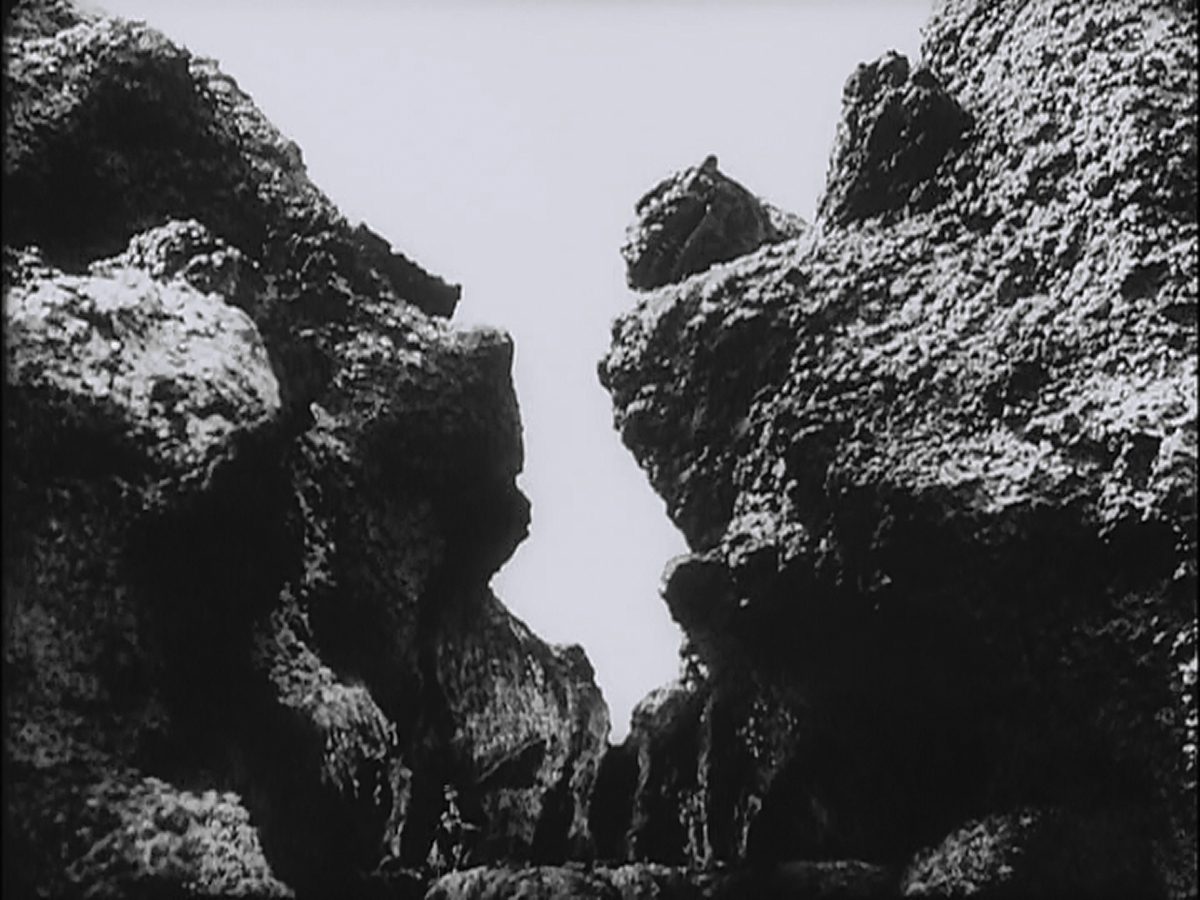
Godzilla is no longer a mystery, so he appears much earlier in the film that the previous one. Less than nine minutes in, Godzilla and Anguirus are shown, already locked in combat. This is a second mutated dinosaur. The original Godzilla was killed by the Oxygen Destroyer, and nuclear testing has once again produced a gigantic version of a dinosaur from the same family. But that's not important. What's important is that Japan must now face another attack by Godzilla.

Who's on my island?

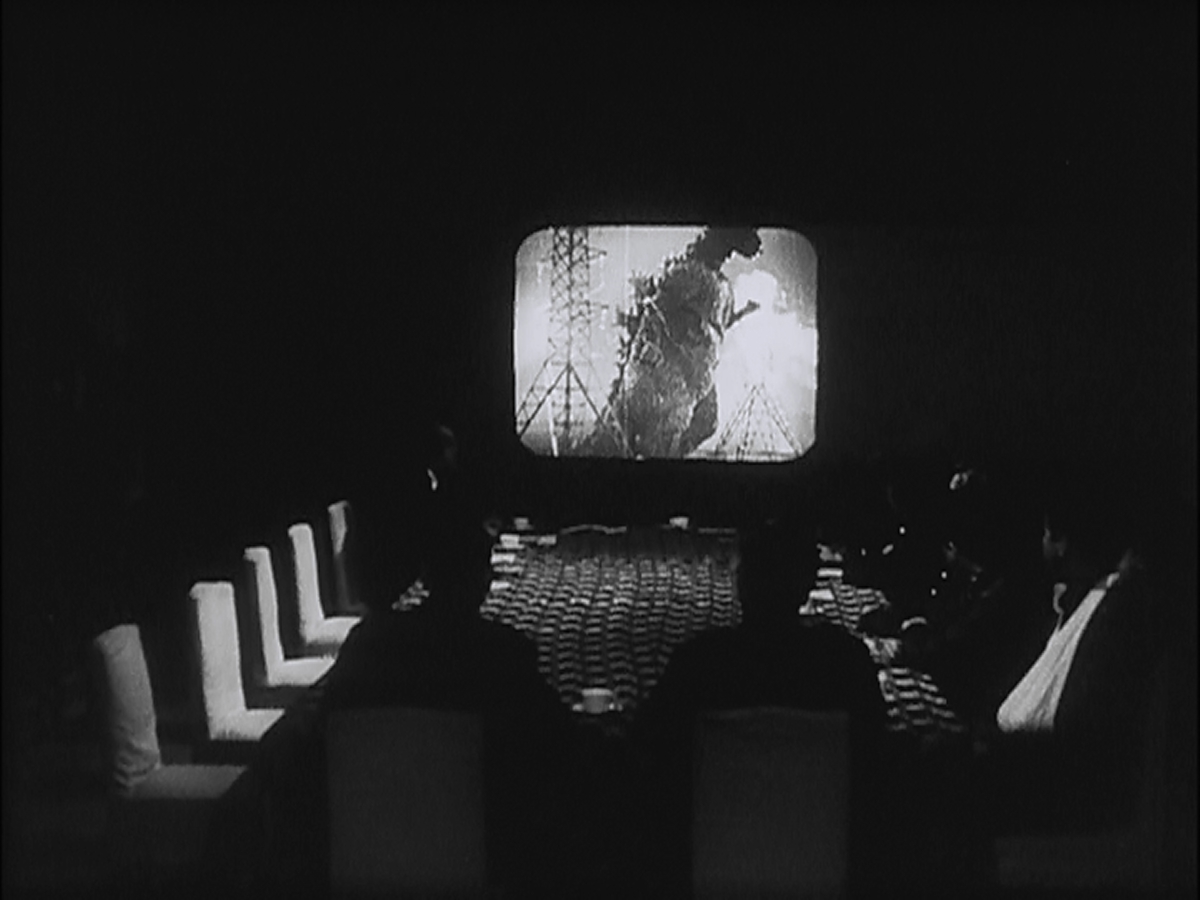
To remind the viewer of the original Godzilla film (remember this is the fifties, so there are no DVDs or home versions of film avalable), Dr Yamane (played again by Takashi Shimura, one of Kurosawa's pernnial players) shows us a quick reel from the previous film. It's a hoary old device, but one that works. Yamane and the military explicitly agree that the military is useless against these titanic monsters, and that they must keep an eye on the monsters in order to predict where they will be most destructive, and evacuate the civilians.

We're watching a documentary called Godzilla.

The device used in this film is that Godzilla is attracted to light. This is a small reference to the first film, when Godzilla attacked the broadcast tower, having seen the flashing lights from the photographers. This may also be a reference to King Kong, as it's the photographer's flashes that set Kong on his rampage. It also reinforces the Godzilla as American military metaphor, since the authorities shut down the lights of Osaka. The audience would have remembered blackouts during WWII bombing raids. It also serves to show the folly of men. Godzilla is indeed distracted by the flares, but a fire at an oil refinery catches his attention, at which point Osaka gets stomped.

I'll bet this is what a city looks like after being firebombed.


The human characters are much more ordinary. Our protagonists are pilots for a fishing company, as well as the girls they are sweet on. Dr. Yamane appears only to give us plot exposition as the Gozilla expert. The smaller lives of these less-developed characters stand in contrast to the previous film. These are working-class, in the employ of Kaiyo Fishing Company trying to do what they can, not researchers or scientists.

Godzilla's breath weapon is used, but in many ways it is downplayed. Anguirus takes a face full of it, but shrugs it off, either because he is already mutated, or it's not that powerful. But we do see the city going up in flames behind him. The wrestling is famously different from the slightly overcranked Godzilla scenes from the original film. These are slightly undercranked, so the wrestling is a bit fast. The effect isn't all that impressive, lending neither weight nor a sense of mass to the struggle. Which is strange, because some of the scenes of collapsing buildings, and a few of the monsters themselves, are clearly overcranked. This (along with the quick glimpse of a crew member while Tsukioka and Kobayashi are on the island) speaks to the cheap and rushed nature of the film.

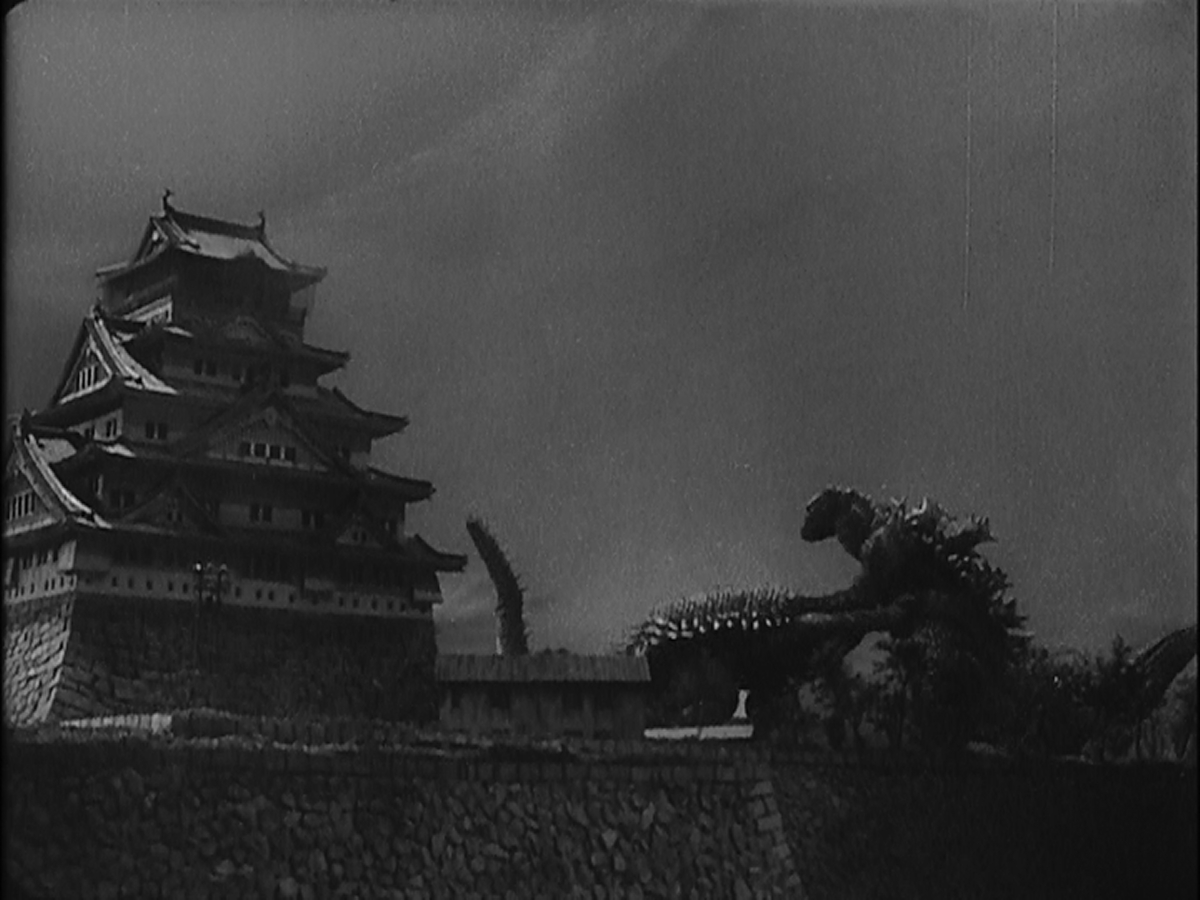
Two monsters and a famous monument.  Ready to crumble?

Anguirus is killed and then incinerated by Godzilla just over halfway through the film. As this was establishing the giant monster vs giant monster genre, this is unexpected. Later, the confrontation between the two monsters will be the set piece climax at the end of the film. Here, Anguirus is more or less there to give Godzilla something to do, rather than just crushing Osaka for the first half of the film.

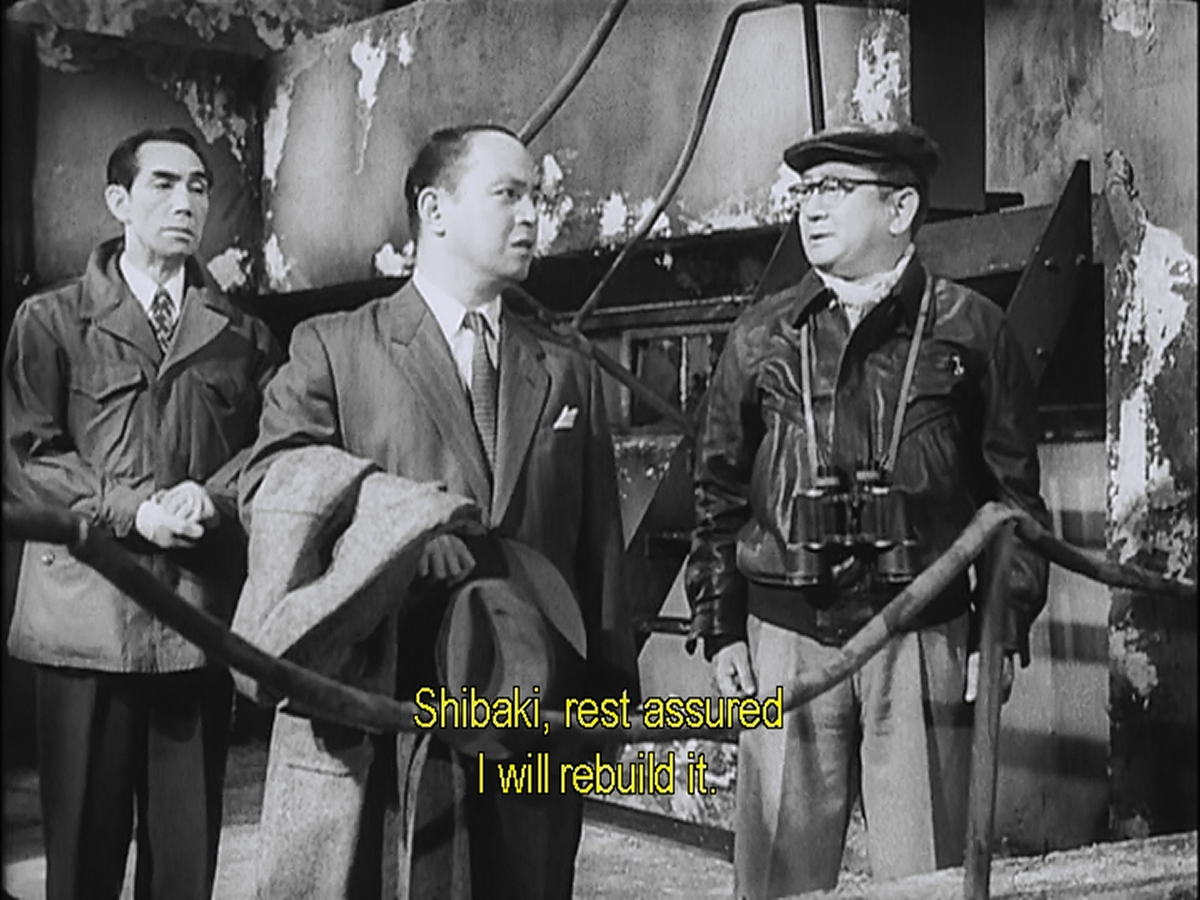
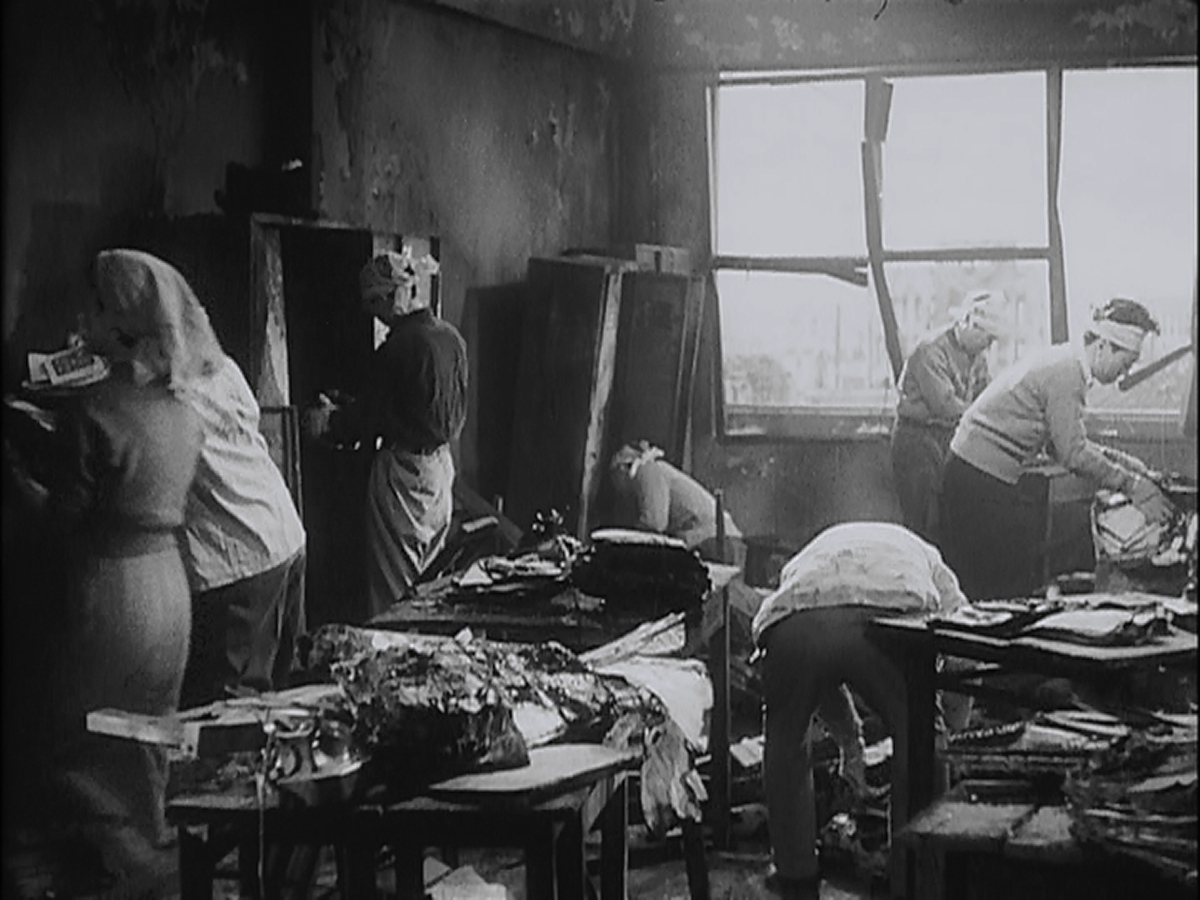
Although Godzilla Raids Again is still grim in tone, the scenes of destruction are not interspersed with scenes of human suffering. There are no crying children, and no scintillation counters. Immediately after the attack, the protagonists are seen cleaning up the burned remains of Kaiyo Fishing, and the president promises that he will rebuild it. This is a spirit of post-war Japan. Their country had been bombed pretty heavily, and there was a lot of work to be done.

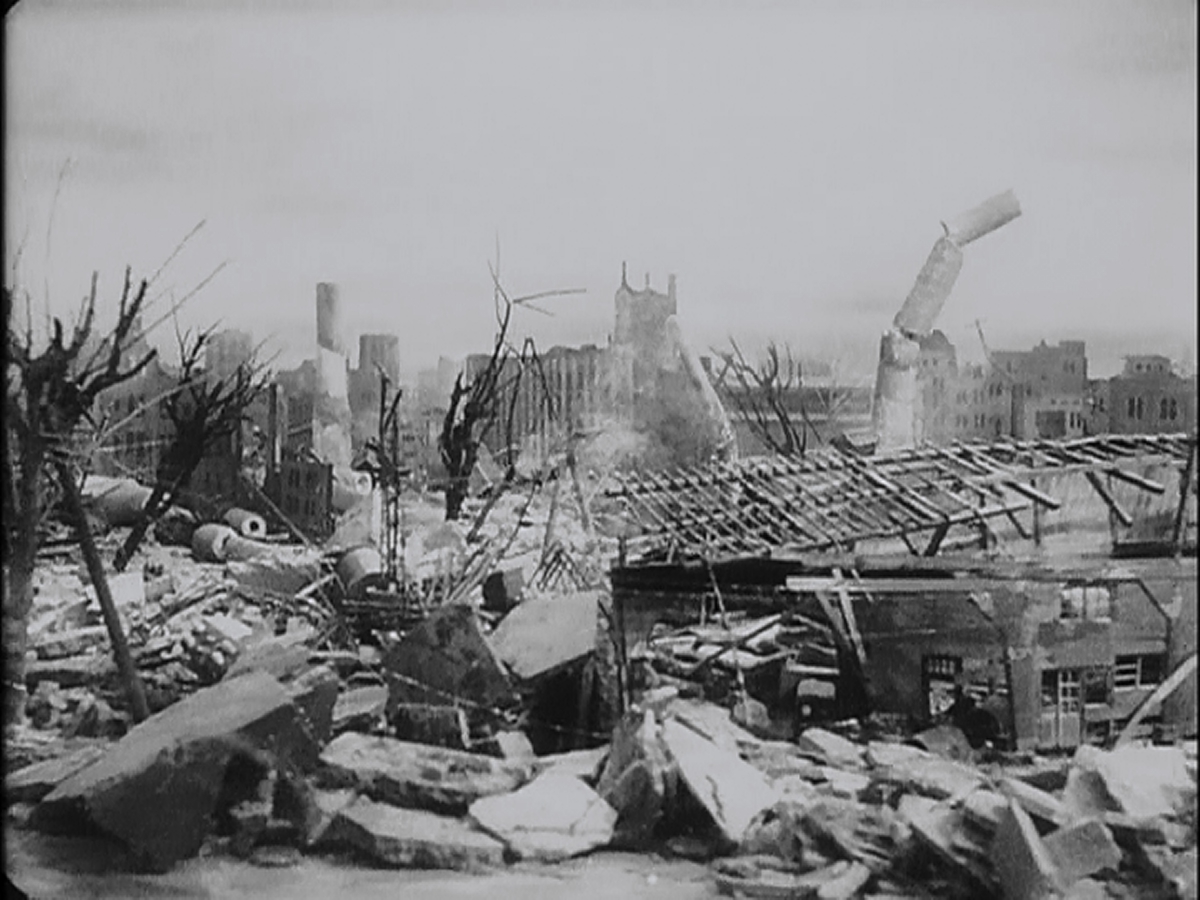
The ruins of Osaka.

Who's that on my island?

Who's that on my island?

Godzilla vanishes the minute Anguirus is defeated. And then we are treated to a sort of slice-of-life comedy. It's a bit strange, although if the intent was to have the characters return to a 'normal' life after Godzilla's rampage, I suppose I understand it. It doesn't contribute to the disaster feel of he film, however.

David Kalat equates the death of Kobiyashi, the popular and genial pilot looking for love, with a kamakazi suicide action. I think that's unclear in the Japanese version of the film. I find it equally possible that Kobiyashi was attempting to distract Godzilla. Yes, he is angry with the big lizard, but he is hit by Godzilla's atomic ray and crashes into a mountain. He was clearly conscious as he did so. If he wanted to crash into Godzilla, he could likely have done so, on fire or not.

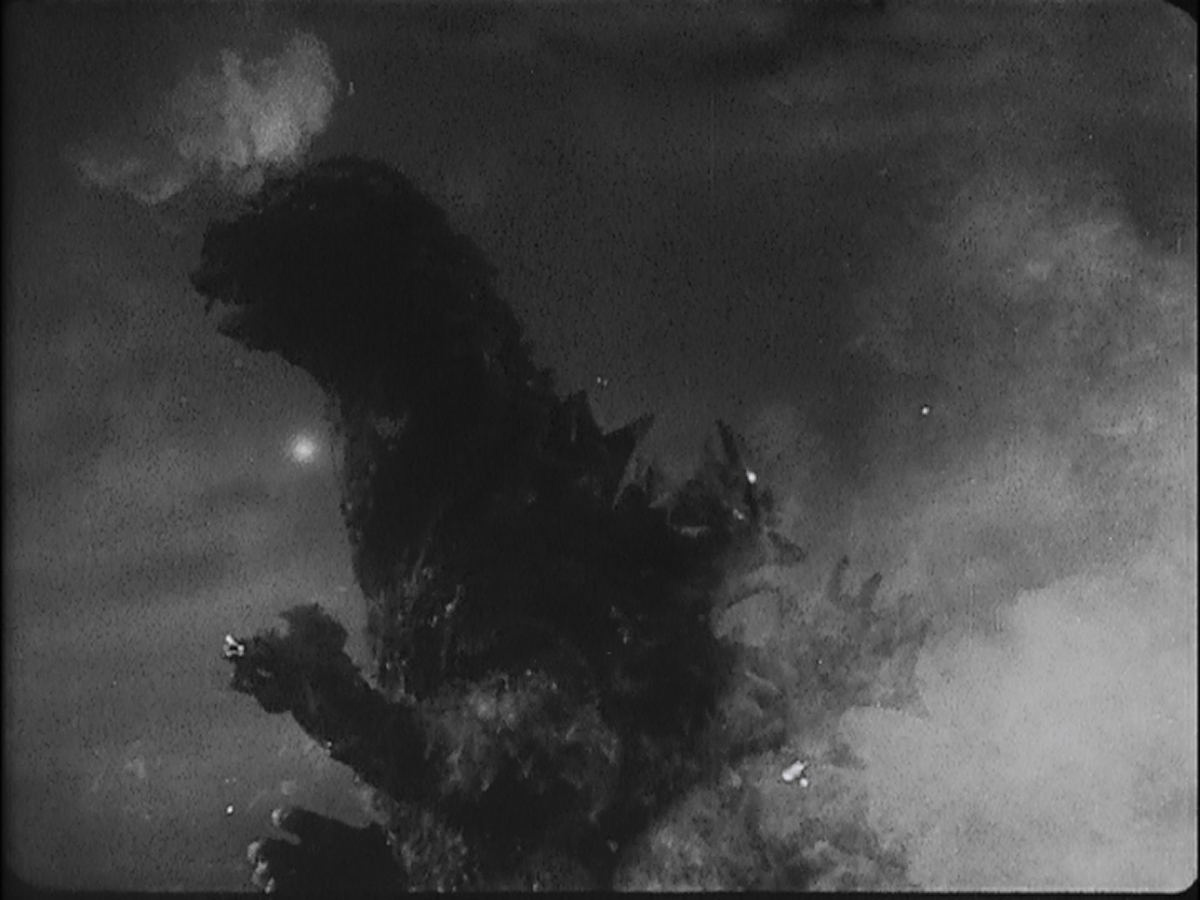
For the first tme in the franchise, the military is not entirely useless. Tanks and missiles are ineffective, and when the search is on to find Godzilla, the military deploys jets. It takes Tsukioka in his prop plane to locates him. However, once Godzilla is located, bombs and missiles work indirectly, causing avalanches of ice to fall on Godzilla, trapping the giantic beast at the cost of several planes and their pilots.

Possibly the best shot of Godzilla in the film.  So many of his appearances are dark.

Godzilla Raids Again is an unexciting, but not awful entry in the genre. It requires a bit of patience to appreciate and love; it's not a great, layered work of art. I find it interesting as a look into the way that the genre evolved.

In the end, Godzilla is buried under induced avalanches of ice on a remote island. And there he would remain until he wakes again. But was it the footsteps of a giant ape that awaken him to color after a seven-year sleep? Or was it something else?