Showing posts with label Baragon. Show all posts

Thursday, December 4, 2014

All About the Rage: Godzilla, Mothra, King Ghidorah, Giant Monsters All-Out Attack

With the commercial failure of Godzilla vs Megaguirus, Toho looked around for ways to save their beloved franchise. But by this time, they had other irons in the fire. Toho was distributing anime. including Studio Ghibli and the Pokemon franchise, as well as producing low-cost, high return J-horror such as Ring and Pulse. If Godzilla could not perform, then perhaps it would have to be laid aside for a time. To avoid this, they tapped Shûsuke Kaneko, who had done a brilliant job revitalizing the Gamera franchise, to helm their new Godzilla film. This turned out to be a smart move.

As with previous and subsequent Millennium films, Godzilla, Mothra, King Ghidorah, Giant Monsters All-Out Attack (hereafter GMK) occupies its own continuity. The first Godzilla film is acknowledged, but the other twenty-four are not. Except for the moment when the film casts some shade on the 1998 Godzilla.
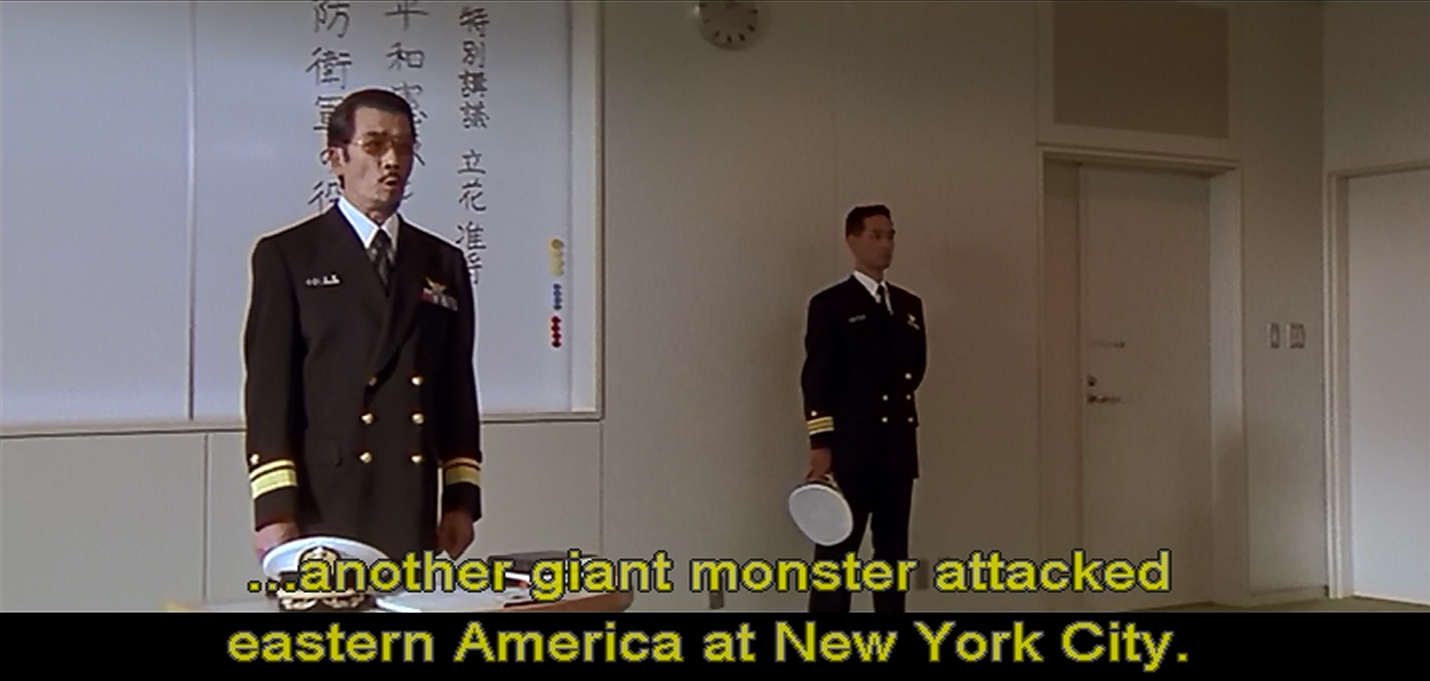
Throwin' some shade.

We begin with a lecture. Commander Taizô Tachibana is talking to a group of students about the function of the Japanese Self-Defence Forces, which has only been tested against Godzilla. Although this film closely engages the character of the admiral and the military, it does so with a very different bent than have previous Godzilla films. Neither there for a useless show (the Showa series), a serious challenge (any film in which MechaGodzilla is built by humans, including the next two films in the Millennium series), or bumblers causing as much destruction as the monster (Godzilla 1998) the military here is neither valorized nor there for comedy. They are treated as people. The man put in charge of the anti-Godzilla task force is a blustering foot-dragger, refusing to believe that Godzilla is even real at the beginning, and spouting inappropriate military doctrine ("Try attacking it from the side! It must have a weak point!") while his men get killed.
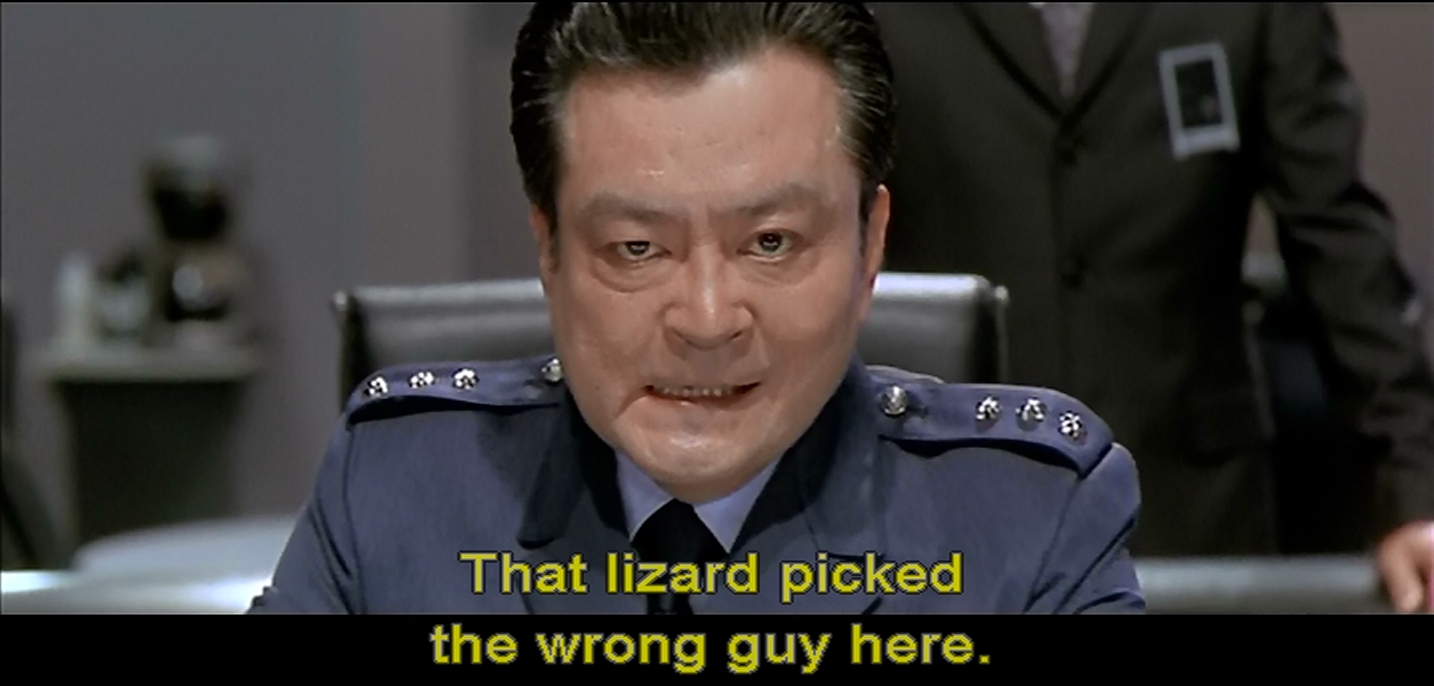
Throwin' some shade.

Taizô Tachibana on the other hand, is very much a lead-from-the-front sort of man, who takes responsibility for his actions, and decides to do the dangerous mission himself. He does not relish the thought of combat, and admits to being afraid just before he goes into battle. it is not the military as a whole that this film praises, but the resonsible individuals who do their duty.
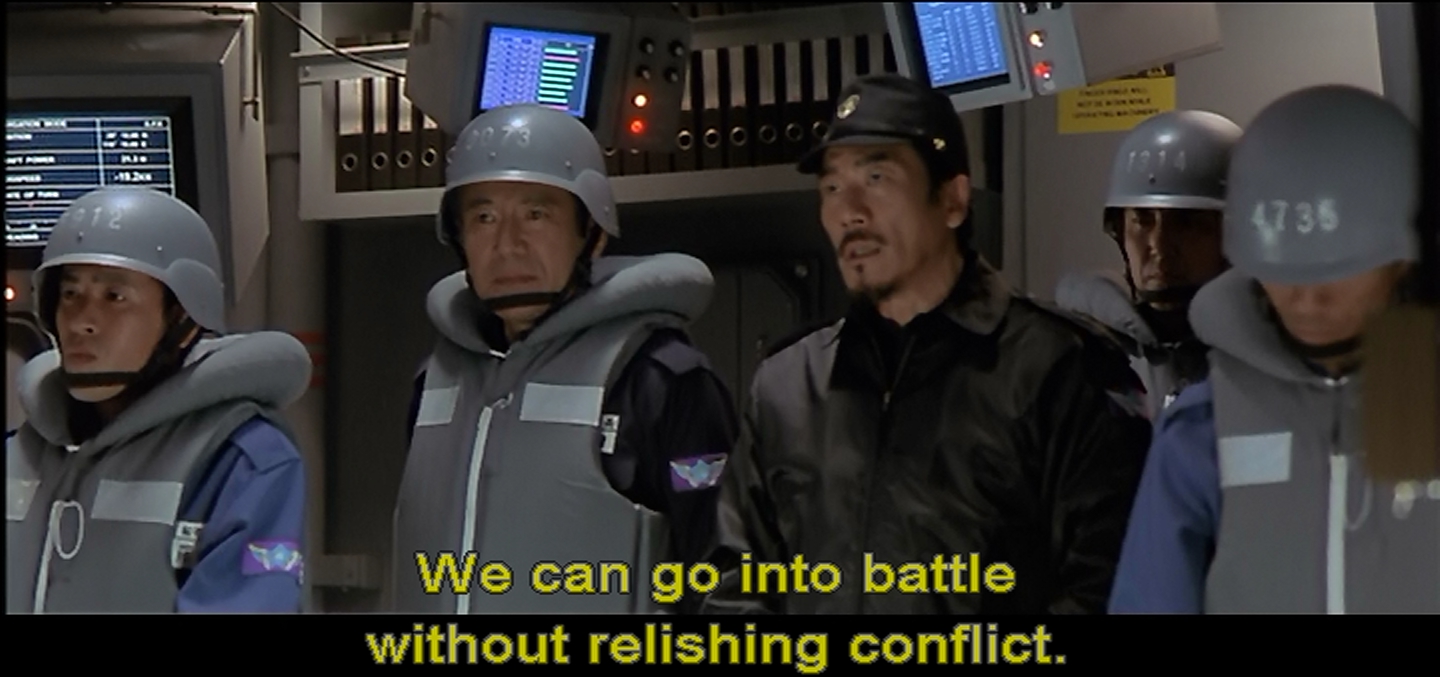
Be calm, don't enjoy the killing.

At the same time, GMK is well aware of its roots. the Japanese Self-Defence Forces help search for a downed American Nuclear Submarine (shades of The Return of Godzilla) with a new submersible called the Satsuma, a callback to both the man who performed as Godzilla in the Heisei series, as well as the rescue ship from the first Mothra film. When Godzilla comes ashore, we get a quick glimpse of a picture of Lucky Dragon #5, the fishing boat that was contaminated after the Castle Bravo nuclear test. Whwen Godzilla uses its atomic ray for the first time, a teacher looks out to see a mushroom cloud. It's the second most chilling moment in the series, after the crying woman and her children in the first Godzilla. It reminds the modern viewer of a time when Godzilla meant something.
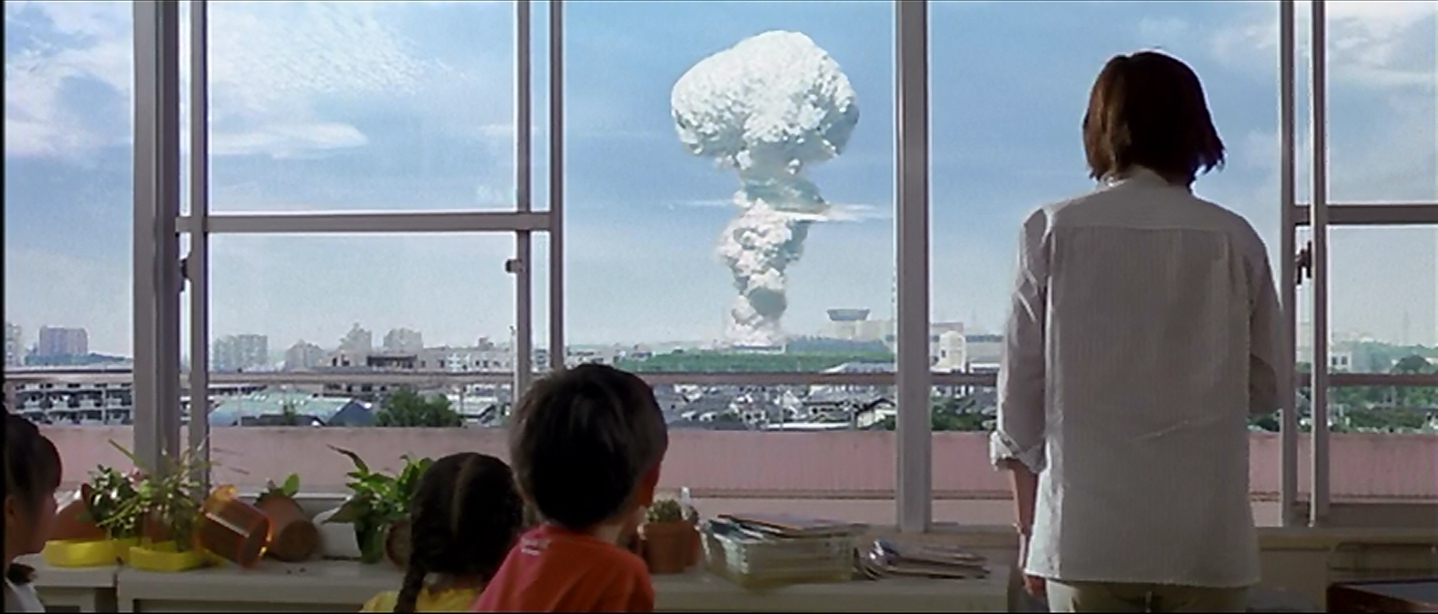
In case you've forgotten that Godzilla was a nuclear metaphor.

The other protagonist is Yuri Tachibana, Taizô's daugher, a reporter, one of the classic Godzilla roles. But in a subversion of the usual Showa roles, she is a sensationalist reporter, working on bogus supernatural stories. This makes her earnestness in wanting to cover real stories, the story behind the guardian monsters all the more powerful. Perhapsd the earnestness of the character grew from director and writer Kaneko's years of making soft-core romance films for Nikkatsu (the studio that had once produced Gappa the Triphidian Monster).
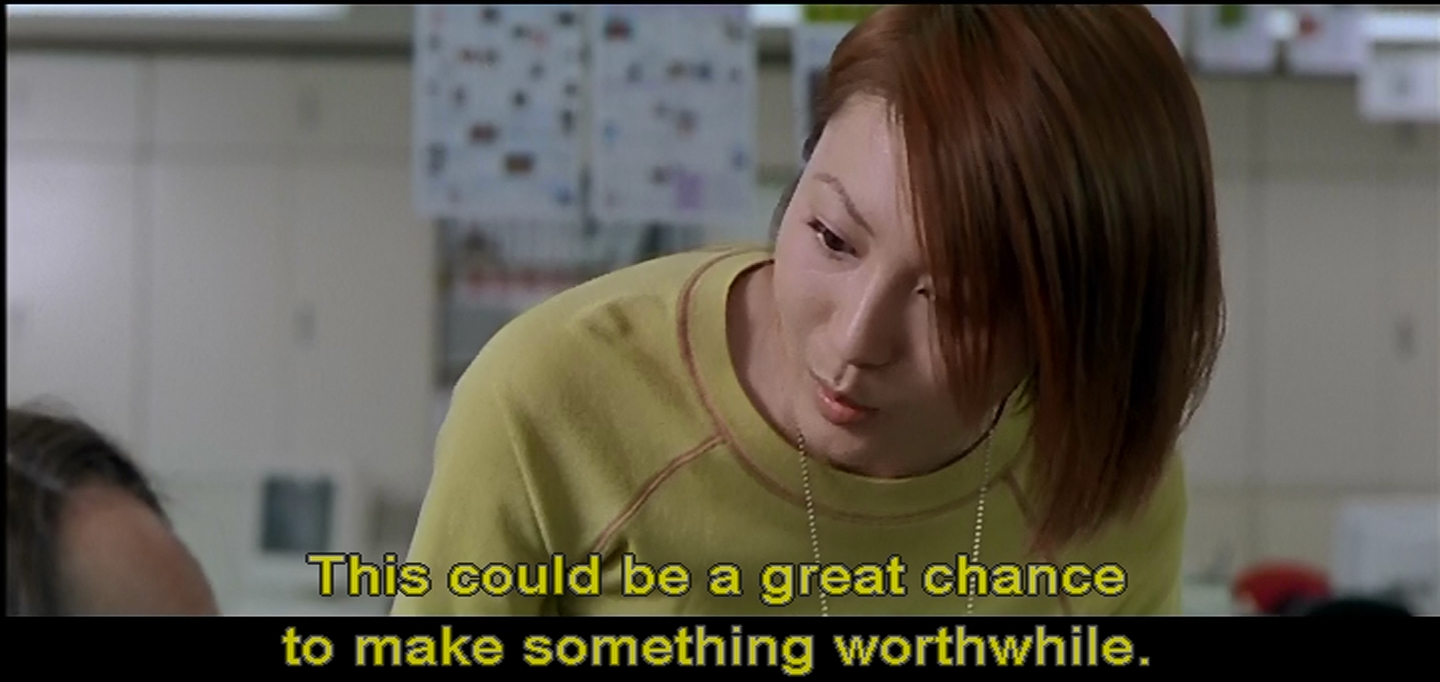
Like a Godzilla film with a social message.

Kaneko has also brought with him several of his own ideas from his Gamera trilogy. There are good kaiju and bad kaiju. Godzilla is a radioactive lizard infused with the angry spirits of the dead from World War 2. Mothra, Ghidorah, and Baragon are beneficial guardians, equivalent to Gamera. But although they are beneficial, they are still giant monsters, and they kill, even if by accident. The first casualties of the film are a group of obnoxious motorcyclers, crushed in a tunnel as Baragon tunnels by. Originally, Kaneko wanted the guardians to be Baragon, Varan and Anguirus, but Toho, remembering the poor return from Megaguirus, insisted their two most popular kaiju, Mothra and Ghodorah, be used. And it works, Ghidorah is the thousand-year dragon, and Mothra started out being worshipped as a god. Which brings some interesting images to mind. I would have liked to see Varan arise in glory after being charged up the way King Ghidorah was.
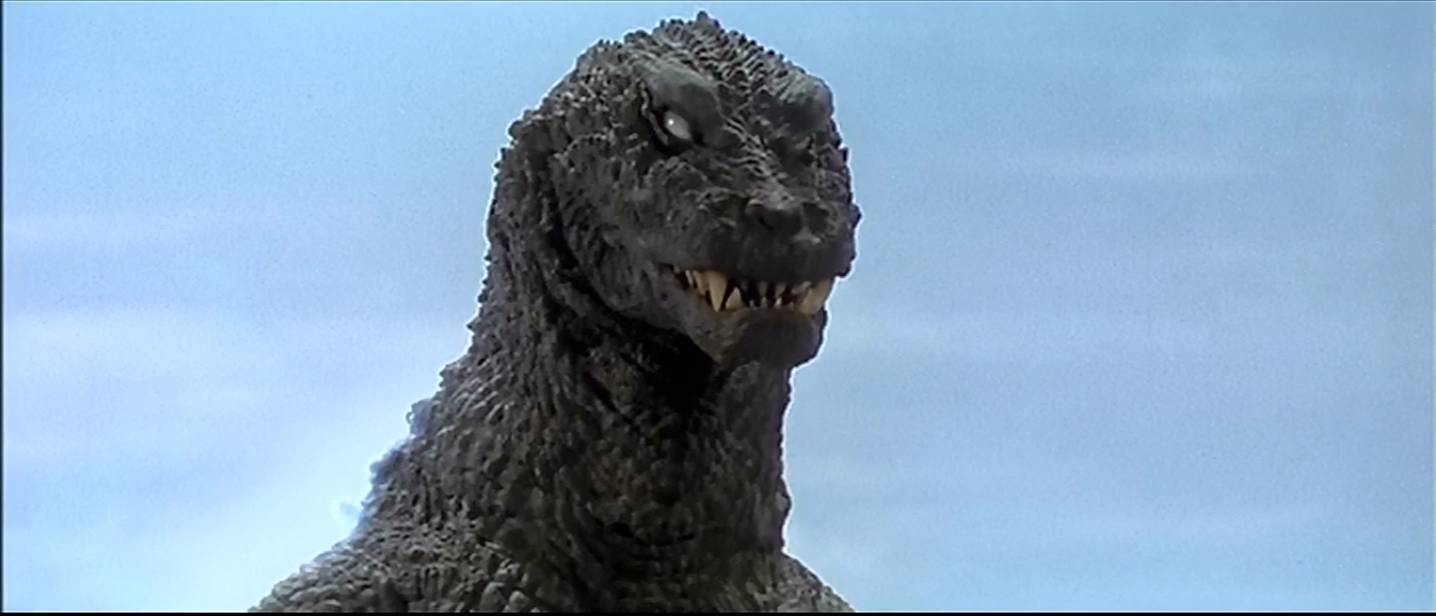
Dead eyes, like a shark.

The guardian monsters also appear to be moral guardians. The above-mentioned obnoxious bikers break a statue, and get crushed by Baragon cruising by. A group of looters disturb one of Mothra's guardian statues, and they are pulled under the water one by one. Godzilla, on the other hand, does not discriminate. People who are in his way die.
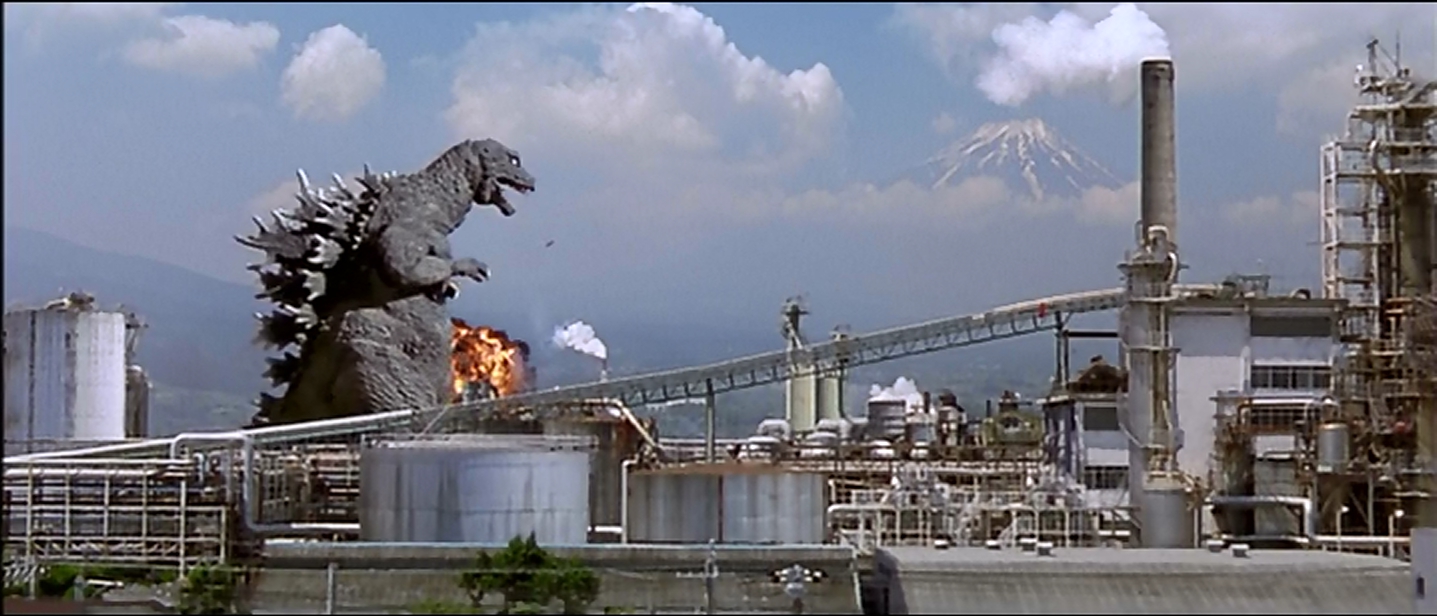
CRUSH!

Further, there's a lot of confusion as to what's going on among the film's characters. With only second hand reports, the military cannot determine which monster is which. It's thirty minutes into the film before the military believes that there's more than one montser. There are no grand overarching shots that show them which is which.

Meanwhile, civilians constantly underestimate the deadliness of the monsters. A pair of tourists want selfies in front of the Godzilla and Baragon fight. They don't make it out alive.
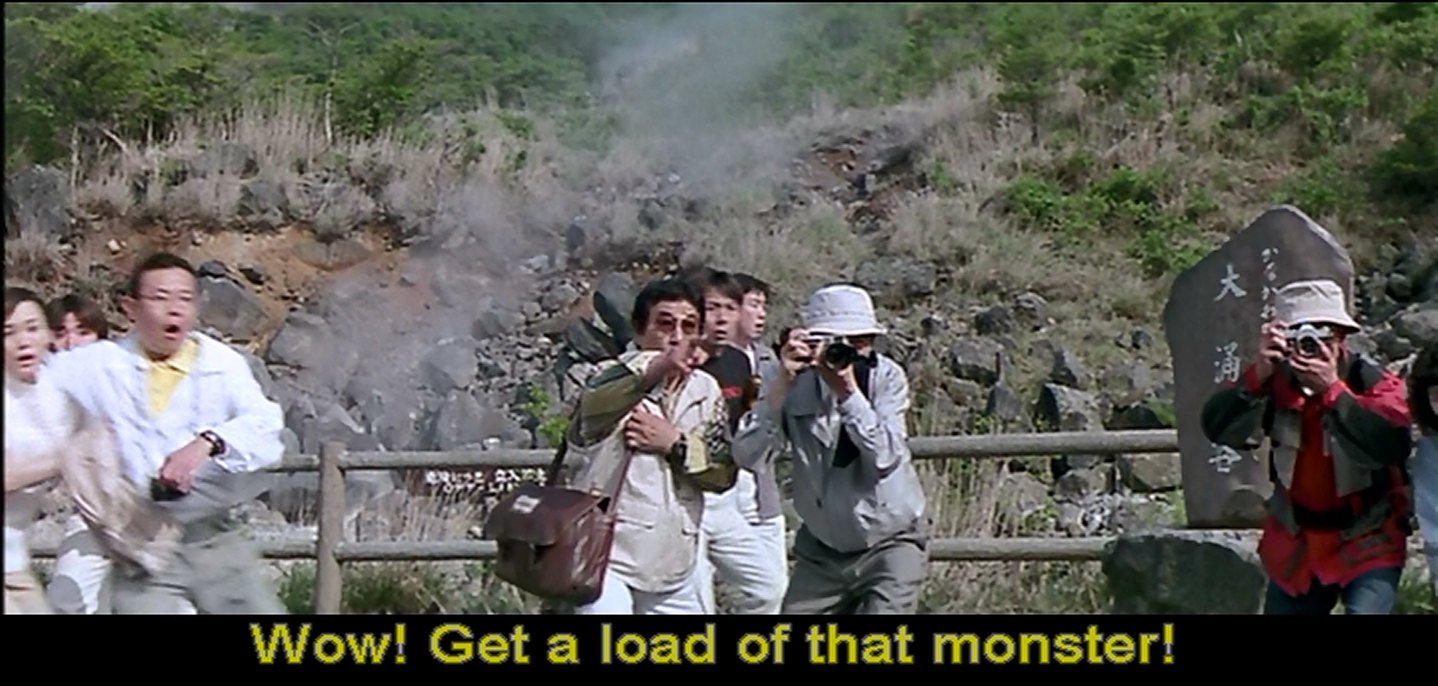
A monster, let's do something that's not running away!

Godzilla looks very different here than he did in the previous two Millennium films. He is no longer lean, but almost bloated, his eyes dead white, his snout blunt. The spines are blunt, also, not the long starp ones Godzilla is an ugly brute. He is not a force of nature, not the hero, but a furious engine of destruction, crushing everything in his path.
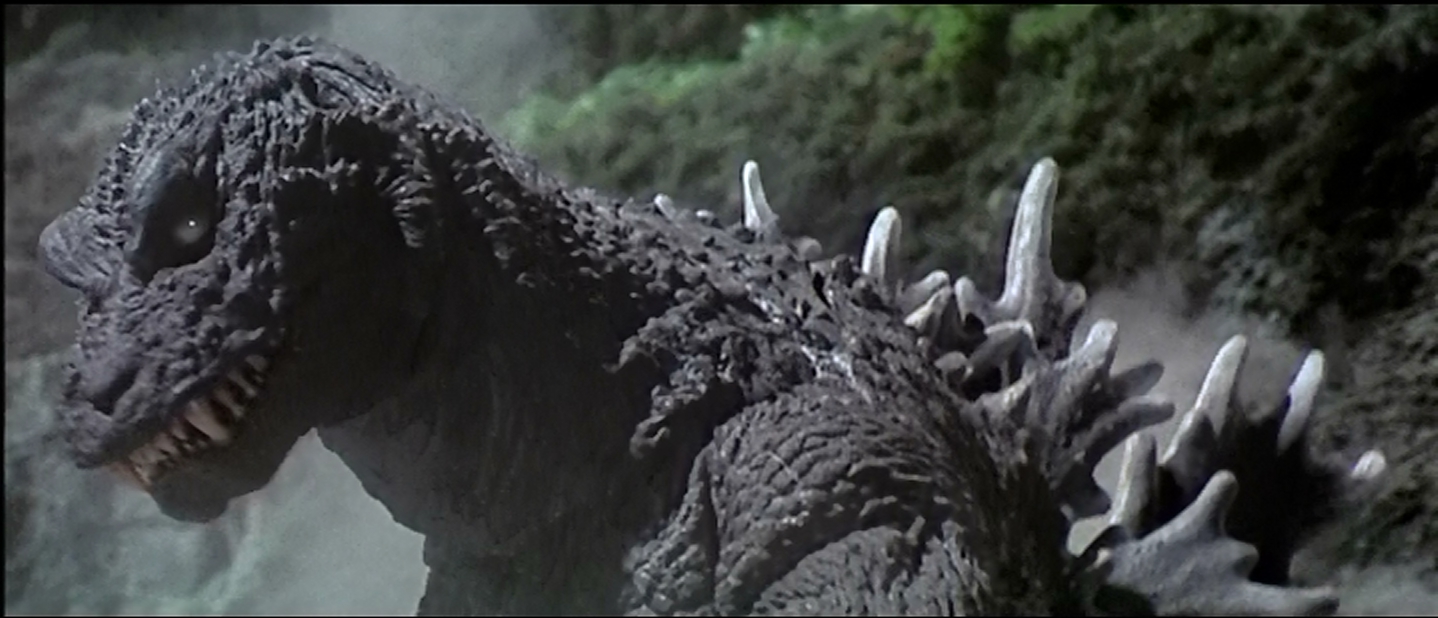
Engine of destruction.

The monster fights are spectacular. The first one is Baragon against Godzilla. Godzilla is enormous compared to Baragon, and the entire thing is a beat-down. Baragon is clearly outmatched, but it will not give up its attack. Godzilla fires off its atomic heat ray, and Baragon disintigrates, leaving Mothra and Ghidorah to fight Godzilla.
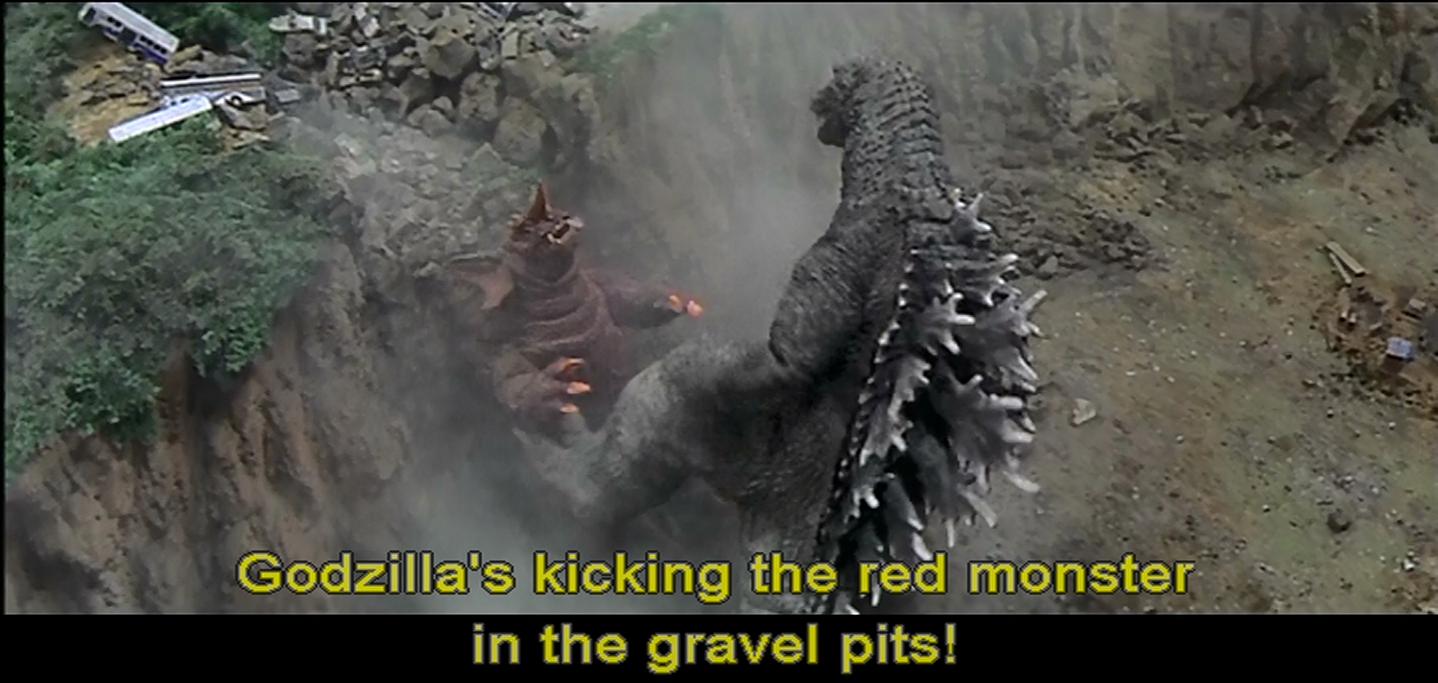
Not an even match.

Mothra ahs changed a bit since her appearance in the Hesei Godzilla vs Mothra: Battle for the Earth. It's not as aggressive-looking as the last Rebirth of Mothra, and that's a bit unfortunate. The later evolutions of Mothra were very dynamic looking, with straight leading edges ion their wings. This is a step backwards toward the traditional Mothra, admittedly the one that nearly took Godzilla to the cleaners in Godzilla vs Mothra. But she's less fussy than she has been, not as much a nurturing monster as something that does look ready for a fight. Further, she's been equipped with a battery of stingers, so she does not have to rely on the poisonous scales.
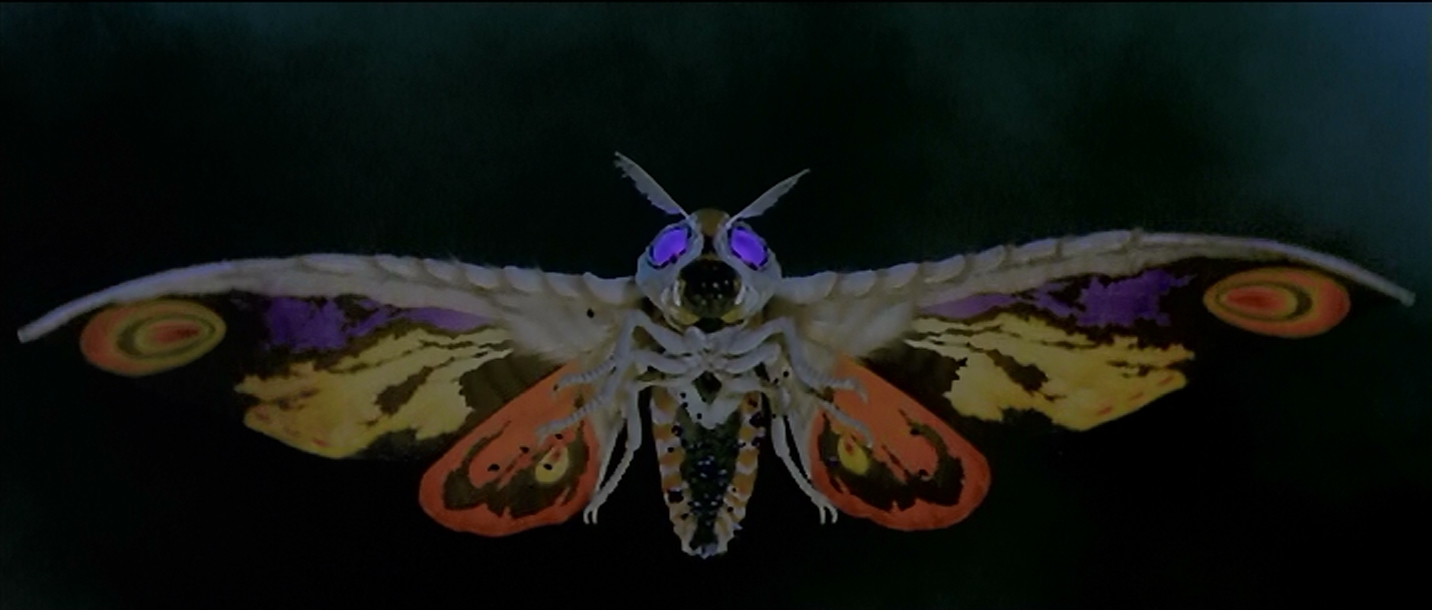
I'm Comin for you, Godzilla!

Ghidorah is much the same, if a bit smaller smaller he has been. It does take on a couple of power-ups in the course of the fight.
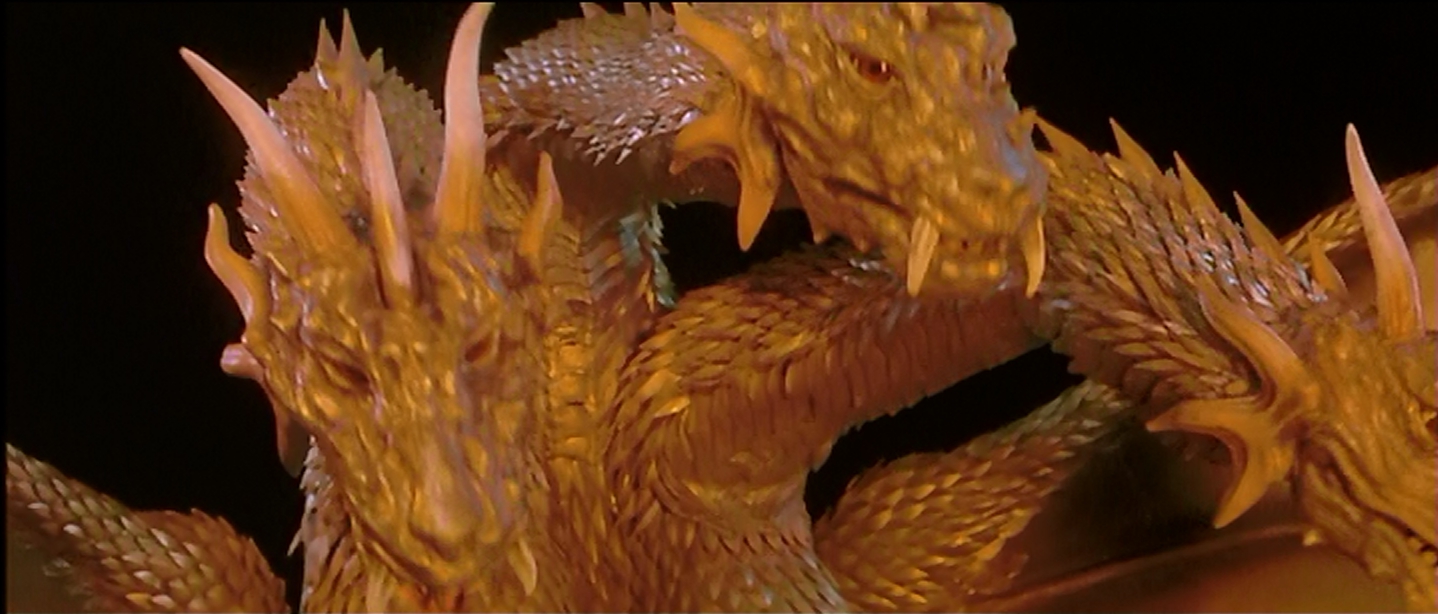
Good Guy Ghidorah feels a bit odd.

The second battle, with Mothra, Ghidorah, and Godzilla in Yokohama, is one of the best kaiju battles ever put to screen. Godzilla is a brute, smashing everything. When Mothra attempts to lansd on a tall building that happens to contain soldiers, Godzilla sends its atomic ray through it, killing the men, destroying the tallest building in Yokohama.
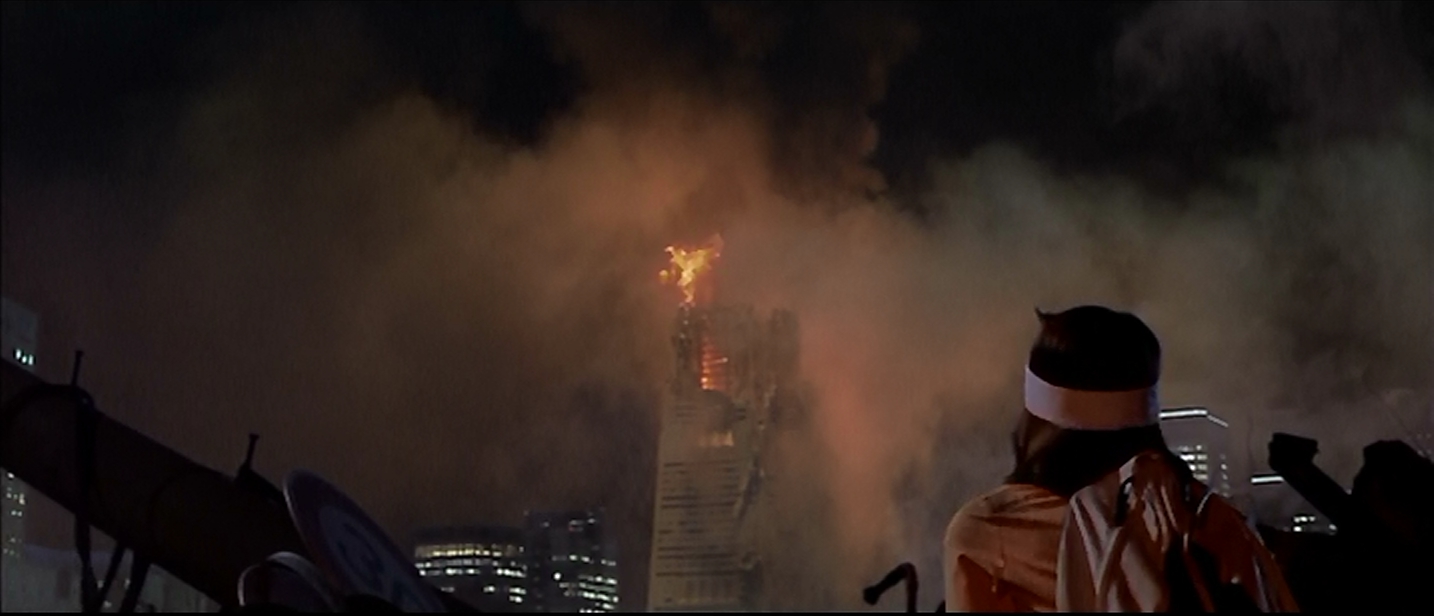
Ssssssmokin.

After the first ten minutes, the fight is no longer shot over complete buildings, but the rubble of structures already destroyed. This helps with the overall sense of dark weight this film has. Men are being killed, buildings are being destroyed, and this is reinfoced by repeated viewings, giving the destruction a sense of permanence.
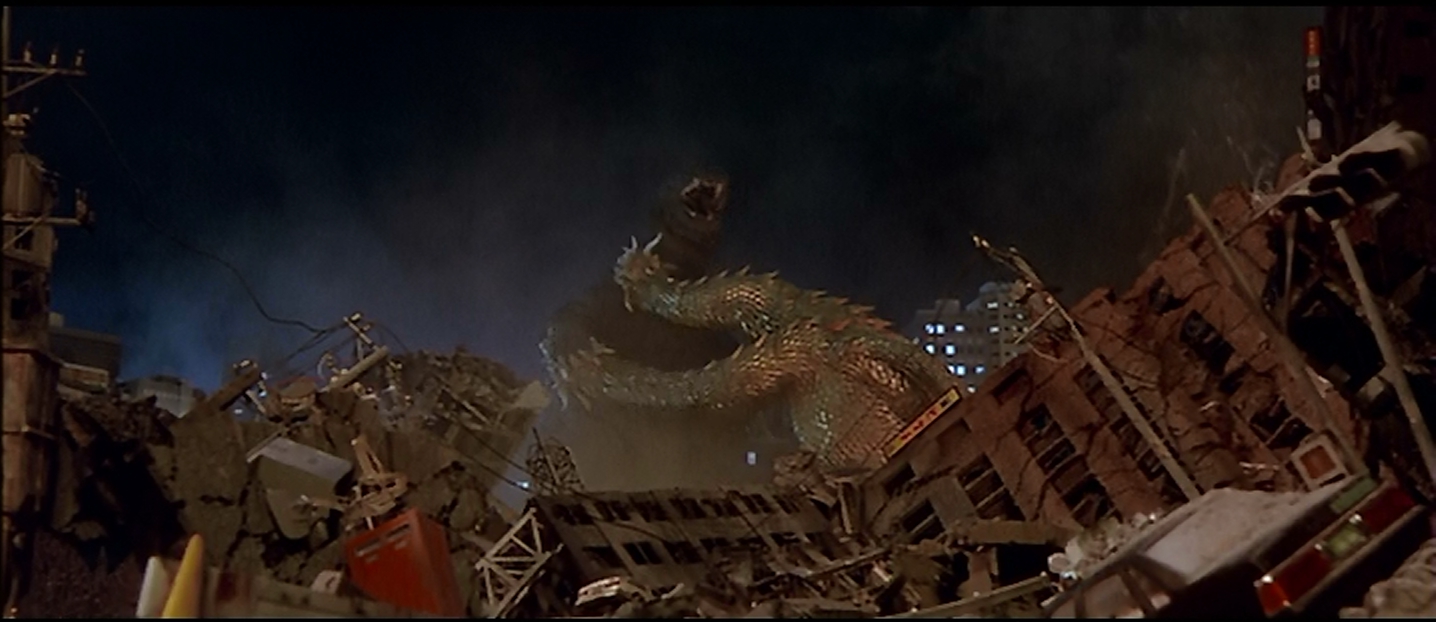
We've already trashed THOSE buildings.

Godzilla, while it has its teeth in one of Ghidorah's necks, casually swats Mothra aside with its tail, a move borrowed later in Godzilla 2014.
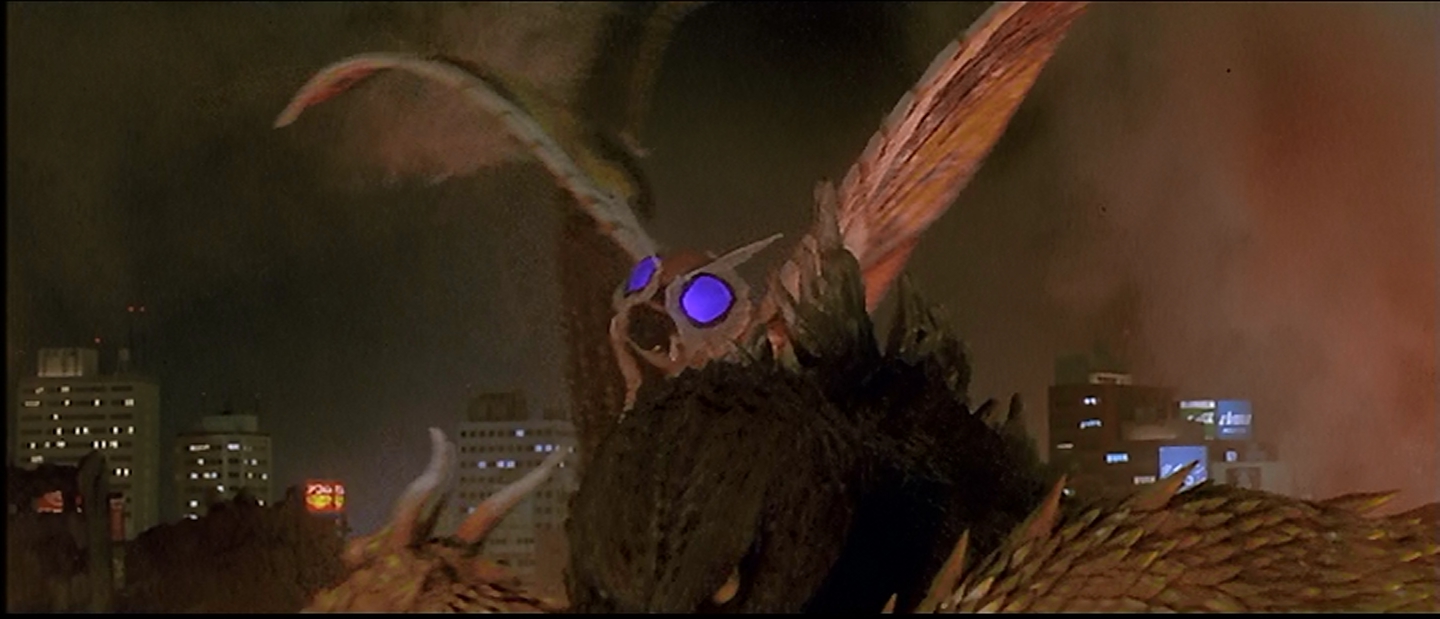
Godzilla as a powerful brute

When both Mothra and Ghidorah go down temporarily, the military moves in. While the display is impressive, it only attracts Godzilla's destructive attention. Godzilla sweeps his atomic ray across the men, annihilating entire platoons, then blowing a destroyer out of the water.
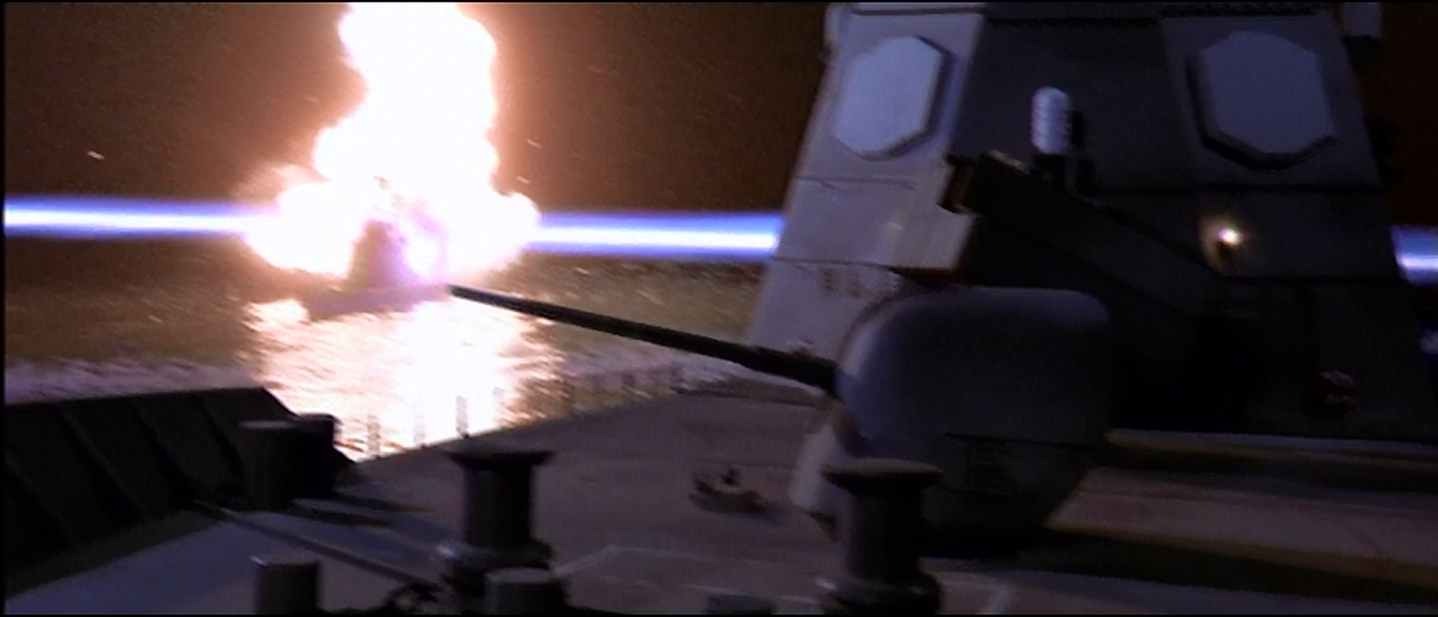
Pitiful humans!

From the smoking shore, Godzilla roars his triumph.
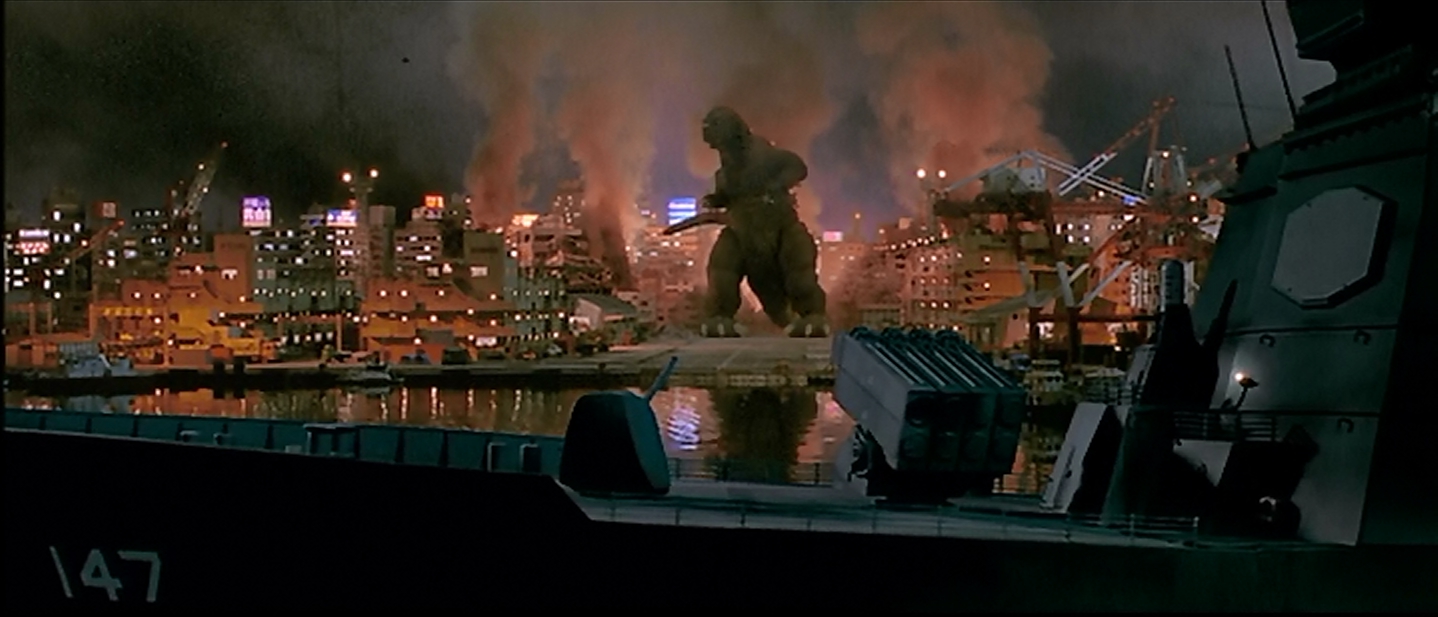
What are you going to do about it, huh?

But at least it keeps Godzilla from destroying the helpless guarsian monsters. Very seldom have human and kaiju worked in such good harmony.

Mothra, wings on fire, confronts Godzilla again, only to be disintigrated by a close-in blast. Like Biolante, she disintigrates into golden particles. These flow into the downed Ghidorah, who awakens, now with a forcefield surrounding it like a clould of electrons.
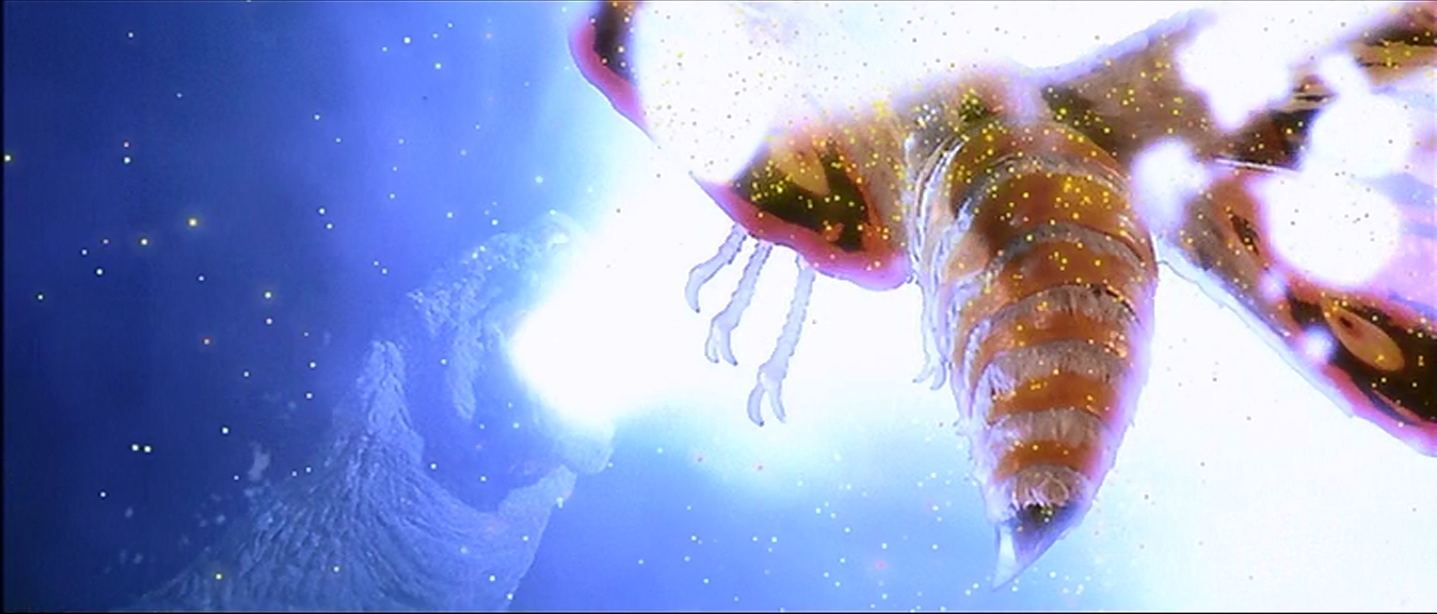
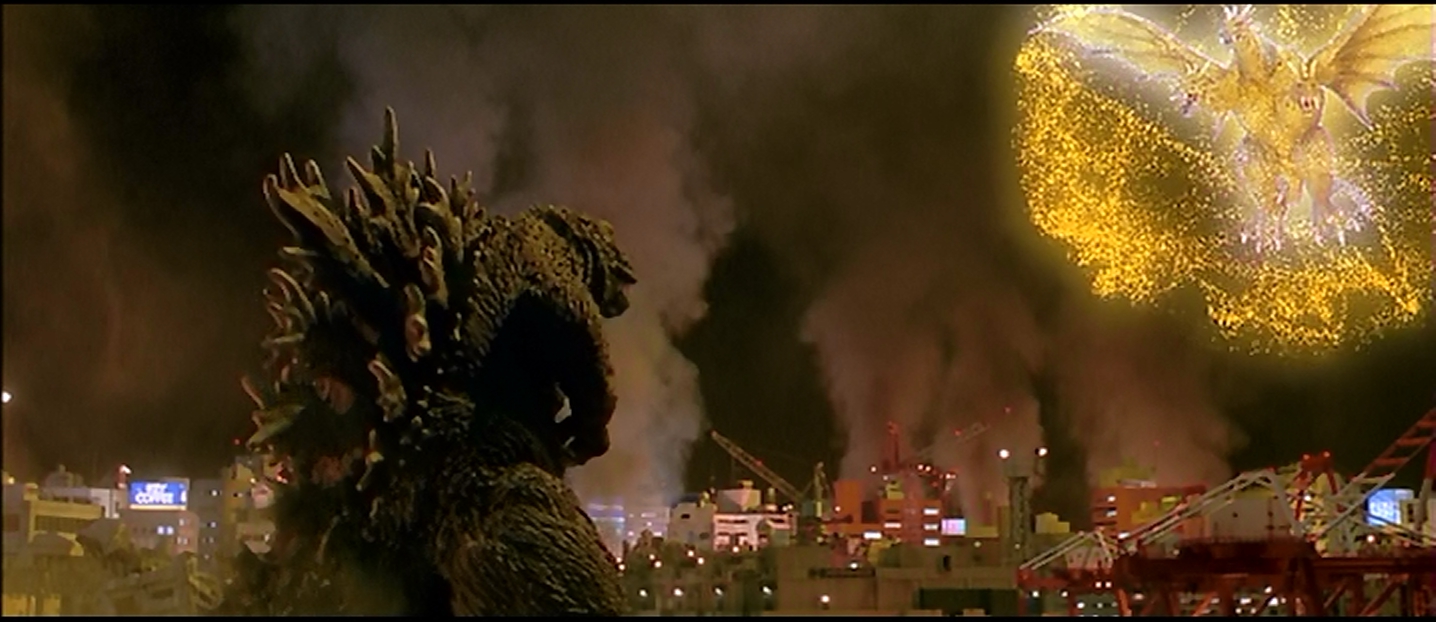
Mothra sacrifices herself... again.

Ghidorah Powers Up.

Godzilla lays into this with a long blast of its heat ray, but Ghidorah collects the energy and returns it to sender in a gigantic ball of destructive energy. At last, Godzilla is wounded.
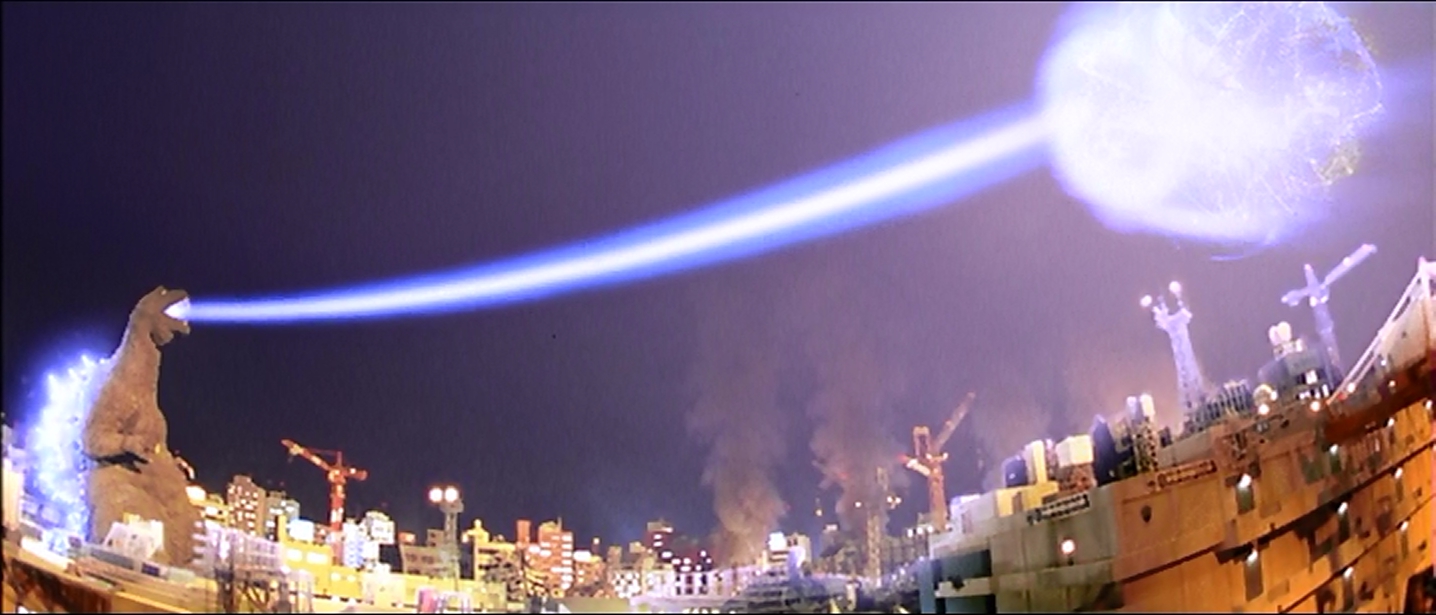
Godzilla blasts Ghidorah.

This doesn't prevent him from unleashing his ray on Ghidorah, and creating a frikkin' huge explosion as the three-headed monster disintigrates.
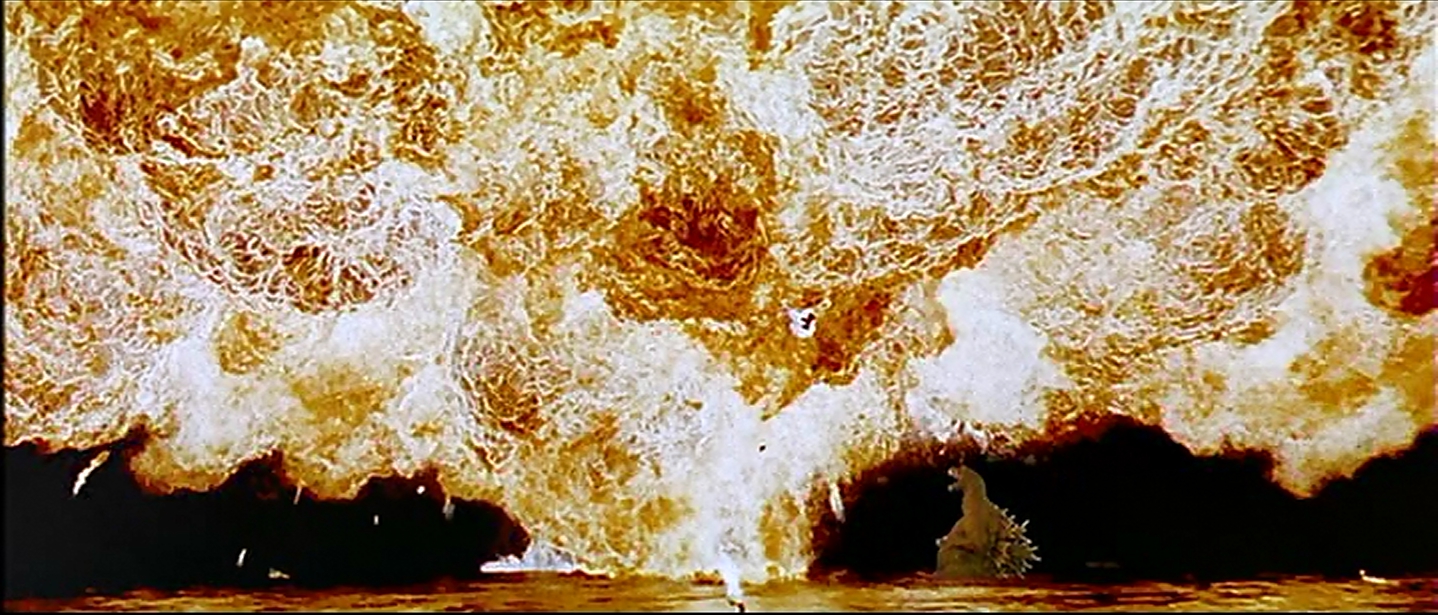
That's a substantially huge explosion.

With the Guardians gone, Tachibana pilots his submersible literally down Godzilla's throat, and relesases the drill torpedo from inside. Godzilla collapses and sinks, pouring blood into the water. Attempting to use its heat ray, Godzilla manages to destroy itself, leaving only a heating heart at the bottom of the bay.
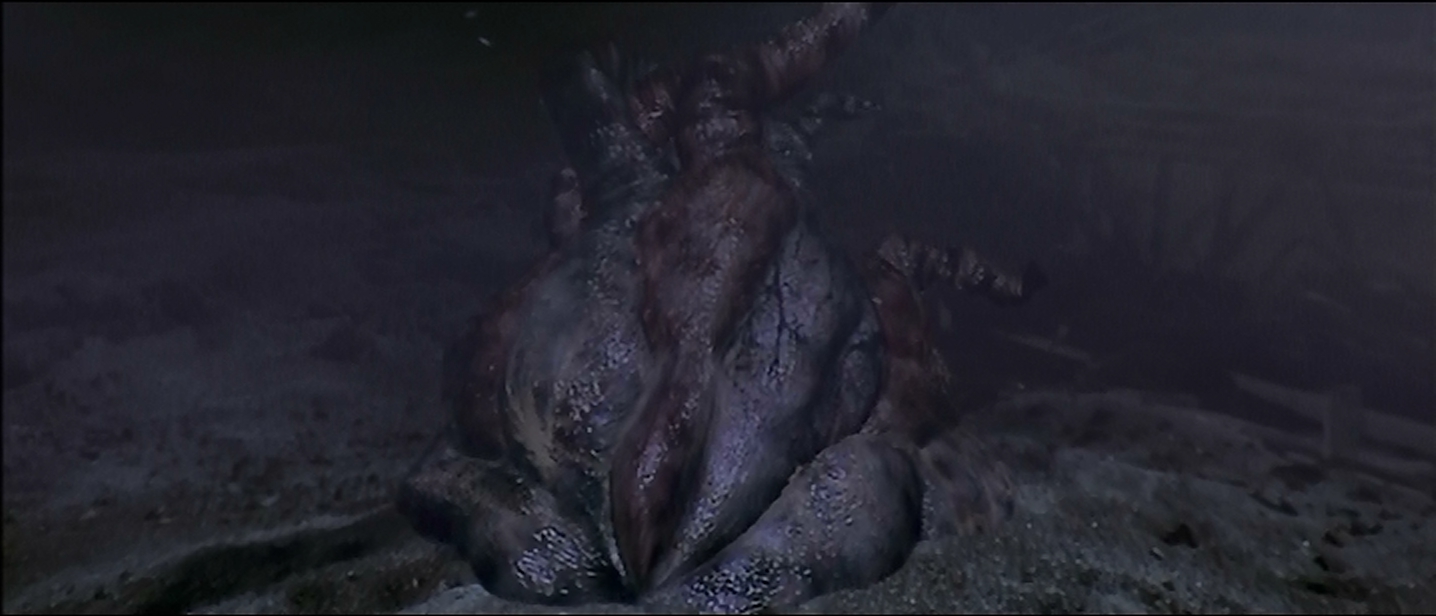
Sing MY HEART WILL GO ON and I will kill you.

The film is political, and I'm not steeped in Japanese culture enough to honestly reflect on Japan's relationship with World War II. But Kaneko is clearly making a statement that Japan is in denial of its responsibility for many deaths in the Pacific during that conflict. Far from destroying the film, which was released as a double-bill with Hamtaro, an animated film about a hamster, this is the most successful film in the Millennium series.
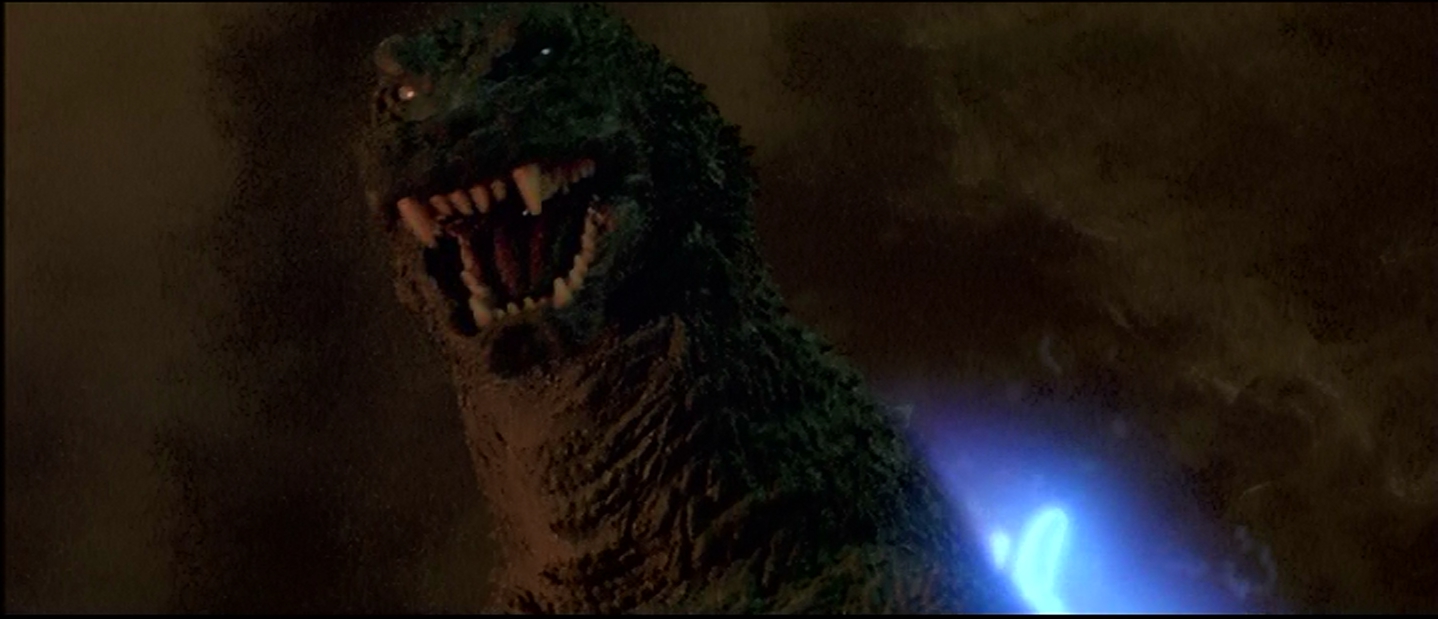
In case you've forgotten that Godzilla was a nuclear metaphor.

Despite, or perhaps because of the layers of subtext, this is one of the best Godzilla films out there. The dark edge appeals to me, and the extended monster fight at the end of the film is everything I could ask for. The writing isn't embarassing, there are no random experts who show up with impossible answers, the characters are well drawn. Shûsuke Kaneko turned Gamera from an extended Mystery Science Theater 3000 gag into an excellent trilogy of kaiju films. He brings the same love and devotion to kaiju film making here. Visrually, the story is exciting and Godzilla is seen with a badly-neede fresh set of eyes.

Of further note is director's excellent choice for score. Kô Ohtani has worked with director Kaneko on his three Gamera films, and the score is excellent. Unlike Michiru Ôshima, who provides a full orchesttral score, Ohtani gives us something a little more electronic, but it's a thrilling, beautiful bit of work.

Godzilla, Mothra, King Ghidorah, Giant Monsters All-Out Attack was a financial and critical success, considered by myself and many other fans as the best of the series. So naturally, Toho returns back to, director of Godzilla vs Megaguirus for the next film.

Thursday, December 26, 2013

WHAM! POW! BASH! DESTROY ALL MONSTERS

Despite the massive number of kaiju films released in 1967, most of them aren't particularly memorable. Many were new entrants into the field by studios that had never endeavored to make a giant monster film before. Even Toho's franchise was running out of steam, with the disappointing performance of Son of Godzilla, as well as the flooded market. Godzilla just wasn't as special as he had been. To celebrate the 15th anniversary of the Godzilla franchise in 1968, Toho decided to get the band back together.

And with immaculate timing, my DVD player has decided it no longer likes my copy. Pictures will come later, sadly.

Destroy all Monsters is the last film with the five original artists from Godzilla; Ishiro Honda, Eiji Tsuburaya (although only in an honorary fashion, he was very ill as this time), Tomoyuki Tanaka as producer, Haruo Nakajima in the suit, and Akira Ifukube writing the music. Some call this the end of an era, but to my mind, it's a Hercluean effort before economic and social forces turned the kaiju film into a cheap and poorly thought-out spectacle.

The year is 1999, and as in several previous films, Japan (or, really UNSC) has a space program. They have also managed to confine all the monsters to a location, Monster Land. The space program trope fades a bit after the excitement of the space race cooled off, but the Monster Island idea is one that stuck with the franchise until the end of the Shōwa era. Moonlight SY-3 is a stylish, almost art deco spacecraft, combining attributes of a high-tech jet as well as a rocket.

Ogasawara Island, called Monster Land, is the culmination of several ideas previous films, such as Mothra vs Godzilla and Ebirah, Horror of the Deep. Although the monsters are not under human control, they are at least confined. If Godzilla and the other monsters are still seen as a metaphor for nuclear testing, this may coincide with the rise of nuclear power in Japan, with the Mihama Nuclear Power Plant beginning construction outside Tokyo in February of 1967. On the other hand, this is the ultimate expression of Dr. Serizawa's desire to study the monsters. Now that they are controlled, they can be understood.

The Kilaaks, the alien antagonists, can control the monsters. Japan can never do so, merely containing the monsters, but alien invaders and terrorist corporations such as the Red Bamboo seek to control the giant monsters for their own ends. Ghidorah is, again, the puppet of an alien intelligence just as he was for the Xiliens and the Futurans. They are all female, all Japanese-looking (despite the more international bent of the film) but this is a disguise. They really look like slugs, and are made of 'living metal.' It turns out that they can control humans just as easily as they can monsters. This creates a paranoia in the film similar to the 1956 film Invasion of the Body Snatchers. Anyone could be a Kilaak agent (until they discover the transmitters which allow the Kilaaks to control humans and monsters).

Strangely, Mothra has shed her unique status as protector of Infant Island, and has been confined in the same way that the other monsters have. Also gone from this film are her twins, the Shobijin, Mothra's interface with humanity. She's just another destructive monster. She's also back in larval form. It's possible (pardon me while I fan-theory) that this is the other larva that hatched in Godzilla vs Mothra and didn't become the Mothra we saw in Ebirah, Horror of the Deep, which I assume is the peacemaker from Ghidorah, the Three-Headed Monster.

The film is very much a retread of the tropes and ideas from Ghidorah. Alien invaders, all the monsters ultimately ganging up against Ghidorah, Godzilla pulling a turn from implacable enemy to unstoppable hero. But where Ghidorah has three monsters attacking the three-headed monster, some seven attack him here. More spectacular, sure, but not as challenging a fight. But more than any previous film, Destroy All Monsters takes a look at the international problem of monsters. Rodan attacks Moscow. Gorasaursus, unseen since King Kong Escapes stands in for Baragon, who was on loan to Tsubaraya's Ultraman. Which is why it is misidentified, as well as shows some rather unlikely tunneling abilities. We are told that Mothra attacks Beijing, and that Manda attacks London, but we don't see these. We do see Godzilla show up in New York harbor and blast the United Nations building with his radioactive breath. 1998 Godzilla is not the first time the big guy took a bite out of the Big Apple.

In the middle of the film (XXX minutes), we have a beautiful miniature of 1999 Tokyo. Small card move along her streets, an elevated train trundles along tracks. The set is large and took a lot of attention to detail. Ironic, really that the construction boom made Tokyo so much more impressive thirty years later. The destruction of Tokyo by Godzilla, Rodan, Manda, and Mothra is beautiful in its mayhem.

For the first time since Godzilla Raids Again, the camera pans over the charred and ruined city. This was one of the most effective shots of the original Godzilla film, and it's a reminder that these films aren't completely fun and games. But it's brief, and the devastation isn't as total as it was in 1954.

Part of the bigger budget for this film shows in the miniatures. The military vehicles are a bit more fanciful, including tanks with missiles on their turrets and strange-looking radar antennae. It's as ineffective as the military always is, but it's a pleasure to see some fantasy deigns come from Tsubaraya's studio. There is also the implication, and a prescient one, that the tanks are drones.

The last battle happens, again like Ghidorah, in front of Mount Fuji, where the Kilaak base is. This is our only glimpse of Baragon in the fight, mostly through a thicket. We get a better shot of him in the farewell section, however. But you have to wonder what the Kilaaks were thinking when they deployed Ghidorah. Godzilla, Rodan, and Mothra got rid of him last time, now Gorosaurus, Anguirus, Manda, Baragon, Varan and Kumonga (I'm not counting Minilla as a threat) are added to the team. It makes for a more impressive fight, but the outcome is pretty inevitable. Godzilla and Anguirus do most of the heavy lifting (the footage of Ghidorah flying with Anguirus firmly attached to one of its necks will be repeated a few times in later films) in the fight.

Once the fight is over, the Kilaaks deploy their Fire Dragon, a flying saucer burning with energy. Even though Godzilla puts an enormous foot through the Kilaak base, the Fire Dragon keeps coming. Ghidorah's inert body falls into the earth, similar to the way Frankenstein and Baragon ended. Only with more explosions, but it's up to the humans to solve the last problem. Which they do with Moonlight SY-3. This represents a major shift in attitude from Toho's previous films. Honda, who experienced WWII, had never allowed the military solution to be anything but show before this. And, although the conclusion is rooted in science fiction, Moonlight SY-3 fires missiles, causing the saucer to go down. The humans have taken the lead, controlling the monsters, no longer the ir helpless victims.

Destroy All Monsters was intended as a finale to the series, the end of monster films. However, it was so successful (admittedly selling only a hundred thousand tickets more than Son of Godzilla), but in a period of sharply declining attendance, this was seen as a major coup. And so the series continued, albeit with declining budgets.

Next up, Boy Scouts in trouble, and loaded with stock footage.

Thursday, September 5, 2013

Monster From Another Franchise: Frankenstein vs Baragon

Toho wasn't the only company making monster films in the sixties. England's Hammer films were successfully mining the classic Dracula, Frankenstein, mummy and werewolf franchises. Following on the classic Universal franchise, Hammer released The Curse of Frankenstein in 1957, Revenge of Franksenstein in 1958, and The Evil of Frankenstein in 1964. Toho, never one to let a good idea slip away, produced its own Frankenstein film in 1965. They hedged their bets by making it gigantic, and threw in a new monster of their own invention. True to the film versions that have gone before, this is the unspeaking creature, not the literate and eloquent creature from Shelley's book.

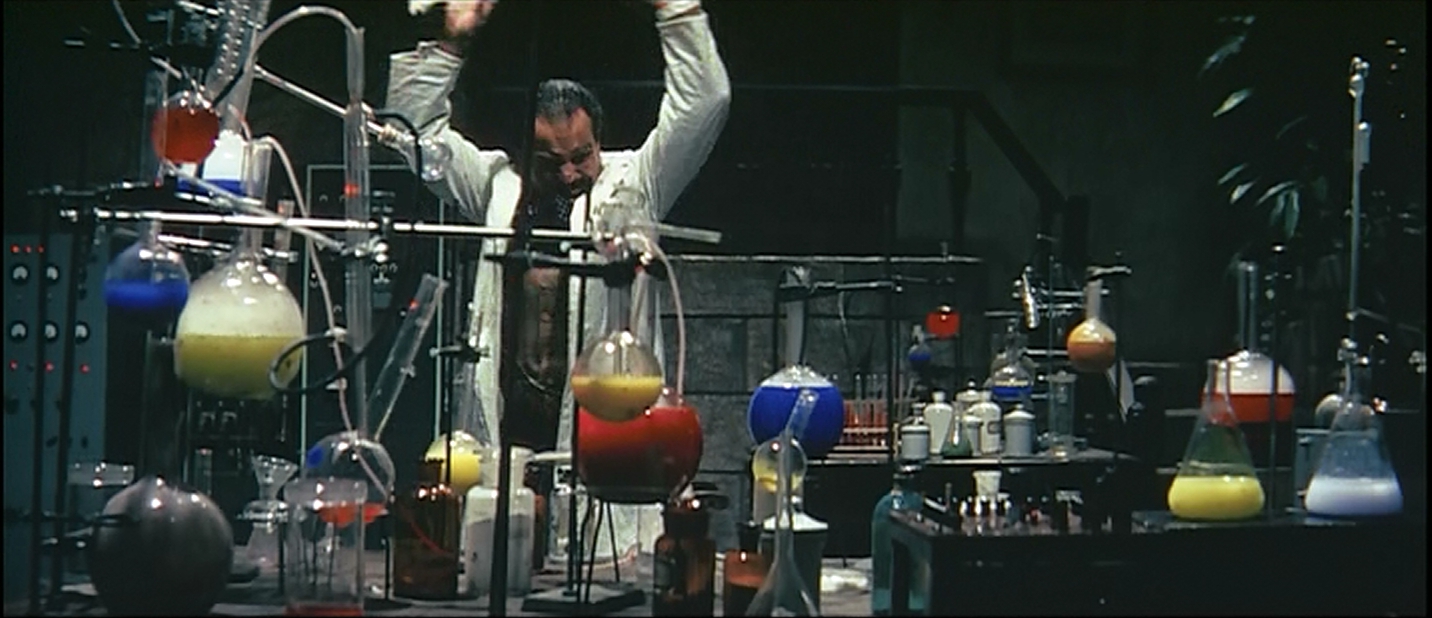
Chemistry will kill us all.

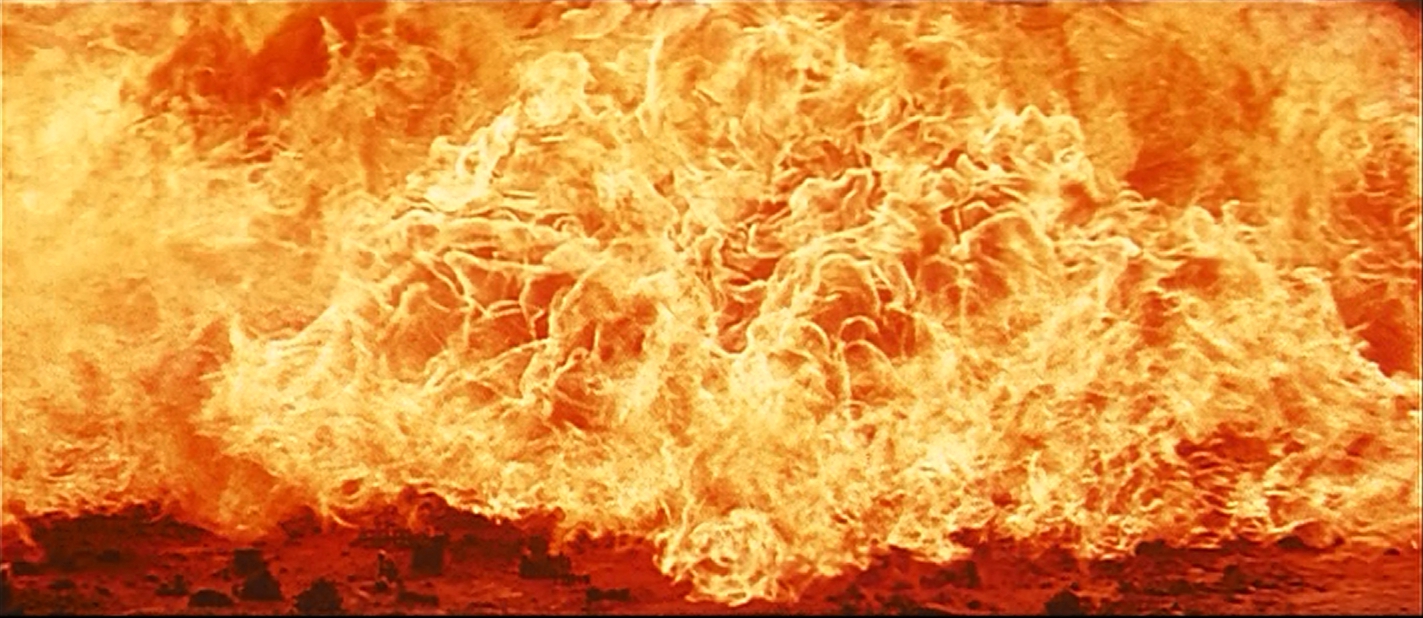
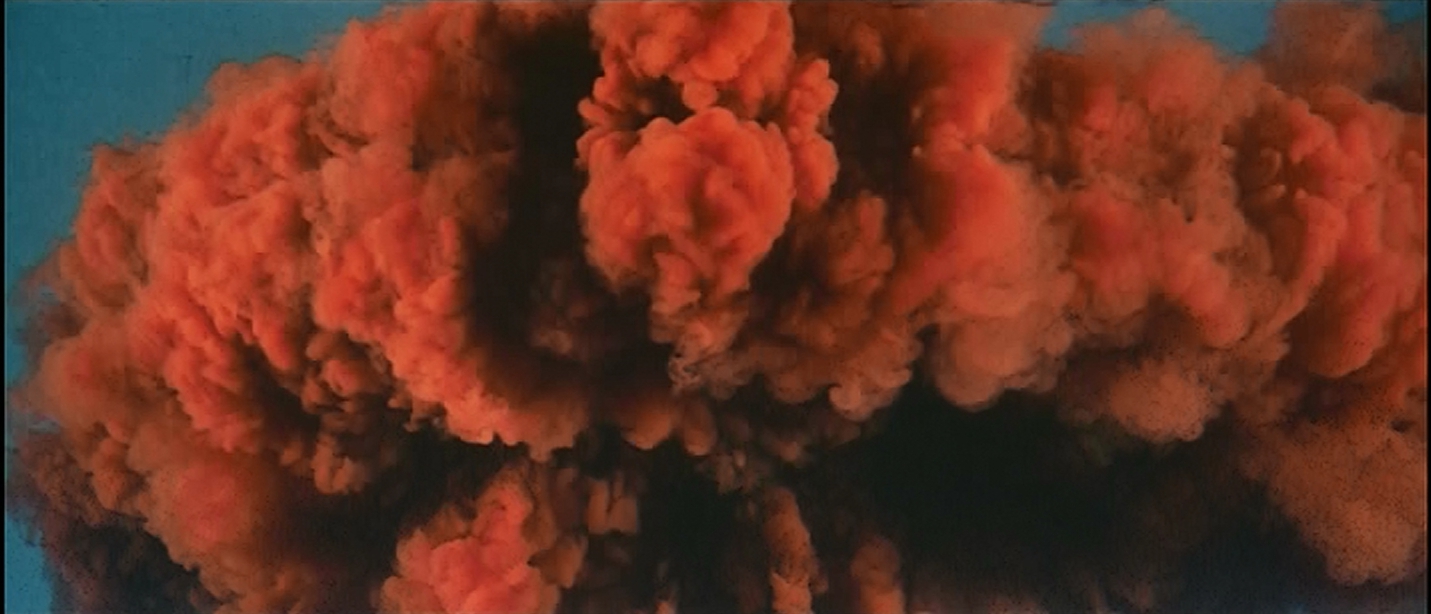
Our first section is a nearly wordless scequence in which Nazi soldiers take Dr. Frankenstein's work, the immortal, beating heart of the Frankenstein creature. The brightly-colored chemistry lab recalls both the Universal and Hammer Frankenstein films. Invaded by the Allies, they send it by sub to Japan, in the hopes of creating soldiers more resistant to bullets. They bring the heart to Hiroshima Army Hospital, which sits in the Hiroshima Prefectural Industrial Promotion Hall, known today as one of the few buildings left standing at the hypocenter of the Hiroshima nuclear detonation. With that small touch of foreshadowing, the atomc bomb does arrive in one of Eiji Tsubaraya's most firey sequences, one of the best atomic detonation sequences outside of the one in Terminator 2.

A rush of flames.

And an impressive approximation of a mushroom cloud.

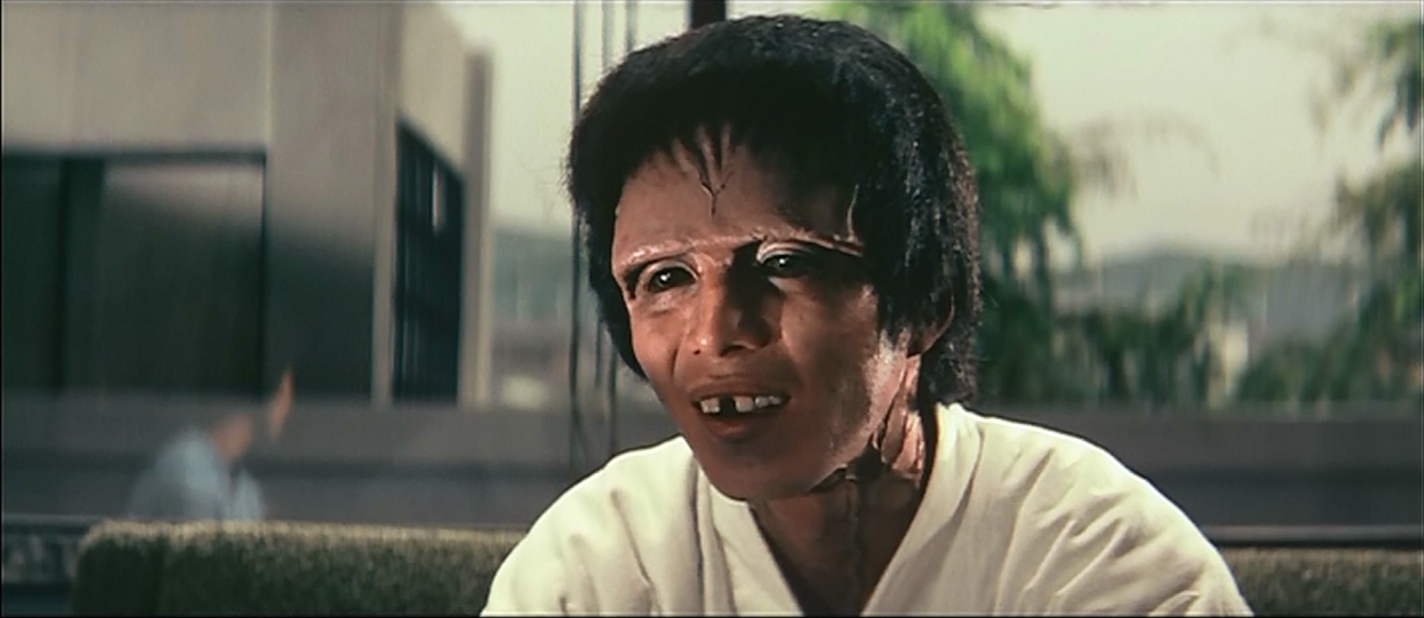
With that dose of radiation, the Frankenstein Heart takes fifteen years to regenerate itself into a boy who continues to grow. The makeup designers clearly used the original Karloff as their model, with the vertical, square forehead, but as he regenerated without human intervention, there are no bolts in his neck.

Flat head, big forehead.  Yep, it's him.

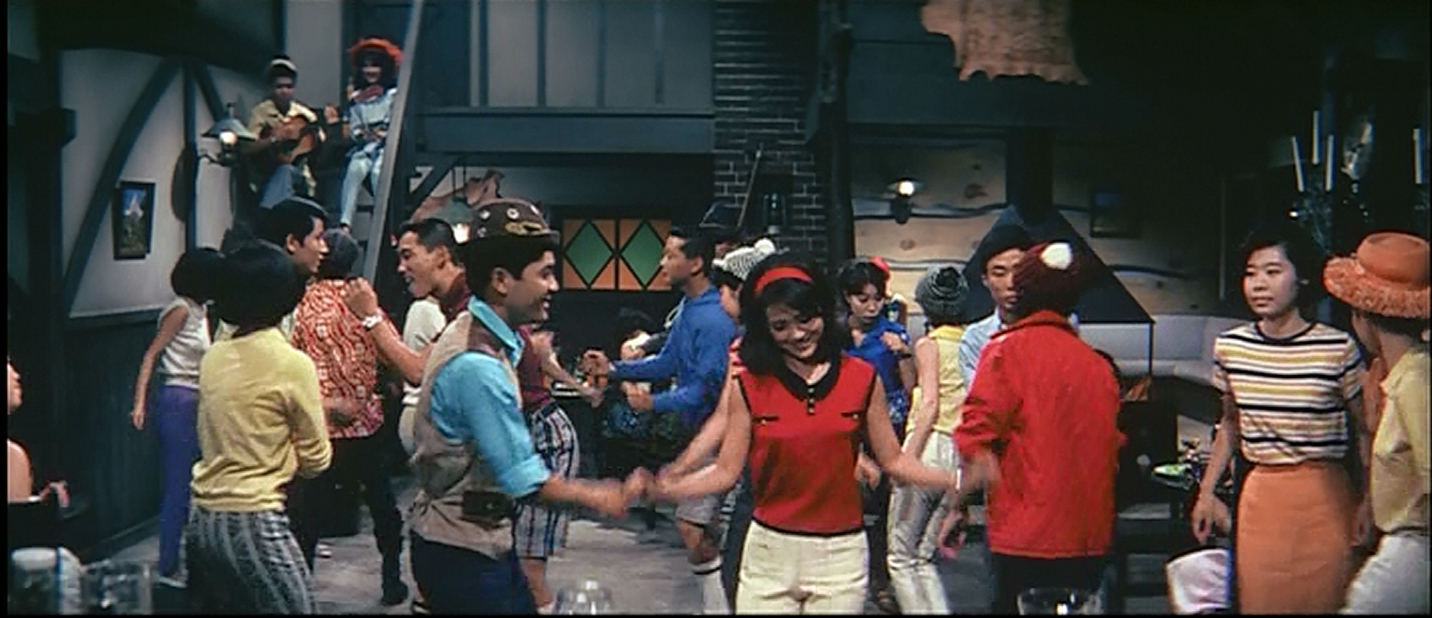
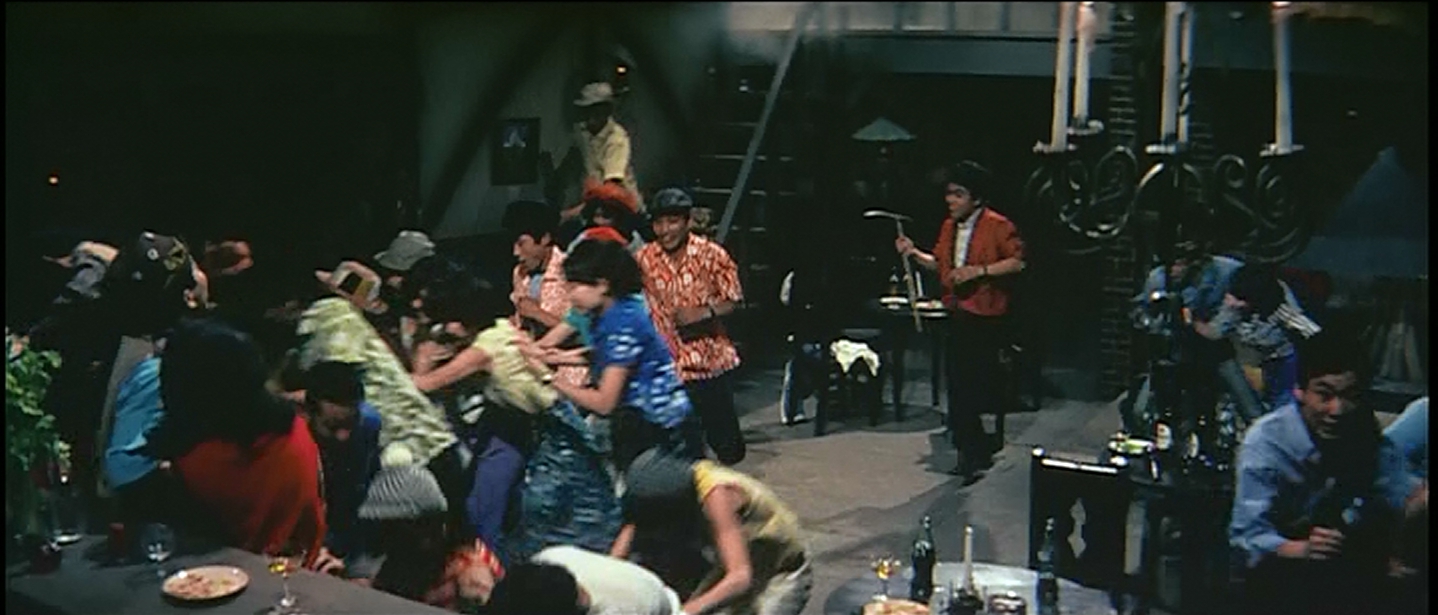
This is another film that features Nick Adams, as American scientist Dr. Bowen this time. The Frankenstein Creature grows and grows, implicitly because of the radiation he absorbed from the atomic bomb. The science boffins have trouble keeping him contained, partially out of fear from his enormous size. In an inversion of the usual Godzilla trope of reporters being seekers of truth, the Frankenstein creature is tormented by the lights of some reporters, like King Kong. This is not all that surprising, since the script is a derivation of the Willis O'Brien script King Kong vs Frankenstein. The Creature escapes the hospital by either pulling off or chewing through his right wrist, leaving a massive hand behind. This sets us up for the next film in the series, War of the Gargantuas, in 1966. Inserted for no reason that I can tell, we have a scene of young men and women dancing at a bar just before Baragon rolls over the town. I understand at this preiod, there was a lot of concern that the youth were wasting their time, doing nothing productive. These scenes will proliferate through the late sixties, in Yongarry, Godzilla vs Hedorah, and several others I haven't yet seen. The youth are always dancing their cares away just before the giant monster crashes in on the building.

Dance, dance dance, HOLY CRAP MONSTERS!

Although even I have to wonder what's with the guy carrying the pick-axe.

Pick axe.  At a dance party.

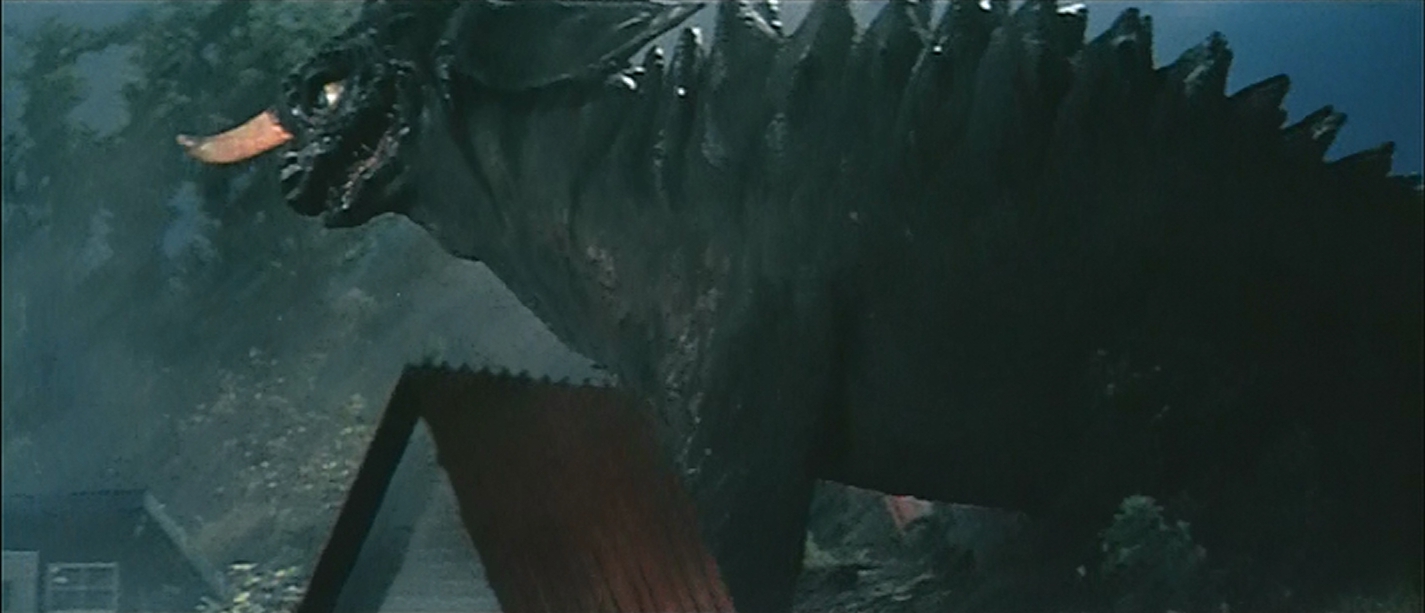
This is the first film in which the obscure but very popular Baragon appears. Its popularity is staggering considering that it has appeared in only three films, this one, Destroy All Monsters and Godzilla, Mothra, King Ghidorah, Giant Monsters All-Out Attack, although the suit would be used several times in Ultraman. But the design is one from the endlessly inventive mind of Tsuburaya and company, and even if it's a bit cute, I like the design.

Barugon!

For a while, the film's military characters believe that the Frankenstein Creature is responsible for the destroction Baragon wreaks. This despite scenes of people watching Baragon tromp over their houses. But this also brings us to the more heroic Frankenstein Creature versus the Evil Baragon. This is the direction Godzilla is taking in his more heroic ascension for the rest of the Showa era.

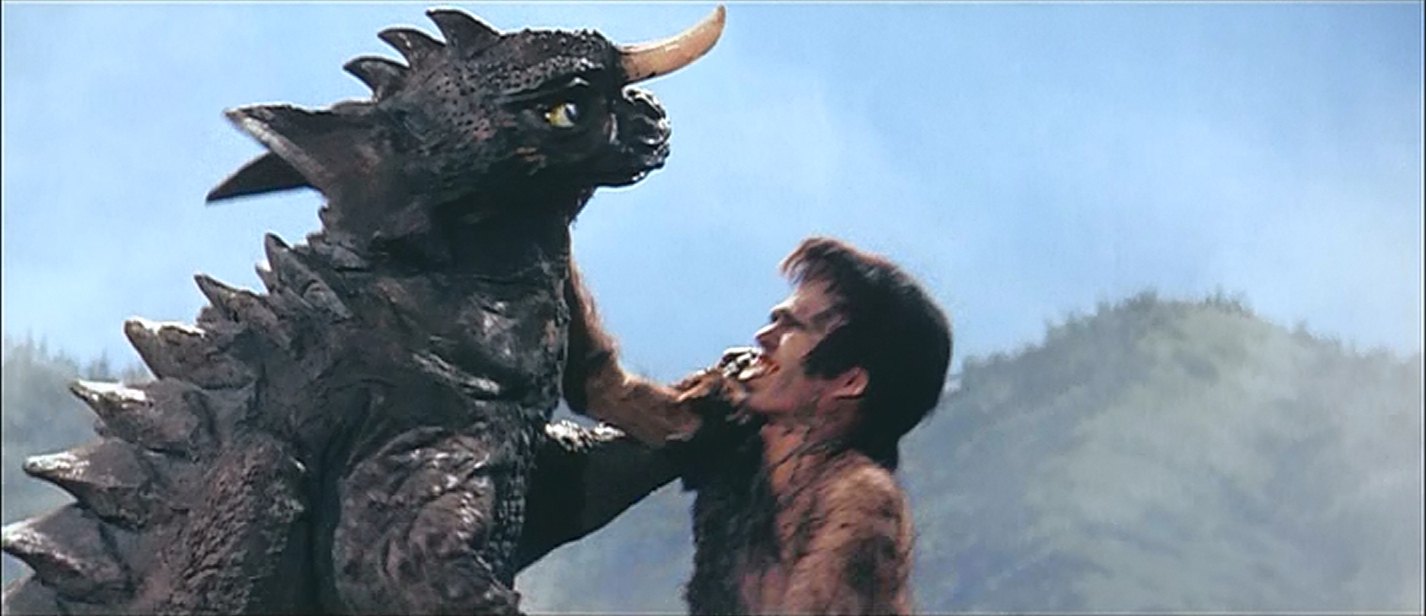
The confrontation between the Creature and Baragon has a very different feel than most giant monster fights. Because Frankenstein is applied makeup rather than a full suit, actor Kôji Furuhata could be very nimble, performing some tumbles that no suit actor has ever been able to. In addition, the fight portrays Frankenstein as much more intelligent than his opponent, something King Kong vs Godzilla attempted to do, but never truly succeeded at. Again like the original Kong, Frankenstein attempts to pry Baragon's jaws open, similar to Kong and the Tyrannosaur. It's not a successful tactic this time.

Frankenstein vs Barugon!  FIGHT!

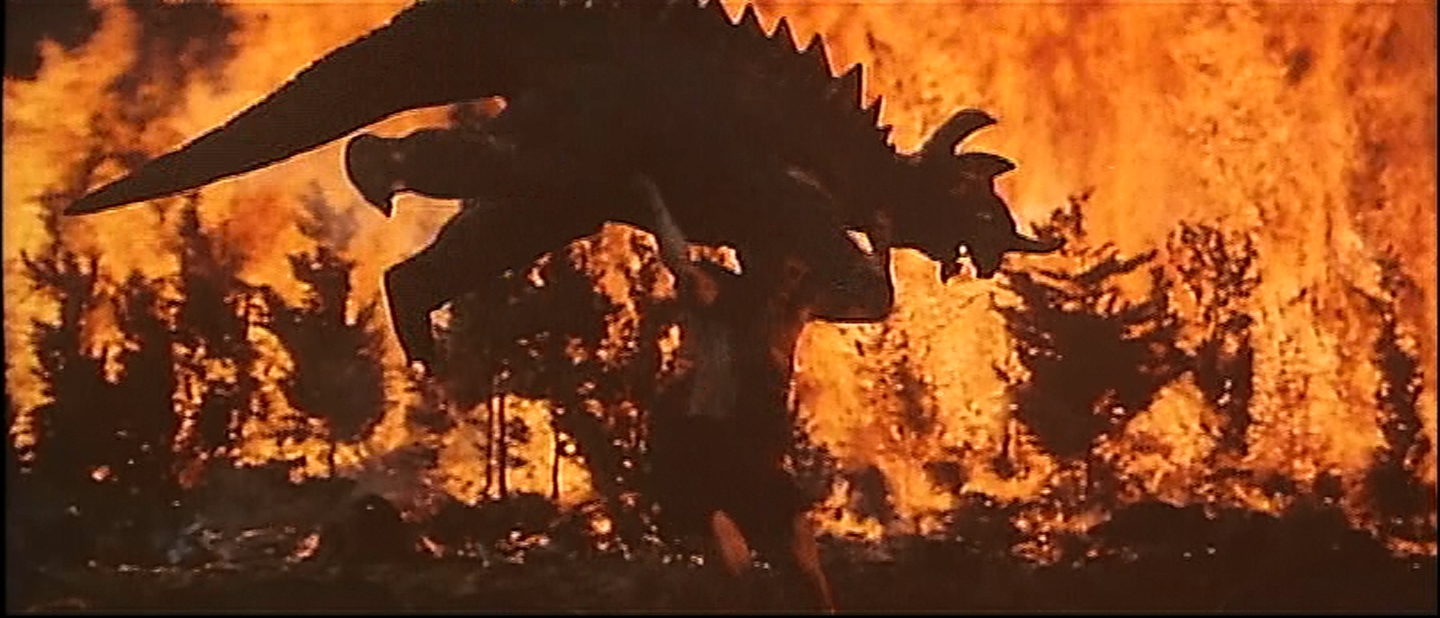
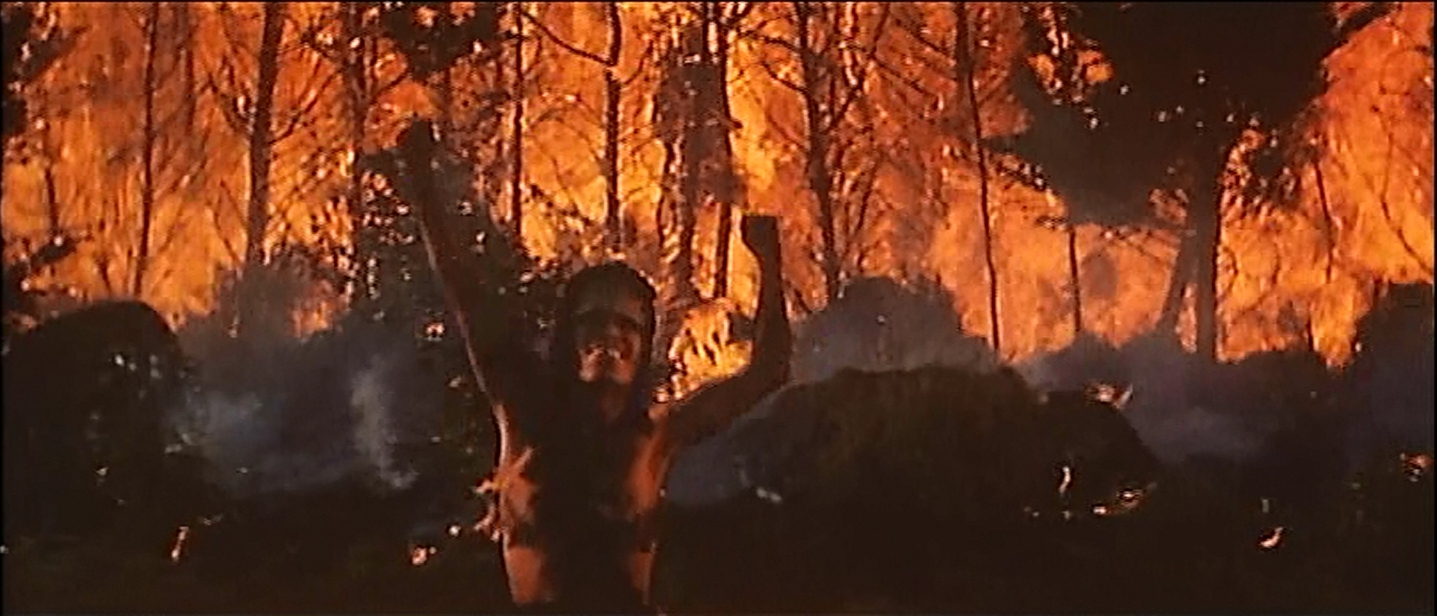
Toward the end of the fight, everything is backdropped by a very impressive forest fire. Again, some brilliant effects work by Tsuburaya.

This Frankenstein is not afraid of fire.

Frankenstein, as the sympathetic monster, is victorious, but the ground crumbles beneath him after Baragon is defeated. He is swallowed by the earth at the moment of his triumph.

I just defeated my first monst---AW CRAP!

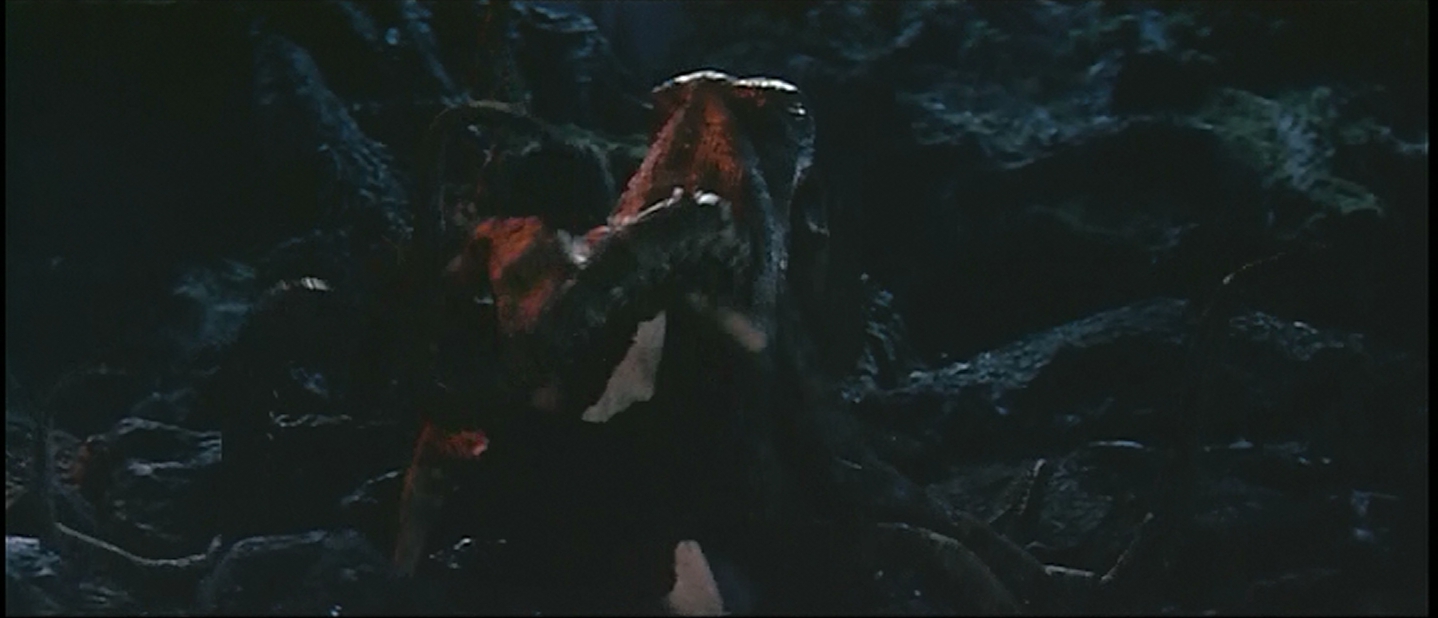
The ending is a bit different in the International version. In it, Frankenstein roars his triumph and raised Baragon over his head, throwing him down on the rocks below. At which point, he is confronted with a giant octopus that happened to be taking a stroll up the rocky cliff. They fight. According to Wikipedia, the American co-producers were so amazed by the octopus fight in King Kong vs Godzilla that they insisted that there be one in this film. Honda shot it, but without any of the live-action octopus footage that made the original so good. The puppet is much better than the one original, but it's not particularly convincing. The alternative ending was cut from the Japanese and American versions of the film, but is part of the International release. Yeah, there's a lot of rock-throwing on the part of Frankenstein. It ends with the traditional fall into the lake ending so common after Kong Kong vs Godzilla. In this case, it would almost certainly spell doom for Frankenstein. He could barely hold his own against the octopus on land. In it's home environment, he's pretty well screwed.

Frankenstein wraps some monster tentacles around himself.

Frankenstein vs Baragon is an enjoyable film, a little slow in the middle, when Dr. Bowen and his associated are puzzling out what Frankenstein is, and what do do with him. it includes a surprisingly humanist question, as to whether Frankenstein is more monster than human, even though he was made of human parts. The question is never answered, and left for the audience, which I felt was a more subtle touch that I have seen in kaiju film for a long time.

Next up, the second most successful kaiju franchise of all time.