Friday, March 23, 2012

Comics and Superheroes

I am pretty selective about the comics I read. I've got eleven long boxes full of comics, and in going through them I've noticed something. I don't like superhero comics.

In fact, I don't like superheroes at all.

The difference between a auperhero and a regular hero is that the superhero is born with their difference from the rest of humanity. They were born special, and often the book is about using that specialness in a non-selfish fashion. But you can't aspire to be Superman. No one was born on Krypton, so no matter how hard you try, you can't fly. Even if you wear the cape.

The comics I have read tend to have more human. Grimjack, Hellblazer, Bone, Castle Waiting, Grendel and Jonah Hex. All of these feature protagonsts who are normal, but not average, humans.

There are exceptions, of course. I've got Mage, Swamp Thing, Hellboy, Girl Genius, and the occasional Batman trade. You don't think Batman was born with powers beyond that or mere mortals? Where would he be without Wayne Enterprises? WOuld Batman be half as effective if he was not ridiculously wealthy and able to afford the Batwing, the Batmobile, and all those other gadgets?

But when I look at patterns, especially in myself, I wonder about the exceptions. Despite the above sentence, Batman is often closer to being a hero than a superhero. When he is being written as the Darknight Detective and investgating crimes, I'm a lot more interested.

But what about Hellboy attracts me? Alan Moore's Swamp Thing and Phil Foglio's Girl Genius are both brilliantly written, transcending the usual tropes of the superhero genre, and Mage is a rather tasty modernization of the Arthur stories, which I've long enjoyed.

So why Hellboy?
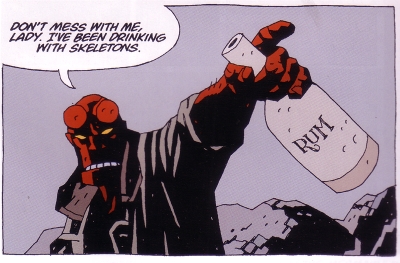

The short answer is because it's awesome.

Hellboy is an exception to the usual superhero tropes. Yes, he's stronger and tougher than the average human, but it's important to note that he was born to destroy the world. Think about that for a moment. He was born to bring about the death of everyone he knows, to split the world and open the way for the apocalypse. That's kind of heavy.

What makes Hellboy such a good character is that as he becomes aware of his "birthright," he intensifies his fight against it. He will not be defined by his birth. He will be himself, not play the role that someone else handed him. The underlying thrust of the series, shot through with stories of killing Nazis, dragons, and trolls, is the growung realization that he is defying his so-called desting and taking his own path. That journey, the personal one, is worth more of my time than a hundred pages of beating up supervillains.

Monday, March 19, 2012

Tim Powers: Master of the Craft, Builder of Worlds

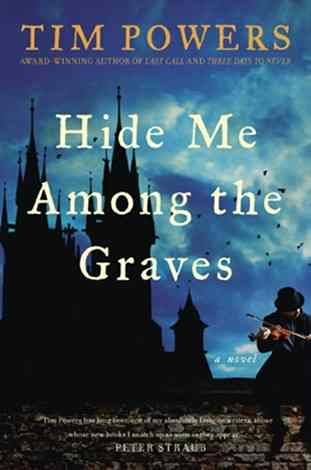
Last week Tim Powers latest book came out. There's two people I buy the hardcover of, and Powers is one of them. Hide Me Among the Graves, is next on my reading list (when the Queen of Science is done).

Tim Powers is the guy who ruined Harry Pottter for me. He is one of the pre-emminent world-builders working in fiction today. When he creates magic, or magical effects, they are strange and quirky, but they follow a consistent set of rules. There is no magic of convenience, something that the characters can do because it makes the plot easier, or worse, make the plot happen. Even Charles Stross can't avoid a little magic of convenience; it makes the plotting a little bit easier, covers up gaps the writer doesn't want to explore.

Powers is a master of prose, but he's also the real father of the mashup novel. In his books, the most unlikely things collide, and as you progress further into the book, it all begins to makse sense. His novel Last Call is a wonderful, frightening wreck in which the train of King Arthur mythology rams headlong into the gaudily-decorated van that is Las Vegas. And I couldn't look away.

And how completely MAD is it to combine bitter cold war John Lecarre spying with Arabic genies? But Powers takes this conceit, james it in a blender with the life of Kim Philby, and builds up all these very strange connections into a real slam-you-out-of-nowhere climax that works because you understand how the magic works. Powers has sucked you into his world, and you begin to see things through what he describes as his 'paranoid hat.'

What makes Powers books so compelling is that it has weird little implications his magic system provides. Magic is not simple, but it is goverened by rules, and the exploration if the implications of those rules is fascinating. Humans are, by nature, rules-gamers. We will try to get away with what we can within whatever rule set we establish. Watch politics and business interact some day and you'll see what I mean. So it stands to reason that humans who discover that there is magic in the world will try to push its boundaries, just to see how far they can go.

So it's not just that Tim Powers writes brilliant prose with compelling characters. His work is pretty much unique in its world-building and his exploration of the strangeness of his rules of magic. And it's brilliant.

Meeting Tim Powers was a major contributing factor to me writing. He a brilliant conversationalist. I thought "I want a job where my co-workers are like him." There are three ways to have frequent encounters with writers; be wealthy, be a publisher, or be a writer. I opted for number three, and I have met an enormous number of wonderful writers. Thank you, Mr. Powers, for openning two worlds to me.

Friday, March 16, 2012

Metatext is Its Own Reward

I love text (and I'm using the term "text": to refer to any work, film, book, comic, or piece of music) that reveals more about a text that I like. I am an enormous sucker for extras on DVDs, and expecially IMDB's trivia section. Because if something was good, then I'm interested in learning something about the process of what created it. How did it get to be that way?

Case in point, Wilum Pugmire's Sesqua Valley and Other Haunts. He provides an afterward for each story. Sometimes they provide the origin of the story, sometimes the intended effect, sometimes just random stuff about the process of creating the story. For me, each of these is a little story in and of itself, a light touch that lets me see the mind behind the creation. I like to think ir brings me closer to understanding Wilum.

Maybe it's the scholar in me, who wants to take something good apart and see what makes it tick. But there's also the glutton that wants to recapture that feeling of something I've already enjoyed, and delving into something I already like means I don't have to go looking for something new.

Because I like people, and I especilly like creative people. I've regretted delving into the creation of something I love only once, and that was Kinka Usher's director's commentary on Mystery Men, in which he revealed himself to be a shallow, purelie person whose contribution to the film was overshadowed by a stellar cast, excellent set design, and good editing.

Thursday, March 15, 2012

Towards a New Atheism

I recently quit a message board I had belonged to for close to a decade because of the religious arguments. With some irony I'll state that it was my fellow atheists who drove me away with their condescention and intolerance. You know; those traits that atheists most often ascribe to the religious.

I want a new movement in atheism. One that is not 'angry' at god or church, one that is not condescending, one that can speak without rancor or snark with those who believe in God. When Christopher Hitchens titles a chapter of God is Not Great "Is Religion Child Abuse?" he is clearly preaching to the choir and not interested in any sort of discussion. How can we establish a meaningful dialog with our neighbors if we do not respect them? Are we so certain of our purpose that we cannot even allow people to practice as they wish? That we must tear them down when discussing religion? Because zeal and fanaticism like that might be mistaken for a crusade.

Now, I'm not against rigorous discussion and even argument when necessary. That's fine. But it would be nice if it could be done without the words idiot, fool, stupid, or ignorant getting thrown around so liberally. Because that's exactly what intolerant people do, and if you adopt their play book, you are one and the same with the religious intolerant.

If we cannot respect religions, then is our intent to destroy them? Mine certainly is not. I believe the vast majority of religious folk work quietly toward what good they can. The loud-mouthed are not the majority, and not representative of any group as a whole. It is my firm belief that religion helps people to live better lives. The accusation that it does not seems to come most often from atheists who have not contributed to a charity in years.

And ultimately, it doesn't matter. We have our lives, and then we are dead. If we are right and there is no afterlife, and no one will be able to gloat over anyone. And that's the joke, isn't it? Atheists seem to believe themselves somehow stonger because they live without the 'crutch' of religion (I do not believe religion is a crutch, but that's a discussion for another time). But if the religious are good people and happier durng their lifetimes than atheists, well the joke's on us.

Monday, March 12, 2012

Why Vermont?

After nine years, it's still funny to tell people that I moved to Vermont from the San Francisco Bay Area. The reaction is usually "Why did you move here?"

The real answer is because I lived in the San Francisco Bay Area. And I couldn't continue to live there.

Don't get me wrong, I miss a lot of things about San Francisco. The people, primarily. We left some wonderful people behind us. Talented, strange, unique, wonderful people, and missing them makes my heart ache. I also miss the food. San Francisco is the Gateway to the Pacific, and there were more delicious and delightful flavors of restaraunt than you could shake a stick at. I miss those tangy Vietnamese sandwiches stuffed with unidentifiable bits that were so amazingly tasty.

Vermont, on the other hand, is very monocultural. It doesn't have the What don't I miss about California? The politics. Yes, I can say that I voted in an the 2003 recall election, which had 135 people running for governor, including Gary Coleman (who took 8th place), porn star Mary Carey (10th), and action movie star Arnold Schwarzenegger, who won. Around that time, we also had the joy of the California Electricity Crisis in which deregulation allowed Enron to manipulate electricity prices, caugint them to triple in little more than a month's time. And hey, rolling blackouts, too!.

Vermont's politics are very different. Only in Vermont could Fred Tuttle have become a leading candidate. That's a world of difference.

Certainly Vermont has fewer employment options, fewer people, and not mearly the ethnic restaraunt selection.

But the real reason, the fundamental reason we came back is for apple cider. Californian supermarkets seem to believe that apple cider is apple juice with some spices in it. This is not true. Cider has a lot of filtrate, and is opaque. For nine years, I've been drinking apple cider first thing in the morning, and a mug with my dinner at night. Because it's the taste of home.

Sunday, March 11, 2012

With Friends Like These

It's good to have friends.

I've been in a writing funk for two weeks. Not writers' block, but a funk. Unconvinced that my work will sell, not motivated to work on the current story. Not motivated to work on anything, really.

Not that I'm surprised by this. I went back to school last year, and school work took up a lot of my writing time. Now I've got it back, and I'm again wodnering if my writing is a worthwhile pursuit. I sometimes get that in the middle of stories, I think that the story is simple-minded and that anyone would have thought of that plot.

Yesterday, while not watchng a movie, I turned to my bookshelf and noticed a copy of Brian Keene's The New Fear, the Best of Brian Keene, vol. 3. Inside, it's inscribed by the author: “For John, May you find some wisdom — or at least some laughs — within these pages.”

My blog is not like Brian Keene's. Not like it is now, and not like it used to be. His blog is so good because he is passionate. He has written blog entries such as “Fuck Rob Zombie” and “And While I'm at it Fuck the Sci-Fi Channel Too.” I am not passionate about stuff. I'm willing to leave well enough alone, generally speaking, live and let live.

But I found both wisdom and good, hard-headed advice in the book. It includes essays that I consider essential reading for anyone who is just starting out in the writing game: “World Domination 101” and “Stork Penis, A Sortid Tale of Small Press publishing (With Beautiful Nudes).” But it's also undilluted Brian Keene. I hear his voice when I read it, because it's written almost exactly the same way that he speaks. As a book, it's sharp and does not coddle or condescend.

I consider Brian a friend. Because we've met and talked a couple of times, but also because friends kick friends in the ass when necessary. The advantage of having writers as friends is that they don't always have to be there to deliver said kick. So, another blog entry within a week. And I'm going straight off this to work on my on-hiatus Cthulhu Steampunk short story. Because no one else can write the stories I do.

And oh yeah. I've thought of something I'm passionate about. Fuck Rick Santorum. Women, gays, and people you don't like are still citizens who deserve the full benefit of law.

Friday, March 9, 2012

My Personal Problem with Fringe

It’s been a formula in the last decade to have a character in a television show that is problematic. Not politically correct. Someone broken. Archie Bunker is an example of this, and more recently South Park’s Eric Cartman. The character often serves as the engine for the show, their inherent rudeness or insensitivity tends to drive the plots.

Notably, this has been primarily a trope of comedies. Because when the story is done, we can laugh off Cartman’s Hitler obsession, or Arnold Rimmer being a complete smeghead, because they are shown to be pompous, ignorant buffons who deserve to be mocked. It's a lot more difficult to dismiss when the show is a drama that keeps a continuity from week to week.

For Fringe, that problematic character is Dr. Walter Bishop. Drug-taking, unethical human experiementer Walter Bishop.

Everyone who has watched the show is aware that he's an archetypal mad scientist, but he reminds me of the very real, very cruel experiments in America's past. Think of what kind of monster it would take to inject children with experimental chemicals. To me, it's right up there with the doctors in the Tuskegee Syphilis Experiments, the guys who gave more than eight hundred pregnant mothers women what they called vitamin drinks, but in fact contained radioactive iron, or those doctors who who killed 83 Guatemalans in a syphillis experiment. Would you watch a show that lionized the doctors performing these unethical experiements? Check out the wikipedia entry on Unethical human experimentation in the United States. Such experiments were real.

Mad science in the real world is horribly victimizing. People are scarred, or maimed, and have lifelong repercussions. Often these doctors preyed on, ironically, fringe individuals whose voice is faintly heard by the legal system.

Fringe us not honest about the experiements Walter performed. For a little while, Walter is shown as seeking redemption for his ethical transgressions, but that thread is dropped at the end of season two. It stops the moment he receives forgiveness from four of his test subjects in the season two closer, "Over There." These former subjects conveniently die later in the episode, absolving Walter of the responsibility of ever having to think of them again. He again gets what he wants that their expense, and the camera spends no time mourning or remembering them. Instead, it is preoccupied with Walter's gunshot wound.

The following season, Walter's quest for forgiveness is concentrated solely on his son, Peter Bishop.

I find the lionization of Dr. Walter Bishop enormously disquieting. John Noble plays him with extraordinary sympathy, but the writing never truly comes to grips with the moral issues the character raises. Walter Bishop is the smartest guy in the world, the only person who can make sense of what the onrushing doom that is the show's overarching plot. For this, he is given a pass for the monstrous acts he performed, because he is the key to the plot. I continue to find this a very dishonest of Fringe writing staff.

Friday, February 24, 2012

Exactly the Wisdom I Needed Today

"[A]ssholes and obstructionists aren't really obstacles.

They're whetstones."

The wisdom of John Tynes, ladies and gentlemen.

Monday, February 20, 2012

3...2...1... Not It!

And a rejection. "Ultra-Fast Delivery" didn't tickle the editors of Eldritch Chrome in the proper way. It's my first rejection in some time (close to a year?), certainly the first since I got out of school. Still, the line-up for the book looks pretty darn awesome:

Playgrounds of Angolaland - David Conyers
The Blowfly Manifesto - Tim Curran
SymbiOS - William Meikle
Obsolete, Absolute – Robert M. Price
Open Minded Jeffrey Thomas
The Battle of Arkham - Peter Rawlik
The Wurms In the Grid - Nickolas Cook
Of Fractals, Fantomes, Frederic and Filrodj - John Shirley
The Gauntlet - Glynn Barrass and Brian M. Sammons
Indifference - CJ Henderson
Dreams of Death - Lois Gresh
Inlibration - Michael Tice
Immune - Terrie Leigh Relf
Hope Abandoned - Tom Lynch
Sonar City - Sam Stone
The Place that Cannot Be - D.L. Snell
Flesh & Scales - Ran Cartwright
Real Gone – David Dunwoody
CL3ANS3 – Carrie Cuinn

It would have been nice company, but I'll just have to start flogging the story elsewhere. Come to think of it, there's a couple of other stories that need selling, so it's time to get back on the horse.

Sunday, January 29, 2012

What a Monster!

I’ve been reading Leonard Wolf’s Annotated Frankenstein, which includes a number of authors, from Brian Aldiss to Robert Bloch to Joyce Carol Oates, discussing their impressions of Frankenstein. Many bring up the inescapable legacy of James Whale and Boris Karloff. Although I’ve seen images from the film, I hadn’t seen it until very recently. My first experience was the book; the 1983 Frankenstein with Bernie Wrightson’s illustrations. And reading Wolf’s text and annotations, I realize how lucky I am. Karloff’s grunting, lurching creature has little of Shelley’s powerful, neglected child so full of questions and desperate to be loved.

When I was eight or so, I got my hands on a couple of issues of the Len Wein-Bernie Wrightson Swamp Thing, and I was just astonished, not just with the stories, but the moody art. Six years later, when I saw that same Bernie Wrightson had illustrated one of the Classic Horror Novels of All Time, how could teenaged me resist?

Wrightson read the story, and without any sort of makeup or special effects budget to hold him back, created a vision of the creature that was true to the book; enormous and hideous, but at the same time, tragic and sympathetic. Shelley’s description of the creature is vague, and in any translation into a visual media, the artist has a great deal of latitude. Wrightson has paid attention to what Shelley did tell us, and builds on what seems like a contradictory set of instructions.

Wrightson does not cherry-pick only the most dramatic illustrations. Although he does point out the moments of high drama, such as Victor’s destruction of his second creation, he also chooses Alpine landscapes, serene moments on a boat, and Victor in his laboratory, reading. In this, he encompasses the book from end to end. It is the masterful execution of the illustrations that makes them important and relevant to the reader, not merely that they are dramatically interesting points in the novel. And that approach takes a lot of confidence in an illustrator. Anyone can be inspired by the creature’s fury or Victor’s pathos when Elizabeth is murdered. But Wrightson is inspired by all the novel, from Walton’s icebound ship to the shores of Ireland.

The original edition of this was published by Marvel in 1983, with an introduction by Stephen King. King and Wrightson had worked together on Creepshow, and also on Cycle of the Werewolf, also published in 1983. Unlike much of King’s other work, I like this introduction. King discusses a few important aspects of the book, how he had to read it because he was going to teach it, and discovered what he’d remembered as a dusty old book was really quite wonderful. The essay is, dare I say it, a sweet love note to a book that waited patiently for him to be able to understand it.

Obviously, copies of Frankenstein, even illustrated ones, are easy to come by. This one, to me, is very special. I hope it’s not just because it’s my childhood Frankenstein, but because Wrightson’s art remains so evocative. This 2008 Dark Horse volume is MSRP $30. And that’s pretty hefty, even including all the production value; it’s a 9x12 clothbound hardcover with a bound-in bookmark, and high-quality paper. It’s heavy, for such a small novella, although it has been padded a bit; the lines are double-spaced, and the reverse of each illustration is not used for print. But the illustrations are enormous, finely-reproduced, and well worth the time to examine them in detail