I’ve long had a fascination with the contradictory nature of humanity. The apparently irreconcilable people interest me the most. Egil Skallagrimsson, for example, and Vlad Tepesh each have two very different, and apparently contradictory reputations.
Egil was an Icelander, subject of his own saga. He killed his first man at the age of eight, lived a full life farming punctuated with large amounts of killing, raiding, and poetry. His poems are considered some of the finest in Icelandic literature. Is it possible to separate the murderer from the poet?
Vlad Tepes has become known in America, thanks to the efforts of Radu Florescu and Raymond McNally, as the basis for Bram Stoker’s Dracula. Vlad was a murderous ruler, who killed a large number of own countrymen, and yet he is regarded as one of Wallachia’s great national heroes. He was unspeakably cruel, if even some of the stories are to be believed–and it’s fairly clear that a lot of foreign propaganda working in some of the tales, and yet, if you managed to steer clear of his displeasure, he was considered a strong and just ruler. He valued honesty, but if anyone was caught being dishonest, or unchaste, or disrespectful, it was slow, painful death on the stake. And yet, there is a fondness for him in Wallachia–after all, he was a brilliant tactician who fought, and lost, to the much-larger army of Sultan Mehmed II. He was born into a brutal and unpleasant time, and he survived (for a time) by being as cruel and heartless as possible.
Neither one, I think, is someone I would want to associate with. They’re interesting from a distance, but there’s an element of danger to being close to them that I just don’t think I would enjoy.
Two days ago, I watched The Last King of Scotland, and Idi Amin Dada was brought back to life by a stunning, Oscar-award-winning performance by Forrest Whitaker. It’s a powerful film, although, historically, a mixed bag. The main character, a Scottish doctor, is completely fictional, although the backdrop cleaves fairly close to actual events of Amin’s bloody-handed rule. However, one of its most powerful images comes from something that is almost certainly legend rather than fact.
The actions of Amin and his murderous government are fact, even if specific numbers are disputed. It is difficult to tell exactly how many people Amin actually killed–likely somewhere between 200,000 and 500,000. Something of a piker compared to the Big Dogs of the 20th century; Pol Pot, Leopold, Hilter, Uncle Joe, and Chairman Mao, yet clearly Amin was of the same mold. Being a paranoid mass-murderer is one of those things that tends to overshadow any other part of someone’s personality. I hear “Hitler” and I immediately think ‘extermination camps’, not someone who may have had a great singing voice, or was generous to his girlfriend.
And yet, the compelling aspect of The Last King of Scotland is its humanization of Idi Amin Dada. This is partially accomplished by showing him primarily in his private life, the film generally avoids addressing the bloody massacre that was happening in the countryside. After all, Amin was simply ordering others to do the killing, rather than participating in it himself. In person, apparently, he was a charismatic and could be quite funny. He once wrote to Queen Elizabeth II, offering to be her lover. Incredibly, the DVD has a series of interviews with people who knew or had met the real Amin, and some spoke of him in friendly terms.
How do we reconcile these two people? There is a modern tendency to view people as one-dimensional, as having one stand-out trait that overshadows all the rest. Bring up the topic of Robert Heinlein with a science fiction fan if you don't believe me. Idi Amin Dada was more than just a madman who had so many bodies dumped into the Nile that the downstream Aswan hydroelectric dam once shut down because it was choked with corpses. He was a personable when he wasn’t paranoid, a champion boxer, a generous giver of gifts in a similar way to Elvis. The intellectual whiplash from trying to meld these two persons into one character is part of what makes The Last King of Scotland so compelling. The psychotic, paranoid face of Idi Amin Dada is slowly revealed through the course of the film, only after we have developed some sympathy for him. The audience is then left unable to look at Idi Amin Dada as a one-dimensional madman. It's an uncomfortable feeling.
How do we look at people, and how do we create impressions of them in our minds? Can I create a character as rich and contradictory, fascinating and yet frightening as Idi Amin Dada, Vlad III, or Egil Skallagrimsson? After all, their actions made sense to them at the time, even if their hands were forced by circumstances. Certainly Vlad and Amin were subject to tremendous political forces against which they struggled mightily against. And yet, all three were certainly the heroes as they understood the stories of their own lives.
Tuesday, June 26, 2007
Madmen, Myths, and Monsters


Tuesday, June 12, 2007
My Own Honest-to-God Nick Mamatas Personal Rejection Letter!
Hey, my very first personal rejection letter, this one from Nick Mamatas at Clarkesworld Magazine. He rejected “God of Chickens” a story I wrote specifically to submit to Clarkesworld, and specifically to follow his guidelines. With his permission, I am reproducing his rejection letter here:
John,
Thanks for the story, but it's not for me. I enjoyed the ending and some of the more visceral imagery, but the "kids/teens finding something horrific" aspect drags the piece down. We get a lot of stories that hang on such a structure, and generally the problem is that whatever they find is so much more interesting than the process of finding it, and given more importance in the narrative than character development, that it ends up feeling like most of the story is there just to get us to the monster. As monsters go, the God of Chickens has a lot of potential, but this story would be much more interesting if it began a little bit before where it currently ends. We've all read the one about the little bastards who get their comeuppance before too; the bloody rampage of a God of Chickens and the way he might change the world is fresher and more exciting.
Hm. I find this encouraging (after several days of not finding it so). He does express interest in the story, although he did reject it. It’s funny, though, I nearly changed the ending because the submission guidelines say that “stories where the climax is dependent on the spilling of intestines” are a hard sell.
Hmmm. The guidelines also state that “stories about young kids playing in some field and discovering ANYTHING. (a body, an alien craft, Excalibur, ANYTHING)” is a hard sell, and this is where he categorizes “God of Chickens.” Hm. I have come to be aware that I like stories, horror or not, in which I can connect emotionally with the protagonist. I think Elizabeth Massie’s “Fence Line” was one of the best stories in Lords of the Razor because she treats the character so intimately. Drawn in by the character, I relate to the story much more intensely. However, “Fence Line” is a much longer short story than “God of Chickens”, and just can't afford to spend as much time on developing character—at 4,000 words, I have to get right into the story.
That said, looking at the story, Nick is right–the story is a one-idea story (ie an episode of Seinfeld, rather than The Simpsons), and the first third of the story is getting to the idea. The God of Chickens is interesting, (thank you Nick), but I need to do something further with it. A thousand words of lead-in and character development could be done in fewer words. I tend to lead in with a lot of character development, and I think it would be better if I focused more on establishing the characters in broad strokes early on, and then develop them as the action happens.
The little bastards getting their comeuppance–there’s a complex little question. I don’t see it as getting a comeuppance–there are two characters in the story, and I wanted to have one of them witness what was happening. I prefer that to the narrator telling the reader what’s going on–it allows me to put emotion into the description without feeling like I’m telling the reader how to feel. And I’d rather work through the more sympathetic character, and of course I want to bastard to get it. And again Nick is right–I have to ignore that urge–the morality tale has been done to death since Aesop, and if the audience knows who’s going to get it, there’s no sense of anticipation (unless you really set it up that the audience is just drooling in anticipation of the bastard getting it, something I’m doing with another piece). Since there are only two characters in the story, this leaves me with a conundrum, and my conclusion, once again, that the problem is more with the structure of the story than who actually gets it in the end. Because even if I flip a coin as to who gets glorked and it comes up ‘the bad boy’, it still feels like a comeuppance. If that’s not the end of the story, however, then it won’t have that morality-tale feel to it.
In a few sentences, Nick has provided me with enough though-provoking material that I’ve come up with a rewrite that does begin about where the current story ends and goes on from there. I won’t be able to send it back to him, unfortunately. Clarkesworld doesn’t take re-submissions.
So, a week after the fact, thank you very much for the for the personal rejection, Nick.
Thursday, May 31, 2007
THANK YOU, CHRIS!
Error #3: Not Having Goals and Deadlines
We had a loud, extended thunderstorm on Wednesday the 15th, which reminded me that I hadn't backed up anything since... February. So I worried through the storm, and the next day I went out and picked up a hundred CDs, and backed up all the important stuff. I was a little curious as to how I had progressed since my last backup, so I stuck my last update CD (February 2) into the computer, and looked at how many words I had written in the last three and a half months.
8,000. I'd gotten 8,000 words done on my novel since February.
8,000 is nothing. Three and a half months averaging 2,000 words a month. A saleable novel is somewhere between 70,000 and 90,000 words. My plan is to have this book finished by November so I can go to the World Fantasy Con (less than two hours from where I live) this year and pitch it. I'll need to have the first draft done by October 1 at the latest so I can have a month to revise it before I go to WFC.
I have four months to get between 35,000 and 40,000 words written. At 2,000 words a month, that just wasn't going to happen. I mean, I had my plan, but I hadn't been keeping an eye on my progress toward that goal.
So for the last three weeks, the goal has been a thousand words done every day that I devote to writing (which is to say three days a week). It hasn't been easy--I've really had to sweat. And I haven't always made trhe daily goal. But more often than not I have, and the progress is wonderful. Since I put myself on the daily goals, the book has grown from 36,000 words to 41,500: five and a half thousand words in two weeks. At this pace, I will finish by the end of September and still have time to revise it.
Lesson learned. I can't just set a deadline for a novel the way I can with shorter works. I have to make sure have set shorter-term goals to make sure I'm getting everything done in proper time.
Monday, May 21, 2007
Sign, Sign, Everywhere a Sign
It’s been a while since I’ve read a book that I had to stop about every paragraph and decide whether I agree with the conclusion presented. I’m currently on page 26 (out of the 200 page Semiotics: The Basics, by Daniel Chandler) , and it has been a long time since I’ve read any sort of literary theory. I am finding the intellectual challenge quite interesting, and although I haven’t discovered anything to directly influence my writing yet. Still, nothing learned is wasted.
I will admit that I picked up Semiotics for two reasons, one much more significant than the other. The first is Umberto Eco. Eco’s novels are interesting and different enough from the mainstream that I’m interested in his literary theories. The second is Mark Danielewski. House of Leaves was described as a semiotic ghost story in a review, and I love House of Leaves.
Anyway, it’s moderately thick going, and I seem to disagree with seminal semiotician Ferdinand de Saussure’s conclusion that signs and meaning are primarily negative in nature, that the concept of tree is composed of dozens of elements such as “Not a bush”. At least partially because defining by negative is a laborious process. To think of a tree as “not a bush, not grass, not a car, not a house, not a book, not a person, not an animal, not a rock, not a road, not a mountain, not a star, not darkness, not light, not water, not a sound, not an act” is simply too cumbersome a definition for any mental process to go through every time we think ‘tree’. Yes, there must be differentiation–a tree is not a bush because a bush is shorter than a tree–but a tree is still a tall, woody stem with branches and leaves that is neither a vine nor a bush. And imagine if we had to define both of the objects in that last definition in the negative. We’d be here all night just listing the things the vine isn’t, and the bush isn’t.
Of course, we don’t think of definitions when we think of trees. Most of us either think of a word or an abstract symbol of a tree, rather than a specific tree. Really. Picture a tree–what’s the first image that comes to your mind? Is it a tree you have known, or is it something like a child’s drawing, a conceptual tree? This is where semiotics comes from–the human mind seems to work better with symbols, possibly for ease of storage, rather than
We also react very well to signs. Think of any cartoon character: Do they really look human? With human-like proportions, a face like someone you know? Not really. I mean, they have two arms and a head, but if you ever saw someone with a head like a paper bag like Bart Simpson, they would appear to be strange and grotesque. But we understand Bart Simpson as not a person, but a symbol representing a person. And this, apparently, is what semiotics are about–how the human mind understands and interprets signs.
Language is one of humanity’s greatest achievements. Few other species have developed something as finely detailed and versatile as language, ands yet all human cultures seem to have it. Now that there is a tribe of chimps that make and travel with spears, humanity cannot be distinguished as the unique tool-using animal. We are, however, the creature with the most complex communication. So what better way to understand humans than through the study of our greatest achievement (according to Madeline L’Engle)?
Sunday, May 6, 2007
“I'm a great believer in luck, and I find the harder I work the more I have of it.” Attributed to Thomas Jefferson
In the same way, I have to be prepared for writing opportunities. I have to be on both my feet, and balanced, to be ready for a window of opportunity. It’s lucky when one of those opportunities arise, but my responsibility is to react in a timely and appropriate manner in order to see that window, extend my blade, and lunge.
If I have done everything right, touché!
Thursday, April 26, 2007
If I Can't Say Something Nice...
That is, if I want to become the sort of writer I admire. We've all heard the old saw "If you can't say something nice, don't say anything at all", but this was repeated to me by Jack Ketchum when I met him at NECON last year. Robert Bloch had given it as advice to him. I LOVE Robert Bloch's work, and his autobiography really makes it clear that he was a genuinely great human being. Someone I want to be like. And part of that is his kindness and generosity.
As I come into contact with more people who write and edit, I need to watch my mouth. Someone who didn't come off well today might well be putting together an anthology I want to be in tomorrow. Or hit it big. Or they might just be having a really bad day and could be a really interesing person. I just never know—but that's not really the point. We really need to be kinder to each other. Robert Heinlein goes to great lenghts to impress on his readers the importance of basic courtesy. I agree with this, but it's something I need to work on.
Today's Writing
600 words (finished chapter 6) on the novel
Today's Reading:
John Goldfarb, Please Come Home by William Peter Blatty
God of War II the Special Edition Game Guide
Thursday, April 19, 2007
Error #2: Print on Demand
There are few greater highs that publication. It's GREAT! When I get opublished, I tend to carry my book around obsessively for at least a week and when people show the slightest bit of interest in it, in such obvious ways as looking at me, or walking past me, I thrust it in their faces screaming "I WROTE SOMETHING IN THIS AND IT'S INCREDIBLE BUY A COPY NOW!" Only I'm such a spaz that it comes out as "IROTSOMTNGNTHISNDNCREDIBLBUYCOPNOW!".
And I want to make sure that I get that awesome feeling of publication as much as possible. 'Cause it's awesome.
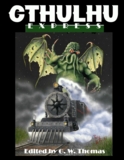
Cthulhu Express which you can see on the left, is an actual physical book, and holding it in my hands gives me exactly the same pleasure as those of any other books with bindings that I've got work in. It is, however, Print on Demand, from Lulu.com. Which means that nobody read it.
The problem with Lulu dot com is that there are a lot of people who use it to get that GREAT feeling of their own physical book in their hands. The current system of agents, slush piles, and rejection letters exists because not everybody writes well enough to get paid for it. The lure of lulu is that I don't have to go through all that. I get my stuff together, and in a few weeks, I can have my own novel, anthology of short stories, or whatever in my hands. And while it's a great feeling, I have to consider how much effort went into it, and how many people are going to read it.
Nobody read Cthulhu Express. It was on Lulu dot com for four months before RageMachine shut itself down, and in that time, it sold eleven non-contributor copies in that time. Eleven. And I know who bought three of them. Again, I could have written the world's best story, but without people to buy it and read it and discuss it and convince other people to read it, it's not going to sell enough copies for my royalties to be anything but pennies. I put effort and time into these stories. I want my time to be worth more than pennies.
POD has its uses. Every now and then I consider putting out a Whateley Family Bible and sending it to people for Christmas. Lulu would allow me to have an economical print run of forty books. So POD isn't some sort of evil presence in publishing, but it is not the same as selling a story to a venue like Clarkesworld or Weird Tales which will pay me in advance, by the word. And which people will subsequently hear about and read.
Writing
1,000 words on William Peter Blatty
300 words of reviews and essays for the EOD
Reading
Finished Razored Saddles (awesome book!)
Finished Which Way to Mecca, Jack
Tuesday, April 10, 2007
Error #1: There is No Ladder

I used to perceive a ‘ladder’ to publication. First I would beg people to take my work, and they would print it for free. After some time doing that, I would have accumulated a series of non-paying anthologies, and from there I would move up a rung to onto the ‘token’ payment anthologies that pay between $5 and $10 per story. After I placed many stories in ‘token’ anthologies, I would tentatively step onto the next rung, semi-professional payment that pays between one and three pennies per word. Only then, when I had paid my dues and have the weight of several dozen stories pushing me on would I even dare to query a pro-pay magazine like Weird Tales or The Book of Dark Wisdom.
Not only is this not true, it’s self-defeating. I started on the lowest possible pay scale, and since my work got accepted there, I never even looked for anything better for that story. What, did I think I would take it to a higher-paying venue later? How stupid is that? An actually intelligent person who has thought about this starts with the highest-paying venue that would possibly take his work and then proceed down the pay scale. Because I’m going to stop with that sale, aren’t I? And the editors don’t really care who I am until I’m a name. Until then, they’re much more interested in my story than my other publications. A hundred stories in a hundred anthologies the editor has never read or heard of do me absolutely no good if my story is no good. And they’re not going to care if this is the first story I have ever written if it’s brilliant.
Let me show you where this thinking lead me. I recently received a copy of an anthology I placed my work in for free: Atlantean Pub’s The King in Yellow anthology.
First of all, Atlantean Pub has a free website. That’s OK, because not every publisher has to have a good website. However, EVERY publisher has pictures of their books, even if they have a really cheap website. Now, I’m, not getting down on Atlantean Pub. They never mislead me, I mislead myself. I never saw any pictures of their product, so when I assumed that they were going to be small but printing actual books, an assumption on my part that had no basis. I never saw a cover to a single one of their books, and I filled in the blanks with rosy dreams.
A few weeks ago, I received my copy of Atlantean Press’s King in Yellow, which no one has ever heard of, and no one is going to read because it has no ISBN. Thus, it cannot be sold to a bookstore, or even on Amazon. And in fact, it’s not even a book, it is in fact photocopies held together with a binder clip. I could have written the best King in Yellow story God has ever seen. No one is going to know because this isn’t actual publication.
The solution? As you see on the score sheet to your right: I’m, now shopping “Sire” as a reprint, and I make less money the next time I sell it. Meanwhile, I’ve missed other opportunities to get it into paying venues.
Publication is worth what I get paid for it. When I put something in an anthology that didn’t pay, I was competing with people who think their work can only be given away. I’m better than that, and my work is better than that.
Writing:
Articles and reviews, 1,400 words
Reading:
Which Way to Mecca, Jack by William Peter Blatty
Thursday, April 5, 2007
Why Flawed Diamonds?
"Writers generally move from one to two and then manage to somehow crap out a little diamond of originality which sparks a personal response, and then finally some editor is enamored with story and accepts it. Then it's a bunch more rejections — some form and some personal, and maybe a second sale. Slowly the forms begin to disappear, and then the ratio of personal rejections to acceptances starts to shift in favor of acceptances as well." --Nick Mamatas
Thanks for the image, Nick, but he nailed perfectly the stage that I'm at. Something has sparked an editor's attention, I've got my first story out, and now I'm getting form rejection letters. Since they aren't that interesting, I'm not going to post them, but I do plan (with the publishers' permission) to post any personalized rejection letters that I get.
OK, next time, I start writing about the errors I have made in publishing. I consider that I've made quite a few, so that should keep me going for a good, long time.
Still reading:
JLB's Collected Fictions
Writing:
Finished the essay for a friend at 549 words. Call it 40 words and a lot of polishing.
"Secret History of Earth": 699 Words
The Novel: 400 words