Tuesday, July 27, 2010

Finally... I'm BACK!

It's been a difficult month, and I apologize for being remiss on this blog. But now I'm back.

One of the more notable joys of June was discovering a new favorite (non-Sondheim, but he's in his own category so other writers have a chance) musical.

Probably some of you have seen Reese Witherspoon in Legally Blonde. It's quite possible you don't approve of the trend of making musicals out of films. I know that generally speaking I don't, although said trend did bring us Spamalot, and I'm willing to forgive a lot for that.

That said, the Legally Blonde musical is fast-rising on my list of favorite musicals. Yes the songs are clever and entertaining, but the central message of the work as a whole, which is emphasized very differently from the film. The plot is the same; vapid but intelligent girl goes to Harvard law to chase boyfriend and discovers that she likes being a lawyer.

In the film, she succeeds because she is true to herself; succeeds with the tasks using her intelligence, social networking, and other feminine skills that the other law students discount. The musical, however, shifts that. Elle succeeds because she works hard. She is thrown one obstacle after another, and she learns to settle down, apply herself, and hammers each problem until it breaks. I can't think of the last time any media had that message, and it's one that really needs to come up more.

Films tend to tell us to be true to ourselves, and if we do that, we will achieve our dreams. Very seldom is there prolonged effort involved, usually just a moment of endurance, and sometimes one of inspiration. Elle Woods discovers when she pursues one goal that what she achieves in that pursuit is better than what she thought she wanted. She isn't staying "true to herself" she's finding new challenges to overcome, and discovers the joy of self-fulfillment. We need more texts like this. Especially ones with clever, catchy songs.

Monday, July 5, 2010

Comfort Reading

Every now and then, I like to blow an afternoon reading at TVtropes.org. They have an enormous collection of trite plot devices and characters that often show up in various media. I lavish a fair amount of love and attention on esoterica. In the extreme, it seems because even TVtropes doesn't have a precise fit for a trope that makes up some of my comfort reading.

I love the riddling trickster's tomb. I love tombs and crypts in which the setup and execution would have baffled NASA engineers, where the concealed 10 x 10 pit traps are still in perfect working condition after centuries, and even millennia.

There's a bit of my affection for ancient Egypt tied up in this. After all, the characters are pludering a trapped tomb, loading up on gold and other grave goods. There's a touch of archaeology, even if it is prying the gold letters out of the walls and melting them down.

The tomb of the riddler seldom appears outside of the RPG media-form. Teasing riddles have little effect on a novel reader. Readers aren't motivated to solve the riddle because it doesn't save them grief; they're just along for the ride. And if they do solve it, they're still saddled with the characters' stupid ball until the author decides its time.

At the heart of the trope lies an arrogance; that those entering the dungeon are too stupid to figure out the traps without help, and that even if the Evil Overlord gives them hints, they're still going to die to the fiendish traps.
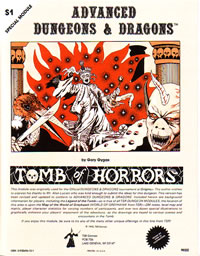
The trope began with Gary Gygax's Tomb of Horrors. Tomb of Horrors was an enormously influential adventure, one of the first modular adventures ever released. People tend to strongly divide between loving and hating it. It was designed to test the skills of overproud D&D players, but there's a lot of personality in it. The reader gets a sense of the builder's nasty sense of humor as well as their capacity for random mayhem.

Tomb of Horrors was quite successful. And with success came imitation. The next adventure in the "S" series was Lawrence Schick's White Plume Mountain, which reinforced many of the concepts, including giving the players a riddle to help them figure out the mind-boggling traps that were laid for them.
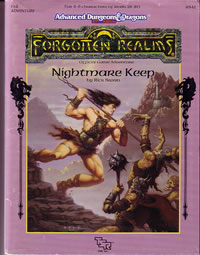
A further exploration of the theme was Nightmare Keep. Like several vertions of the trope to come, this adventure set out to make a bigger and nastier Tomb of Horrors . Included are the strange poetic traps, the same distinctive undead horror waiting at the end. However, it's a bit overblown, the traps rather self-consciously weird rather than traps for individuals to get themselves killed by being greedy or careless.
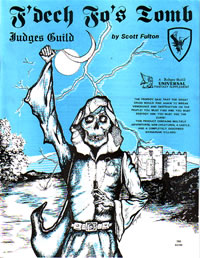
Other imitations include third-party adventures such as F'Deck Fo's Tomb. I often champion third-party variations on a theme because individuals removed from the editorial control of a single entity (in this case TSR) often have wider mematic interpretation that brings something new and fresh to the trope. This is not the case here. With the adventure-writing in its infancy, some publishers seemed willing to publish anything. This adventure would never have gotten past the editors at TSR.
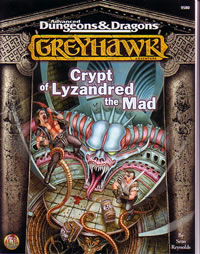
Rising RPG star Sean Reynolds wrote his own bigger, badder riddle tomb for second edition Dungeons and Dragons adventure The Crypt of Lyzandred the Mad. Like many bigger versions of the original, this feels like the creator (Lyzandred, alternately Reynolds) is trying too hard. The riddles rely heavily on logic and word puzzles, sometimes straight-out asking the riddle, giving the feel of an enormous pop quiz. the Tomb of Horrors' Acererak was trying to kill the characters. From a read-through, it feels like Lyzandred is grading them.
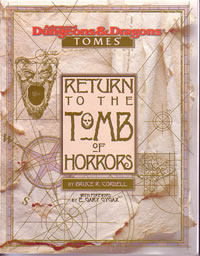
In the waning years of AD&D 2nd ed, the Return to the Tomb of Horrors mega-adventure was published. Both a sequel and an enormous expansion of the original, this gave the original TOH a definite location as well as an ecology. Not only has the tomb attracted a cult of worshippers, but the builder's designs in creating such a deadly location come into very large, interdimensional view. Of course, it's up to the adventuring party to foil the mighty plot. The author, Bruce Cordell, did a good if not completely satisfying job with this expansion. It won best adventure for the year, and is certainly one of the most overarchingly grand adventures I've ever read.

Gygax went topped his own meatgrinder dungeon with Lejendary Adventures' Necropolis, later converted to D&D 3rd edition by Necromancer Games. If the Tomb of Horrors was a meat-grinder, Necropolis is astonishing. The sophistication and resourcefulness of D&D players had increased, at least in Gary's opinion. However, it also shows a a definite change in Gary's style, and the expected style of play. Where Tomb of Horrors is a location with no background, Necropolis is set in a pseudo-Egyptian location, with a large number of encounters that contribute to a broad storyline leading up to the assault on the tomb of SetRahotep.

With the advent of third edition and the Open Game Licence, third parties were allowed to publish their own adventures in the D&D system. Unlike the earlier efforts, this time some extremely talented people got into writing adventures. Some of them wrote riddling trap tombs, and again the memetic mutation carries them to different yet interesating places, adding to the richness of the trope.
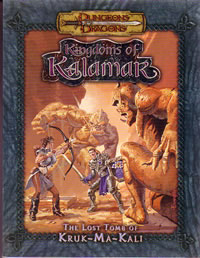
KenzerCo's Lost Tomb of Kruk-Ma-Kali is one of my favorite meldings of the old meat-grinding trope with more in-depth playstyle. While the killing traps remain, the tomb is presented not only with an ecology surrounding it, it also has a political history. The end of the text also deals with the political and cultural repercussions of the players actions, allowing the adventure to become part of a larger tapestry. But this adventure made me wonder: if Kruk-Ma-Kali was basically a Hobgoblin Genghis Khan, why the blue frell did his followers dump his mortal remains into a supremely elaborate trap-tomb rather than paying for a resurrection?
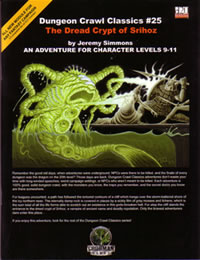
Dread Crypt of Srihoz is part of Goodman Games' Dungeon Crawl Classics series. These deliberately call back to adventures of first edition D&D, right down to a cardstock cover with the dungeon map printed in blue ink. Goodman's writers clearly know and love the dungeon tropes they are playing with. The Dread Crypt is another deathtrap dungeon, but the writers have understood the need for the perception of a single guiding hand behind its construction. The tomb's locations serve a purpose, even if this will not be apparent to the adventurers, the cohesive design allows the Game Master to view it as an expression of the individual who built it. Of particular interest is the fact that it lampshades other riddling labyrinth lords by offering riddles that don't help the players at all. A very perceptive stroke.
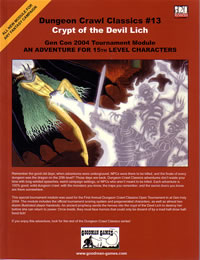
One of the earliest Dungeon Crawl Classics was produced as a direct homage to Tomb of Horrors. Called the Dread Crypt of the Devil-Lich, it was a tournament adventure, just as the original TOH was. Imitating the older adventure, it contained many strange traps designed to test the adventurers' ability against deadly hangman's riddles. Its failing is that it does not feel like a cohesive adventure. Each trap is radically different from the other, never revealing the likes of the dislikes of the tomb's designer. Still, the adventure is very solid, and the climactic battle with the eponymous devil-lich looks both deadly and intriguing, especially after the party has waded through more than a dozen rooms of nightmare traps.
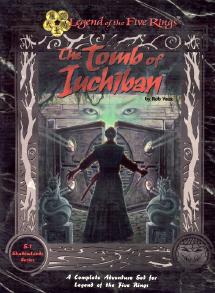
One of the best and most unusual homages to the Tomb of Horrors is Tomb of Iuchiban for the Legend of the Five Rings game. TOH tributes seldom appear outside of DUngeons and Dragons, and L5R's Oriental setting is not one I would have thought that lent itself to the trope. Rob Vaux does so magnificently, however, creating an ever-changing maze of traps that range from simple but deadly to complex, magically weird meat grinders. This adventure is a real pleasure: well written, original, and cohesive.

And yes, now there is a fourth edition version of the Tomb coming out this month. Although 4th ed hasn't thrilled me so far (I haven't actually played since 2nd), I think that may be the impetus for my most recent return to deathtrap tombs. I'm actually more interested in the Erol Otus-illustrated Tomb of the Blind God (Goodman Games again).

This is my 'comfort' reading, imagining the D&D party trapped and besieged in a stone crypt loaded with traps and monsters. At best, they fire my imagination, wondering how characters (and players) would face the illogical hangmans' riddles they are presented with.

Wednesday, June 23, 2010

Gunfighter Nation

"By the terms of the Frontier Myth, once imperial war was conflated with savage war, both sides become subject to the logic of massacre. The savage enemy kills and terrorizes without limit or discrimination in order to exterminate or drive out the civilized race. The civilized race learns to respond in kind, partly from outrage at the atrocities it has suffered, partly from recognition that imitation and mastery of the savages' methods way the best way to defeat them. A cycle of massacre and revenge is thus inaugurated that drives both sides toward a war of extermination. Only an American victory can prevent actual genocide: the savage enemy would indeed exterminate all the civilized race, but the civilized carry massacre only as far as necessary to subjugate the savage. To achieve victory in such a war, Americans are entitled and indeed required to use any and all means, including massacre, terrorism, and torture."

Slotkin, Richard; Gunfighter Nation (1992) p. 112

Thursday, June 10, 2010

Hide Your Women and Lock up the Fried Chicken!


Cthulhu's Dark Cults is finally out. You should totally order it.

If you want to know about my story, "Captains of Industry" then head over to editor David Conyers' blog in which he hand gives each author a little time to discuss their story (I'm at the bottom) and a little snippet from each story. The inestimable Stephen Gilberts provides the delightful cover.

I'm really fascinated by the human side of horror. Monsters are interesting, but their relationship to the people in the story is what will really pull the audience in. David was surprised when I turned in a story without any of Lovecraft's brilliantly detailed alien horrors. But with the title Cthulhu's Dark Cults I figured that the human cultists should be the focus of the stories.

Wednesday, May 26, 2010

HP Lovecraft and the Non-Euclidian Plot

I like a Cthulhu Mythos pastiche as much as anyone. Probably more, I've got shelves full of Chaosium anthologies, as well as four volumes of Japanese stories in honor of Lovecraft, as well as various small press books of stories in imitation of Lovecraft. Hell, I've even got a couple books of August Derleth's imitations of Lovecraft.

I do have a crap limit. Lovecraft shows up in strange and unexpected places... including children's television. The animated superhero show Justice League broadcast a two-parter "The Terror Beyond" on November 15, 2003. I Netflicked the disk, and watched it.

It's terrible.

The plot revolves around Dr. Fate and Aquaman joining forces with Solomon Grundy in order to seal a breach between out dimension and that of Icthultu, a noxious horror that has a mysterious link to Hawkwoman's homeworld of Thanageria. There's some fighting, because the Justice League aren't just going to ask Fate and Aquaman what they're doing. Once that's cleared up, they take a trip (in the second half-hour) to Icthultu's dimension to kick his ass.

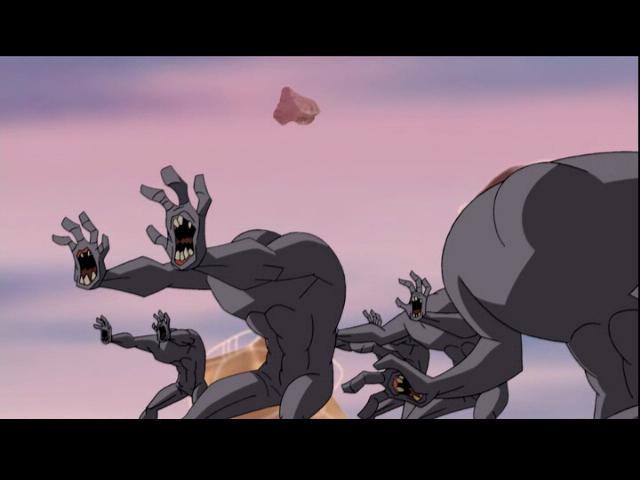
Now I'm going to start with the pictures. Some of Icthultu's defenders are gray, headless creatures with screaming mouths in their hands. Ramsey Campbell, are you paying attention?
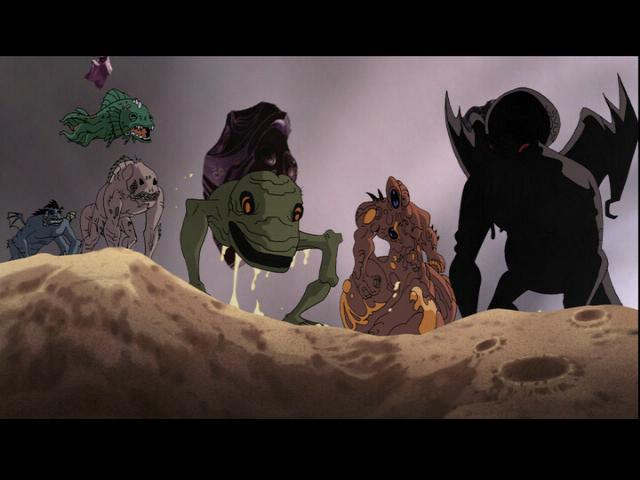
With the gray IP violations defeated, the team separates, Fate, Grundy and Hawkgirl going to face Icthultu. We are treated to a good reveal of the tentacled face of Icthultu glowering down on our heroes. Atheist Hawkgirl tells us that her Thanagarian people used to worship Icthultu, which gave them philosophy and agriculture in exchange for their souls. But the price was too high, and they stopped believing. They beat up some star-spawn (look at the right hand of the picture, that's practically Cthulhu in silhouette) , and get right up to in Icthultu's grill.
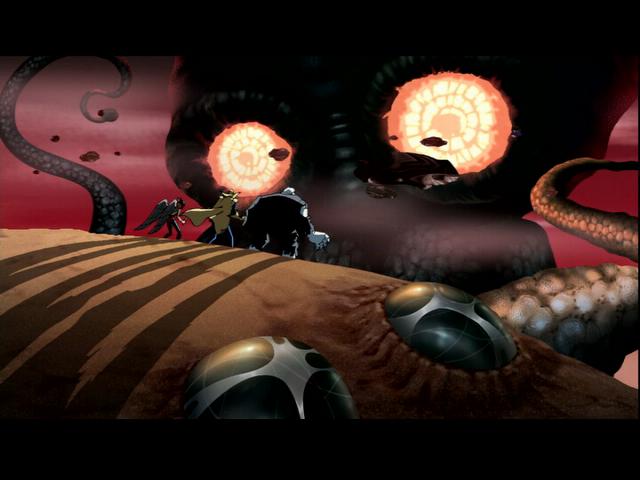
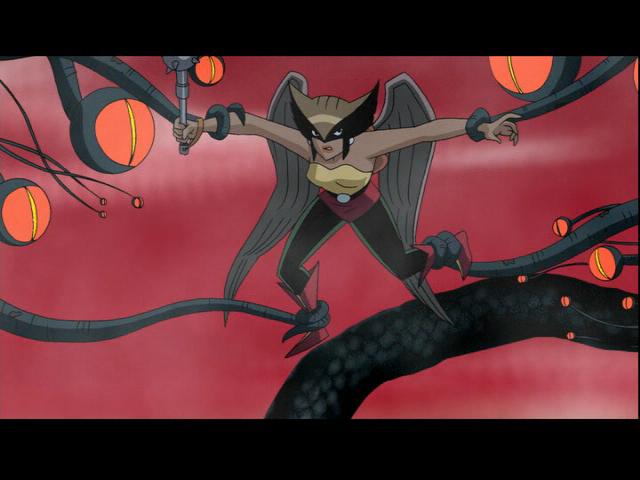
In a G-rated nod to hard-core pseudo-Lovecraftian Japanese porn, Hawkgirl is grabbed by tentacles. Golly, who saw that coming? She's held spread-eagle (haw haw!) before the burning eyes of Icthultu, and banter is exchanged.
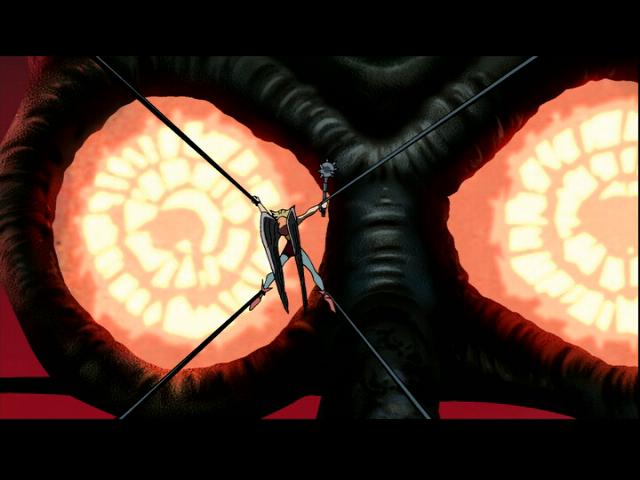
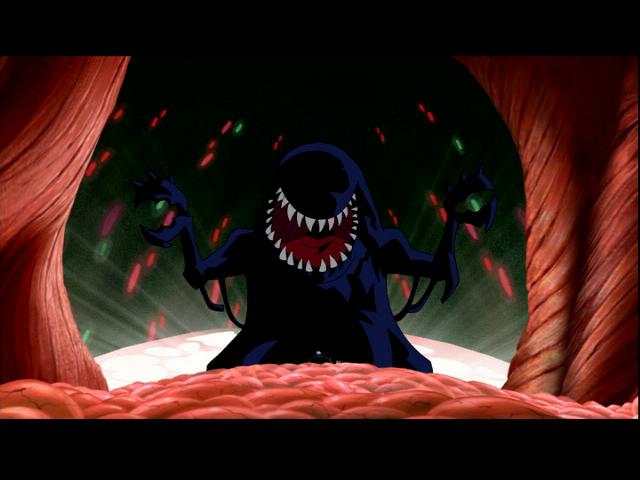
As the great Old One is distracted, Solomon Grundy gets into its head, and runs down icky corridors fighting off weird alien antibodies. I think he's in Icthultu's brain, the landscape looks like the neurons from the episode of Futurama when Fry does the same thing. But it turns out that there's something living inside Icthultu's brain... a giant monster!
Rawr!

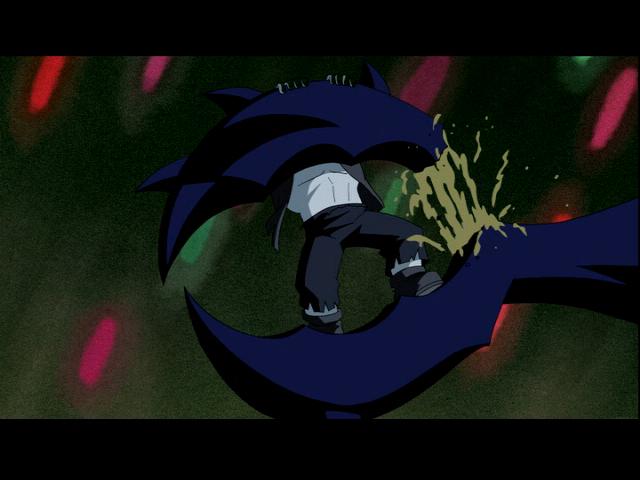
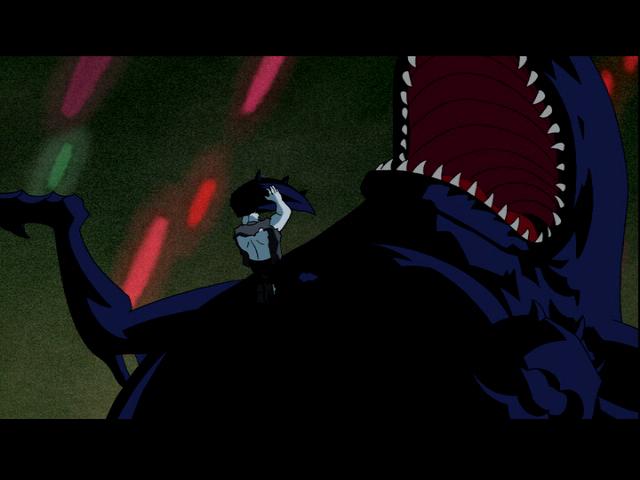
Fortunately, Icthultu (as voiced by Rob Zombie) is a enormous wimp. Grundy snaps off its claw, stabs it a few times, and that does the trick.
He probably stabs two feet of claw into a creature that's taller than a three-story building. But that seems to do it for Icthultu, and down it goes.

Grundy having done the mighty deed, is dying, and Hawkgirl comforts him. When Grundy asks if he is going to meet his soul, Hawkgirl chokes back the reply that she doesn't believe in them. THEN WHAT WAS THE BIG PRICE ICTHULTU EXTRACTED FROM YOUR PEOPLE, LADY? She believed in her ancestors' souls enough to build up a big mad-on at Icthultu for stealing them.

The non-Euclidian arc of this story, serving mainly to give us fights (some do feature some pretty smooth moves), drives me nuts. Superman and Wonder Woman are too hasty to ask Dr. Fate and Aquaman for explanations, and barrel right into a ritual that's keeping the Icthultu out of our dimension. But if they'd asked, the episode would have been over in fifteen minutes. Hawkgirl's comforting of Solomon is touching, but the moment is ruined because she's reversed her stance on souls in the last ten minutes.

Not all Lovecraft references are interesting, and not all are worth dissecting.

Saturday, May 22, 2010

Carnifex vs Angry Marine

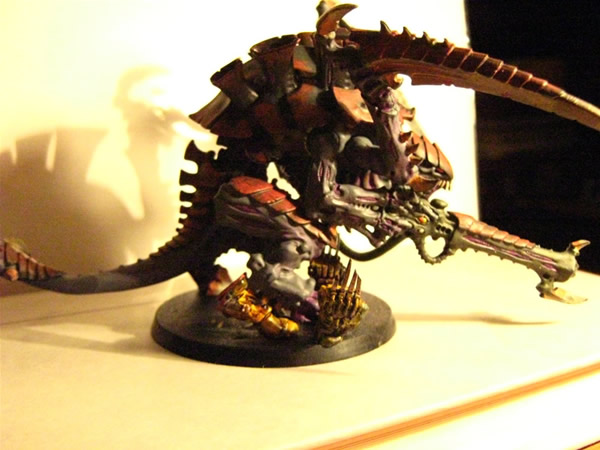
I like to tell stories. This comes through even when I paint the models of Splinter Fleet Mordiggian. A picture is worth a thousand words, so here's some flash fiction about an Angry Marine and a Carnifex.

Tuesday, May 11, 2010

The Big Fan-Fic Kerfluffle

Well, somebody blew up about fan fiction, and SF being a fairly small community, there's been a bit of discussion about it.

And it's been interesting to hear various people weigh in on the discussion. Predictable, I find the most interesting and cogent thoughts to be from writers of my generation, and who I've met.

Charlie Stross has a very well thought-out post on his attitude toward fan fiction using his characters or settings.

Nick Manatas presents a very interesting case of what copyright is and what it is not, using the rather complex case of HP Lovecraft as an example.

Me? I'm essentially still a fanfic writer, although I've gotten paid decently for one of them. And, as Silviamag said in the comments of Nick Mamatas' post, "I'll say it again: the day there's erotic lesbian fan fiction of my work is the day I've made the big leagues."

Sunday, May 2, 2010

How it's Done...

I've had this bee in my bonnet that someday, I would put together an anthology of really stunning stories, the best short stories I've ever read. I should have written it down then, because I don't remember half that list:

"The Hedge Knight" by George R. R. Martin
"The Great Lover" by Dan Simmons (yes, these two are novellas. It's my anthology)
"Jigsaw" by Stephen Bissette
"The Statement of Randolph Cater" HP Lovecraft
"The Cleft" by Gahan Wilson
"Monster" by Jack Ketchum

I'm forgetting a number of others.

However, there's a new story to add to it. I've been enjoying the Silver John stories of Manly Wade Wellman, thanks to Paizo Publishing's collection Who Fears the Devil. Wellman writes very well, and his stories of rural Appalachian folk are appealing in their evocation of this slice of Americana.

And there's a story that stands over the rest, as there usually is. "On the Hills and Everywhere" is simply told, and powerful for all that. It's officially going on the "How it's Done" list.

Thursday, April 29, 2010

The Run-Up to Cthulhu's Dark Cults

It's been a log time coming, but Chaosium appears ready to release Cthulhu's Dark Cults this summer. This anthology has my story "Captains of Industry" in it.

David Conyers, editor of the anthology, is putting up snippets of the stories, as well as notes concerning the stories' creation on his blog. And it's my turn today.

Wednesday, April 28, 2010

Why Computer Games Aren’t Perceived as Art Yet, and Why That’s Unfortunate

A friend on Facebook is annoyed that Roger Ebert doesn’t think computer games are art. He’s enormously into computer games, and thinks that should be treated as art. The problem is that they won’t be, not for some time. I've identified four major reasons for this.

1) Grind. The leveling and power-gaining apparatus of most plot driven games (RPGs) (first person shooters tent to rely on acquisition of equipment) are such that they require the player to engage in dozens, if not hundreds of combats that are not germane to the plot. As such, grind and random encounters place the main plot on hold. At this time, great works of art are analyzed in such a way that everything is important. See the creations of William Shakespeare and Charles Dickens. Wordy they may be, but in modern critical thinking, nothing is wasted, and everything in them contributes to the overall effect and greatness of the text (using “text” in the semiotic sense, the work of art as a whole). Nothing is repeated, nothing is there specifically to make the text longer. In any other art form, repetition of minor elements that do not contribute to the overall effect is called padding, and is understood to the impact of the text. In computer games, it’s expected.

2) Impermanence. The Microsoft Windows platform is at least polite about backwards compatibility, although God and Heinlein help you if you try to work with one of those games with XML memory usage, or proprietary memory extender. Games created for Windows are generally workable, however it’s quite possible that the average user won’t be able to get it running and not know why. One of the tenets of great art is that it can withstand the test of time. How can we introduce our friends and colleagues to good, older games if we can no longer play them?

The game industry itself has little interest in games that are not recent. It’s very bang and bust–make a big hit, get the money, and then the game is forgotten for the next new shiny one. Sometimes, there’s an extension or additional downloadable content, and a game gets a gold, Platinum or Game of the Year edition. Yet good games are seldom available again after a major media shift. If you own a game on 5.25" or 3.5" disks, you’re probably out of luck. If the game was on an Amiga, or any other no longer extant computer architecture, you’re almost definitely out of luck.

Platforms, with one exception, are even worse. A limited number of PS3s can play PS2 games, and those were the first wave available. The current ones cannot. There’s a strict list of Xbox games that can be played on the X360. Only Nintendo made its most recent generation (the Wii) fully backwards compatible with its previous generation (the Game Cube). Much of the computer game industry does not take game longevity seriously, apparently believing that no one wants to play a game more than five years old. I can think of three franchises that have moved older games onto newer platforms: Wing Commander (now dead for a decade), Fallout, and God of War. I’m sure there are others that I’m not familiar with, but these updates remain the exception rather than the rule. If the industry itself regards games as cheap, throw-away trash to be forgotten in a few years, why should anyone else regard them differently?

3) Insularity. In order for an art form to be taken seriously, it must be taken seriously by people whose opinions matter to people other than gamers.

There is no language of critical apparatus within the video game community. There are awards and reviews, but there really isn’t anyone writing about the underlying structure of the games, dissecting them in a public forum to see what makes them tick.

It took Alan Moore and Watchmen to make critics look at (some) comics with a more serious eye. It wasn’t until this decade that Pop Matters started publishing books of essays on television shows (thank you Joss Whedon and Buffy). Computer games are going to have to wait until the generation that came up playing them become tenured professors and start writing critical essays about them. And even then, they will need a champion, a well-respected individual who comes lays out a difficult-to-refute case that video games should be considered art, and then hammers the point. ST Joshi did this for HP Lovecraft.

4) Complexity: Much modern criticism is celebrity-based. There is discussion of a Kurosawa film, the oeuvre of Scorsese, a Joss Whedon series. This singling out of individuals who are responsible for the brilliance of a film undercuts the contributions of the hundreds, or thousands of people who made minor contributions small but telling contributions to the completed work. It can be said that the director of a film deserves praise for all decisions, because they selected competent individuals whose artistic sense agreed with their own, but the fact remains that the director does not make all decisions, and film is very much a collaborative art form.

Modern criticism is based on literature, where a single individual is responsible for the creation of a work. It is easier to praise the individual at the helm of a film, as it were, because it is often impossible to say who made a particular decision. Was it the director of photography that suggested a particular shot? Did the actor or the director suggest an affecting line reading? Listening to commentary may help, but the creation of the work is so moment-based that the individuals involved sometimes disagree on a decision.

How much more difficult it is in computer games? Does the praise for a particularly beautiful set piece go to the Project Coordinator, the Lead Artist, or Visual Coordinator?

That said, I think analysis of computer games is important, precisely because it has become such a pervasive commonality in our culture. What are the underlying themes (and yes, these things affect us whether we realize it or not) that are being underscored in individuals minds as they play Modern Warfare 2? How is that likely to affect individuals attitudes toward armed conflict when they are asked to vote for or against involving their country in such a conflict? How do Mario game players perceive non-game intellectual challenges, such as at work? I don’t know, but these questions cannot be answered in a satisfactory fashion until games receive serious, rigorous, scholarly attention.