I've attended three different colleges, gotten a Master's degree, and now I'm back on school for a professional certificate.
In all of my previous University experience, I've been taught by academics. People who have dedicated their loves to the study of their particular focus: Shakespeare, computers, etc.
What the Community College offers is a more motley collection of people. However, I have to say, they're a lot more colorful. I've been taught anatomy by a former chief of surgery, and now I'm being taught microcomputer apps by a Roller Derby coach who posts her own videos. It's quite the different perspective.
Tuesday, May 24, 2011


Wednesday, May 18, 2011
My writing is... inscrutable?
In my copious spare time, I sometimes Google myself to see if there are any new reviews of my work out. This has led to several quite interesting discoveries. Most recently, I came across this review of “God of Chickens” at Scary Minds. It's a good and detailed review. And in the middle of the fourth paragraph, there's this little sentence:
“John Goodrich lays down the gore track with the amazing God Of Chickens, like a good Harold Pinter outing it works but try figuring out exactly how!”
“John Goodrich lays down the gore track with the amazing God Of Chickens, like a good Harold Pinter outing it works but try figuring out exactly how!”
Sale!
I'm pleased to announce another sale, this one to Henrik Harkesn's Urban Cthulhu: Nightmare Cities. Editor Harksen's his first anthology, Eldritch Horrors, Dark Tales was a solid read, and I wrote “The Neighbors Upstairs” specifically for the follow-up. I'm quite tickled that he liked it.
Thus far, the table of contents includes:
• “the guilt of each… at the end…” by Joseph S. Pulver, Sr.
• “Dancer of the Dying” by Jayaprakash Satyamurthy
• “The Neighbors Upstairs” by John Goodrich
• “Carcosapunk” by Glynn Owen Barrass
• “Architect Eyes” by Thomas Strømsholt
• “Slou” by Robert Tangiers
• “Ozeelah’s Lake” by Morten Carlsen
• “The Statement of Frank Elwood” by Pete Rawlik
• “Night Life” by Henrik Sandbeck Harksen
Mmmm. Urban Cthulhu.

Thus far, the table of contents includes:
• “the guilt of each… at the end…” by Joseph S. Pulver, Sr.
• “Dancer of the Dying” by Jayaprakash Satyamurthy
• “The Neighbors Upstairs” by John Goodrich
• “Carcosapunk” by Glynn Owen Barrass
• “Architect Eyes” by Thomas Strømsholt
• “Slou” by Robert Tangiers
• “Ozeelah’s Lake” by Morten Carlsen
• “The Statement of Frank Elwood” by Pete Rawlik
• “Night Life” by Henrik Sandbeck Harksen
Mmmm. Urban Cthulhu.
Sunday, May 8, 2011
I think I Needed a Little Time Off...
I still do. The school semester's over, and I've got to test out of something to get a class I've already taken (don't ask). I'm working more, and I have less time to write than I want because it's Spring, and in the Spring I get all ambitious and want to actually go do things.
Last night, for example, we went out to see a movie for the first time in months. We don't go out to the movies much. There's a lot of crap being produced. As a friend said, Hollywood has the reverse of the usual business model. You can see the good parts of a movie for free in the trailer, but you have to pay to see the crap.
Part of a movie's charm is the ambiance in which you see it. For this reason, and because we were hopeful but not expecting greatness, we went to the drive-in.
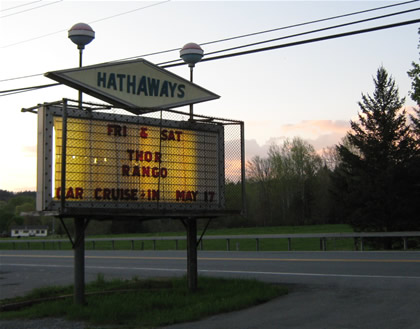
Mostly there for Thor, which could easily have been an enormous disaster, and Rango, which was only of vague interest.
But hey, Hathaway's drive-in! I've blogged about it before, but this time, I brought the camera. It was a mild Spring day, the sunset was lovely, and the bugs were outside the car. You kind of bring your own environment when you see a movie from the comfort of your own car. Families were there, and kids were throwing a ball around before the show. It was just that sort of bucolic, rural scene that does happen every now and then, not just in peoples' nostalgic biographies.
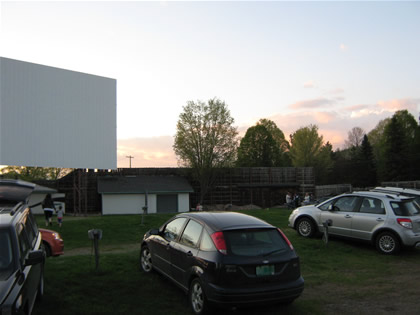
We used our radio for sound this time, and it sounded a lot better than using the provided speaker. We also visited the snack bar for tasty local burgers, pretty good fries (they provide vinegar for those of us who like them that way) and surprisingly tasty popcorn.
An enjoyable way to watch a couple of films. It's not really the way to watch a film you really want to pay attention to, because there's people walking around, drivers entering and exiting, and overall a fair mount of distractions. But the average film doesn't require you to pay attention to every frame, so it's fine. I will want to pay attention to every frame of On Stranger Tides, so I'll be seeing it in a more traditional theater. But I'm hoping we'll catch another double-feature before it closes for the winter.
Oh,the movie? Kim Newman was right, and Thor was well done especially considering the comic. The perfect drive-in film. Entertaining, pretty to look at (that the costume designer managed to turn Kirby's designs into wearable clothing is Oscar-worthy), with just the right amount of things blowing up. Rango was an amiable film, neither knocking my socks off nor wasting my time.
Last night, for example, we went out to see a movie for the first time in months. We don't go out to the movies much. There's a lot of crap being produced. As a friend said, Hollywood has the reverse of the usual business model. You can see the good parts of a movie for free in the trailer, but you have to pay to see the crap.
Part of a movie's charm is the ambiance in which you see it. For this reason, and because we were hopeful but not expecting greatness, we went to the drive-in.
Mostly there for Thor, which could easily have been an enormous disaster, and Rango, which was only of vague interest.
But hey, Hathaway's drive-in! I've blogged about it before, but this time, I brought the camera. It was a mild Spring day, the sunset was lovely, and the bugs were outside the car. You kind of bring your own environment when you see a movie from the comfort of your own car. Families were there, and kids were throwing a ball around before the show. It was just that sort of bucolic, rural scene that does happen every now and then, not just in peoples' nostalgic biographies.
We used our radio for sound this time, and it sounded a lot better than using the provided speaker. We also visited the snack bar for tasty local burgers, pretty good fries (they provide vinegar for those of us who like them that way) and surprisingly tasty popcorn.
An enjoyable way to watch a couple of films. It's not really the way to watch a film you really want to pay attention to, because there's people walking around, drivers entering and exiting, and overall a fair mount of distractions. But the average film doesn't require you to pay attention to every frame, so it's fine. I will want to pay attention to every frame of On Stranger Tides, so I'll be seeing it in a more traditional theater. But I'm hoping we'll catch another double-feature before it closes for the winter.
Oh,the movie? Kim Newman was right, and Thor was well done especially considering the comic. The perfect drive-in film. Entertaining, pretty to look at (that the costume designer managed to turn Kirby's designs into wearable clothing is Oscar-worthy), with just the right amount of things blowing up. Rango was an amiable film, neither knocking my socks off nor wasting my time.
Tuesday, April 12, 2011
Return to the Tombs of Horror
The Return to the Tomb of Horrors was written and released some twenty years after the initial Tomb of Horrors. The Return was to be an event; one of TSR’s (now owned by Wizards of the Coast) last boxed sets, it contained a book for the main adventure (printed in two colors), a booklet of maps and monsters (printed in color), a small journal from a previous survivor of the tomb, and a color card of art. Where the original adventure looks very much like it was typed out, twenty years had brought a fair amount of progress to desktop publishing. Return is printed in two colors, with border art and a watermark. This makes it more visually pleasing, but I can’t really say it improves the adventure itself.
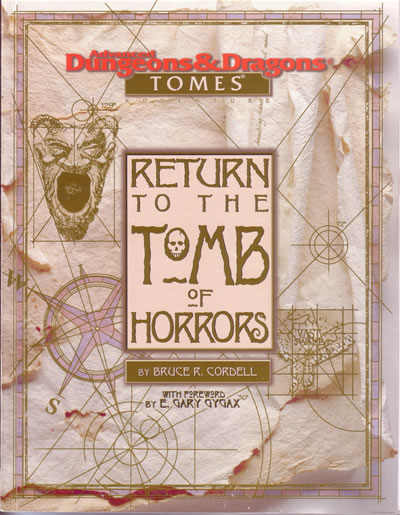 Return to the Tomb of Horrors has a very late nineties feel. Dungeons and Dragons had expanded enormously from its original days of a largely terrestrial combat encounter game to setting within a larger multiverse with dozens of planes that could be visited. Multiple campaign settings had come been published, including the dimension-hopping Spelljammer, which took place on sailboats that plied the spaceways between magical stars. There are unfortunate aspects to the period, also. The term ‘demon’ is never used in the text. Following the Satanic Panic of the late 80's, the term demon was replaced with tanar’ri. Because if you change something’s name, you change its nature, right?
Second edition mega-adventures don’t start at the door of the dungeon. Return has two adventure sections before the adventurers even reach the Tomb. The lead-up provides the adventurers with information concerning the ultimate end of the adventure, as well as a string of clues that get them to the tomb without the GM having to say “You arrive at the Tomb of Horrors.” As someone used to the investigative play style of Call of Cthulhu, I find the clues that link the plot to be fairly weak and easily missed.
The adventure does have a fairly grand plot behind it. The original Tomb simply had the trap-laden tomb with Acererak waiting passively in the middle. The Return features a grand plan of apotheosis for the lich, interplanar locations, a spooky city in the midst of nowhere, and a second dungeon-style Tomb, the Fortress of Conclusion, out in the planes.
The Return shows how much Dungeons and Dragons had changed in twenty years. Now there was a great deal happening behind the scenes of the adventure, which the adventurers would only become aware of as they progressed in the adventure. Acererak now had a background that could be learned, and an overarching plot that had to be foiled. The characters’ motivation is no longer “treasure” or “because it is there” but because very bad things will happen if they do not pursue the adventure to the end.
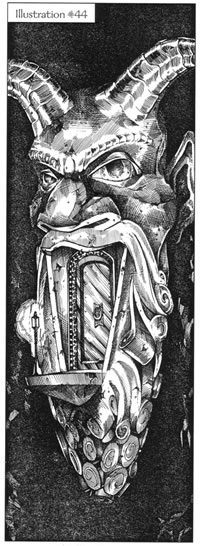 The Return also encompasses the original Tomb, giving it a sense of continuity. Return is literally built around the original tomb, creating a continuity from the old adventure to the new. I can’t view it as pastiche, because it expands on the original adventure, retaining certain iconic elements (the Green Devil Face, for example) while introducing a far more than the first adventure.
Although the Return also includes a booklet of images to show the players, these are poorly chosen. The originals were there to hand clues to the players. These are much less necessary. Do we really need a drawing of a room with a dirt floor and three coffins? Or a walkway stretched over a room full of bones?
Ultimately, The Return to the Tomb of Horrors is a reasonably satisfying continuation of the Tomb of Horrors. The traps are less crazy deadly; there are few “characters are dead, no saving throw” traps. It’s a good read, longer than the original, with a lot more change of setting, and much more plot. It has a lot more polish, but in places seems to lack the ferocious creativity Gygax put into giving the players, and their characters, a real challenge.
Return to the Tomb of Horrors has a very late nineties feel. Dungeons and Dragons had expanded enormously from its original days of a largely terrestrial combat encounter game to setting within a larger multiverse with dozens of planes that could be visited. Multiple campaign settings had come been published, including the dimension-hopping Spelljammer, which took place on sailboats that plied the spaceways between magical stars. There are unfortunate aspects to the period, also. The term ‘demon’ is never used in the text. Following the Satanic Panic of the late 80's, the term demon was replaced with tanar’ri. Because if you change something’s name, you change its nature, right? Second edition mega-adventures don’t start at the door of the dungeon. Return has two adventure sections before the adventurers even reach the Tomb. The lead-up provides the adventurers with information concerning the ultimate end of the adventure, as well as a string of clues that get them to the tomb without the GM having to say “You arrive at the Tomb of Horrors.” As someone used to the investigative play style of Call of Cthulhu, I find the clues that link the plot to be fairly weak and easily missed.
The adventure does have a fairly grand plot behind it. The original Tomb simply had the trap-laden tomb with Acererak waiting passively in the middle. The Return features a grand plan of apotheosis for the lich, interplanar locations, a spooky city in the midst of nowhere, and a second dungeon-style Tomb, the Fortress of Conclusion, out in the planes.
The Return shows how much Dungeons and Dragons had changed in twenty years. Now there was a great deal happening behind the scenes of the adventure, which the adventurers would only become aware of as they progressed in the adventure. Acererak now had a background that could be learned, and an overarching plot that had to be foiled. The characters’ motivation is no longer “treasure” or “because it is there” but because very bad things will happen if they do not pursue the adventure to the end.
The Return also encompasses the original Tomb, giving it a sense of continuity. Return is literally built around the original tomb, creating a continuity from the old adventure to the new. I can’t view it as pastiche, because it expands on the original adventure, retaining certain iconic elements (the Green Devil Face, for example) while introducing a far more than the first adventure. Although the Return also includes a booklet of images to show the players, these are poorly chosen. The originals were there to hand clues to the players. These are much less necessary. Do we really need a drawing of a room with a dirt floor and three coffins? Or a walkway stretched over a room full of bones?
Ultimately, The Return to the Tomb of Horrors is a reasonably satisfying continuation of the Tomb of Horrors. The traps are less crazy deadly; there are few “characters are dead, no saving throw” traps. It’s a good read, longer than the original, with a lot more change of setting, and much more plot. It has a lot more polish, but in places seems to lack the ferocious creativity Gygax put into giving the players, and their characters, a real challenge.
Friday, April 8, 2011
AVP, or How to Lose My Interest in A Single Scene
After watching and really enjoying Aliens, I decided to try the newest series in the franchise, AVP, Aliens Versus Predator. This was not a mistake, because it did not waste a lot of my time, and it gave me something to write about.
I made it to the second scene, at which point, the film strained my credulity beyond my interest in continuing.
Here's the scene: An ice-climber in Nepal. We are told this on-screen. Nepal.
The ice-climber's phone rings. I live in Vermont, and there are places where you can't get cell reception. I seriously doubt that there is good cell coverage in Nepal, let alone on isolated ice flows. Strike 1.
And then the ice-climber, hanging on a vertical ice flow, answers the phone. Yes, this was pretty inevitable when the phone rang, because it doesn't do to have a phone ring and no one answer it. But it just heightened the unfolding absurdity. Ice-climbing alone, and answering our cell phone as if it were a priority. Strike 2.
The third insult, and the point at which I turned the film off, was the "awesome reveal" at the end of the scene. After having a conversation with the person on the other end of the line, the ice-climber decides to go meet with the person who has called her. And she climbs to the top, and it is revealed that the guy she's on the phone with is up there, with a helicopter, ready to whisk her away.
This is another example of a tiresome trope of "What happens off-screen is silent." You can't sneak up on anyone with a helicopter, especially not somewhere as silent and abandoned as an isolated ice-flow a few days from civilization. Are we to believe that he flew in while she was sleeping and set down? That he's got a cool stealth-copter? That he flew in, landed, and she just didn't notice?
The scene is clearly intended toward the reveal of the helicopter already being there, impressing us with the Company's reach and grasp. Nowhere is beyond the Company's grasp, and they've got the resources to find you no matter where you are. But the scene doesn't make sense if you think about (yes, I understand that's a problem) what had to happen off-screen to make the scene work. And that attitude, in my experience, does not make for a good script.
So goodbye, AVP, it was time to watch a film with a better thought-out script.
I made it to the second scene, at which point, the film strained my credulity beyond my interest in continuing.
Here's the scene: An ice-climber in Nepal. We are told this on-screen. Nepal.
The ice-climber's phone rings. I live in Vermont, and there are places where you can't get cell reception. I seriously doubt that there is good cell coverage in Nepal, let alone on isolated ice flows. Strike 1.
And then the ice-climber, hanging on a vertical ice flow, answers the phone. Yes, this was pretty inevitable when the phone rang, because it doesn't do to have a phone ring and no one answer it. But it just heightened the unfolding absurdity. Ice-climbing alone, and answering our cell phone as if it were a priority. Strike 2.
The third insult, and the point at which I turned the film off, was the "awesome reveal" at the end of the scene. After having a conversation with the person on the other end of the line, the ice-climber decides to go meet with the person who has called her. And she climbs to the top, and it is revealed that the guy she's on the phone with is up there, with a helicopter, ready to whisk her away.
This is another example of a tiresome trope of "What happens off-screen is silent." You can't sneak up on anyone with a helicopter, especially not somewhere as silent and abandoned as an isolated ice-flow a few days from civilization. Are we to believe that he flew in while she was sleeping and set down? That he's got a cool stealth-copter? That he flew in, landed, and she just didn't notice?
The scene is clearly intended toward the reveal of the helicopter already being there, impressing us with the Company's reach and grasp. Nowhere is beyond the Company's grasp, and they've got the resources to find you no matter where you are. But the scene doesn't make sense if you think about (yes, I understand that's a problem) what had to happen off-screen to make the scene work. And that attitude, in my experience, does not make for a good script.
So goodbye, AVP, it was time to watch a film with a better thought-out script.
Thursday, March 31, 2011
Tombs of Horror
March 2011 will not go down in history as my best or most productive month ever.
When I’m stressed and encounter long stretches when I have difficulty concentrating, I tend to read role-playing game supplements. RPG adventures and setting books don’t require the sustained attention that a novel does.
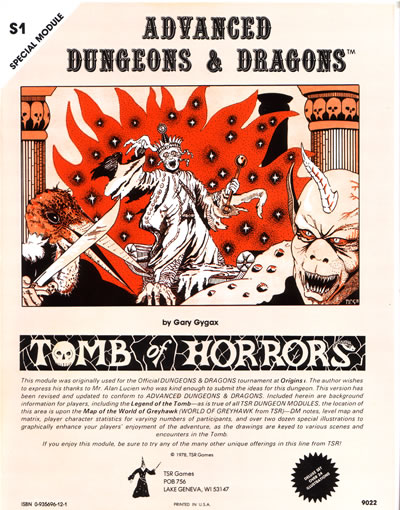
One of the first adventures to be published for Dungeons and Dragons was Gary Gygax’s Tomb of Horrors. Probably more fun to read than to actively participate in, the Tomb of Horrors is a death-trap meat-grinder. Where most adventures are a string of combat encounters strung together by the thinnest semblance of a plot, the infamous Tomb has three combat encounters and dozens of traps designed to kill and maim the greedy, the inattentive, and everyone around them.
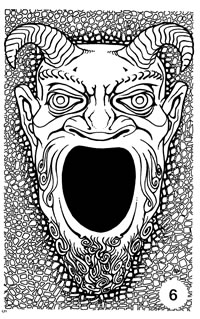 Unique among adventures up to this point, Tomb of Horrors includes a booklet of pictures so that the players can see what their adventurers see. Which is very important given the technicality and lethality of the traps, but also went a long way towards establishing a ‘feel’ that few other modular adventures have. Anyone who has encountered the Tomb of Horrors remembers the Devil’s Head illustration, for example. It has also become a central point for all of the future expansions and revisions.
Tomb of Horrors also saw the birth of the riddling undead archvillain trope. Acererak, whose tomb this is, leaves a helpful hint in the form of a poem, in the entrance of his tomb. This was followed by Keraptis in White Plume Mountain, the Dread Crypt of Srihoz, and various other would-be poets that are found in RPGs with some frequency. This trope, for , but seldom appears in other fictions. Partially, this is because of the interactive nature of the game. A riddle handed to a book or television show character doesn’t require the viewer or reader to figure it out. Which is a pity. I love the trope.
I think the real key behind the Tomb’s popularity is that is was true to itself. Originally envisioned as the location of an evil undead horror that did not want to be disturbed, the traps were lethal (sometimes exceptionally so), and secret doors and passages placed where they were unlikely to be detected. The players/characters were only encouraged to succeed through the corrective of being killed if they weren’t. Without a lot of luck and foresight, they would not succeed. Most adventures point the characters in the right direction with not-so-subtle clues, or hand over the necessary magic item just before it is required. Not so much with the Tomb of Horrors.
Like any good piece of pop art, the Tomb has spawned a number of spin-offs, rip-offs, tributes and homages. D&D has produced a continuation of the Tomb of Horrors at least once per edition, and there have been many imitations, good and bad. For me, they're all wonderful comfort reading. In my head, I can see half a dozen different ways that the characters would react to a trap, and how would they try to avoid it, and what sorts of players' characters are likely to get caught and killed. I find it very relaxing.
When I’m stressed and encounter long stretches when I have difficulty concentrating, I tend to read role-playing game supplements. RPG adventures and setting books don’t require the sustained attention that a novel does.
One of the first adventures to be published for Dungeons and Dragons was Gary Gygax’s Tomb of Horrors. Probably more fun to read than to actively participate in, the Tomb of Horrors is a death-trap meat-grinder. Where most adventures are a string of combat encounters strung together by the thinnest semblance of a plot, the infamous Tomb has three combat encounters and dozens of traps designed to kill and maim the greedy, the inattentive, and everyone around them.
Unique among adventures up to this point, Tomb of Horrors includes a booklet of pictures so that the players can see what their adventurers see. Which is very important given the technicality and lethality of the traps, but also went a long way towards establishing a ‘feel’ that few other modular adventures have. Anyone who has encountered the Tomb of Horrors remembers the Devil’s Head illustration, for example. It has also become a central point for all of the future expansions and revisions. Tomb of Horrors also saw the birth of the riddling undead archvillain trope. Acererak, whose tomb this is, leaves a helpful hint in the form of a poem, in the entrance of his tomb. This was followed by Keraptis in White Plume Mountain, the Dread Crypt of Srihoz, and various other would-be poets that are found in RPGs with some frequency. This trope, for , but seldom appears in other fictions. Partially, this is because of the interactive nature of the game. A riddle handed to a book or television show character doesn’t require the viewer or reader to figure it out. Which is a pity. I love the trope.
I think the real key behind the Tomb’s popularity is that is was true to itself. Originally envisioned as the location of an evil undead horror that did not want to be disturbed, the traps were lethal (sometimes exceptionally so), and secret doors and passages placed where they were unlikely to be detected. The players/characters were only encouraged to succeed through the corrective of being killed if they weren’t. Without a lot of luck and foresight, they would not succeed. Most adventures point the characters in the right direction with not-so-subtle clues, or hand over the necessary magic item just before it is required. Not so much with the Tomb of Horrors.
Like any good piece of pop art, the Tomb has spawned a number of spin-offs, rip-offs, tributes and homages. D&D has produced a continuation of the Tomb of Horrors at least once per edition, and there have been many imitations, good and bad. For me, they're all wonderful comfort reading. In my head, I can see half a dozen different ways that the characters would react to a trap, and how would they try to avoid it, and what sorts of players' characters are likely to get caught and killed. I find it very relaxing.
Tuesday, March 1, 2011
With My Name on the Cover!
I think this is what they mean when they talk about "momentum." Midnight Echo #5, from the Australian Horror Writers Association, is out, with my story “God of Chickens”. With my name on the cover.
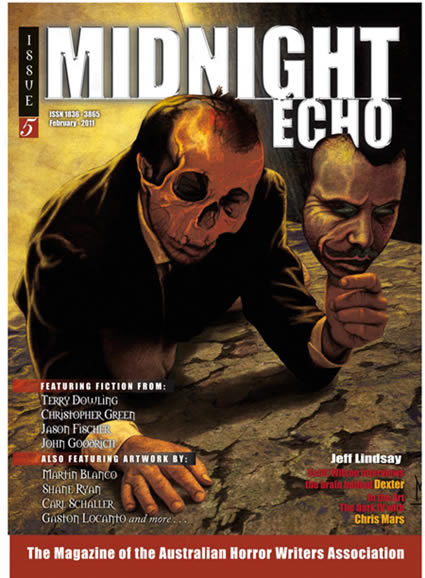
You can order it in PDF as well as print from the AHWA website.
You can order it in PDF as well as print from the AHWA website.
Monday, February 21, 2011
Tuesday, February 1, 2011
Ephermeral Eons...
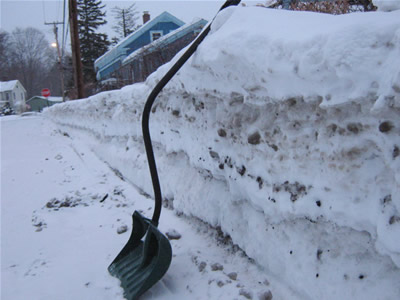
With all the snow, we've developed layers in our snowbanks like a geological cross-section from a road cut through rock. I've enjoyed the study of certain types of ephemera, and wondered if there is any point to being able to learn the layers of snow. "This fall was light and fluffy, but it was later compacted by the action of heavy wet snow and sleet on top of it."
Subscribe to:
Posts (Atom)