Since we no longer have television, we have not been bombarded with Christmas carols to sell us things. And it has been a welcome relief. I mean, sure there's still the stores, and that damned place in the center of town that pipes their carols outside, but so far, there hasn't been that onrushing crush of the same damn carols that I remember for the last thirty years.
This is why Gen X cannot say or write or enjoy anything without irony. We've been bombarded with so many things that are supposed to pull at our heartstrings and thus sell us something. Christmas carols are just an example. We don't have a memory of singing them in a beautiful, reverent way, we remember that they were being cheerily piped at us when we were doing our last-minute holiday shopping at Sears or Wal-Mart. That heart-string has been pulled so many times that it's damned difficult to get a reaction from it anymore.
There are a couple of Christmas CDs that I do play every year, but they're not the usual classics. This is the kind of stuff you'll never hear in a store.
A Very Scary Solstace by the HPLHS. Familiar Christmas carols with rewritten lyrics to acknowledge HP Lovecraft's works. How many songs, let alone carols, do you know have lyrics that refer to NonEuclidian Geometry? Wonderful stuff.
Arrest these Merry Gentlemen by the Kipper Family. This is series of dryly humorous Christmas-related songs by by a rather odd collection of North Yorkshiremen. Hard to find, it takes a little time to appreciate, but is well wort6h the effort.
Sunday, December 7, 2008


Thursday, December 4, 2008
Leaving the Wedding in Tears

Mood: Gruntled

Another new experience. Dark Scribe Press sent me a copy of Unspeakable Horror: Terrors from the Closet, which my story was a bridesmaid (I made the initial cut with an invitation to rewrite, but didn't get all the way to the altar). Dark Scribe Press kindly sent me a free copy. I probably would have picked it up anyway, since I want to read more of Lee Thomas's work. And there's the morbid curiosity of wondering if the stories are better than mine. I know that I cannot be impartial, and that the editors' taste is not my own, but I've been given the opportunity to pick at this particular scab.
It still smarts a bit. The stories are good (I'm only half-way through it), so far the standouts are Michel Scalise's "I am the Shadow that Walks There" and Joy Marchand's "Black Annis." Overall, it's a book I would have been squeeingly happy to be in. But yesterday, that bastard Nick Mamatas told us how every "quiet horror" story ever written goes. Unspeakable Horror contains at least two quiet horror stories, and Mamatas is not wrong.
Also, I see that the horror is a bit less visceral than the story I sent (since renamed "Not an Ulcer"). I hadn't considered that my horror was particularly hard edged, but I can see that the editors were looking for something less gruesome and uncomfortable as my story. And, if I'm honest with myself, better written.
Sunday, November 30, 2008

Beautiful and snowy at my parents' place for Thanksgiving, and yes, this is the view from their living room. The turkey was delicious, the stuffing bad for me, the candied yams so full of butter and sherry that I forgot they were originally tubers.
Of course, Thanksgiving now involves other traditions. This year, my brother and I helped take the lawnmower attachment off his sit-down lawnmower and put on the snowthrower. I'm slightly less handy than a one-armed man without thumbs, but I helped around the periphery.
We had good, traditional Thanksgiving. Much food, enjoyable conversation, and time with beloved family. It strikes me as so very strange that we have the quintessential Thanksgiving: New England, and family that can get together without screaming, sulking, of sniping. For this, and for the reasons behind it, I am extremely thankful.
If you'd like a window into my family's thanksgiving, my brother took many pictures, and posted them to his flickr site.
Monday, November 17, 2008
Professionalism lesson of the day...
Know when to shut up.
Case in point, the fascinating, if incredibly one-sided 'argument' between a group of professional authors and the editor of SNM Horror Magazine.
Case in point, the fascinating, if incredibly one-sided 'argument' between a group of professional authors and the editor of SNM Horror Magazine.
Simon Pegg on Episode 1: The Phantom Menace
"You are so blind. You don't understand, you weren't there at the beginning. You don't know how good it was, how important. This is it for you, this jumped-up fire-work display of a toy advert."
Simon Pegg has articulated my feelings better than I've been able to.
Go buy Spaced and see what all the fuss is about.
Simon Pegg has articulated my feelings better than I've been able to.
Go buy Spaced and see what all the fuss is about.
Thursday, November 13, 2008
Politics and Semiotics
An interesting bit I've heard kicked around the Internet is: "If Obama is elected, the first thing he'll do it take care of his own people."
One concept in semiotics is the level of abstraction, a phrase that assigns a framework to the attributes we assign to an object. What categories we put it into. Obama is; the son of a 'broken' home, the son of a Kenyan, a lawyer, a husband, a male, a world-traveler, a Harvard graduate, a senator, a professor, a father, an admitted former drug user, a smoker, a published author, former editor of the Harvard Law Review, a basketball player, a successful politician, and a human being, a comic-book reader, and a liberal, among many other designations. To single any one out, I think, says a great deal more about the individual interpreting the statement than it does about the president-elect.
One concept in semiotics is the level of abstraction, a phrase that assigns a framework to the attributes we assign to an object. What categories we put it into. Obama is; the son of a 'broken' home, the son of a Kenyan, a lawyer, a husband, a male, a world-traveler, a Harvard graduate, a senator, a professor, a father, an admitted former drug user, a smoker, a published author, former editor of the Harvard Law Review, a basketball player, a successful politician, and a human being, a comic-book reader, and a liberal, among many other designations. To single any one out, I think, says a great deal more about the individual interpreting the statement than it does about the president-elect.
Thursday, November 6, 2008
Review: Apocalypse Now Redux
There’s a certain amount of trepidation involved in reviewing an American classic. Apocalypse Now is extremely popular, regularly placing in most top 50 lists, and even gets a reference in Buffy the Vampire Slayer. It’s one of those 500 pound gorillas of film, most film makers assumed that you’ve seen it.
And I haven’t. Or hadn’t.
First, I should say that I come at it from a different place than most people. I should have read Conrad’s Heart of Darkness before I saw the film, simply because I like to have a bit of background before I take on a classic. However, I have read King Leopold’s Ghost, which recounts the atrocities that happened in the Belgian Congo that form the backdrop of Heart of Darkness. So yes, the majority of the atrocities described in the book (which I haven’t read yet) are based on reality, rather than being metaphorical, which I believe is the assumption. I’ve also read Kim Newman’s novella “Francis Ford Coppola’s Dracula” which mixes his Anno Dracula universe with the experience of creating Apocalypse Now.
Apocalypse Now is an extremely American film. It involves one very American metaphor while employing the central motif of the uniquely American genre, the Western.
Ever since Huck Finn, the river has been a metaphor for life in American literature. The protagonist drifts down the river, and sees all the random places that it takes them, and the strange people they meet. Apocalypse Now utilizes this metaphor of the river as life, merging it with the Greek river Styx, which the dead had to cross over in order to get to Erebus (the name of the boat Captain Willard takes). This is an American journey down the river Styx into Hell.
Additionally, Apocalypse Now is a Western. Ken Hite in his Dubious Shards (yes a secondary source, I need to read the originals) says that the central conflict of the Western is this: Anyone who picks up a gun is a barbarian. Yet only someone with a gun can deal with a barbarian. In the best of Westerns, this leads to conflict for the hero. In Apocalypse Now, Kurtz is repeatedly said to be effective. He was an admirable, civilized man who achieved great things. Yet his actions are so barbarous that the price of victory is too great to be bourn by a civilized nation. Which is why the protagonist, Willard, is dispatched to take him out. The phrase “Terminate... with extreme prejudice” is popularized in this film.
In addition, many Westerns, especially those of John Ford, use the landscape as a character. Ford often uses a sweeping establishing shot of the landscape to establish mood. In the same fashion, Coppola uses the lush Philippine jungle to convey the differentness of the jungle from urban America.
With these two metaphors firmly in place, the film moves very strangely, in what is likely a deliberately surreal fashion, from farce to horror. The majority of the farce is delivered by the famous character of Lieutenant Colonel Bill Kilgore. Kilgore, the epitome of subtlety in character naming, is an arrogant loose canon who gets his men and civilians killed because he uses military means to achieve nonmilitary objectives. Either the narration is right and Kilgore will get through the conflict without a scratch, in which case his invulnerability makes his presence intolerable since he risks nothing while his men risk all, or he is not, in which case he’ll take a bullet off-screen at some later date. He is supposed to represent all that is crazy and wrong with the officers in Vietnam. He seems overly-ladled with insanity and lacks complexity. Yes, he helps the child toward the end of his sequence, which is supposed to be an encapsulation about the contradiction of the way Americans treat war. We’ll gun down enemies, and then help to fix up the wounded. I found him broadly painted, and lacking in nuance.
I find Coppoloa’s hand too heavy on the film. A lot of time is spent showing us the absurdities, and he wants to make sure that we catch them all. Kilgore’s role could have been reduced significantly, giving us a background taste of his madness, instead of a front-row seat. But the sophistication of audiences is different than it was in 1979, we are much more used to picking up minor cues and taking a large inference from them.
The film is at its best when the boat is on the river. We watch passively, with our own thoughts as the fog and green miles pass us slowly by. Coppola evokes mood beautifully utilizing the local jungle and fog. The image of the bomber’s tail sticking silently out of the river is one of the most powerful of the film. Rather than preach at us, Coppola allows the audience to look at this enormous thing that appears out of the mist, and consider what we know about it. Something that cost America millions of dollars, and was crewed by six or seven men. Where are they now? We don’t know. What was it bombing when it went down? We don’t know. How was it shot down? We don’t know. Those questions with empty answers made a stronger impression on me than Kilgore’s Wagnerian madness.
The ending is a bit of a disappointment. Kurtz becomes Frazier’s Corn King, and Willard the one who will kill him and receive the worship of the simple natives. Coppola does not spend any time investigating the culture of these people, but simply allows us to know that a charismatic white man has made himself the local god-emperor. It was a perfectly cricket assumption in ‘79, but it hasn’t aged well for me. Hollywood still employs it, however. In Dances With Wolves, the white man goes native and then shows the Indians how to live their lives, and I didn’t bother to watch the Cruise film where the white man shows the Japanese how a samurai honor should be maintained. This cultural arrogance sticks in my craw.
Apocalypse Now Redux’s perfect metaphor is contained within itself. Like Marlon Brando, it arrives with great ballyhoo, only to show itself bloated and unprepared. While it has some genuinely astonishing moments, they are buried in a lot of self-indulgent rambling.
This is why I don’t review films.
And I haven’t. Or hadn’t.
First, I should say that I come at it from a different place than most people. I should have read Conrad’s Heart of Darkness before I saw the film, simply because I like to have a bit of background before I take on a classic. However, I have read King Leopold’s Ghost, which recounts the atrocities that happened in the Belgian Congo that form the backdrop of Heart of Darkness. So yes, the majority of the atrocities described in the book (which I haven’t read yet) are based on reality, rather than being metaphorical, which I believe is the assumption. I’ve also read Kim Newman’s novella “Francis Ford Coppola’s Dracula” which mixes his Anno Dracula universe with the experience of creating Apocalypse Now.
Apocalypse Now is an extremely American film. It involves one very American metaphor while employing the central motif of the uniquely American genre, the Western.
Ever since Huck Finn, the river has been a metaphor for life in American literature. The protagonist drifts down the river, and sees all the random places that it takes them, and the strange people they meet. Apocalypse Now utilizes this metaphor of the river as life, merging it with the Greek river Styx, which the dead had to cross over in order to get to Erebus (the name of the boat Captain Willard takes). This is an American journey down the river Styx into Hell.
Additionally, Apocalypse Now is a Western. Ken Hite in his Dubious Shards (yes a secondary source, I need to read the originals) says that the central conflict of the Western is this: Anyone who picks up a gun is a barbarian. Yet only someone with a gun can deal with a barbarian. In the best of Westerns, this leads to conflict for the hero. In Apocalypse Now, Kurtz is repeatedly said to be effective. He was an admirable, civilized man who achieved great things. Yet his actions are so barbarous that the price of victory is too great to be bourn by a civilized nation. Which is why the protagonist, Willard, is dispatched to take him out. The phrase “Terminate... with extreme prejudice” is popularized in this film.
In addition, many Westerns, especially those of John Ford, use the landscape as a character. Ford often uses a sweeping establishing shot of the landscape to establish mood. In the same fashion, Coppola uses the lush Philippine jungle to convey the differentness of the jungle from urban America.
With these two metaphors firmly in place, the film moves very strangely, in what is likely a deliberately surreal fashion, from farce to horror. The majority of the farce is delivered by the famous character of Lieutenant Colonel Bill Kilgore. Kilgore, the epitome of subtlety in character naming, is an arrogant loose canon who gets his men and civilians killed because he uses military means to achieve nonmilitary objectives. Either the narration is right and Kilgore will get through the conflict without a scratch, in which case his invulnerability makes his presence intolerable since he risks nothing while his men risk all, or he is not, in which case he’ll take a bullet off-screen at some later date. He is supposed to represent all that is crazy and wrong with the officers in Vietnam. He seems overly-ladled with insanity and lacks complexity. Yes, he helps the child toward the end of his sequence, which is supposed to be an encapsulation about the contradiction of the way Americans treat war. We’ll gun down enemies, and then help to fix up the wounded. I found him broadly painted, and lacking in nuance.
I find Coppoloa’s hand too heavy on the film. A lot of time is spent showing us the absurdities, and he wants to make sure that we catch them all. Kilgore’s role could have been reduced significantly, giving us a background taste of his madness, instead of a front-row seat. But the sophistication of audiences is different than it was in 1979, we are much more used to picking up minor cues and taking a large inference from them.
The film is at its best when the boat is on the river. We watch passively, with our own thoughts as the fog and green miles pass us slowly by. Coppola evokes mood beautifully utilizing the local jungle and fog. The image of the bomber’s tail sticking silently out of the river is one of the most powerful of the film. Rather than preach at us, Coppola allows the audience to look at this enormous thing that appears out of the mist, and consider what we know about it. Something that cost America millions of dollars, and was crewed by six or seven men. Where are they now? We don’t know. What was it bombing when it went down? We don’t know. How was it shot down? We don’t know. Those questions with empty answers made a stronger impression on me than Kilgore’s Wagnerian madness.
The ending is a bit of a disappointment. Kurtz becomes Frazier’s Corn King, and Willard the one who will kill him and receive the worship of the simple natives. Coppola does not spend any time investigating the culture of these people, but simply allows us to know that a charismatic white man has made himself the local god-emperor. It was a perfectly cricket assumption in ‘79, but it hasn’t aged well for me. Hollywood still employs it, however. In Dances With Wolves, the white man goes native and then shows the Indians how to live their lives, and I didn’t bother to watch the Cruise film where the white man shows the Japanese how a samurai honor should be maintained. This cultural arrogance sticks in my craw.
Apocalypse Now Redux’s perfect metaphor is contained within itself. Like Marlon Brando, it arrives with great ballyhoo, only to show itself bloated and unprepared. While it has some genuinely astonishing moments, they are buried in a lot of self-indulgent rambling.
This is why I don’t review films.
Friday, October 31, 2008
A Halloween Treat
I love books. Owing to my recent economic downturn, I've had to curb my book spending (which is nothing like Ellen Datlow's, but still enough to make me wince when I see the credit card bill) recently, but this... this I could not resist.
I also really love well-made books. A hardcover something to be held. I love the feel of the cloth, the solid permanence of what it contains is what a book should be. A book should be forever.
Mary Shelly's Frankenstein is a classic. I've read it several times, and I've never seen a better visual interpretation than Bernie Wrightson's moody line art. Far from the James Whale square-head with bolts sticking out of his neck, Wrightson's creature is beautiful and hideous at the same time, a creature that evokes both the pity and fear that the story evokes.
Marvel published Wrightson's Frankenstein in 1983, but Dark Horse just put out their own version this year. It's a gorgeous black hardcover with a bound-in ribbon bookmark, large enough to command attention on the shelf, no mean trick since Frankenstein is a fairly short novel.
The perfect Halloween treat.
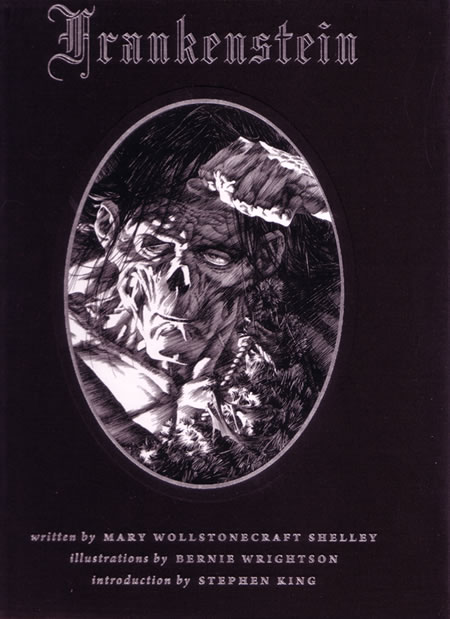
I also really love well-made books. A hardcover something to be held. I love the feel of the cloth, the solid permanence of what it contains is what a book should be. A book should be forever.
Mary Shelly's Frankenstein is a classic. I've read it several times, and I've never seen a better visual interpretation than Bernie Wrightson's moody line art. Far from the James Whale square-head with bolts sticking out of his neck, Wrightson's creature is beautiful and hideous at the same time, a creature that evokes both the pity and fear that the story evokes.
Marvel published Wrightson's Frankenstein in 1983, but Dark Horse just put out their own version this year. It's a gorgeous black hardcover with a bound-in ribbon bookmark, large enough to command attention on the shelf, no mean trick since Frankenstein is a fairly short novel.
The perfect Halloween treat.
Wednesday, October 29, 2008
Aaaand back
Hi. My time wasn't entirely eaten by Spore. I was laid off, and that sort of thing kills my creativity.
To help get it back, I ran a single-shot Call of Cthulhu game. It's been five years since I've run a game, and close to (eeesh!) fifteen since I've run Call of Cthulhu. I spent a couple of weeks mucking with the adventure, a modern, very tangentially Delta Green adventure involving grave-robbing in New York City. It was good to delve into Pagan Pub's rich, horrible, and very 90's background. I drew many threads from their various publications, perhaps too many. The plot involved ghouls, the Karotechia, with a quick visit to the Fate. Although I had only two players, I think it went well. The players have suggested I set up a campaign, which I considered for about an hour. Tempting as it was, it would cut heavily into my writing time. But the instant gratification of not having the story rejected is a tempting one.
Now that I'm basically over myself, I have nothing to complain about on the writing front. Six stories sold (in green), and two have made it past the initial screening process into 'bridesmaid' territory. And at least a couple I shouldn't talk about yet.
To help get it back, I ran a single-shot Call of Cthulhu game. It's been five years since I've run a game, and close to (eeesh!) fifteen since I've run Call of Cthulhu. I spent a couple of weeks mucking with the adventure, a modern, very tangentially Delta Green adventure involving grave-robbing in New York City. It was good to delve into Pagan Pub's rich, horrible, and very 90's background. I drew many threads from their various publications, perhaps too many. The plot involved ghouls, the Karotechia, with a quick visit to the Fate. Although I had only two players, I think it went well. The players have suggested I set up a campaign, which I considered for about an hour. Tempting as it was, it would cut heavily into my writing time. But the instant gratification of not having the story rejected is a tempting one.
Now that I'm basically over myself, I have nothing to complain about on the writing front. Six stories sold (in green), and two have made it past the initial screening process into 'bridesmaid' territory. And at least a couple I shouldn't talk about yet.
Thursday, September 25, 2008
Semi-Intelligent Design

Thanks in no small part to Bear and Walter Jon Williams, I am now playing Spore. It's a pretty fun game. the graphics are good, the sound quality good, and if the depth isn't really there until you hit the galactic civilization, there is a lot of investment in your creation.

Funny thing, Spore has got to be the biggest elevated finger to Intelligent Design and Creationist that has ever been placed in public media. In the initial stage (above), you start out as a fairly simple organism, swimming around in the primeval soup with all the other simple organisms. You swim, eat, find special DNA prizes, and if successful, reproduce into something with more advantages. It was here that my little guys acquired their defining trait that becomes useless at later stages, but I never removed them. Their back spikes. And thus, the Spiketagenet was born.

At the end of the Cell stage, you acquire legs, start running around on land. You get to assemble yourself a herd/pack, and then make friends or meals of the rest of the indigenous wildlife. I chose 'herbivore' and stuck to it. I've been playing a lot of games about killing people recently, and decided I wanted to be more constructive. It's during this stage that the Spiketagenet changed the most, from a four-legged critter to something bipedal. the duck bill was the first mouth I was offered, and I started to like them. The back spikes are completely useless at this point, but I got sentimentally attached to them (they'll never use chairs).

There's a fair amount of messing around with the DNA to get the creature to do what you want. Some feet have stealth, others allow you to charge. Some hands have claws for fighting, some are better at gathering fruit. And there's a nice amount of variability as to size and splay of feet.

In the end, you get a creature that you have built, and I think that's a big thing for me. Here's this thing I have created, guided through the water to its first faltering steps onto land, watched its relatives get sucked up into UFOs (which I later did when I got space drive), adapted to different conditions, and created in an image I thought was interesting and useful. But as he shows his back, you can still see those vestigial spikes, from when the species was a swimming group of cells in the ocean. The eyes on tentacles have been something from its earliest stages, too. Not that this seems to affect how they work in space, but it's kind of cool to look at them and have all that history. I think that makes each creation endearing. I'll find out when I start again.
I also notice that on my first run, I'm staying pretty anthropomorphic. Two legs, two eyes, and even if it doesn't have a head, it still has a pretty human face. Maybe next time, I'll make a race of omnivorous space-faring octopoids.
So, Spore gets a couple of prehensile thumbs up from me.
Subscribe to:
Posts (Atom)