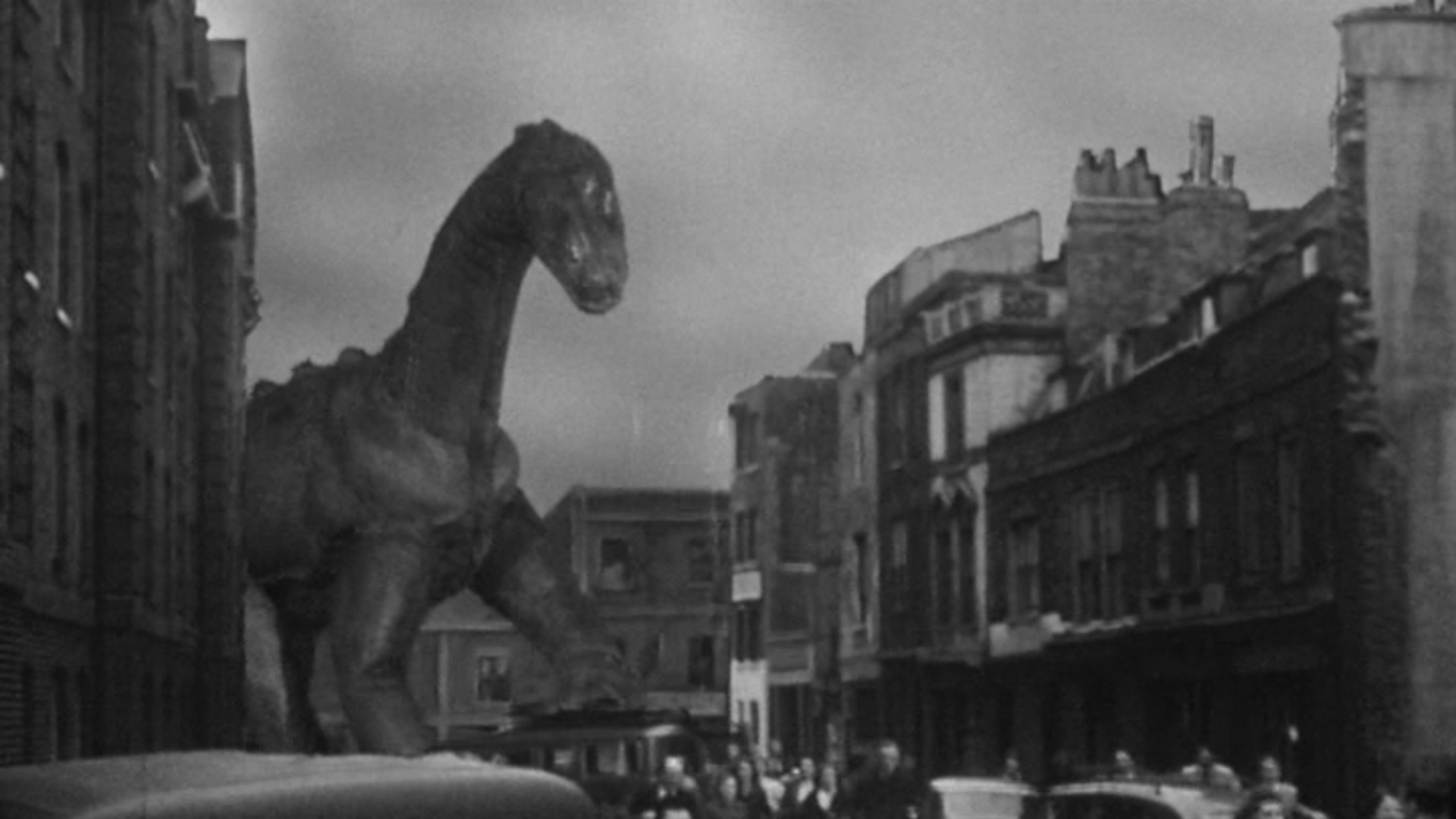
Thursday, August 22, 2013

Godzilla Gets a Worthy Foe: Ghidorah, the Three-Headed Monster

The first thing that I noticed is that structure for 1964's Ghidorah, the Three-Headed Monster is very different from the previous films. For the first time monsters work together. Mothra, Rodan, and Godzilla fight each other, and then, realizing Ghidorah is a greater threat, join forces to defeat him. Godzilla is, for the first time, really a member of an ensemble cast. He's nothing special, compared to Rodan, and cannot take on Ghidorah, even with help from Rodan. The real powerhouse here is larval Mothra, who doesn't play macho games.

The invasion from outer space trope hasn't yet been fully formed. That would come next year, with Monster Zero. Instead, the film starts off with a 50's UFO cult in which Naoko, our woman reporter is the only non-believer. Her negative waves have prevented an anticipated communication from the stars. It's no coincidence that she is up against a group of male leaders.
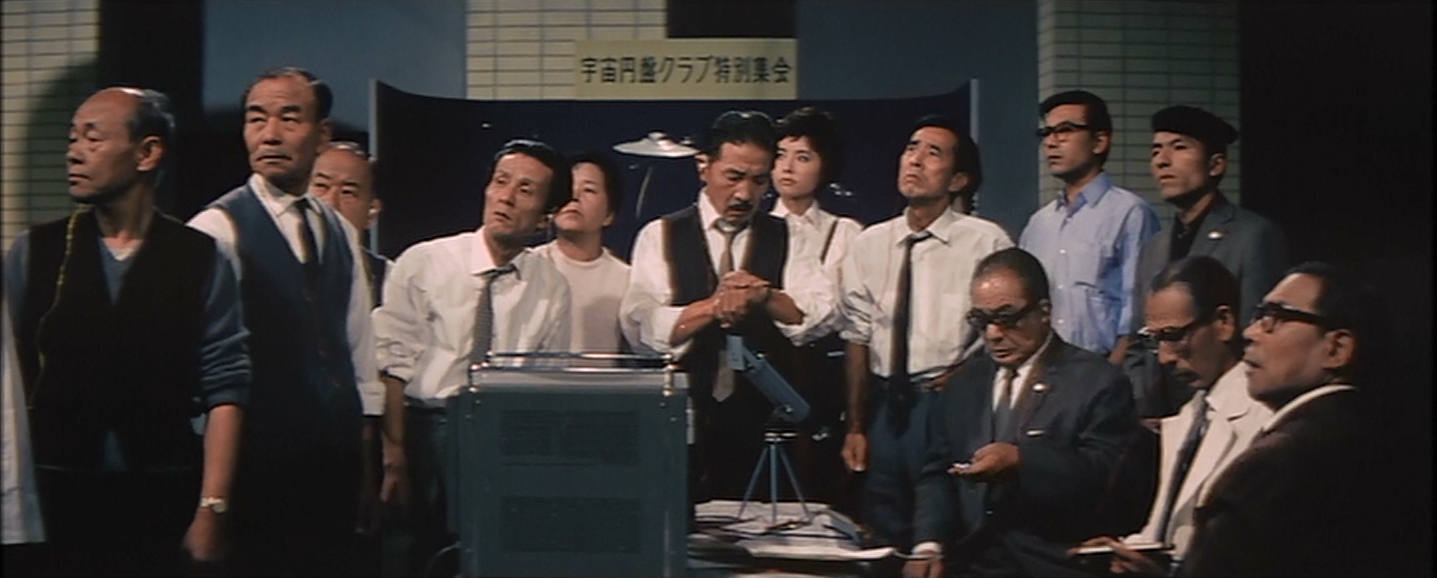
The sign explicitly states that they are not a creepy cult.

Further, Princess Salno, of Selgina, which seems like a Middle-Eastern nation, is coming to Japan, and our manly Detective Shindo is assigned to covertly keep an eye on her. This is, again, the beginning of a creeping James Bond-style spy thriller plot that will surface periodically in the franchise. After this, actress Akiko Wakbayashi would play a spy in the Bond film You Only Live Twice. Detective Shindo falls in love with her after viewing her photograph (it's not the jewelry she's dripping with in the photo, I'm sure!).
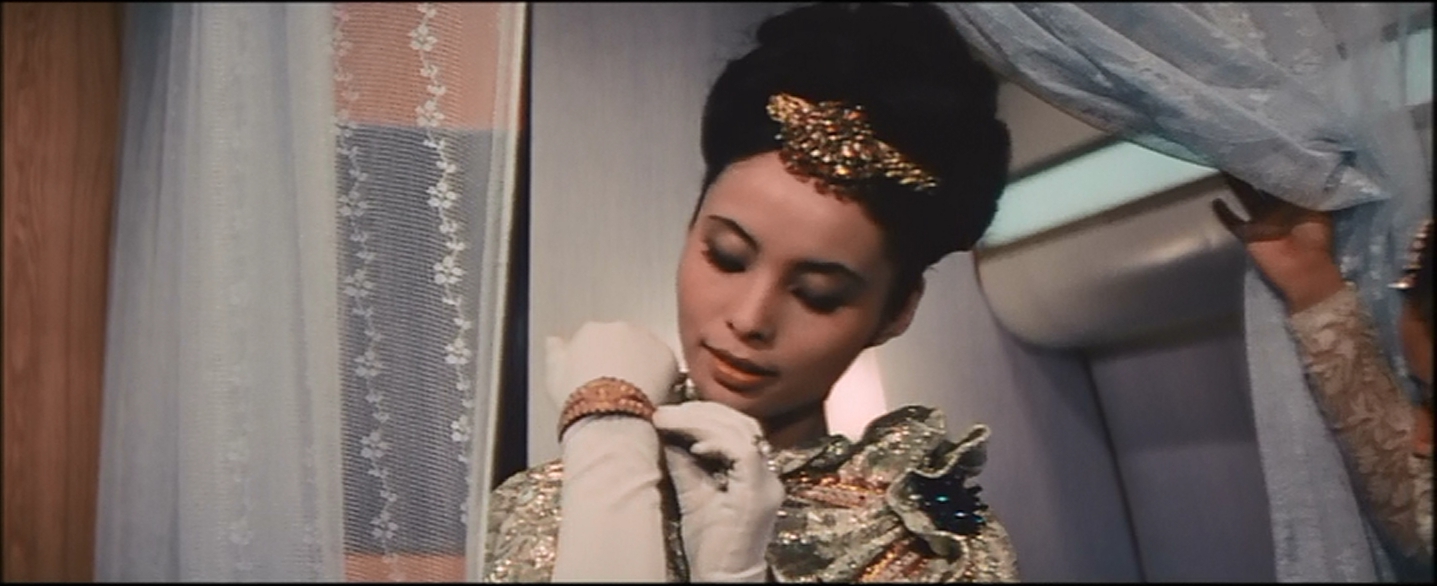
Prrrrrrrrincess...

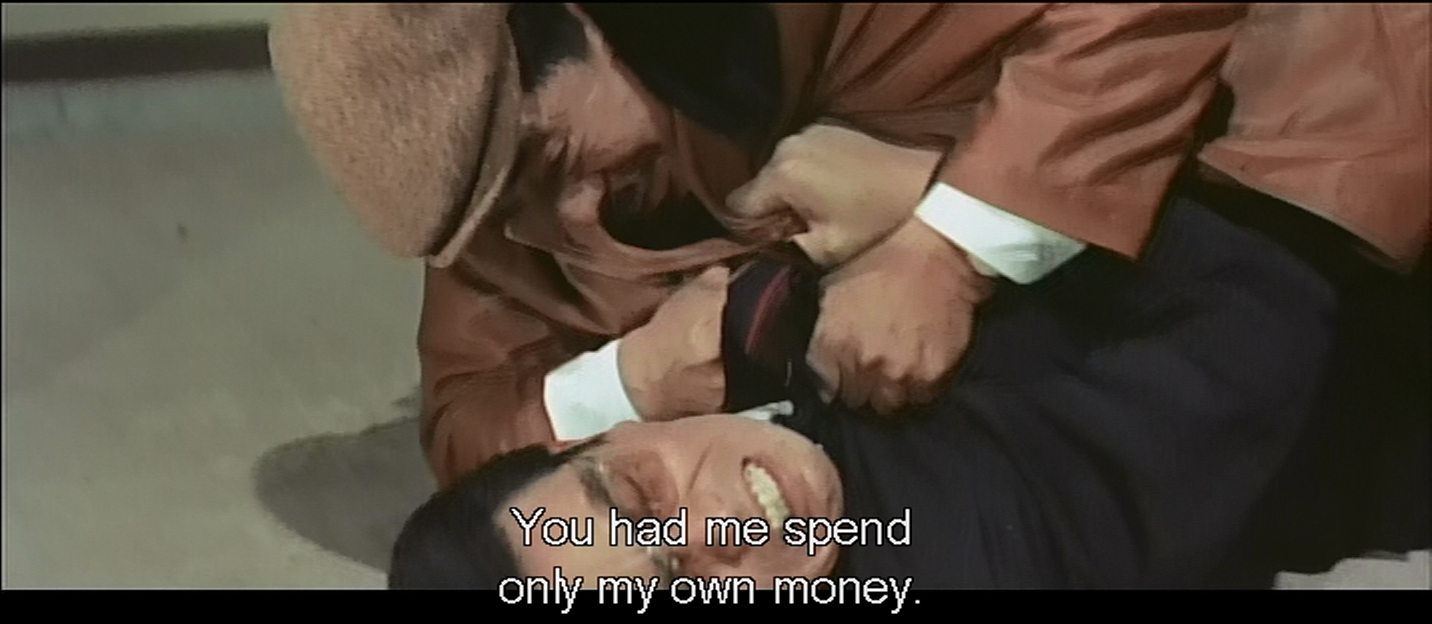
Aside from Ghidorah himself, the main antagonist is Malness, an assassin sent from politically unstable country of Selgina to kill the princess. He's a cold customer who never removes his sunglasses, and manages to be threatening, even while wearing a ridiculous white ruff in his first scene. His car gets buried under an avalanche, but he gets out and keeps on gunning for the princess. Even our detective can't lay a glove on him, but his end comes in another avalanche caused by the conflict of the giant monsters.
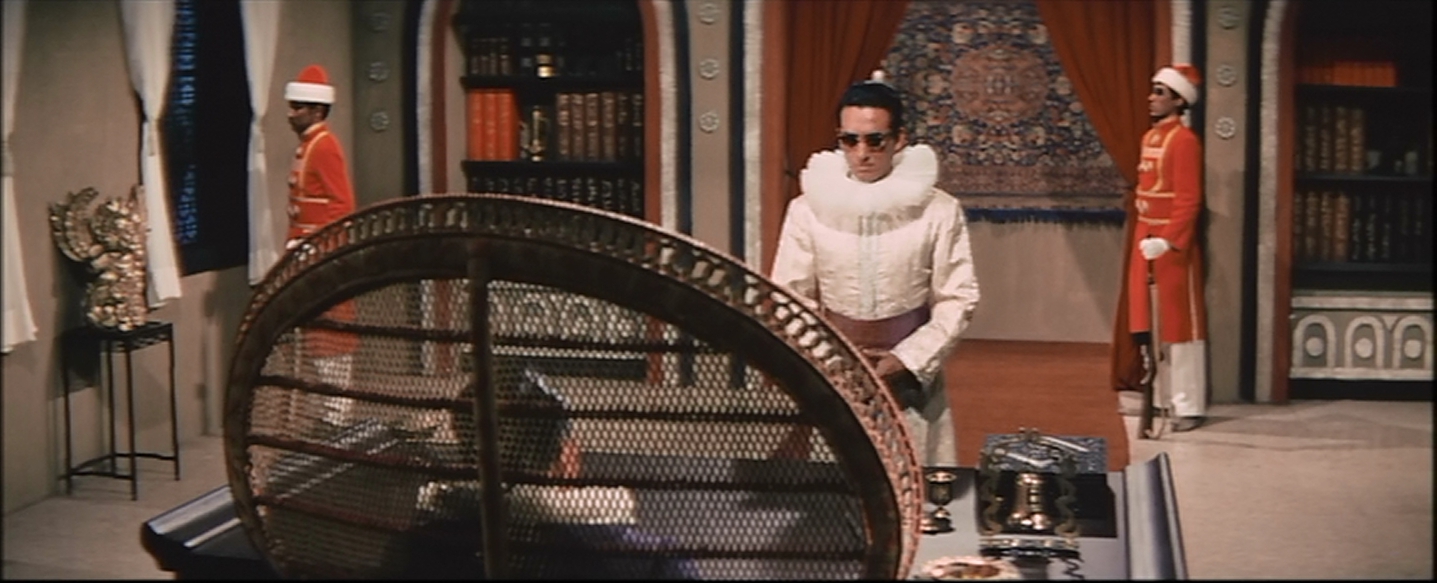
Malness.  Clown or unstopable badass?

This is also the first Godzilla film with any sort of psychic phenomenon. Later, the longest-running recurring character in the franchise will be psychic Miki Sagusa from the Heisei series. In fact, Godzilla vs Biollante seems to take a lot of its tone from this film; spies, psychic powers, and fictional Middle- Eastern countries. Anyway, Princess Salmo is posessed by a Venusian consciousness, and sets out to warn the world that Ghidorah is coming, and that he will destroy the world. In the backstory, we learn that Venusians came to Earth five thousand years ago, and interbred with humans, whose descendents lost their ability to see the future.

The film also features the recently-completed Kurobe Dam, an engineering feat that remains the largest hydroelectric dam in Japan. Toho knew its monster films were being exported, so it would not surprise me if this was a deliberate moment of nationalist pride.

This film also involves Mothra, so the Shobijin fairies also make an appearance. David Kalat points out that this, the Peanuts last appearance as the Mothra fairies, is radically different from previous appearances. In the last two Mothra-related films, the Shobijin have been kidnapped. Here, they appear, by request, on a television show, and are treated with respect and deference. And a good thing, too, since Mothra is a pivotal character in Godzilla's heel-face turn. As per usual in a Mothra film, there's a brushstroke of religion, here provided by the Venusian-posessed Princess, who prays for the world to be spared. Unfortunately, as she does this, she becomes an immobile target for her assassin. Good thing Malness learned to shoot at Stormtooper school.
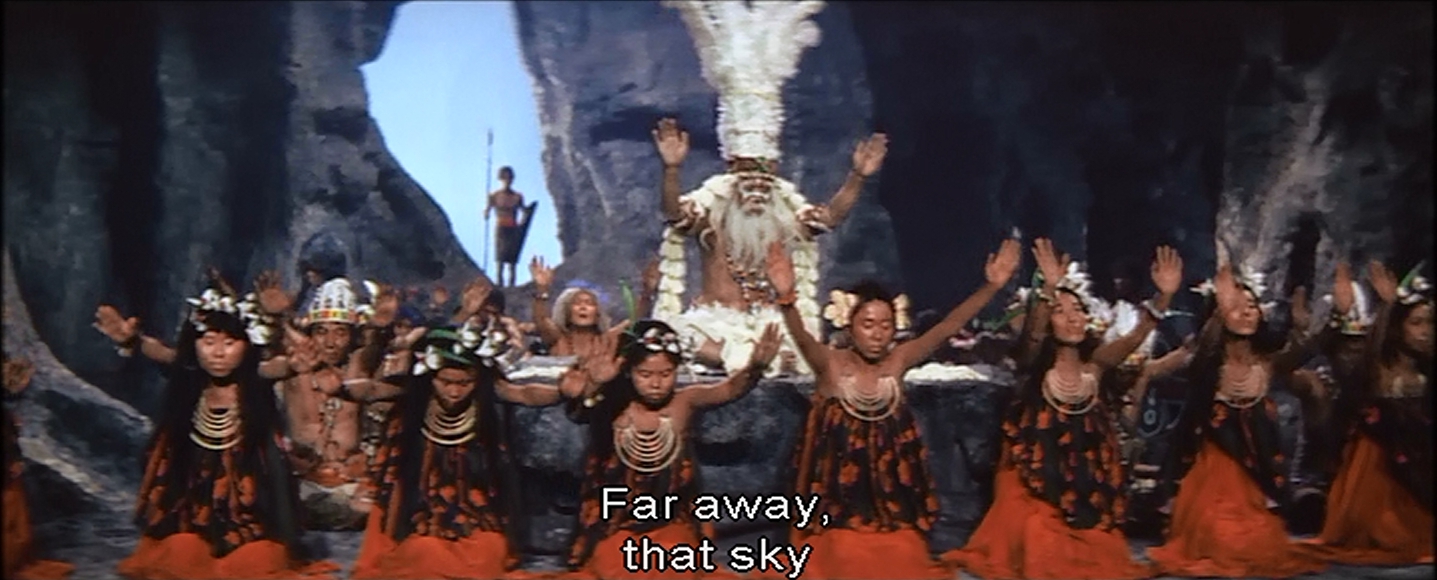
We shall conquer the forces of destruction with the power of my Big Damn Hat!

This is also Mothra's first appearance in which she does not become the giant moth version. Oddly, we don't see what happened to the other Mothra larva. The last film ended with the two larvae swimming towards Infant Isle.
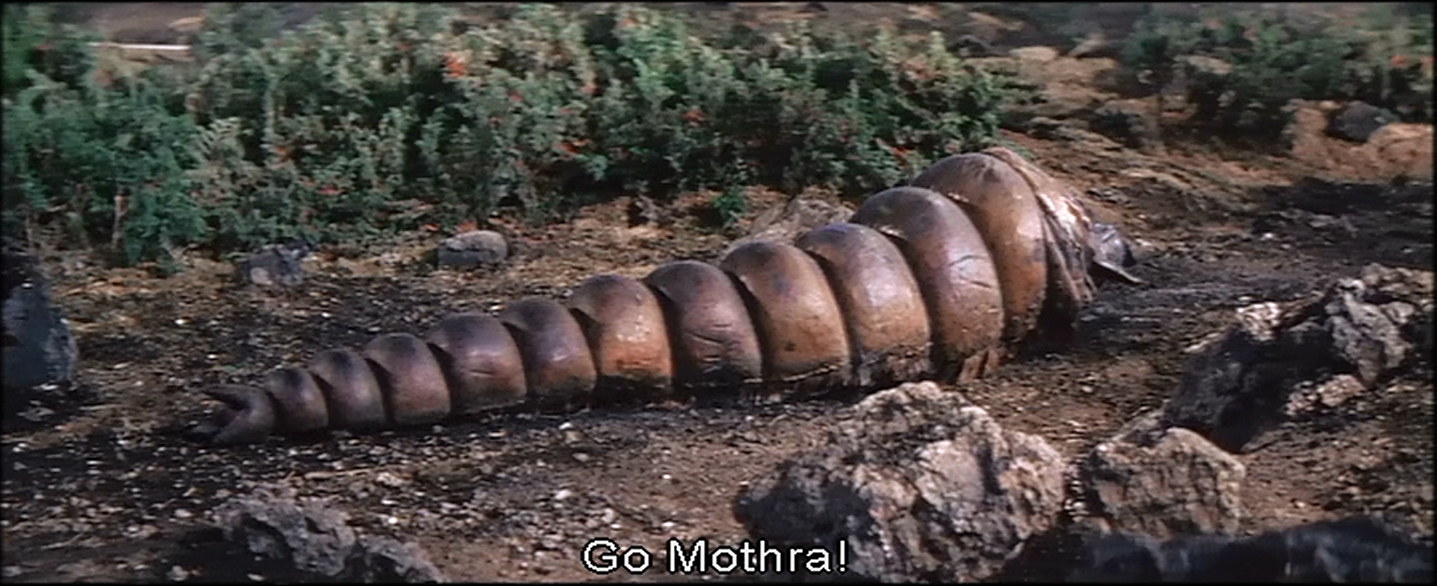
My hypothesis?  This one ate the other one.

Godzilla and Rodan are humanized in this film to make them more sympathetic. Godzilla and Rodan talk with each other, and Godzilla takes a couple of shots to the groin. Seeing him take a humiliating blow like this makes the audience more sympathetic. When Mothra attempts to get the monsters' attention, she sprays each one with her silk. When Godzilla gets a facefull, Rodan yucks it up. When their roles are reversed, Godzilla has a good laugh. These point to a growing desire to make the, characters, ratehr than just rampaging plot points. Godzilla demonstrates a capacity for sympathy. When Mothra fails to convince the other monsters to fight Ghidorah, she sets off to do so alone, and gets smacked around. Godzilla and Rodan won't stand for that, so they join forces and attack.
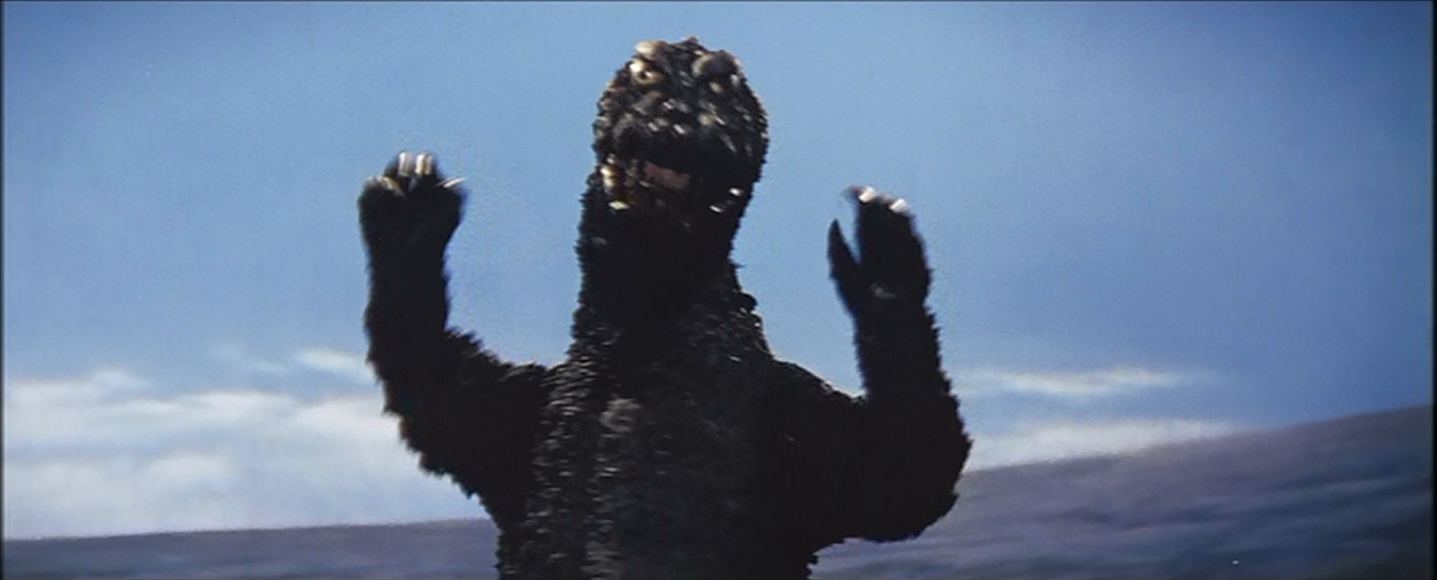
Godzilla shows his sensitive side.

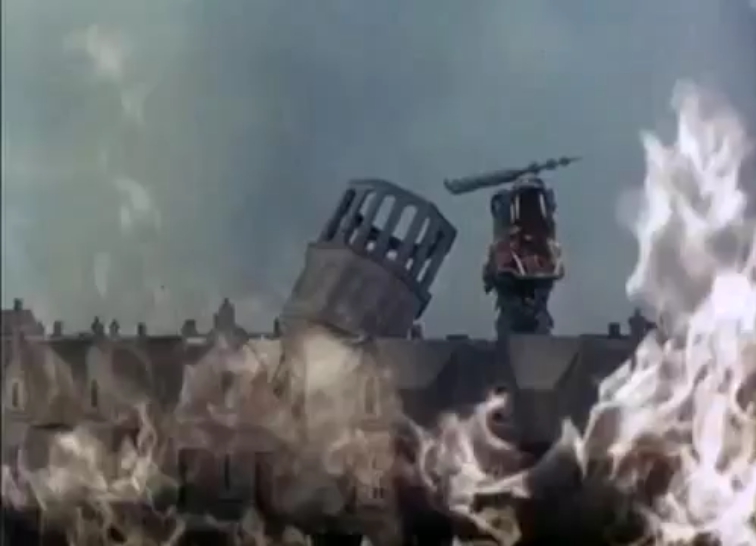
Ghidorah is thoroughly and well built up. He destroyed Venus, and now he's coming to destroy the Earth. Some of the Venusiam Princess's best lines are her prophecies of destruction. We ate treated to portentious fireworks display before the three-headed monster hatches from his meteor/egg. And although no one-really listens to the Venusian prophet, the name she gives the monster is instantly adoped by the local government. And we know Ghidorah is bad, because the very first thing he does is blow the roof off one of Japan's remaining castles! He gets a very good sequence of flying over a city, indiscriminately blasting the crap out of it. This film shows Ghidorah as an evil menace, even in a franchise filled with evil menaces.
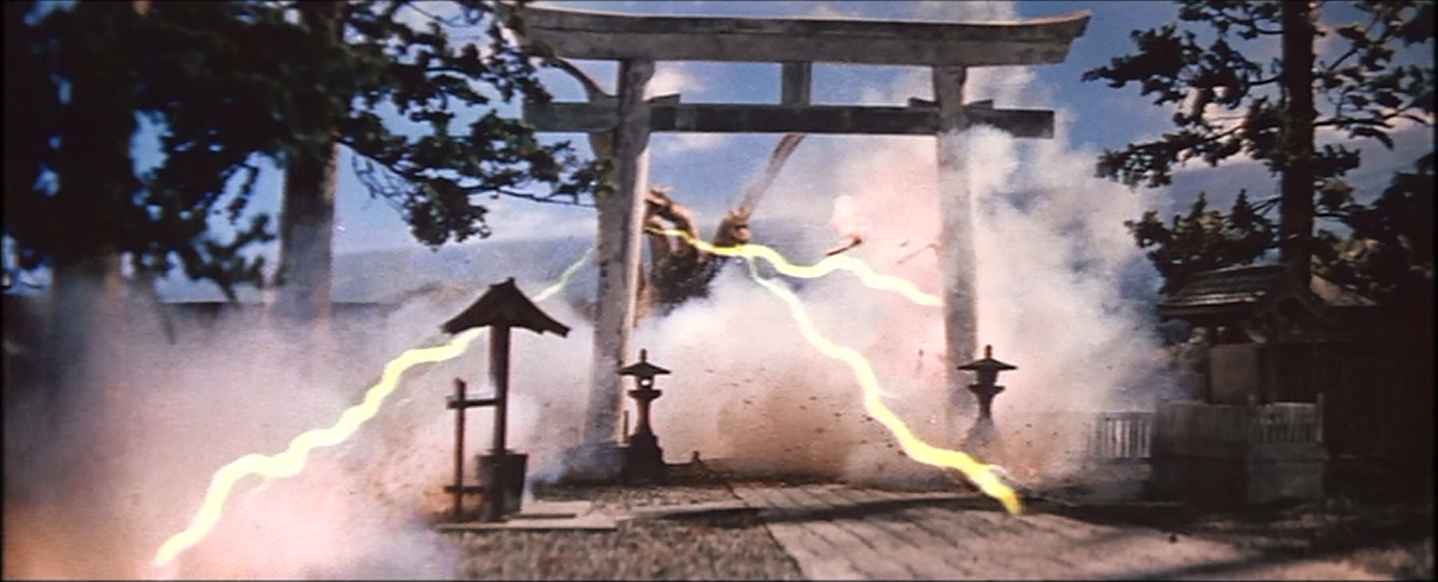
Ghidorah SMASH!

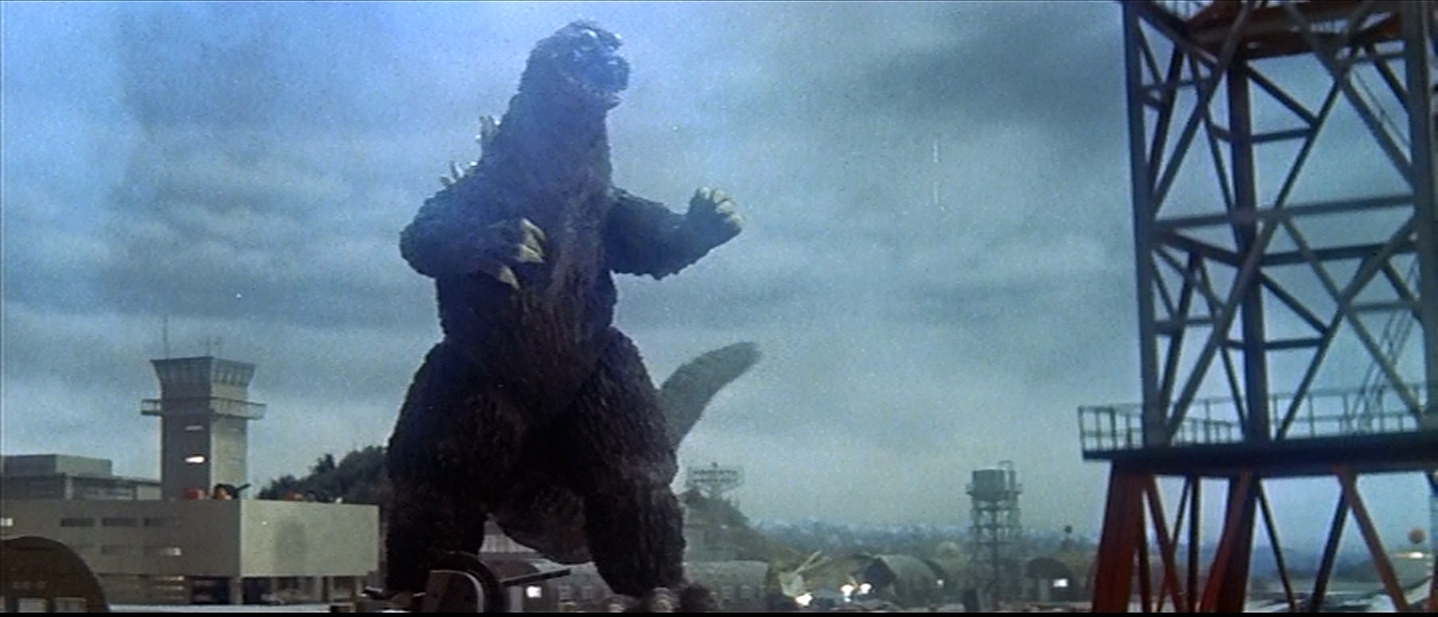
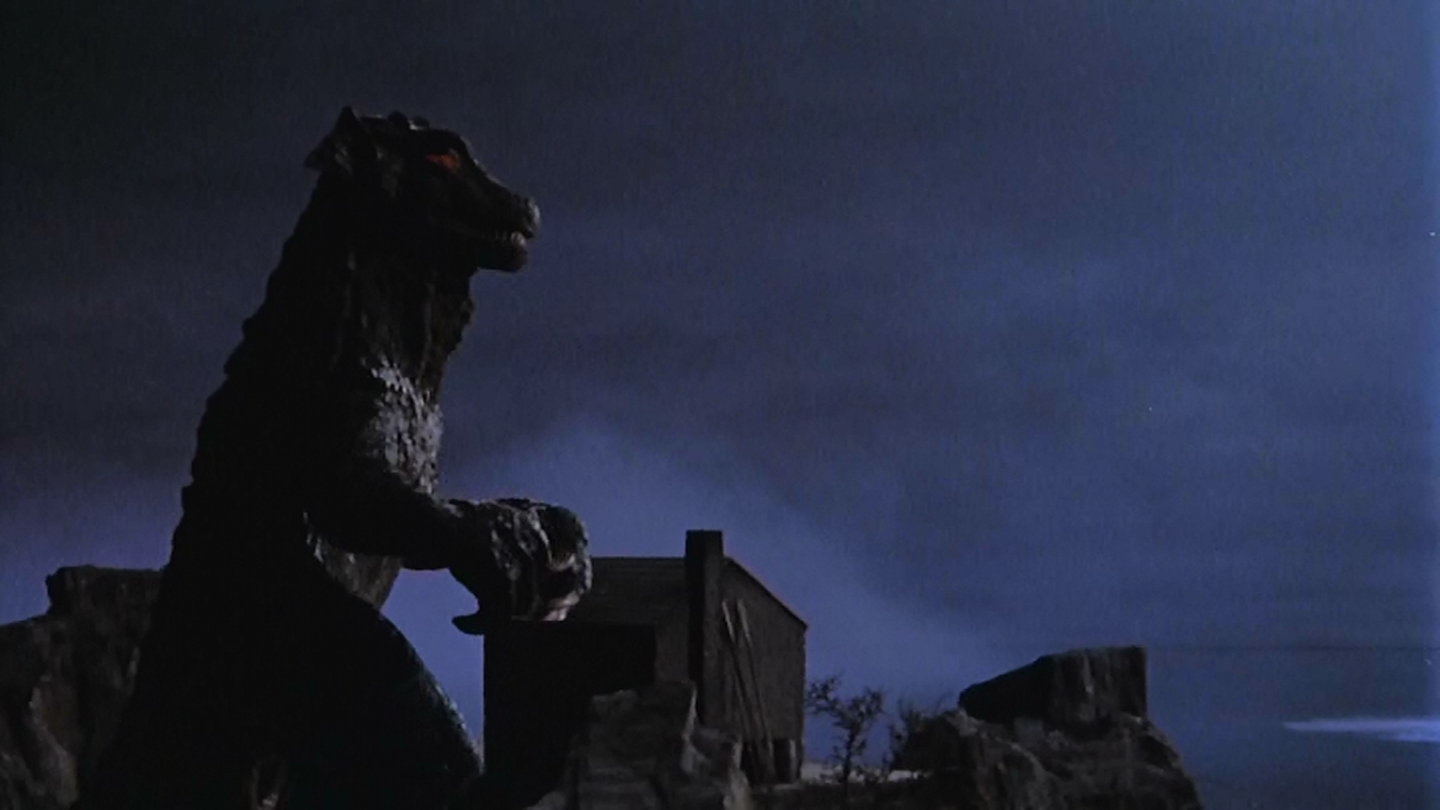
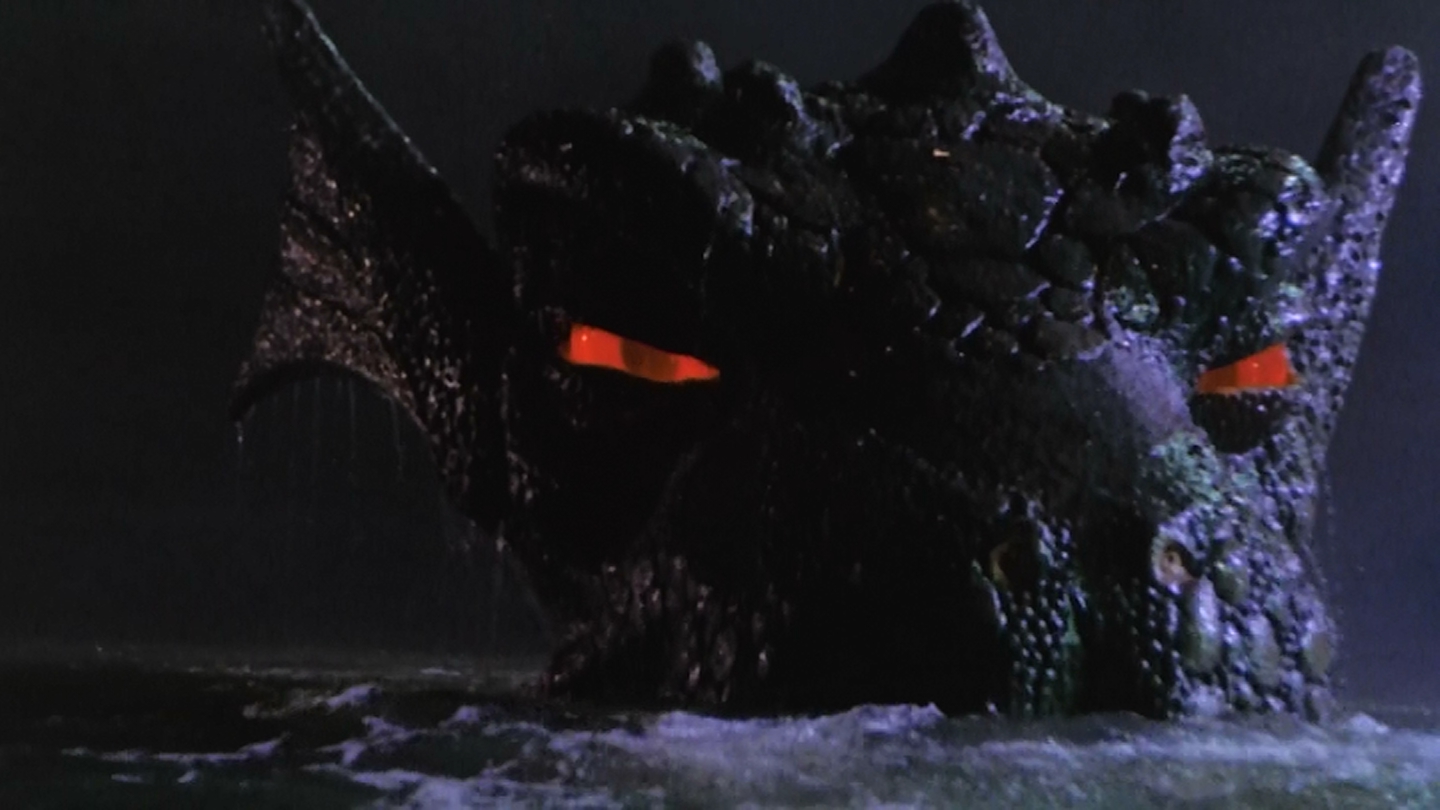
There are, as usual several different Godzillas. It seems that the suit from Godzilla vs Mothra is used when Godzilla rises out of the sea, probably because the special effects team didn't want to expose the current suit to deterioration due to submersion in water. Again, there is a long-shot with the Godzilla puppet (I've noted at least one of these scenes in King Kong vs Godzilla as well as Mothra vs Godzilla). Puppet scenes are generally have Godzilla in the far backgroud. They are easily notable because the arms move as a whole from the shoulder, something the suit has a lot of difficulty doing. This is, of course, difficult to show in a still.
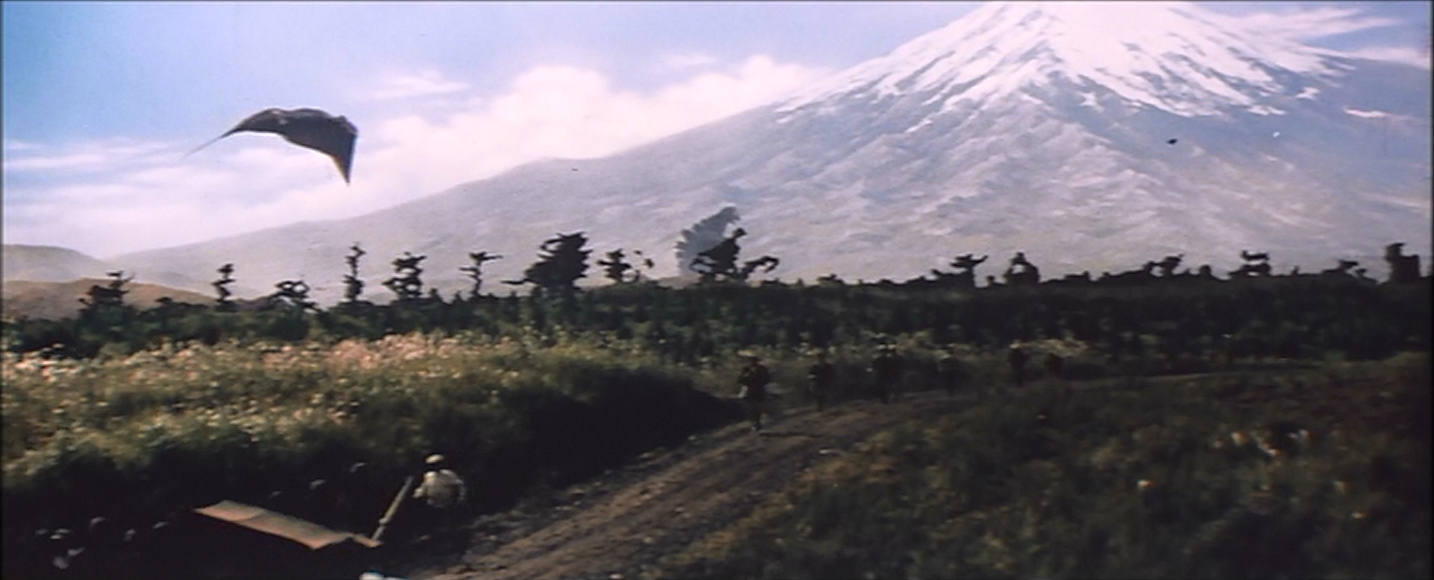
The Godzilla puppet.  It's more obvious in motion.

Godzilla's breath is surprisingly ineffective. And he doesn't use it against Ghidorah, only Rodan. Like Anguirus in Godzilla Raids Again Rodan just shrugs off two blasts of Godzilla's breath. It works on the puny constructions of humans, Godzilla lights a bunch of stuff on fire, but apparently, it's just not working against Rodan today.
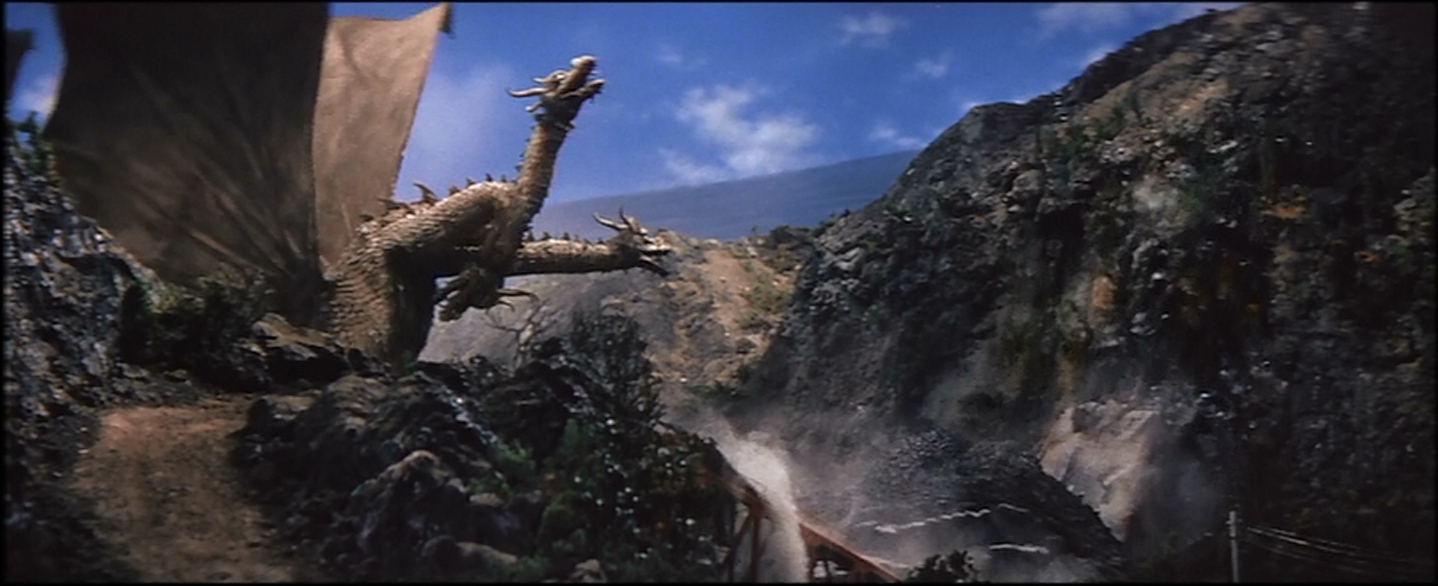
And down goes Godzilla, bridgework and all.

This movie has the exceptional bonus of two different monster fights. The first involves Godzilla and Rodan as antagonists, and the second has Mothra, Godzilla, and Rodan ganging up against Ghidorah. Godzilla vs Rodan is mostly played for laughs, but it's a good monster fight, despite the brief descent into rock-throwing. The real treat is the battle against Ghidorah. Even Godzilla and Rodan together can't keep Ghidorah down. Larva Mothra has to save the day with her silk.
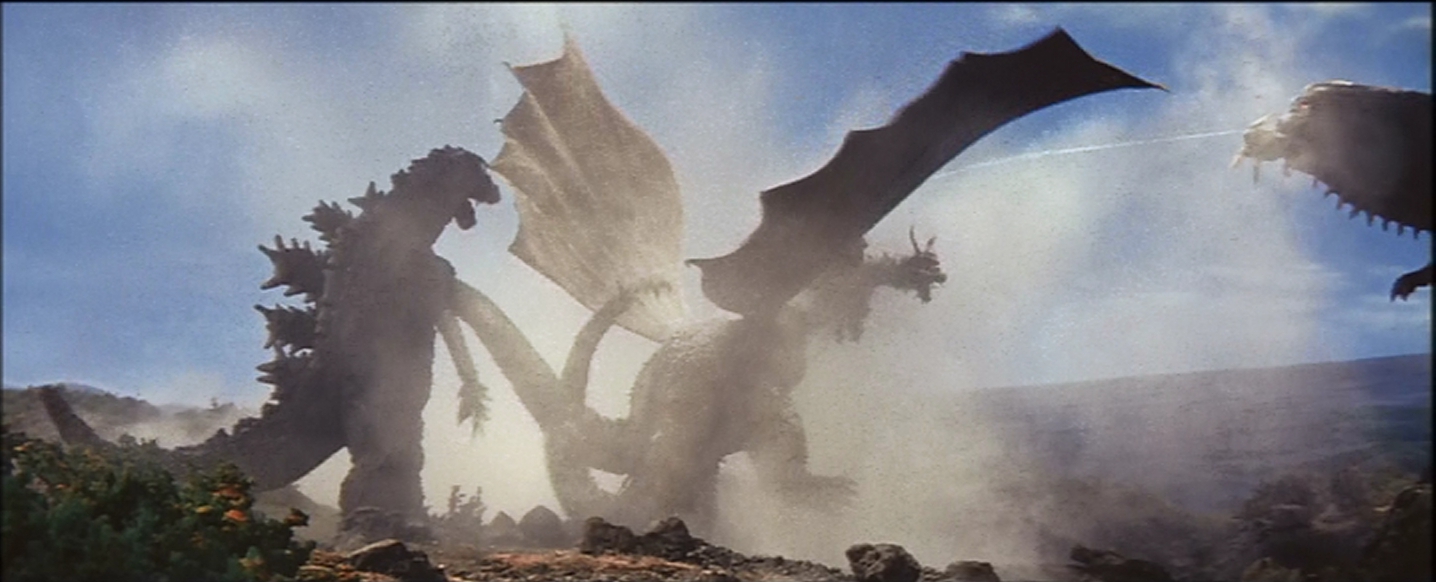
An battle the likes of which will not be seen until Destroy All Monsters.

Toho, or at least director Ishiro Honda and screenwriter Shinichi Sekizawa, knew the value of a good monster. With the money flowing freely, they knew better than to kill off such a useful opponent. Ghidorah is defeated, but flies off, ready to engage our familiar monsters once more.
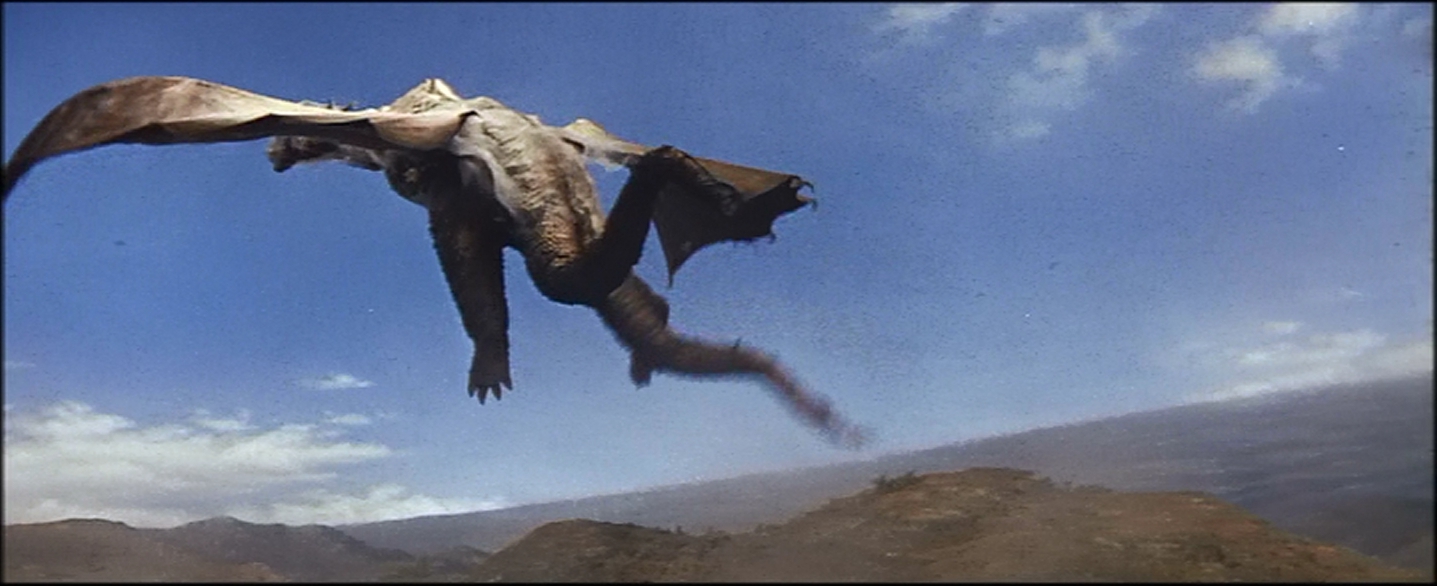
I'm sure there's a curses foiled again in monster dialog as Ghidorah flies off.

It turns out, we only have to wait a year before he turns up once more. And when we advance the clock to 1965, another studio decides to horn in on that sweet, sweet monster movie money.

Thursday, August 15, 2013

Godzilla and the Island God: Mothra vs Godzilla

As a monster, Mothra is weird. It's a moth. Moths are delicate. So what's this gigantic moth doing facing down the King of the Monsters all by herself? We have to remember a few other things about Mothra. In her 1961 debut, Mothra was decidedly different from other monster films. Unlike Godzilla, Varan, and Rodan, who were relics of the past awakened to wreak havoc on mankind, Mothra is worshiped as a living god by the people of Infant island. Mothra also has twin miniature fairy girls, the Shobijin, to speak for her, giving her understandable motivations. Like Gorgo, released the same year, the first Mothra film allows the monster to walk away from its confrontation with humanity. Also unlike Rodan, Varan, and the Big G, Mothra is brightly colored, with red and yellow on her wings and luminous blue eyes.
Christ-Symbol Moth vs Giant Radioactive Lizard.

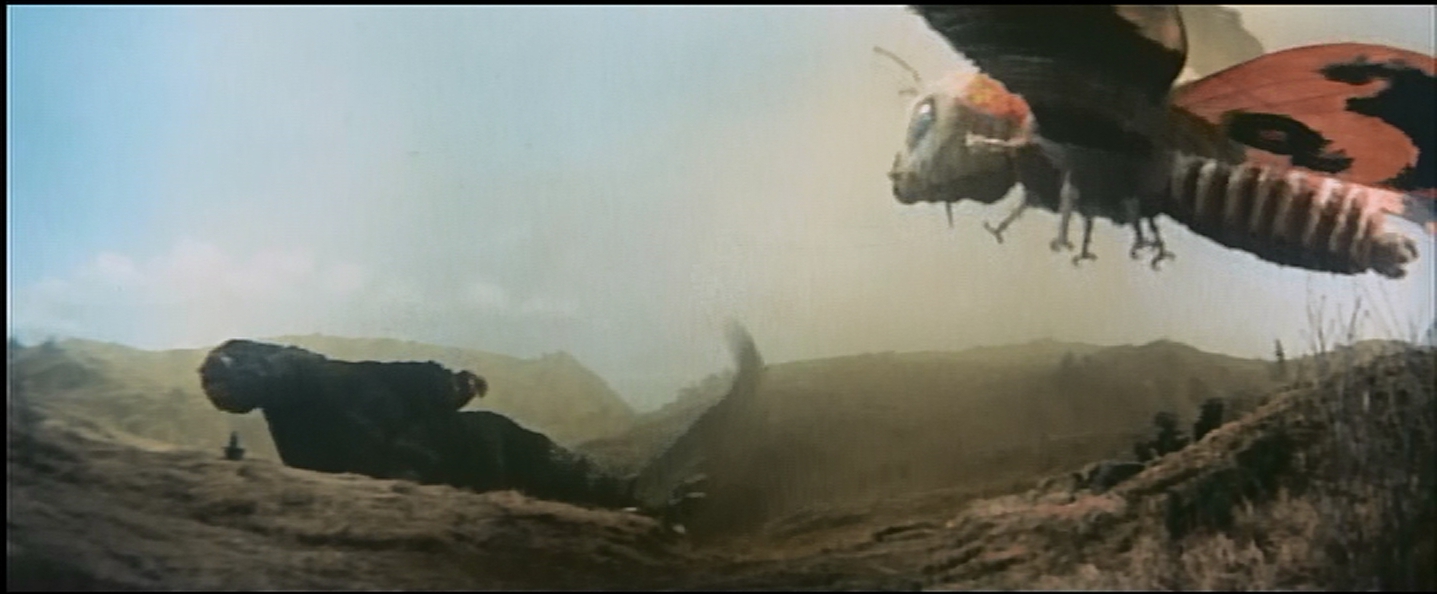
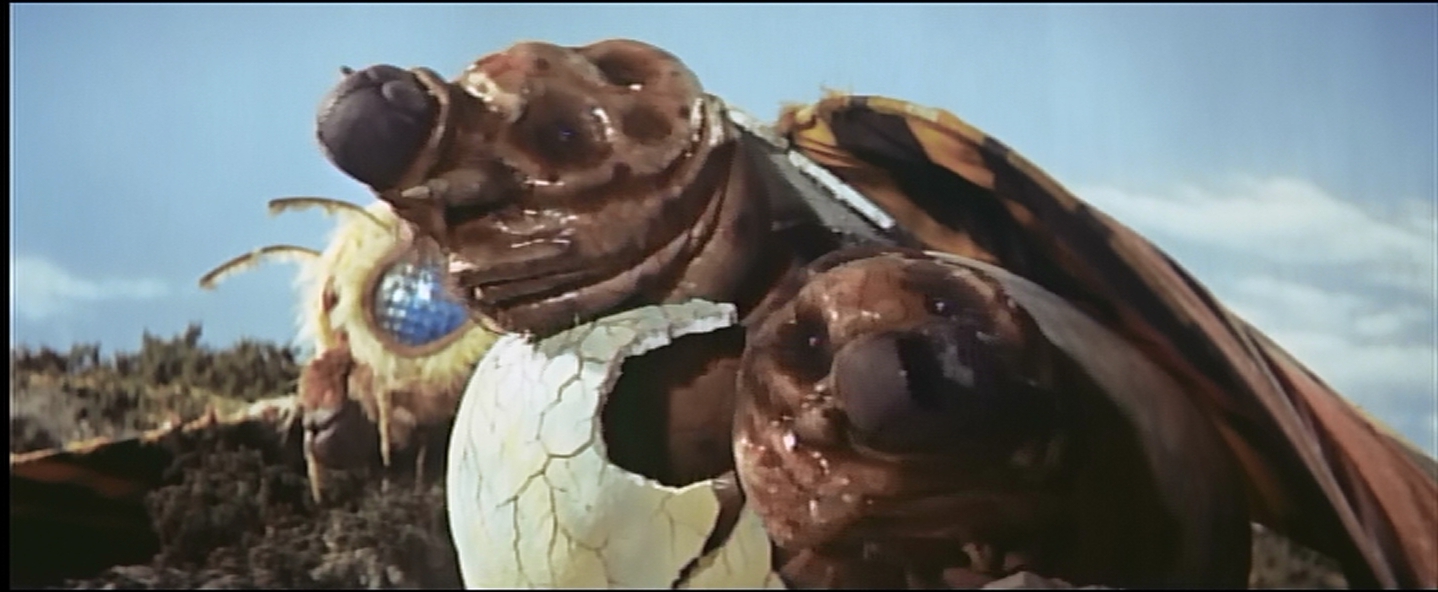
Mothra's human-like motivation and compassion are demonstrated when it becomes clear that she will sacrifice herself for others. Mothra does not expect to come back from its mission to fight Godzilla, but fight even though humanity has refused to help her not an hour ago. In an expansion of her previous powers, Mothra deploys her poisonous powder, a weapon of last resort from a dying monster. Amid a thunderous rendition of her theme, Mothra dies minutes before her egg hatches. In keeping with the twins theme, and possibly in honor of the Peanuts, a rare set of Japanese twins, the egg hatches into a pair of Mothra larvae.

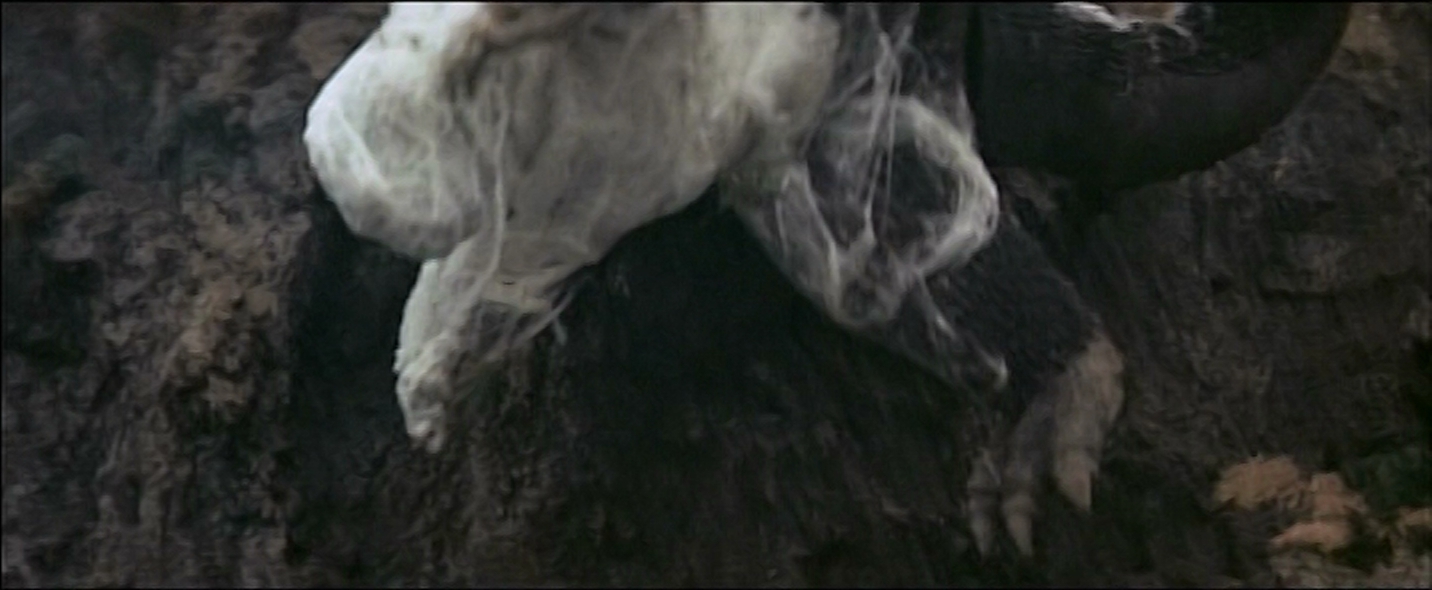
With a nearly Shakespearian sense of tragedy, the larvae hatch from under dead Mothra's giant wing.

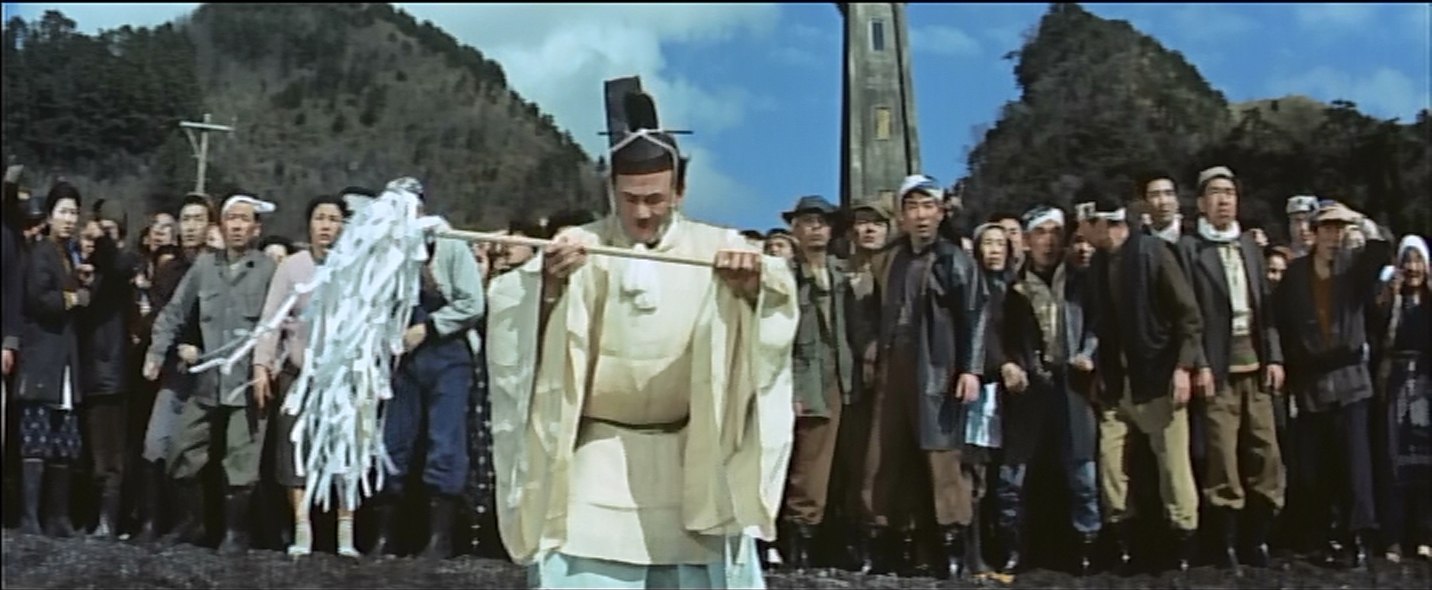
Mothra films also involve themes that other Kaiju fulms tend to neglect, from religion to the role of women. Junko is a woman photographer, apparently new to the job, but whose photographer's eye catches the important detail in the midst of the debris in the opening sequence. She doesn't do much other than follow the protagonist around and notice things for the rest of the film, but at least she's there, and she's doing something. In a nod to the religious motifs of the first Mothra, we see a Shinto priest go out to banish bad spirits when the giant Mothra egg drifts into the luckless village. Obviously, he should have driven away the greedy industrialist.

Bless this gigantic egg.  Or something.

Despite Mothra's innovative nature, Mothra vs Godzilla is essentially a retread of King Kong vs Godzilla. A monster from another franchise challenges Godzilla. The similarities between Kong and Mothra are quite apparent, each is a living god to an island-swelling people, each is more thoughtful than the Godzilla-style monster of rampage and destruction. The worshippers of Infant Island seem more Pacific Islander than the ones from the previous film. And their chief may have the most impressive hat in all of moviedom.

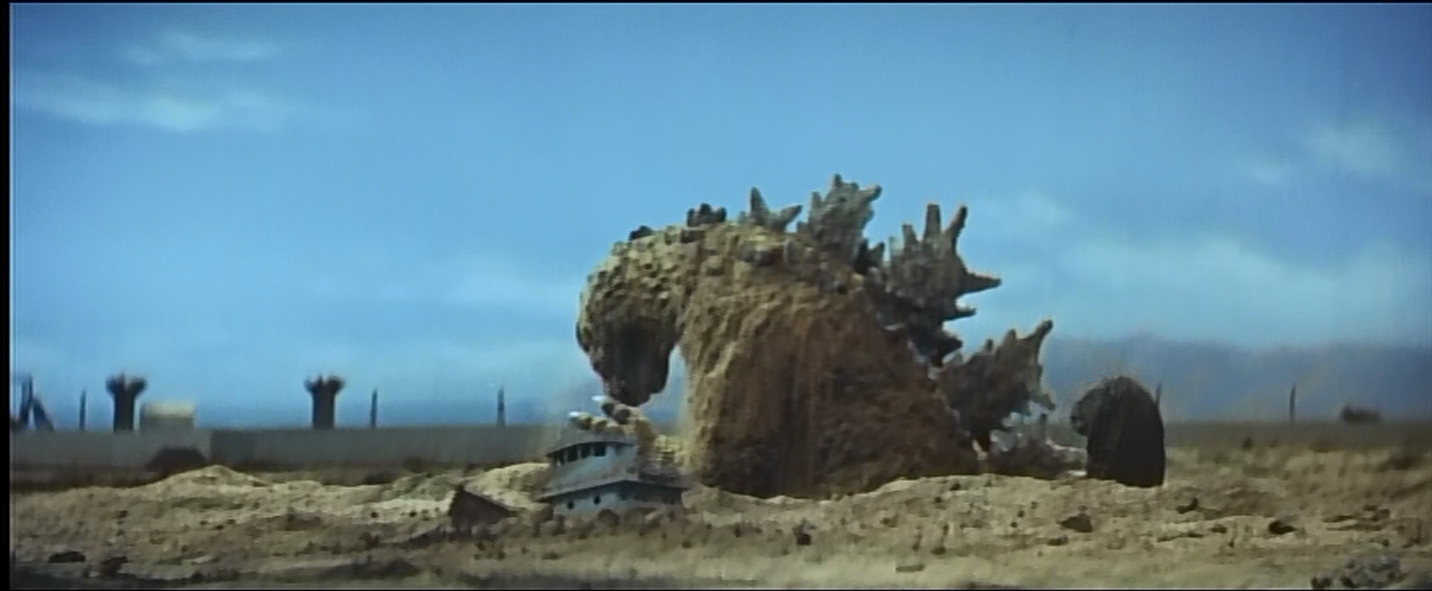
This is one of the few films in which Godzilla does not come directly from the sea. Instead, he wakes up on the beach, after being washed ashore and buried by the typhoon at the beginning of the film. Of course, he immediately begins destroying everything in sight.

Let's shake some dust.

Although the film eschews the humorous edge of King Kong vs Godzilla, it has a few funny moments, such as when Godzilla gets its tail stuck in a tower. Reporter Jiro is constantly being told about the Mothra egg as he eats a hard-boiled egg. The addition of humor to relieve the grim nature of the film will play a larger role in future Godzilla films.

The human plot is OK. Reporters are once again present to show the truth, and cut through the industrialists' lies. We have not just one greedy-head but a pair of them who receive morality-play justice. After they quarrel over money, one shoots the other in the back. The survivor then attempts to haul a heavy load of money out of a hotel as Godzilla approaches. He doesn't get out in time.

Only a fool fights in a hotel when Godzilla approaches.

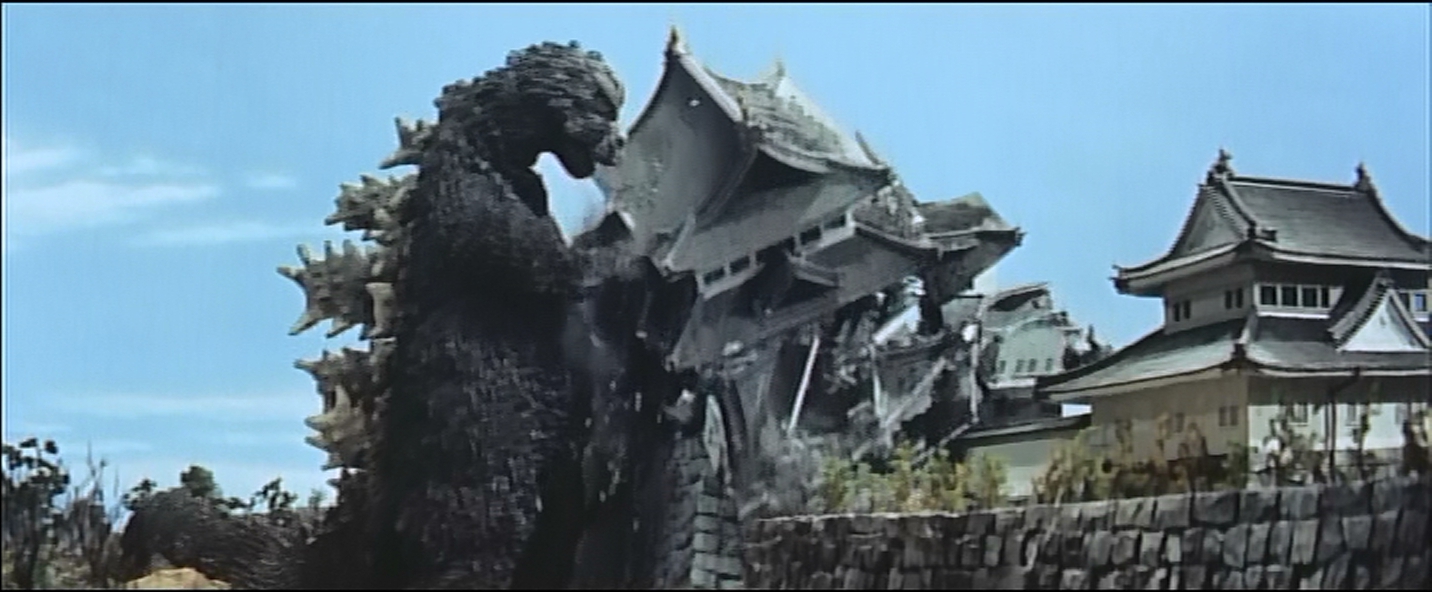
As with the three previous Godzilal films, Godzilla takes down a castle. In this case, it's Nagoya Castle in Nagoya. It's worth noting that in Godzilla's last Showa film as a villain, he destroys a famous landmark that was rebuilt after being bombed and burned by US forces in World War II. Godzilla's association with the American military is fading with this film, as Japan's economic boom let people look forward to the future, rather than back to gone glories.

Godzilla tears down more of Japan's national heritage.

And again the military does its best to stop Godzilla. Now that Japan has expanded its industrial capacity, the military is expecting to run some 20 to 30 million volts through Godzilla, to see if that stops him. And, for a wonder, it does. Metal nets are dropped on Godzilla, and they light him up. Godzilla writhes on the ground, obviously in pain. But in a moment of incompetence, the commander orders the voltage increased. The wires melt, and Godzilla is freed. Naturally, no-one ever tries to stop Godzilla with electricity again.

We got him! So close! Now, let's never try this again!

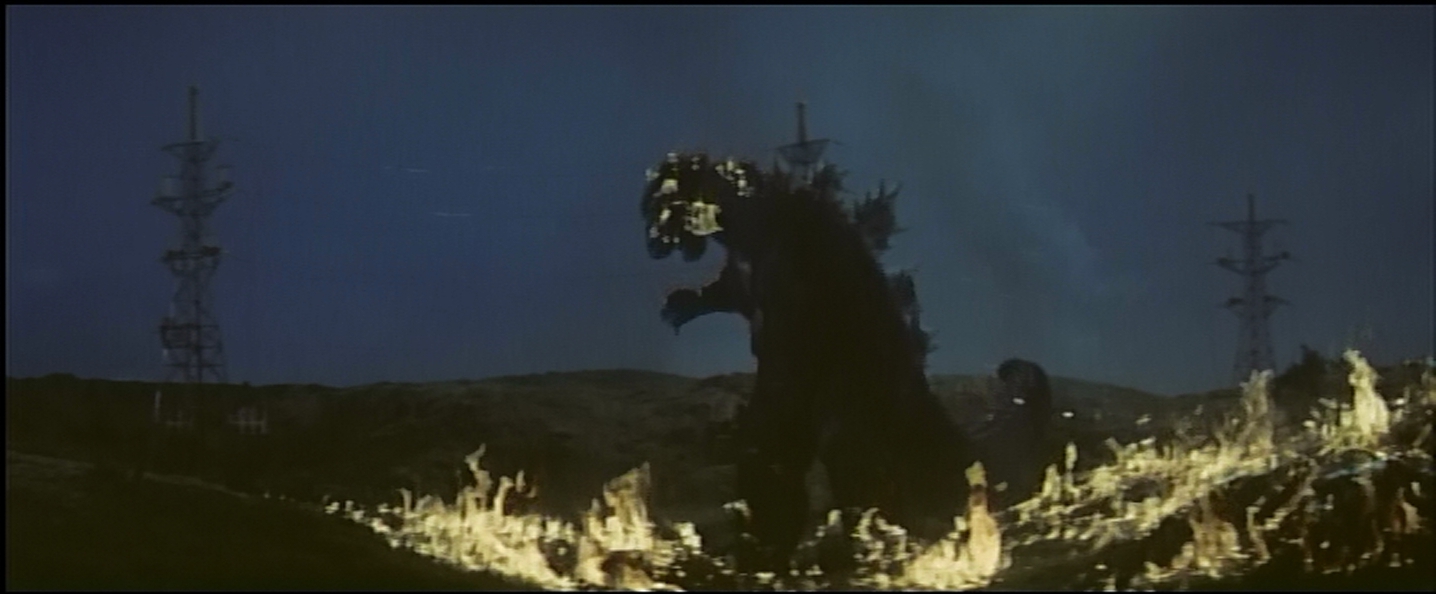
The monster fighing scenes are extensive, as are the military ones. In particular, there are a lot of explosions and fires, as if Tsubaraya was suddenly interested in the practical application of lighter fluid. Unfortunately, his inexperience shows, and we are treated to a brief moment when the Godzilla suit's head catches fire.

Apparently, the suit actor didn't know it was on fire.

Godzilla's roar in this flm is one of my favorites. There's a metallic grind as it bottoms out, making it monstrous and angry. The suit is a bit overly-rubbery, and has two lighter eyebrows that give him a look of concentration.

Themes of motherhood and nurture are continued when it is discovered that a group of schoolchildren are on Iwa Island, which seems to be Godzilla's destination. A ferry crew risk themselves to save the children. Luckily, the Mothra larvae understand teamwork from birth, and move to intercept Godzilla as the children are rescued.

The ending leaves me a bit flat. At first, a larva grabs Godilla's tail, only to be thrown around in a scene that will be repeated a couple of times in the franchise. When this fails to work, the larvae dodge Godzilla's atomic ray as they coat him with their silk. Practically cocooned, he falls into the ocean. The Shobijin wave their goodbyes and ride back to Infant Island on the Mothra larvae. The End.

Godzilla goes into the drink.  But he'll wake up in less than a year.

Despite the let-down of the ending, Mothra vs Godzilla is one of the strongest of the Showa era Godzilla films. The plethora of themes, the long monster action sequences, and the well-scripted B-plot all combine to make this a film that's a pleasure to watch.

Next up, the first appearance, of Godzilla's greatest, most enduring enemy. Who has more than the usual number of heads, and some of Akira Ifikube's most beautiful music.

Wednesday, August 14, 2013

What I Get From Googling Myself

It's quite nice to see that even in 2010, there were positive reviews of my story “Arkham Rain” from the Arkham Tales anthology. Specifically, on Yog-Sothoth.com, reader N'Gah-Kthun said:

‘... two in particular impressed me: “Disconnected” by Brian M. Sammons and “Arkham Rain” by John Goodrich. “Disconnected” is interestingly arranged, is genuinely chilling, and utilizes several characters who are not often used in contemporary Mythos fiction. “Arkham Rain” is a frightening story about the Deep Ones, and deals with the concept in an interesting and original way.’

Thursday, August 8, 2013

The Royal Rumble: King Kong vs Godzilla

King Kong vs Godzilla is, I think, the first Godzilla film I remember seeing. I remember catching both it and Godzilla vs the Smog Monster on the Chanel 30's 4 O'clock Movie, and I can't say which one I saw first, but King Kong vs Godzilla was definitely more memorable.

Sadly, the Royal Rumble is one of the most heavily adulterated films that is not available in its original Japanese version in America. The difference is notable: the American version opens with an irrelevant news report by some reporter opens the film, which clearly has blessed nothing to do with the rest of the fim. The special UN reporter continually pops in to tell us what we've seen, or occasionally what we're about to see. Akia Ifukube's beautiful score replaced with recycled American film music. Nevertheless, the film retains a lot of appeal.

See?  NOT GREEN!

King Kong vs Godzilla owes it's origin to Willis O'Brien, who was looking to make another King Kong film. After several iterations, he attempted to sell King Kong vs Promethius (another name for the Frankenstein creature) to Hollywood, and then abroad. In a delightful irony, Toho bought it. Kong's role went to Godzilla, and Kong was put in the role of Frankenstein's creature. Which is why Kong is strengthened by electricity. O'Brien's history of disappointing unproduced projects makes it difficult to tell whether the unscrupulous character of Mr. Tako comes from O'Brien's original idea, or the influence of Gorgo. Regardless, the jerk entreneneur becomes a stock character and MacGuffin for many kaiju films, from Gorgo's Joe Ryan to Mr. Tako to Pacific Rim's Hannibal Chau. Chau, as the product of a genre-savvy director, manages to be a better-rounded character than Tako or either of the selfish businessmen in Mothra vs Godzilla.

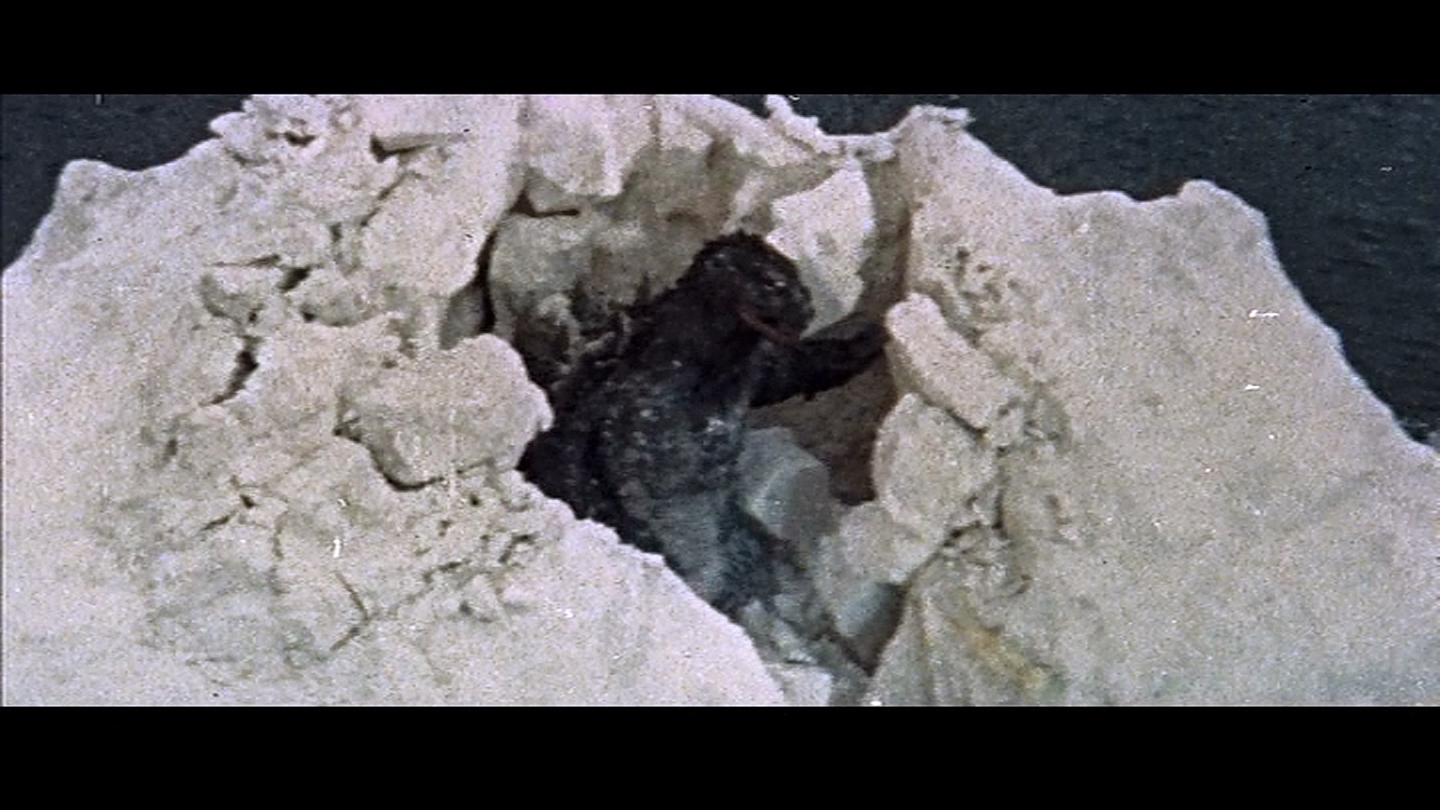
The rewrite is pretty competent. The film acknowledge Godzilla Raids Again. Godzilla is released from an iceberg, which makes sense since he was buried in ice at the end of the last film. The American insert, unwilling to assume the audience has seen either of the previous films, just claims the monster has been frozen for 65 million years, ignoring the fact that they already know it's name and express no surprise that it has atomic breath.

Out of ice and ready to RUMBLE!

King Kong vs Godzilla sets the standard for “versus” monster films to come, in much the same way that King Kong set the template for the single-monster rampage. The two monsters appear, and the humans are caught in the middle. The small human dramas play themselves out, as each makes a small contribution that either benefits humanity or makes life difficult. In the last half hour of the film the two titans clash, giving the audience what they've come for, and resolving all plotlines, occasionally by fiat of monster stomp.

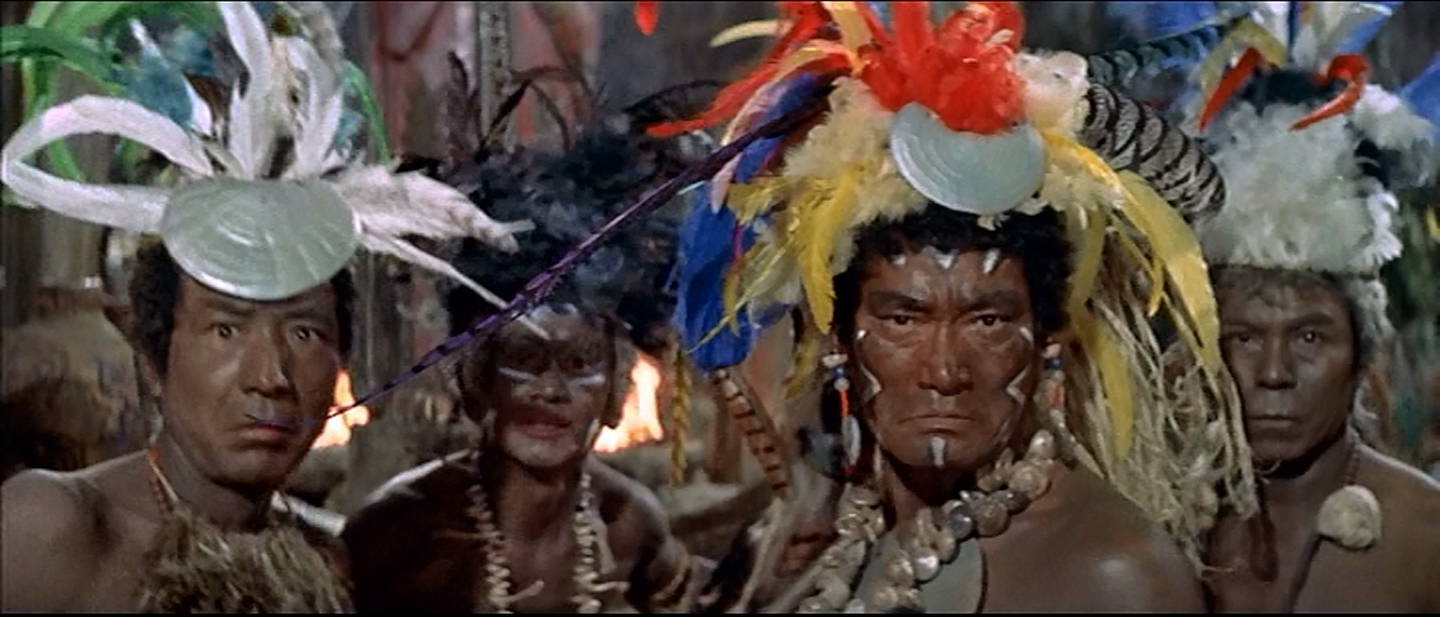
After Godzilla awakens, Kong must be brought into the picture. The scenes from Faro Island scenes are careful studies of the original King Kong ones. I cringe at the portrayal of the 'primitive' people, dressed like Hollywood Africans, leaping and yelling like Hollywood Indians. They are astounded and won over by Western technology and cigarettes. According to David Kalat, the Japanese version is more of a satire than American version. Still, these stereotypes were only just beginning to fade from American films. However, if the Japanese film is more satiricial in tone than the American one, this may be intentional. It's difficult to say.

I'm neither a stereotype, nor do I look silly.  Or maybe I do.

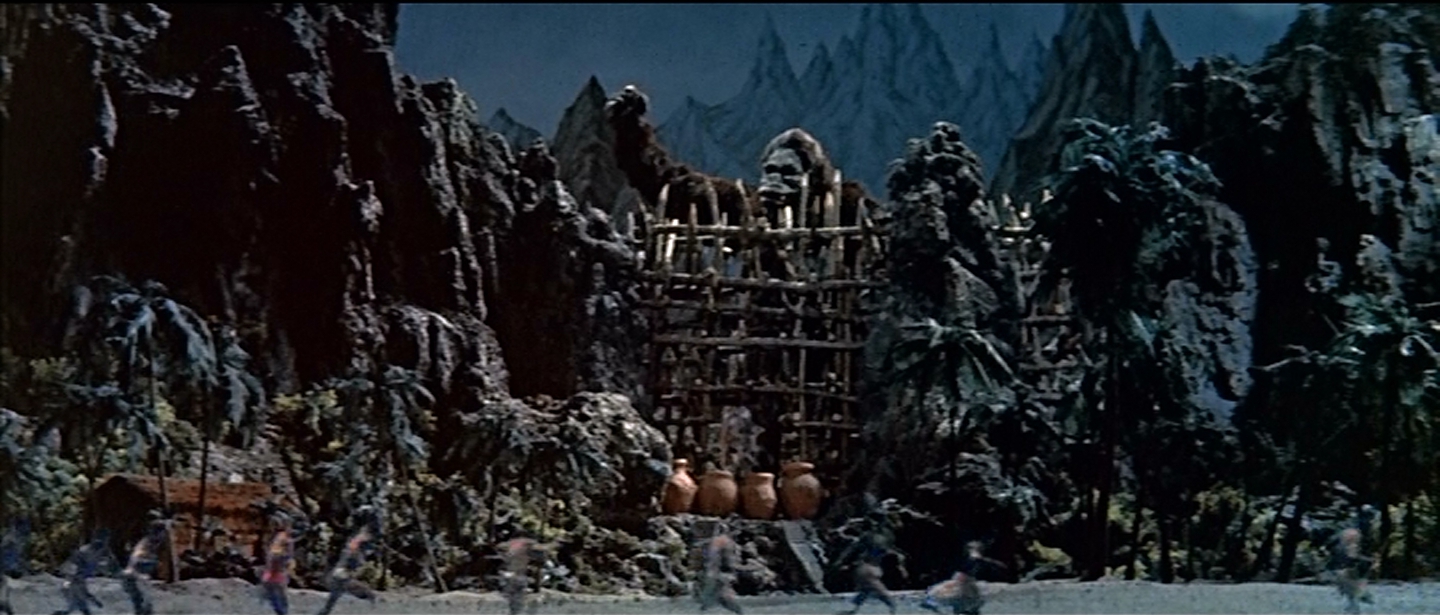
Kong's setup is very similar to that of the original film. He lives on an isolated island, is restrained from the human-inhabited part of the island by a great fence (much more flimsy than the orignal). Ultimately, he is hauled off the island after being drugged (in original Kong, Denham has gas grenades. Here, he drinks local berry juice, and listens to the drumming of the locals).

Of course, it doesn't matter how big the fence is.  Kong will get through it

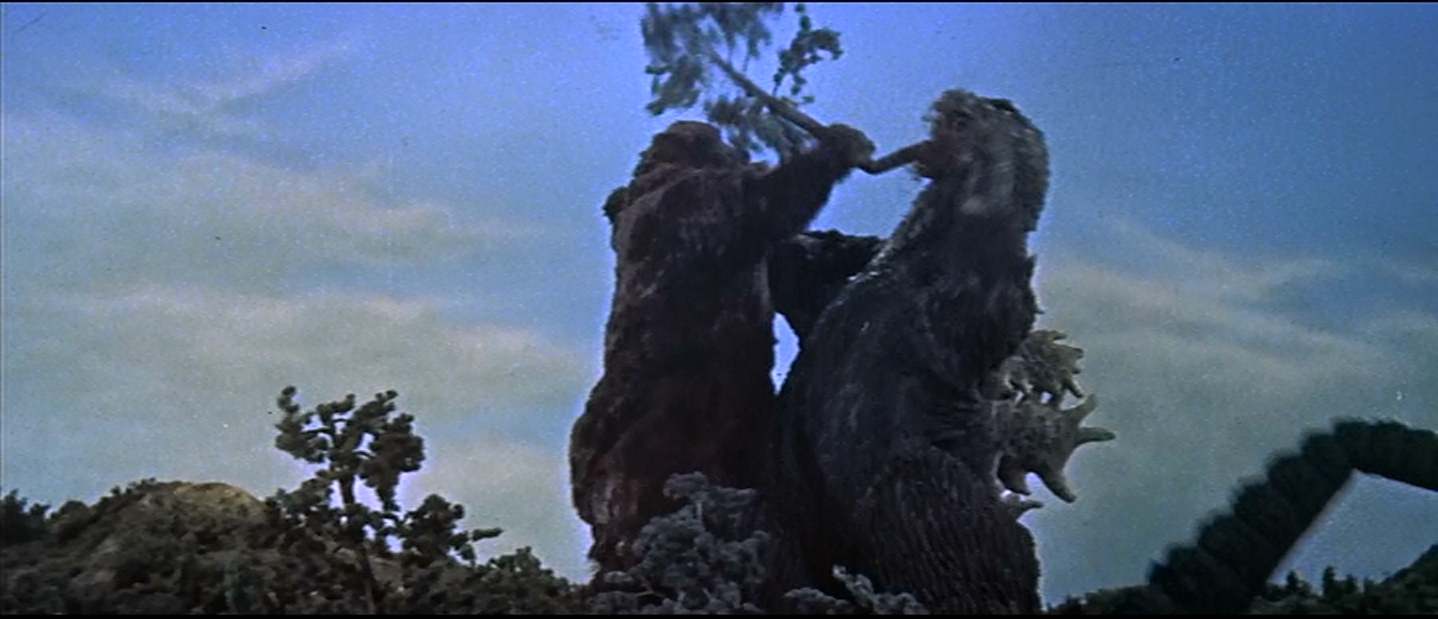
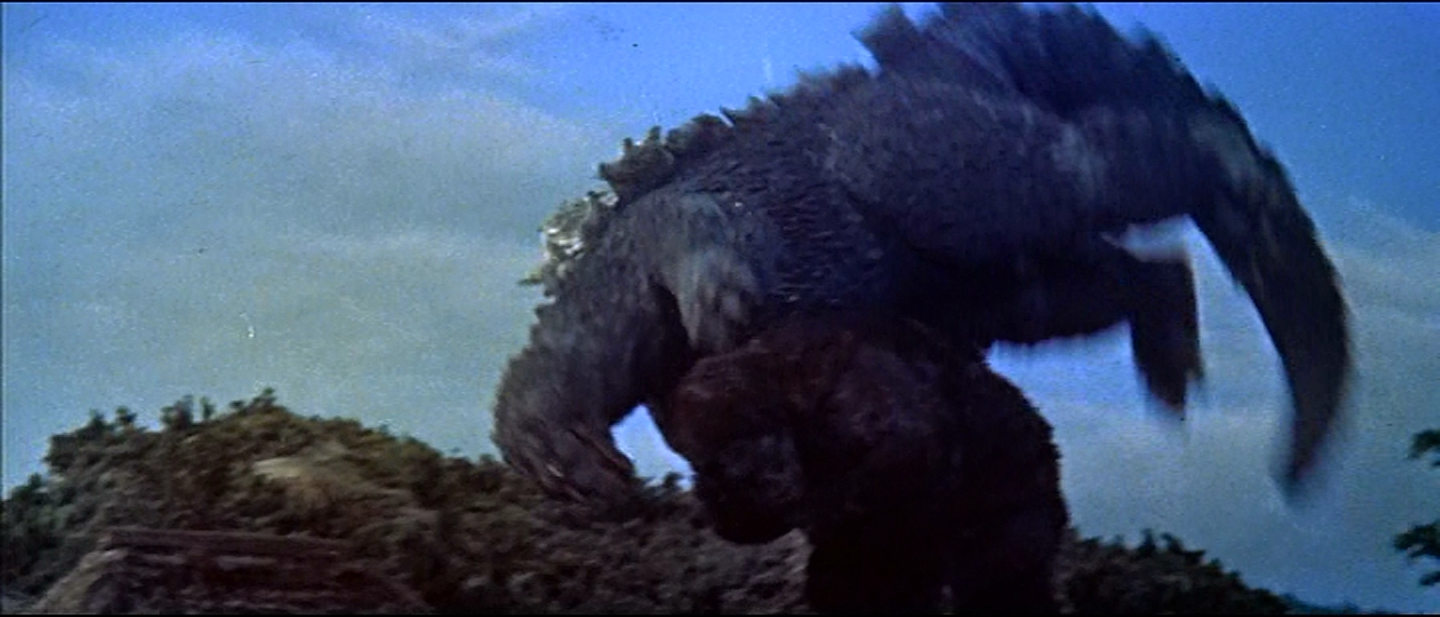
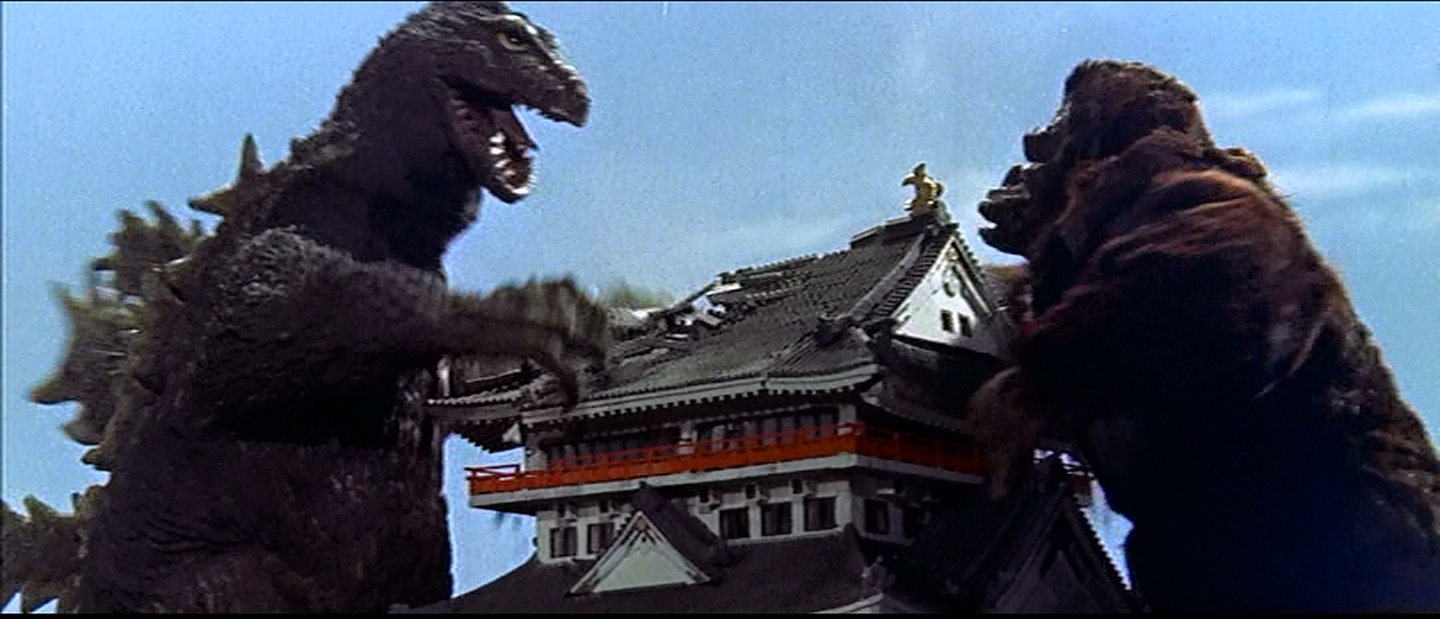
A fair amount of the film is homage to the original Kong. Tokyo, for example, lacked anything as tall as the Empire State Building, so Kong stands on the National Diet Building instead. It's about as tall as he is. But the military lights him up with spotlights, and he's got a girl in his hand. During the climactic battle, Kong shoves a tree into Godzilla's mouth, an homage to a promotional still that wasn't in the actual Kong vs tyrannosaur fight. Kong also throws Godzilla, something he did with the tyranosaurus, which Godzilla closely resembles. Legend has it that suit actor Shôichi Hirose threw the Godzilla suit with actor Haruo Nakajima inside, as a way of demonstrating his strength. If true, it's a hell of a throw.

Godzilla clears it in his inimitable way: he burns it out.

A *hell* of a throw.

The Kong suit doesn't look good. His face is very immobile, and the costume looks sewn together. However, the Shôichi Hirose, the suit actor who showed up in a lot bit parts in Kurosawa's work, looks like he's having a wonderful time, and attacks the role with a lot of energy. Godzilla has also gotten new suit, with clawed hands and larger eyes to make him look more intelligent. The neck is more stocky, and the head set into it, rather than perched on top.

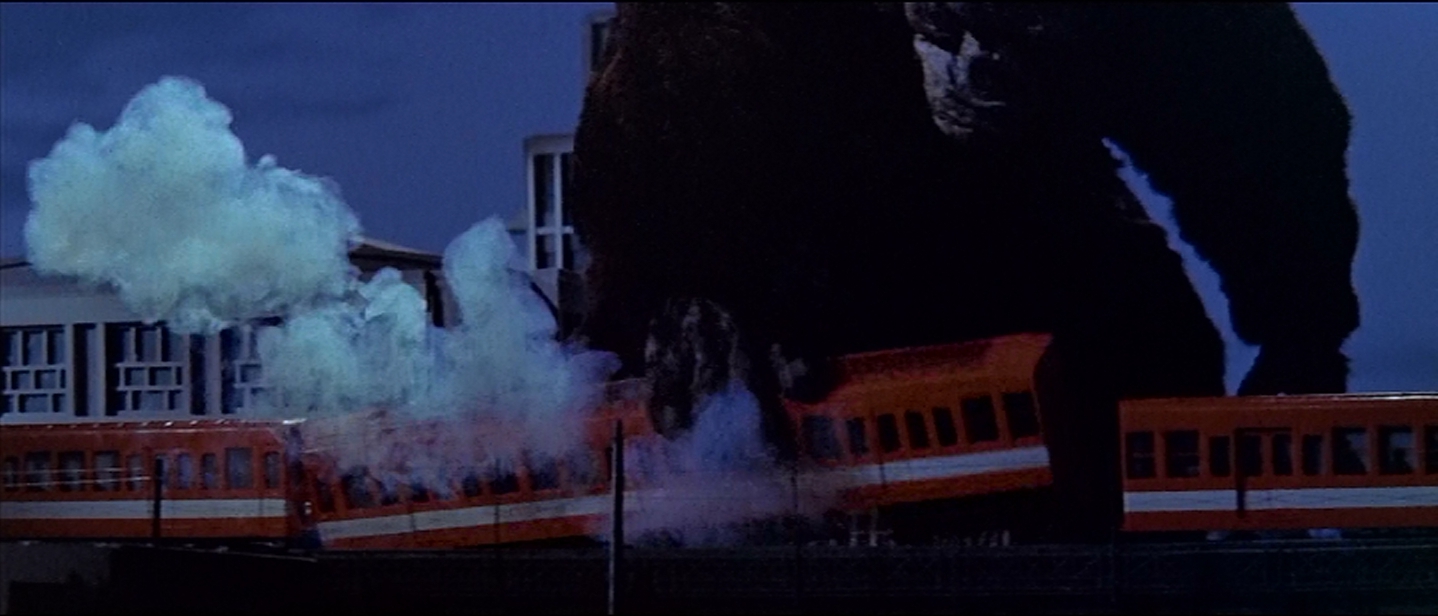
Director Ishiro Honda had not yet shifted the film's completely into fantasy. In keeping with the real world, rather than showing us the human cost of the devastation the monsters' rampage, we instead use the unique device of following Fumiko Sakurai, played by future Bond babe Mie Hama. As the love interest of Kenji Shara and desgnated princess-to-be-rescued, Fumiko has train encounters with both Godzilla and King Kong. The Godzilla encounter is similar to the one in the original Godzilla, and the Kong attack is rather different from the one from the original film, since Kong is so much larger. Still, Fumiko gets to play tiny Fay Wray to gigantic Kong. I imagine that after this experience, Fumiko will never take a train again.

Kong will never make peace with trains.  Let's accept this and move on.

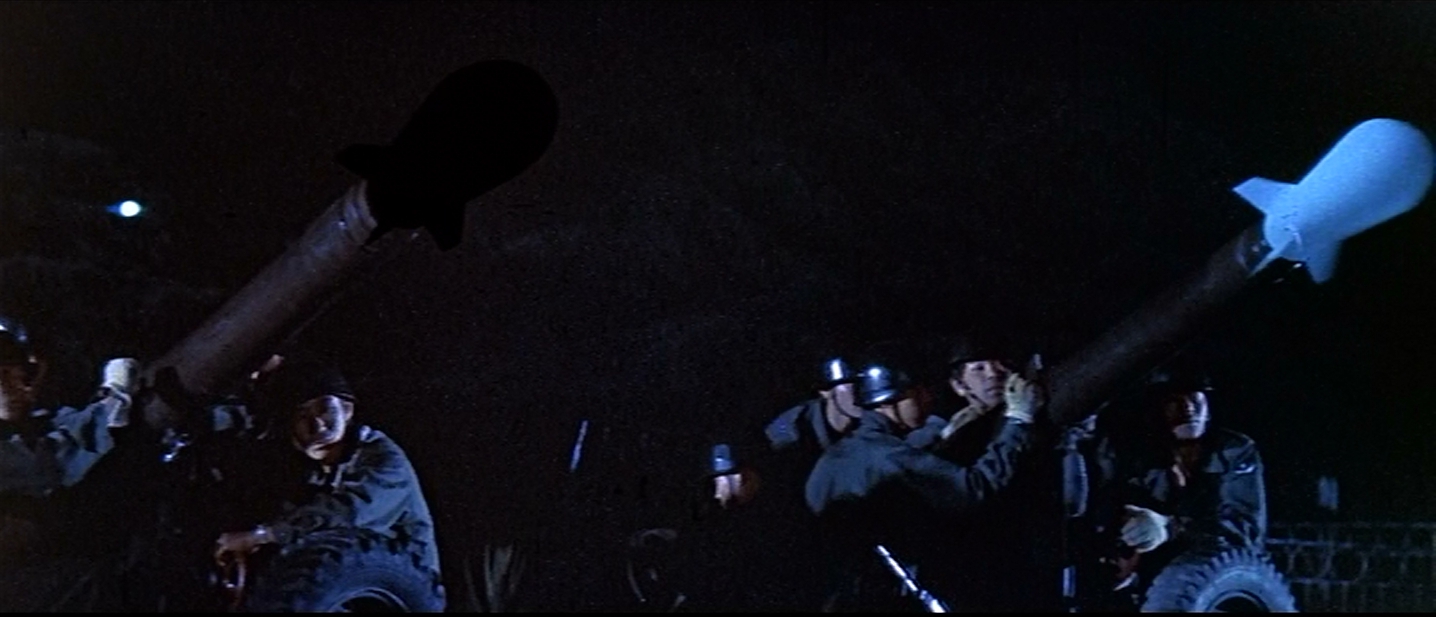
There's a strange technical effects goof when Kong stands on the Diet building. Rockets are being fired off artillery pieces. The rockets themselves are animated onto the artillery barrels, probably because they had no way to make the models launch convincingly. The first round goes off fine, but in the second shot each rocket leaves a black negative of itself on the film after it is launched. It's an odd error, and the shot is as quick as possible to prevent the viewer from noticing.

People will only notice if they have a pause button.  Ah, crap.

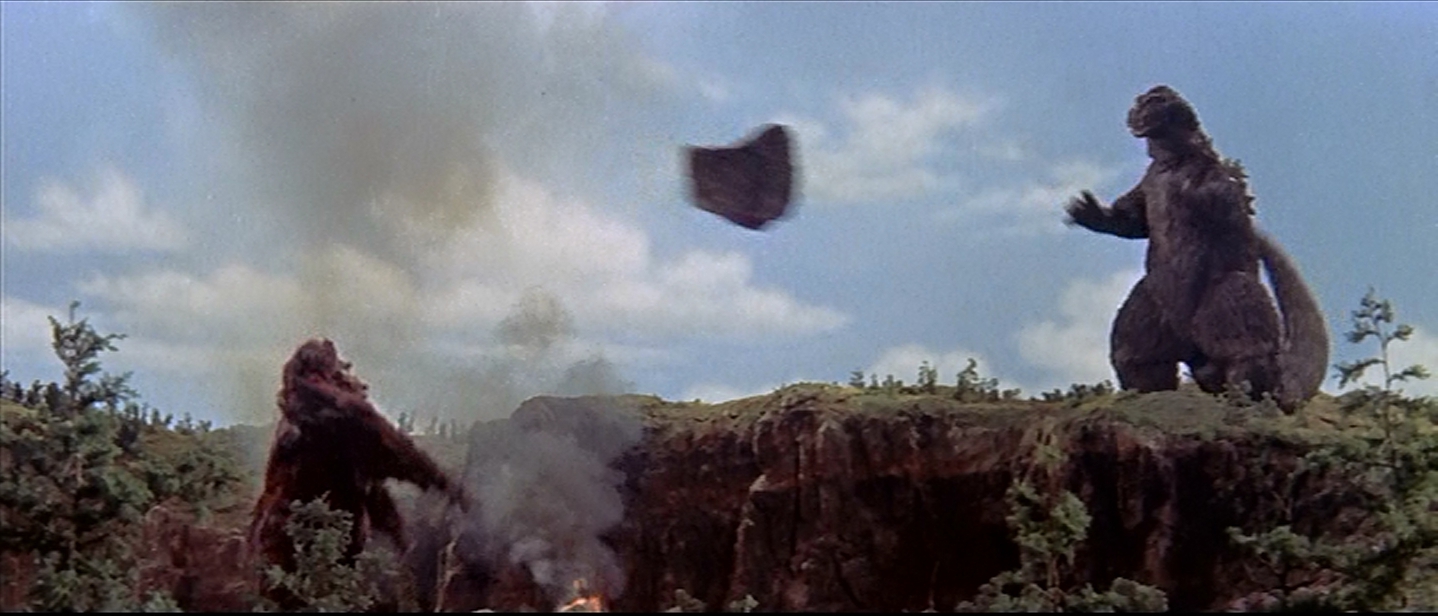
This is the beginning of the regrettable stone-throwing, which infests the franchise for the next five or six films. It's silly and I find it uninteresting time-filler.

Ugh.

The military has a different trick up its sleeve. this time, rather than running the usual ineffective wires, they dig a trench and fill it with gasoline. Godzilla falls in, and explosives are detonated. This, predictably, does not stop him. However, the high-tension wires do. We aren't given an explanation for this, given that high tension wires didn't stop him in the original Godzilla. Perhaps these carry a higher voltage, what with Japan's surging industrial capacity and power production.

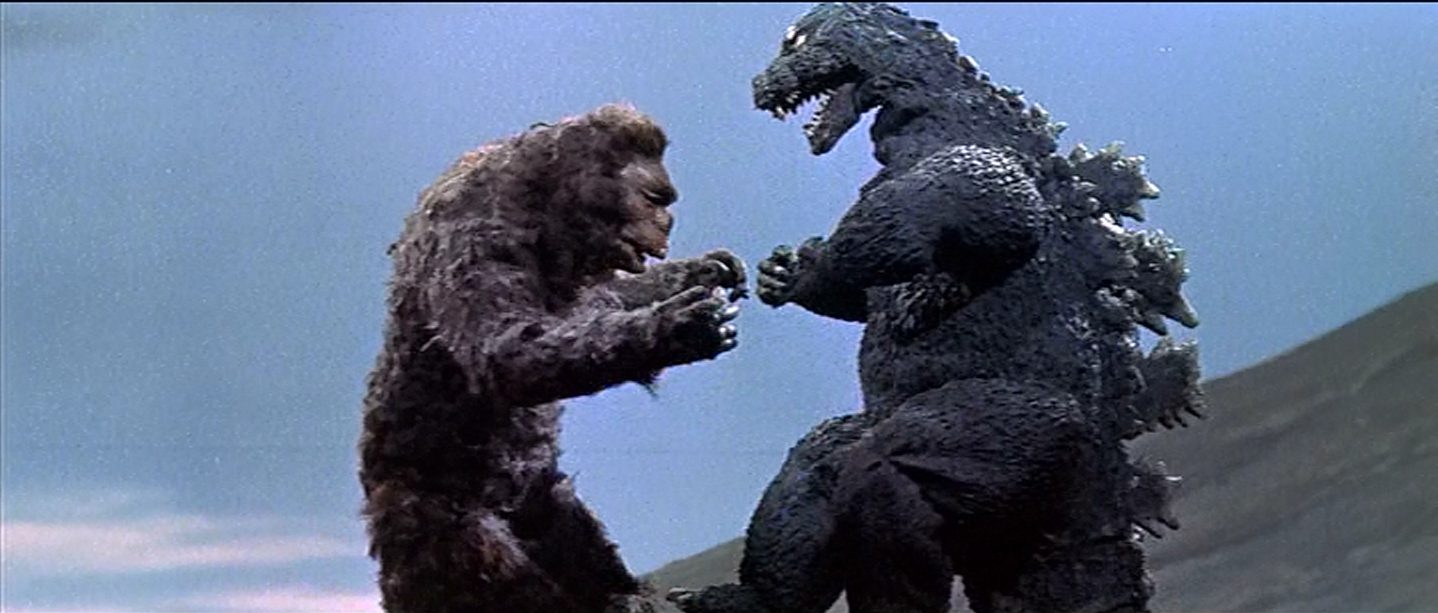
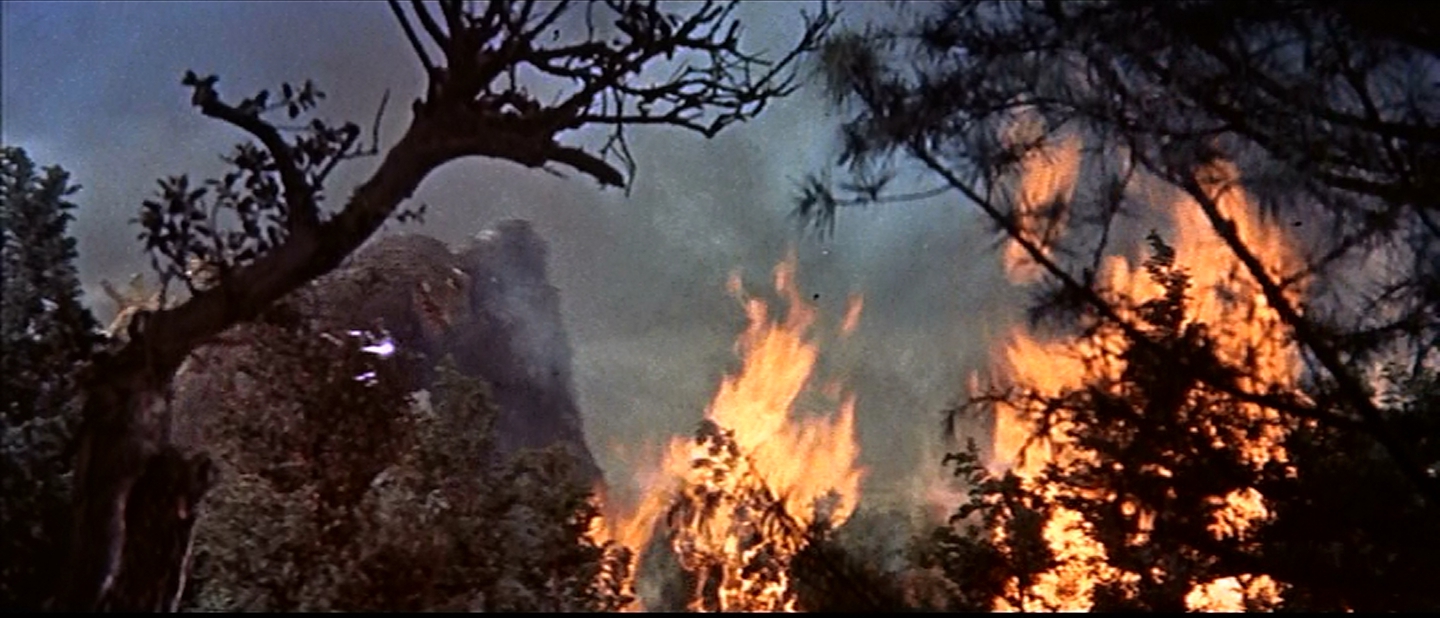
The climactic scene, unlike that of later versus films, is surprisingly short. But if you look for screenshots of the film, or remember it for yourself, those are hugely memorable eleven minutes. The fight is fast and furious, filled with building-stomping action, gigantic fires, and several reversals. Initially, Kong doesn't come off too well. He's knocked unconscious, or at least unresponsive twice in four minutes.

The fight also includes the only bit of stop-motion Godzilla footage ever filmed, in a jump kick that sends Kong sprawling. This could not have been done by suitimation, and I wonder if Honda created the scene to keep Tsuburaya in practice? There had been a single scene of stop-motion in the original Godzilla, also. Perhaps it was included as an homage to O'Brien. It's good quality, I might add. I wonder what might have happened if Toho had had enough money to pursue a fully animated Godzilla film. There are a few scenes with puppets, also. While unconvincing, they are quick enough that it's difficult to tell.

Kong looks better in stop-motion than he does in suitmation.

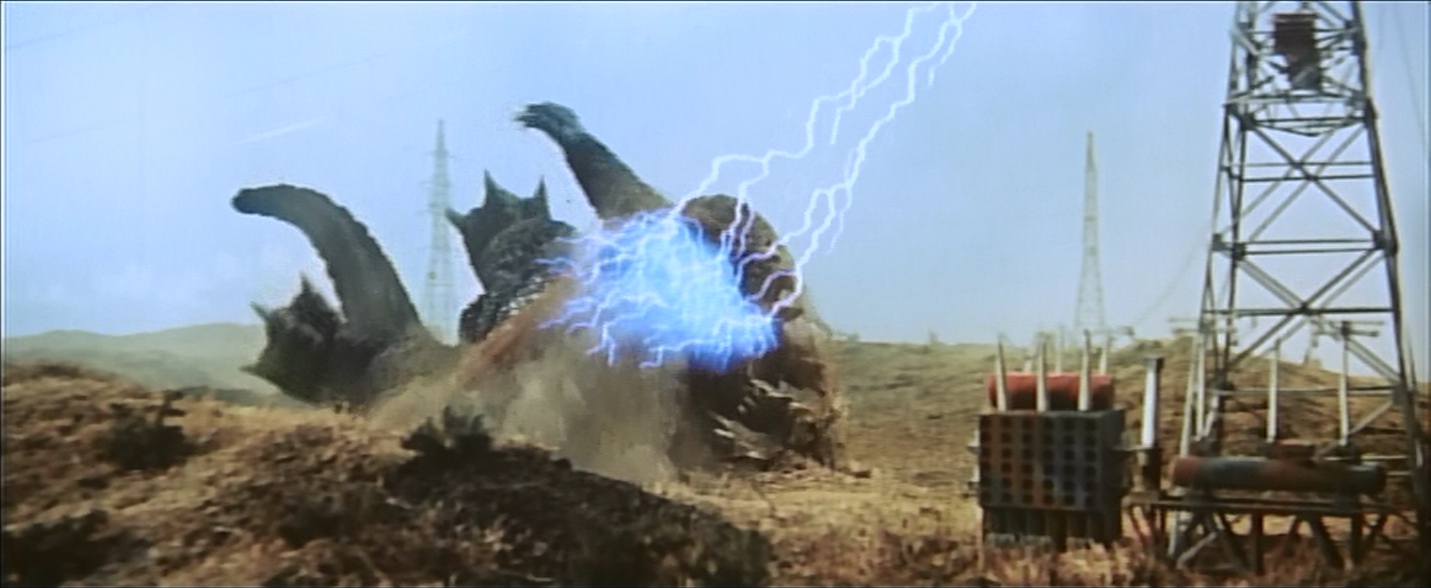
Only after Kong is struck by lightning (since he's the Frankenstein of the fight) does he gain enough strength to deal with Godzilla on a more even footing. And he seems to be able to channel the electricity through his hands, which hurts Godzilla. This will be an important part of Godzilla vs Mothra, the next film in the series, and later contradicted by Ebirah, Horror of the Deep and Godzilla vs Mechagodzilla. In these films, Godzilla gains strength from lightning.

Fire!  Electricity!  Giant Monsters!.

As with Godzilla Raids Again, the end comes as the two monsters destroy a castle, Atami this time, and plunge into the ocean. The fight up till this point has been furious, once of the most intense seen in the series.

Kong looks better in stop-motion than he does in suitmation.

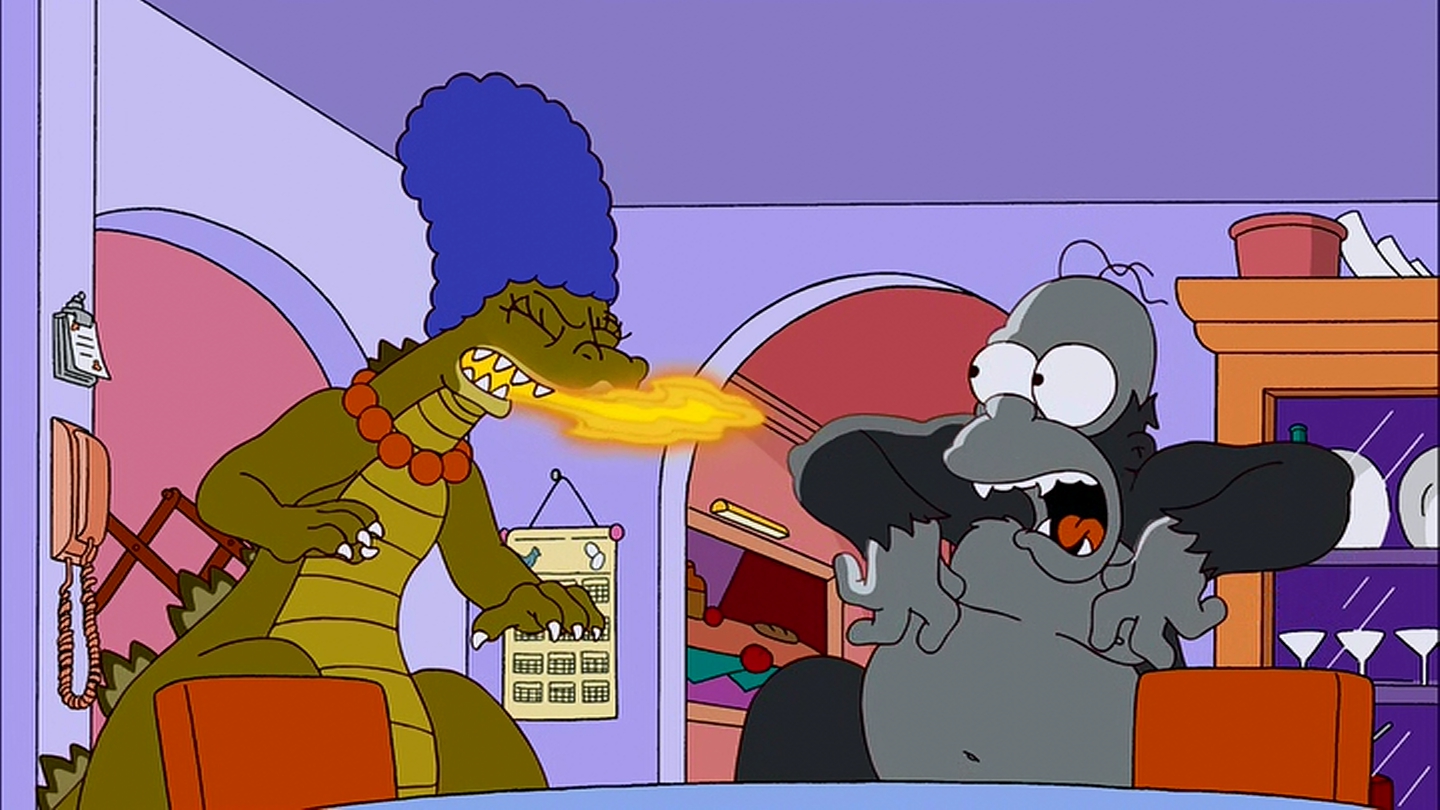
Despite being flawed in several critical ways, King Kong vs Godzilla remains a touchstone for many of us who stumbled on it flipping channels. Although Godzilla vs Megalon is said to be the most seen Godzilla film by American audiences, King Kong vs Godzilla seems to be the one that is most remembered. Megalon was never referenced in The Simpsons, for example. This is a clear reference in the episode “Wedding For Disaster”

Kong looks better in stop-motion than he does in suitmation.

Let's hope that Toho and Sony will release the Japanese version of the film, as they have with every other Showa-era Godzilla film. Perhaps in the lead-up to the release of the 2014 Godzilla

Next up, Godzilla faces his weirdest opponent with a exceptionally strong script.

Thursday, August 1, 2013

Scarionettes: The Giant Claw and Reptilicus (but mostly Repticlicus)

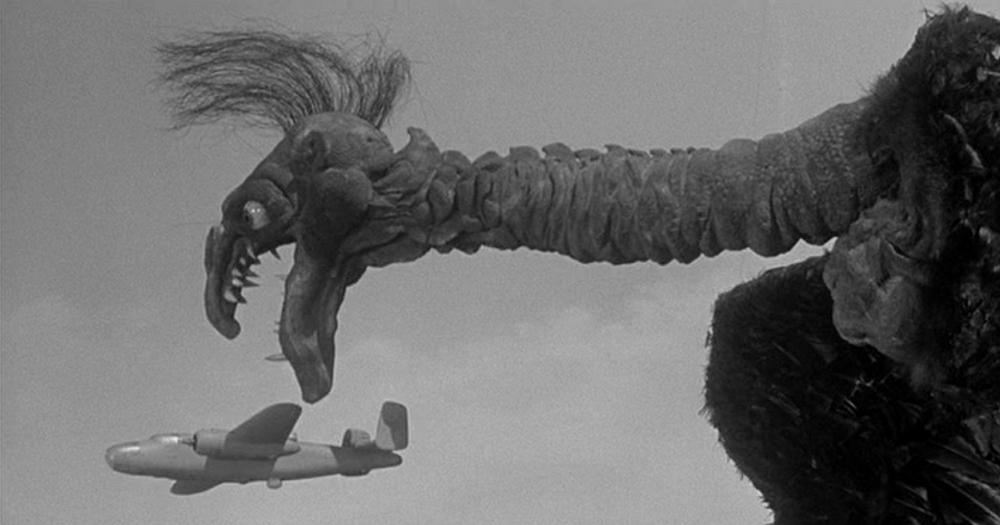
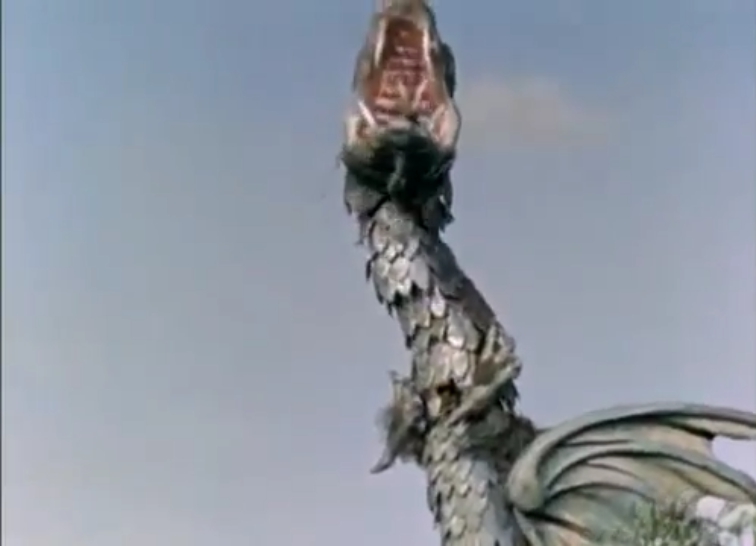
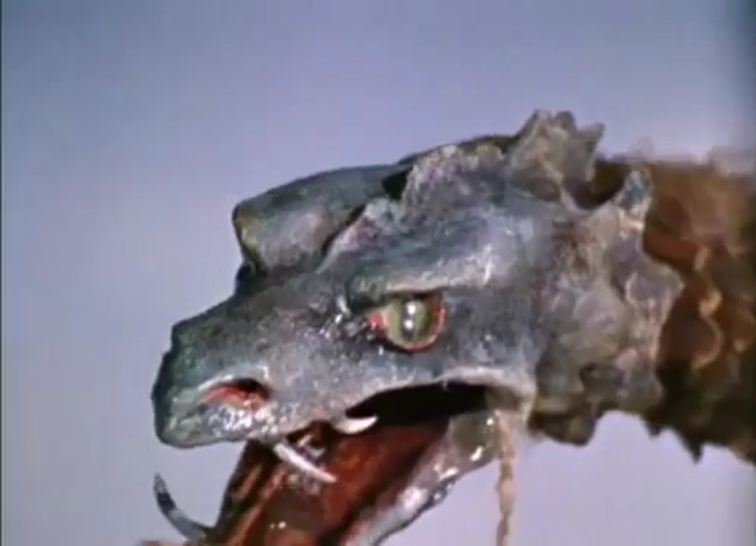
The intention with My Year of Monsters is to trace the way that monster movies formed, to see the influences that have brought us to the modern monster movie. So some films only deserve a minor mention. The Giant Claw (1959) is one. It's a cheap, by-the-numbers monster film with an unconvincing marionette that is actually let down by the plot and dialog. The monster effects are so legendarily bad that the film has a Plan 9 From Outer Space-style fanbase. Don't believe me? Try being terrified by this:

What you aren't seeing is the articulated nostrils on the beak.  Or maybe that's just as well.

Sadly, the film's logic roughly matches the special effects. The script is cheap, but at no time do the actors treat it as anything but dead serious. There's a lot of nothing that happens. I probably shouldn't be picky about the logic of my movies. After all, Godzilla is a giant, walking dinosaur with radioactive heat breath. I'll stretch my suspension of disbelief pretty far, given a good set-uo. But a gigantic space bird that's not actually a bird while having an antimatter shield kind of hurts my brain. Even if it chows down on the Empire State Building and the United Nations. It's bad. And I've already given it more time and attention that it deserves.

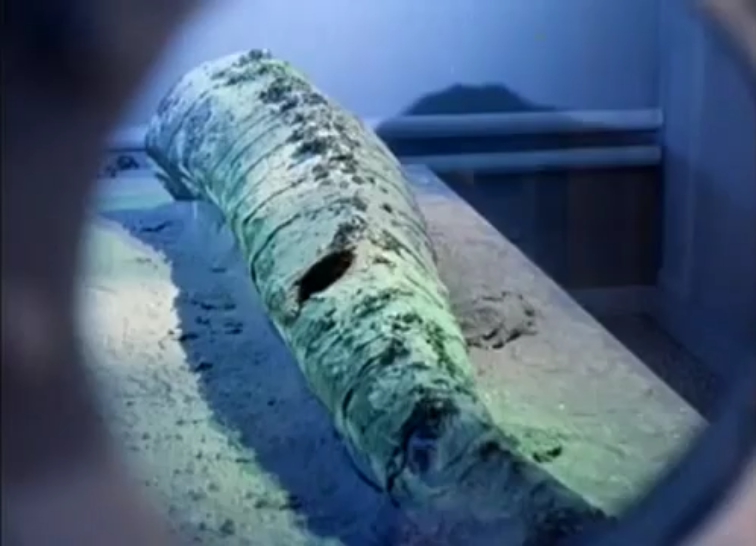
The 1961 Reptilicus, on the other hand, is a lot more interesting. The only kaiju film made in Denmark, Reptilicus is a significant departure from giant monster films of the past. While Reptilicus is a unique, unprecidented dinosaur-like creature, we do not initially encounter it full-size, or as the result of radiation. Reptilicus is discovered by a team of prospectors searching for copper. A portion is brought up on a drill, and through some scientific mismanagement, the creature manages to regenerate its entire body.

Looks like a Reptilicus roast in the freezer.

The only version available to me is the English dub. The preliminary narratation feels like it was added, and the dubbed dialog is staid. Getting small glimpses of the Danish version (bracketing the Danish-exclusive flying scenes) convinces me that the original delivery, in Danish, has a lot more energy and character. Like the Godzilla franchise, the early protagonists are a scientist and a reporter, men of truth, loaning the plot credibility. But that switches over to General Greyson when Reptilicus is ravaging Denmark. The film is places a comedy, with the lovely young women fighting over the handsome scientist, and Dirch Passer, a very popular comedian, was cast as the bumbling security guard.

About a half an hour in, there's a five-mnute commercial for Danish tourism, includng a lounge singer extolling Copenhagen. It's not horrible, but it certainly stops the film cold. And it feels a little strange to tourish-shill for a city a giant monster is about to destroy. It should be said, however, that Japanese cities have apparently lobbied for their city to get stomped in the later Godzilla franchise films.

Look at them tiny little feet!

Our first glimpse of the resurrected Reptilicus is about half an hour into the film, and we get our first good look at minute forty, right as the military starts sending a lot of ammo downrange. Reptilicus, like all self-respecting kaiju, is immune to shells and bullets. However, it can be lit on fire, and the military force a retreat by unleashing a flamethrower.

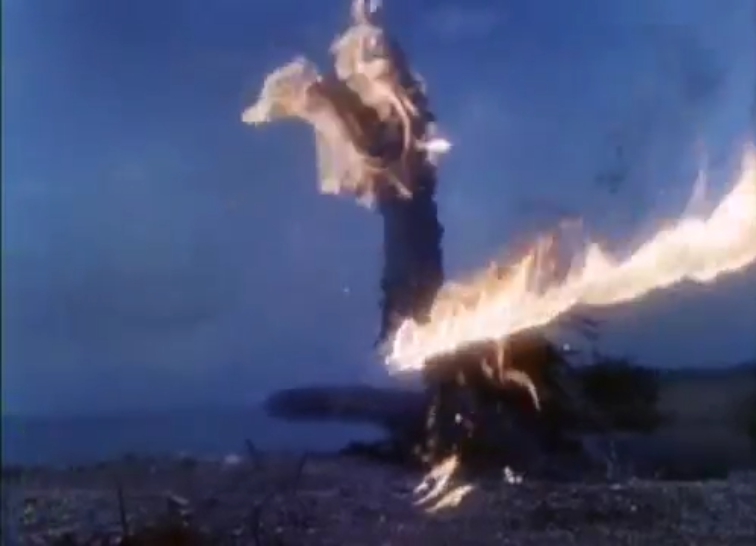
Smoked Reptilicus, in what I assume is the last shot for this marionette.

This shows a very Western reliance on the military to solve problems. Although the science boffins are kept along as advisors, General Greyson is lionized as the military man who doesn't want the job, but delivers the final blow to the creature when all is ready. This was something that the 1998 American Godzilla suffered from, that conventional arms and armaments are able to deal with the gigantic mence, even if it isn't in the standard fashion. In a post-World War II country that has not reounced violence, this is understandable, but it removes some of the novelty of the monster. If conventional weapons can destroy it, then it's just a matter of deploying them, and the problem is solved. Pacific Rim sidesteps this by showing us human-made momsters, Jaegers, that were able to take on kaiju on their own terms.

Reptilicus's cry/bellow is long and complex, and seems to include some sort of bell. It isn't strong enough to identify itself above the musical soundtrack. It's more like ambient sound when the monster is being shown, which is something of a relief after the ruacous and repetitive nature of The Giant's Claw's battle cry.

Reptilicus is watching YOU!

The American Reptilicus has an acid breath that is not present in the Danish version. Once the viewer is aware of this, it's easy to see that it has been introduced post-production, because it never affects anything. Reptilicus vomits/spits a line of glowing green slime, then the screen gets covered by it, and the shot ends. Some dialog refers to the acid slime, but never we see any victims. I would like to see the Danish version some day, because it would be very strange to watch Reptilicus unable to strike back at the military, only destroying what comes within its short reach.

I think her expression captures the moment!

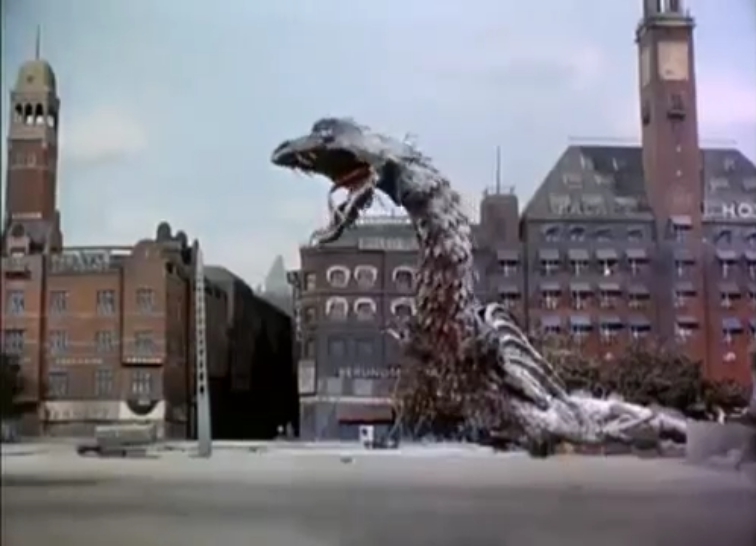
Monsters are drawn to cities like college students to a keg, so Reptilicus heads for Copenhagen. Once it is there, it homes in on a famous landmark. It chooses the Børsen, which held the Danish stock exchange until 1974. We get an unintentionally funny moment as the spire, shaped like twining dragons' tails, balances on its head after falling.

Reptilicus gets clocked by the Børsen's spire.

Reptillicus offers us only two very quick scenes of the destruction left behind by the monster, which could be stock footage sowing the aftermath fo a fire. The film clearly wants to be more of a fantasy film than a horror one, thrilling the audience rather than bringing up memories of bombing raids. There are plenty of scenes with fleeing crowds, but I couldn't help wonder what happened to all the bicycles that had been mentioned in the section promoting Denmark. Perhaps all the cyclists got out of the city earlier.

Reptilicus is defaeted in a combination of the Kong and Beast from 20,000 Fathoms techniques; by drugging it, but delivered by a special shell. Of course, they've only made one shell, and they don't have Lee van Cleef to fire it. So the general has to, because being a high military rank means you're the best shot witgh a bazooka. But once Reptilicus is drugged and down in front of the Scandic Palace Hotel, the film ends. What are they going to do with 70 meters drugged regenerating pseudo-dinosaur? And, of course, there's a paw that was blown off earlier, so there was the possibility of a sequel. Following the success of 1998's Godzilla, director Sidney Pink attempted to make a sequel, but he died before he was able to.

Reptilicus before the Scandic Palace Hotel of Copenhagen.

Reptilicus is a fun film, different from the kaiju films that preceeded it. Although uneven in tone, moving from comedy to military action to science discussion, it manages to cohere into a decent, if not spectacular monster film. Certainly it's good to get away from the usual tropes, but it becomes clear each time a new film studio got involved with giant monster films that the Toho crew were spectacualarly good at their jobs, and the brilliance of monster-maker Eiji Tsuburaya is stunning.

Next up, the most famous match in kaiju history, as the Big Ape and the King of the Monsters go toe to toe.

Thursday, July 25, 2013

Godzilla's Little Brother: Gorgo

During Godzilla's hiatus, Eugène Lourié made a pair of giant monster films, Giant Behemoth, and Gorgo. Gorgo is the first real suitimation film made outside of Japan, and is clearly an homage to Ishiro Honda's Godzilla. There is of course an irony that Eugène Lourié, who directed Beast from 20,000 Fathoms, made a film that is a clear homage to a film that was heavily influenced by his own Beast.

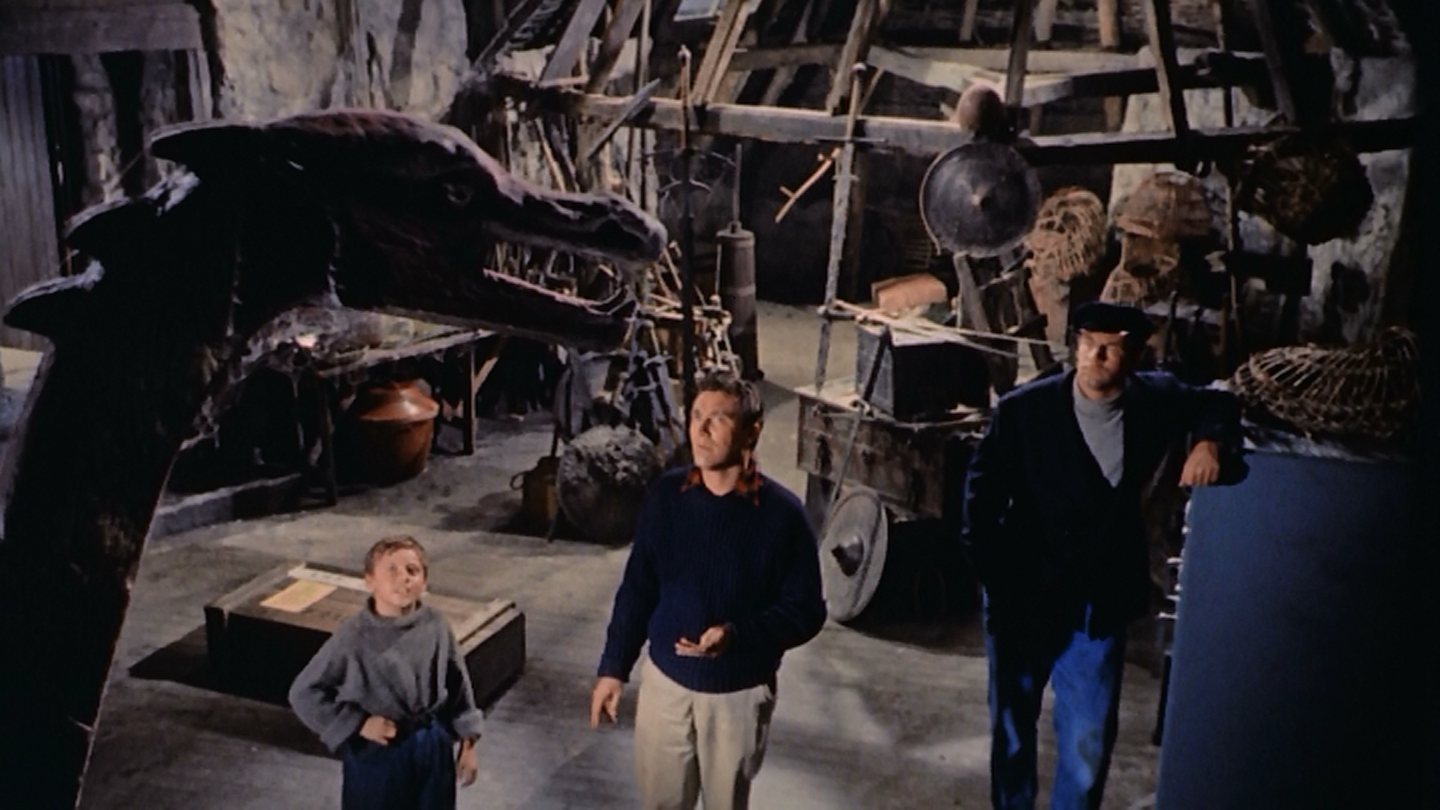
The spectre of Ogra looms over tiny men.

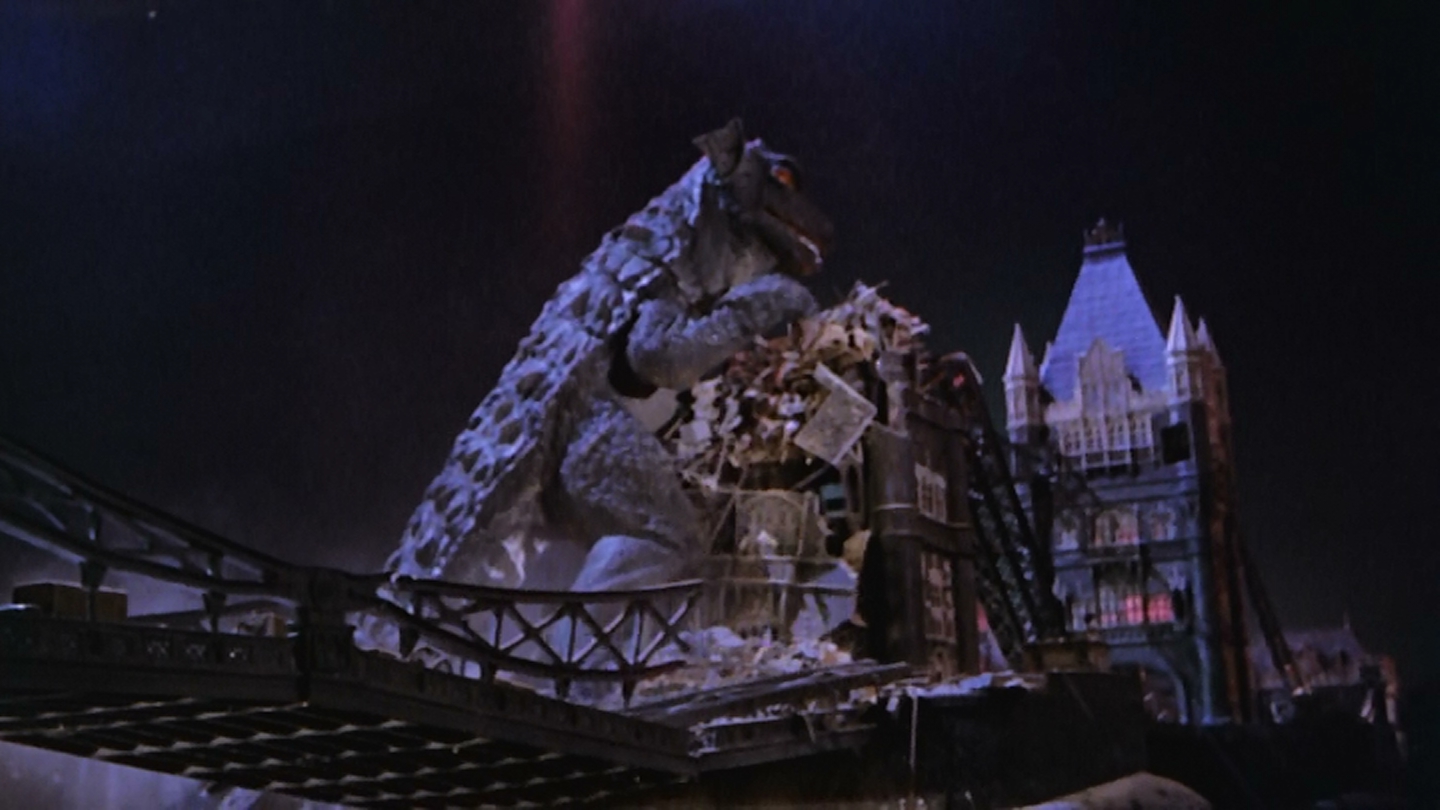
Gorgo takes many tropes from Godzilla, including the isolated island, Nara in Gorgo's case, which has legends of the giant monster, the city-destroying rampage that destroys a bridge, the seat of government (Tokyo's National Diet Building, London's Houses of Parliment). As with Godzilla and the Beast, one of the lines of defense is high-voltage wires, which fail to work. Both feature the helplessness of the military before the beast's onslaught. Gorgo is notable for having the jets stand at a proper distance from the monster, rather than flying so close that the monster can catch them. This didn't even make sense with King Kong, when biplanes fired bullets at the big ape. No jet should ever come within arm's reach of a monster, especially when firing missiles. But it looks good if the monster can swat a fast-moving jet model out of the sky, and from Godzilla to Pacific Rim, monsters have been smacking jets out of the sky. Gorgo is an exception because Eugène Lourié was at odds with the King Brothers, his producers, concerning the role the military should play. Lourié wanted to downplay the military, but the King brothers wanted a lot of exciting gunfire during the climax. The military was added through stock footage and in post-production, so there are no model planes for Gorgo's gigantic mother, Ogra, to swat.

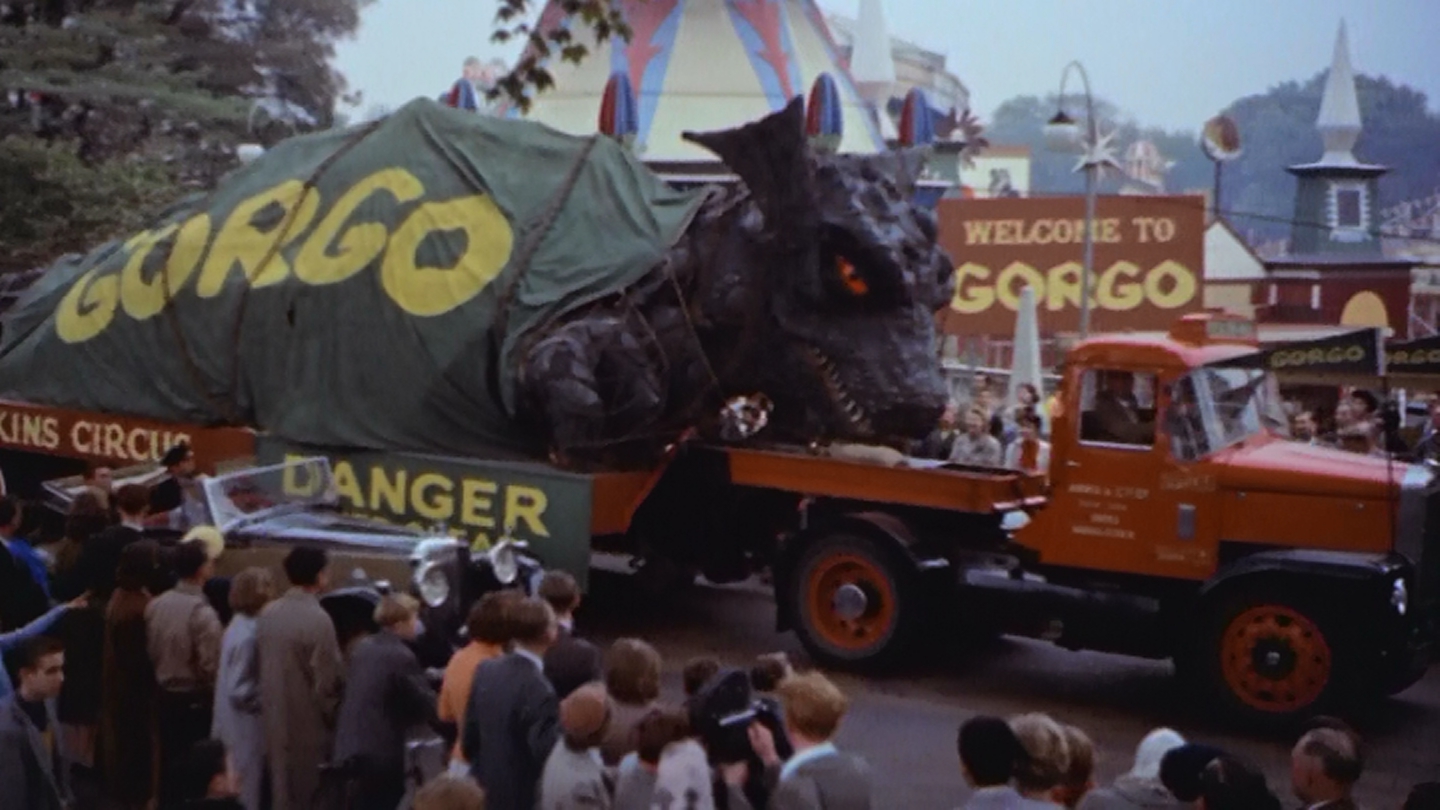
Gorgo also combines ideas from King Kong; the capture of the giant animal, which is put on display in a major city. Gorgo, like Kong, is called the Eighth Wonder of the World. Like Rodan, this features a pair of giant monsters, but in this case, we first see the smaller, thirty-five foot Gorgo, as an immature dinosaur. Later, mother Ogra performs the usual city-stomping duties.

Gorgo!  The eighth... errrr, ninth, well better make that tenth, TENTH wonder of the world!world!.

Gorgo doesn't hide it's monsters. Gorgo makes its first clear appearance only sixteen minutes into the film. Lourié knows the audience is there to see the monster, and obliges us through the entire film. We have some build-up, but it isn't the standard giant footprint in the sand. We hear a little talk, evidence of its existence, including a man who died of fright. And then the monster is on us, attacking Nara Island.

And there goes the house.

Like the Beast, but unlike Godzilla, Gorgo and Ogra aren't nuclear freaks. They are natural monsters that were preserved, and woke up in the modern world due to volcanic activity. They are not tortured by radiation, and this can be seen to have a life cycle, which includes reproduction. Re-imagining the monster as not a singular creature, but something with young and a parental instinct changes the dynamic of the film, giving the monster a motivation other than just being too large. The demonstration of a this, in this case Ogra recovering her young, is the first step in the humanization of the monsters that would lead to Godzilla and Rodan having a conversation three years later in Ghidorah, the Three-Headed Monster. If we are to believe the oft-repeated story that Lourié's daughter cried when the military detroyed the Beast from 20,000 Fathoms, and that he determined not to kill Gorgo and Ogra in this film, it seems that this is probably the first kaiju film intended specifically for children. Lourié, however, knew that kids like a scare, so this isn't a soft-pedalled film. Someone catches on fire, a doomsday preacher is trampled to death. No one is gruesomely killed, but there are frightful moments. Gorgo doesn't talk down to it's intended young audience, something that many later films, in the genre and outside it, do. And in condescending to kids, they often lose their audience.

If Ogra ain't happy, NOBODY's happy.

Further, this is the first giant monster film to feature a child as a main character. Young Sean is precocious, and ultimately, the first person to understand that the monster has feelings. Gorgo wants its freedom, and Ogra has the power to set her child free. The child protagonist becomes more apparent, and more obnoxious, as the Shōwa era kaiju films continue, reaching their nadir with the Gamera franchise. Young monsters also begin to appear after Gorgo, including Minilla, the much-derided son of Godzilla. Even in the more serious Heisei era created a cute baby Godzilla in 1993's Godzilla vs Mechagodzilla. The influence of Gorgo on Japanese monster films was considerable, even to the point of being remade as Nikkatsu's 1967 film Gappa.

He's only barely annoying.  Unlike some other kid-sidekicks I could name.

Toho was producing a special effects science fiction film (and Kurosawa film) every year. Godzilla Raids Again in 1955, Rodan in '56, The Mysterians in '57, Varan the Unbelievable in '58, Battle In Outer Space in '59. The same year Gorgo was released, Toho and Ishiro Honda produced Mothra. According to the featurette on the Gorgo disk, the film was first released in Japan, to great reception. I have been unable to find independant confirmation of this. But it is possible that the success of Gorgo may have prompted Toho to revive the Godzilla franchise the next year with King Kong vs Godzilla.

Tower Bridge is falling down, falling down.

Several tropes are introduced in Gorgo that later become Kaiju standards. Joe Ryan is the prototype of the the greedy entrepeneur, which recurs with Tako in King Kong vs Godzilla, Torahata in Godzilla vs Mothra, and several other Godzilla films, generally those including Mothra. The trope character acts as a foil to the honesty of scientists and reporters, the Godzilla franchise's favorite characters. Interestingly, the character is similar to Clark Nelson in Toho's Mothra also from 1961. So it appears that the exploitative capitalist was a disliked figure across the world, at least by writers of monster films.

Ogra sees something almost as tall as she is.  Better do something about that.

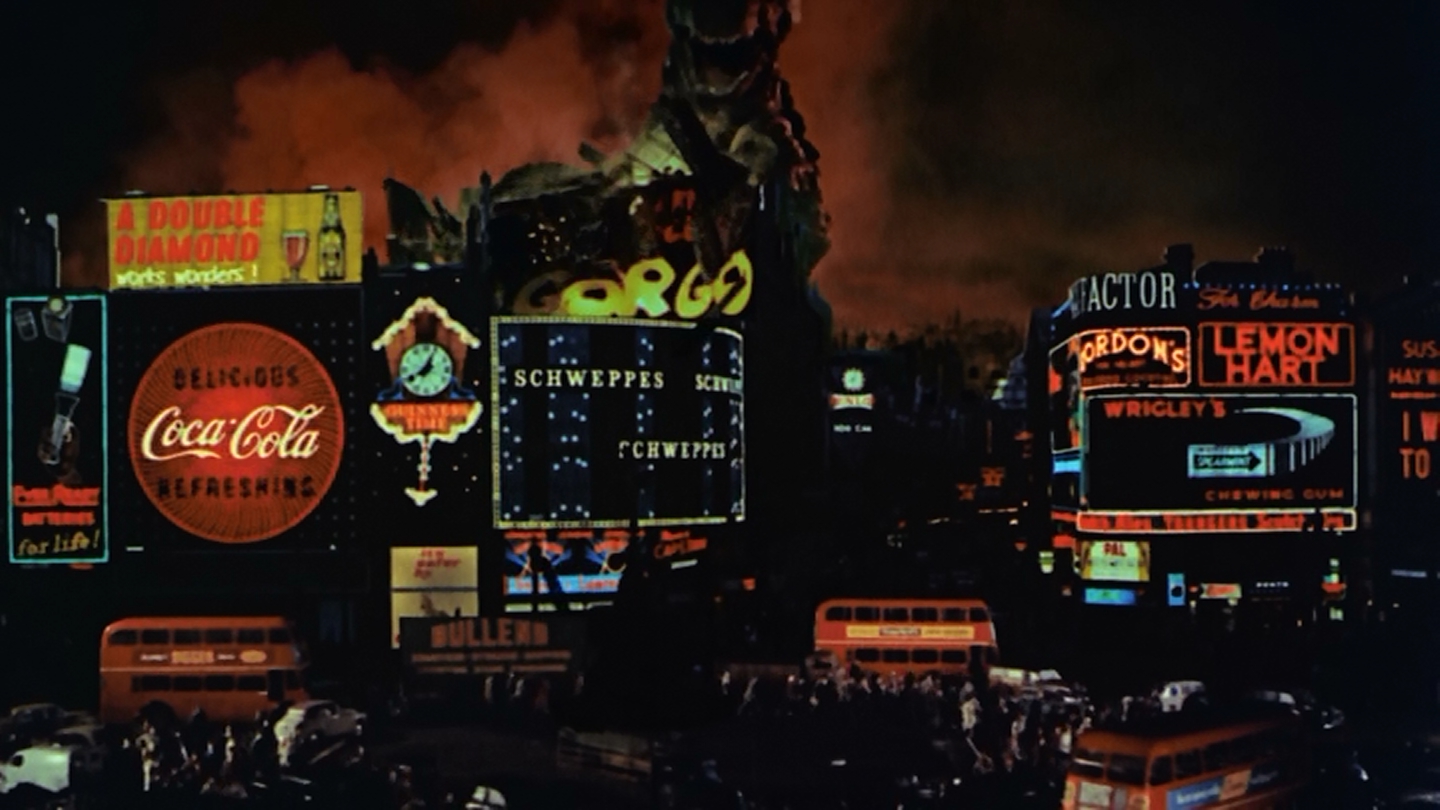
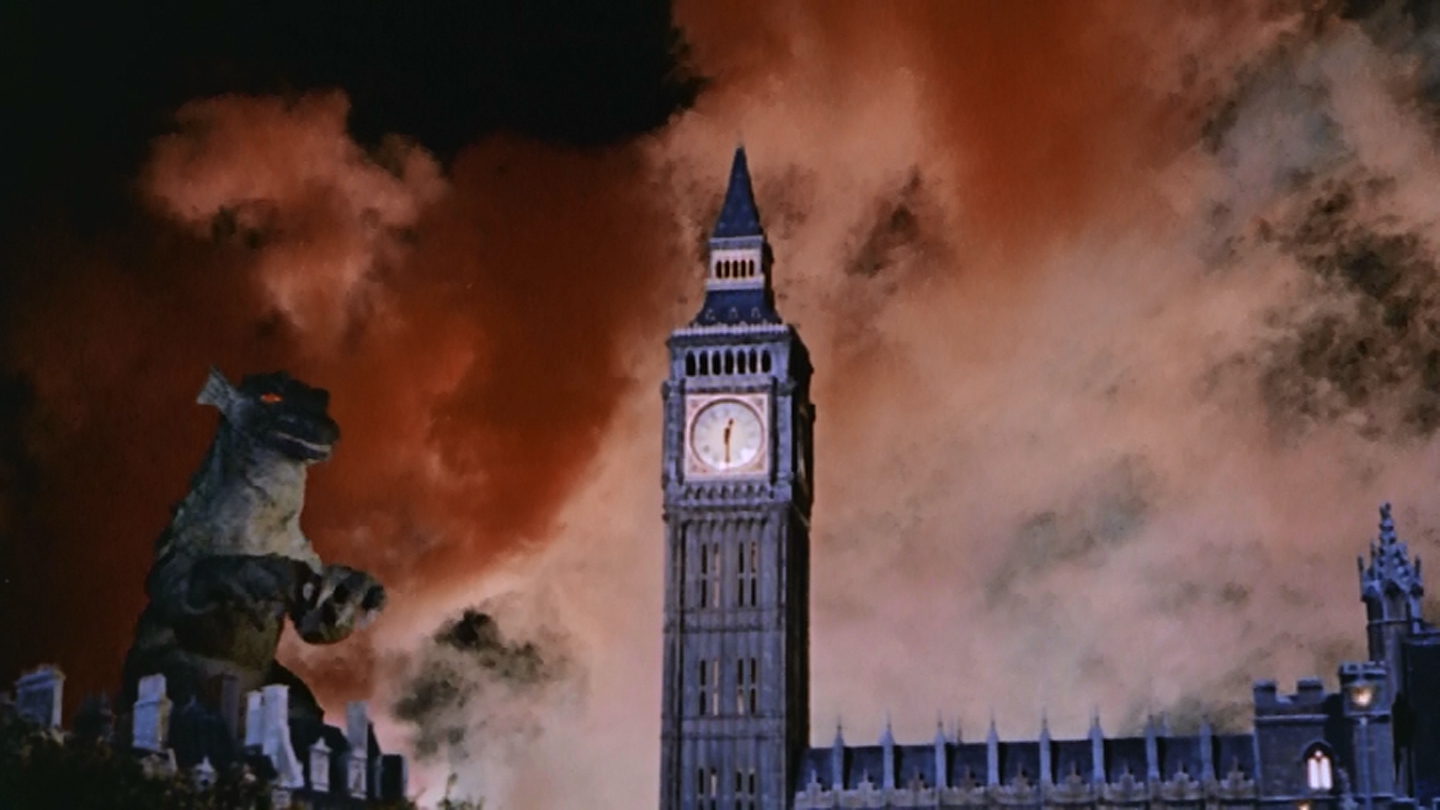
1959's Behemoth also ran amock in London. Thanks to the King Brothers financing, this time Laurie had the money to make it look good. Gorgo is a very well-executed film, with plenty of exciement and a very good 20-minute climax which trashes Tower Bridge, the Houses of Parliment, and Picadilly Circus. It seems like the producers may have felt it necessary to add the reporter's narrative during Ogra's rampage. It feels tacked on, and seems like the reporter is standing in front od a rear-screen projection of the film. Most of the military footage is clearly stock, but that doesn't bother me that much.

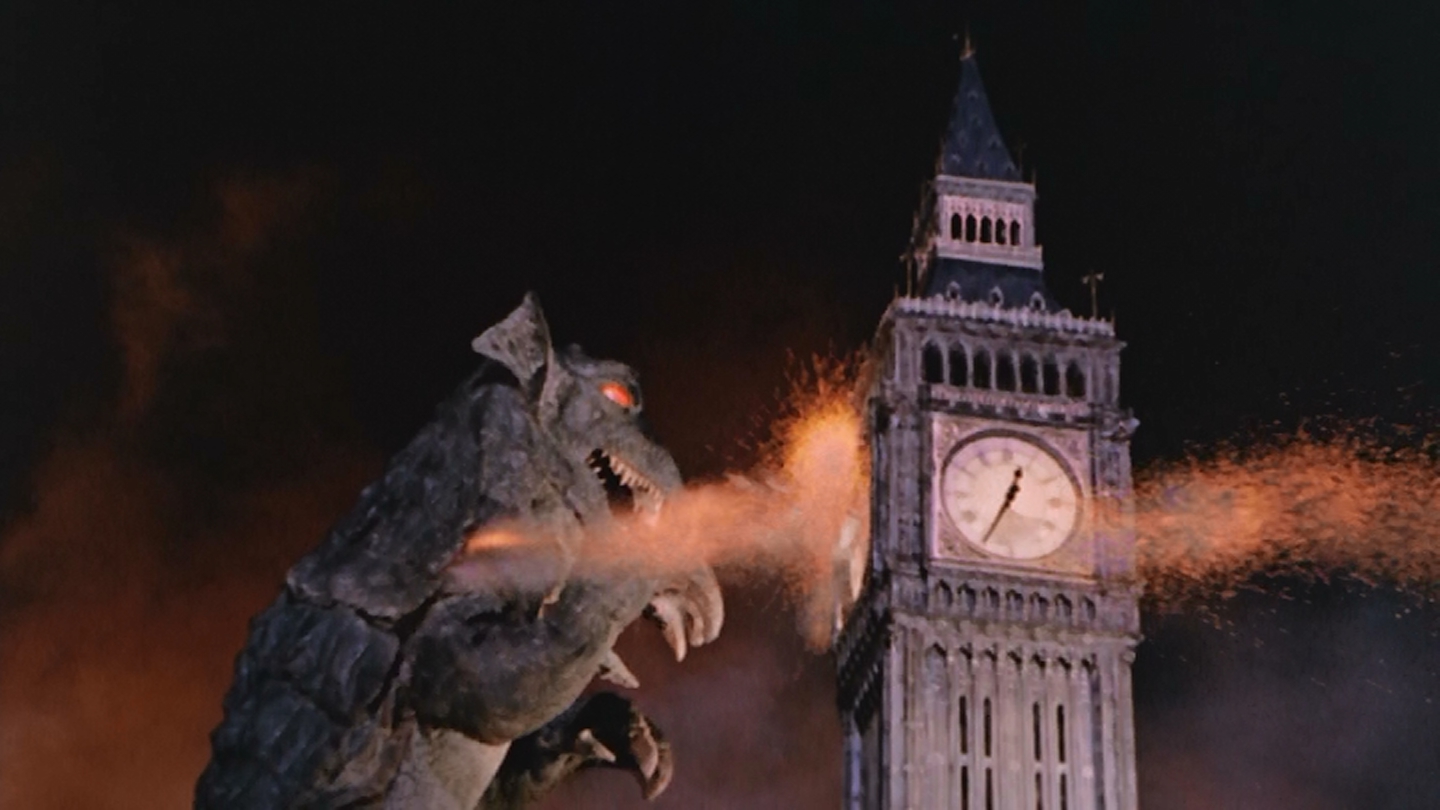
Ogra getting tagged by a missile that has actually gone through the Clock Tower.

I wasn't the kind of guy to talk aboutr transfer, but I've seen both the 2005 release, the Widescreen Destruction edition and the Ultimate Collector's Editition, released in 2013. The difference is stark. The Collector's edition's colors are bright, where Destruction Edition's work is muddy, exactly the sort you remember from TV.

Ogra improves traffic by destroying Piccadilly Circus.

Gorgo is like a good cover version of a favorite song. There's a lot to recognize, but here and there, a creative touch that makes it feel different, and sometimes throws a light on the assumptions of the original work. Gorgo is a wonderful monster film, just different enough from the Godzilla franchise to be itneresting, similar enough to be comfortingly familiar. it was also featured on Mystery Science Thrater 3000, which was how I first came to see it. You can watch it in all its older, muddy glory here:


Additionally, there is a sequel, of sorts, called "Waiting for Gorgo," a good short film by Benjamin Craig. There isn't a lot to analyze, but it's fun, and quite worth watching. Very British.


Next Week, a take a quick step back in time and look at scarionetts from Denmark and Los Angeles!

Thursday, July 18, 2013

Eugène Lourié Takes Up the Torch: the Giant Behemoth

While Godzilla was hibernating under ice, Eugène Lourié was pressed into service to carry giant monster movies forward. He directed three in the span of eight years, after which he felt he was being typecast. He left directing after Gorgo and made a successful name for himself as an art director.

Sadly, this is sadly the last time we will see the marvellous work of Willis O'Brien on screen. And it's not even close to his best work. In fact, this little film is nobody's best work. The British film industry was struggling at the time; budgets were tight, special effects were expensive. Behemoth is nowhere near as detailed and believable as the Beast from 20,000 Fathoms. The film has been strung together cheaply and the viewer, especially the video viewer who can pause, can see where the corners have been cut.

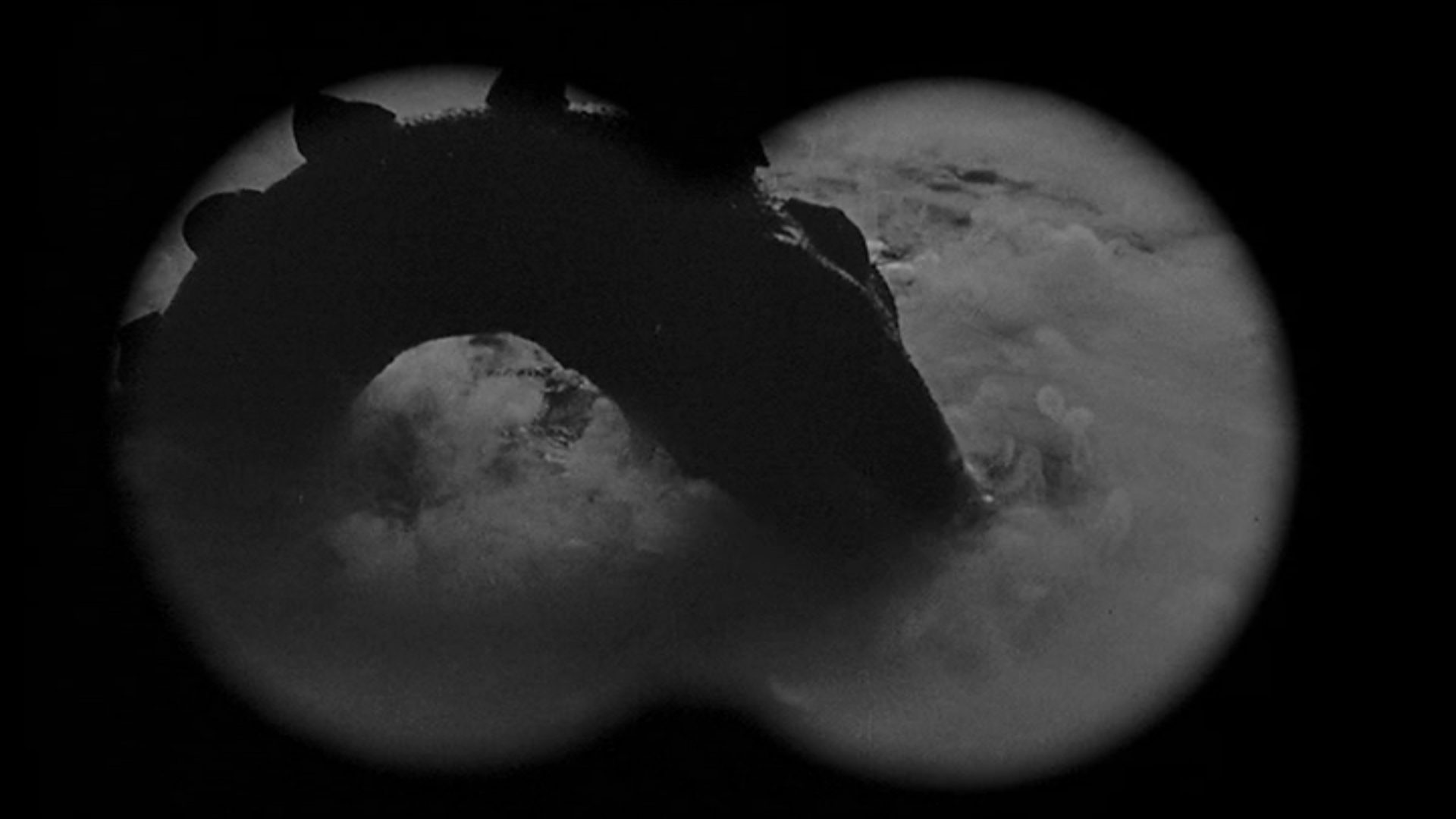
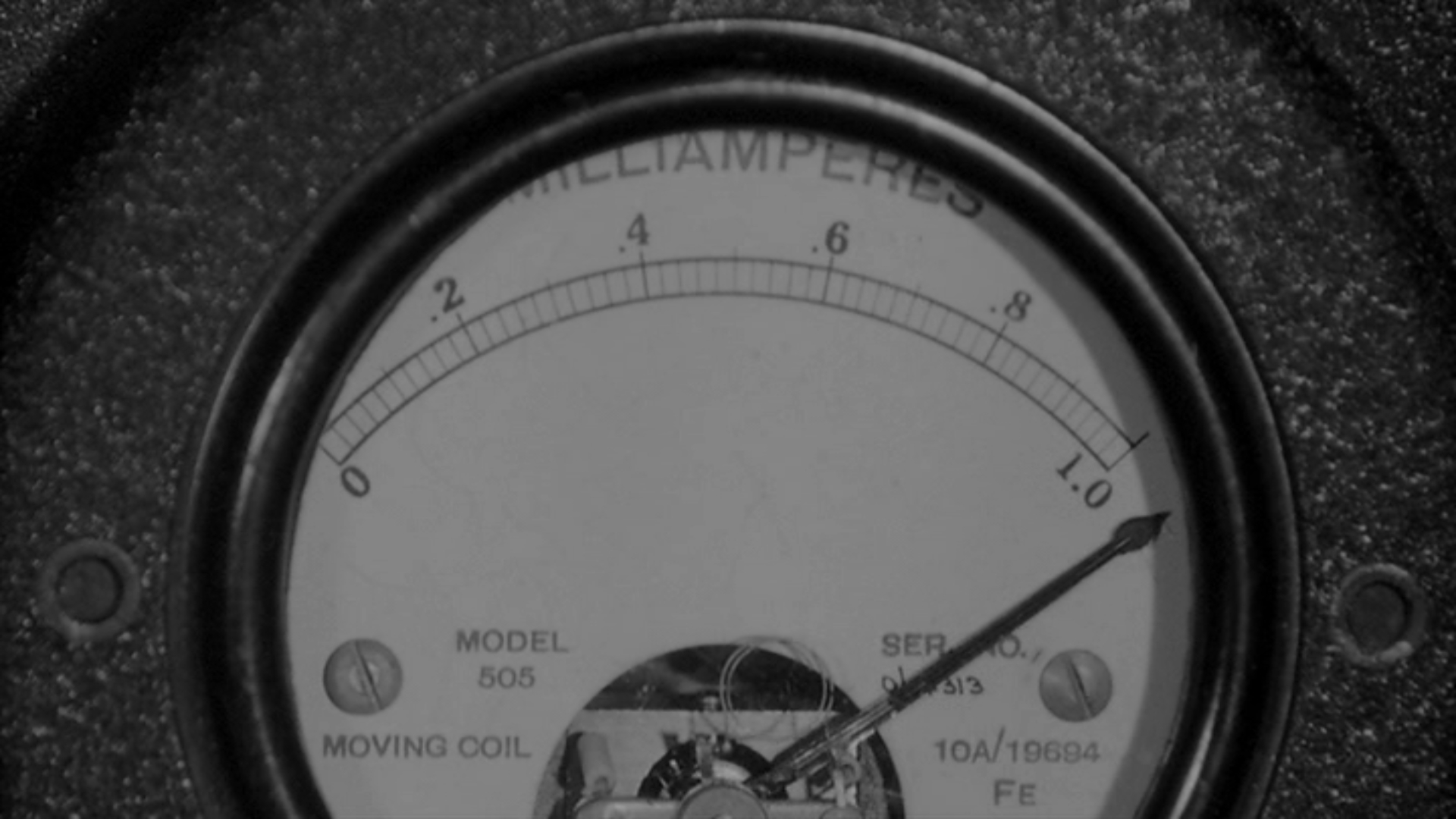
The first glimpse of the monster shows that it has been influenced by Godzilla. It has a string of fins down its back, and while its breath isn't radioactive, it has a radioactive pulse that it can activate at will. Like original Godzilla, Behemoth is radioactive. The initial attempt to track it is conducted with a scintillation counter.

Our first glimpse of the Behemoth.

Radiation detector says there's a giant behemoth somewhere nearby.

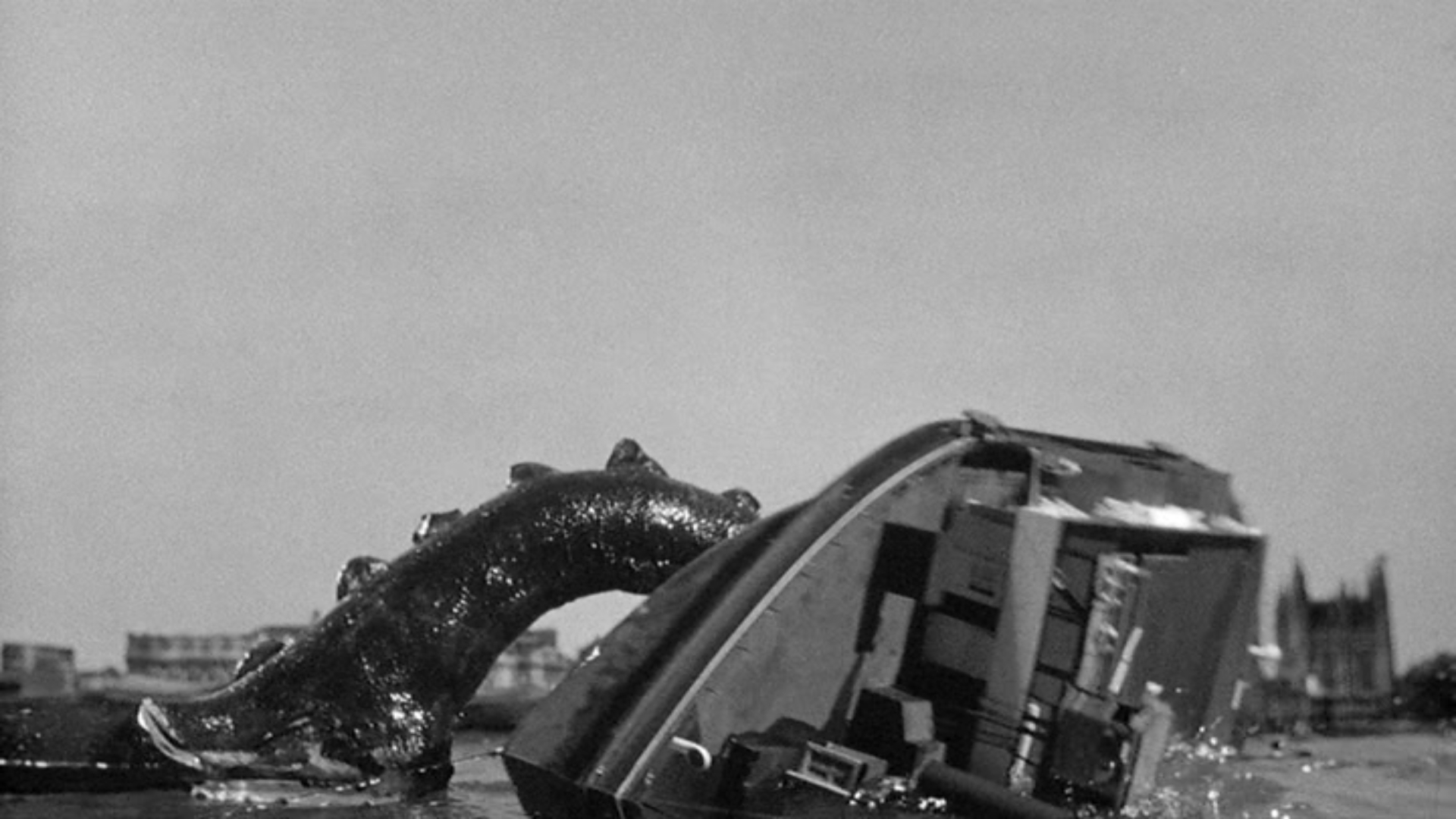
Giant Behemoth works a little more on the Roger Corman “Don't show the monster” than previous giant monster films. In part, I suspect because of the limited funds available for the production. Our first good look at the monster is fifty minutes in, as it capsizes a ferry. But this is an immobile puppet which can't even move it's mouth. And that's all we see of the monster until an hour in. The stop-moton Behemoth is much more impressive than the puppet, because of the expressiveness of the O'Brien and Pete Peterson model. The rampage is also on a budget, and so only lasts some ten minutes. This makes me realize that part of the genius of Godzilla is that the rampage falls in the middle of the film, which allows Ishiro Honda to show us the aftermath.

And there goes a ferry!.

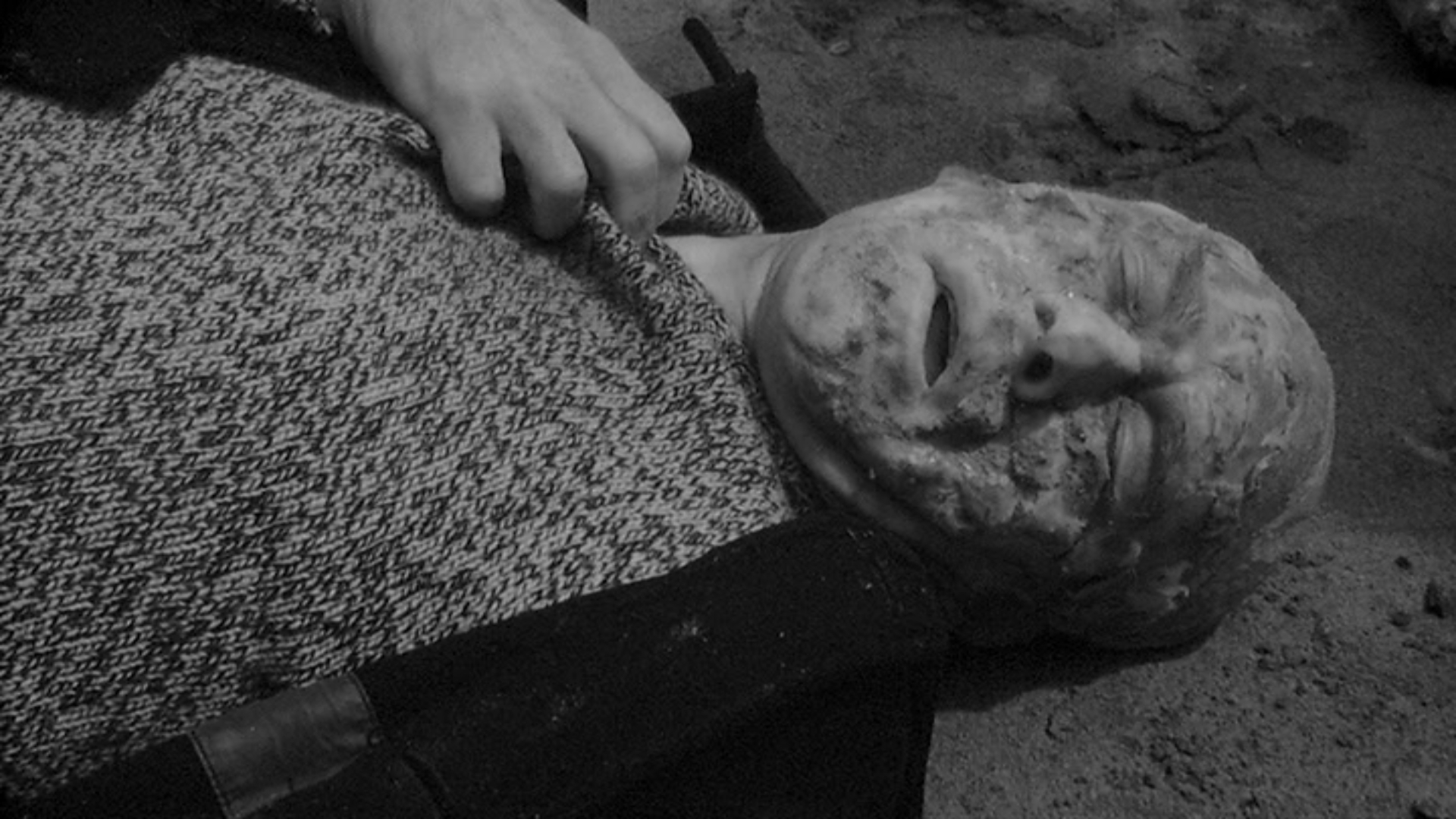
Which is not to say Giant Behemoth is a light film. Lourié takes several opportunities to show people dying, something that becomes increasingly rare in kaiju films. The fisherman is shown with horrific radiation burns. The ferry goes down, and people are shown waving their hands and going beneath the water. The last shot is a man floating face-up, radiation burns clearly showing. During its rampage, the Behemoth uses its radiation to kill fleeing civilians as well as destroying a machine gun crew. These moments of horror remind us that this is not just a fantasy film, but has roots in horror. Scenes like this become more rare as kaiju films become more and more child oriented.

Another radiation victim.

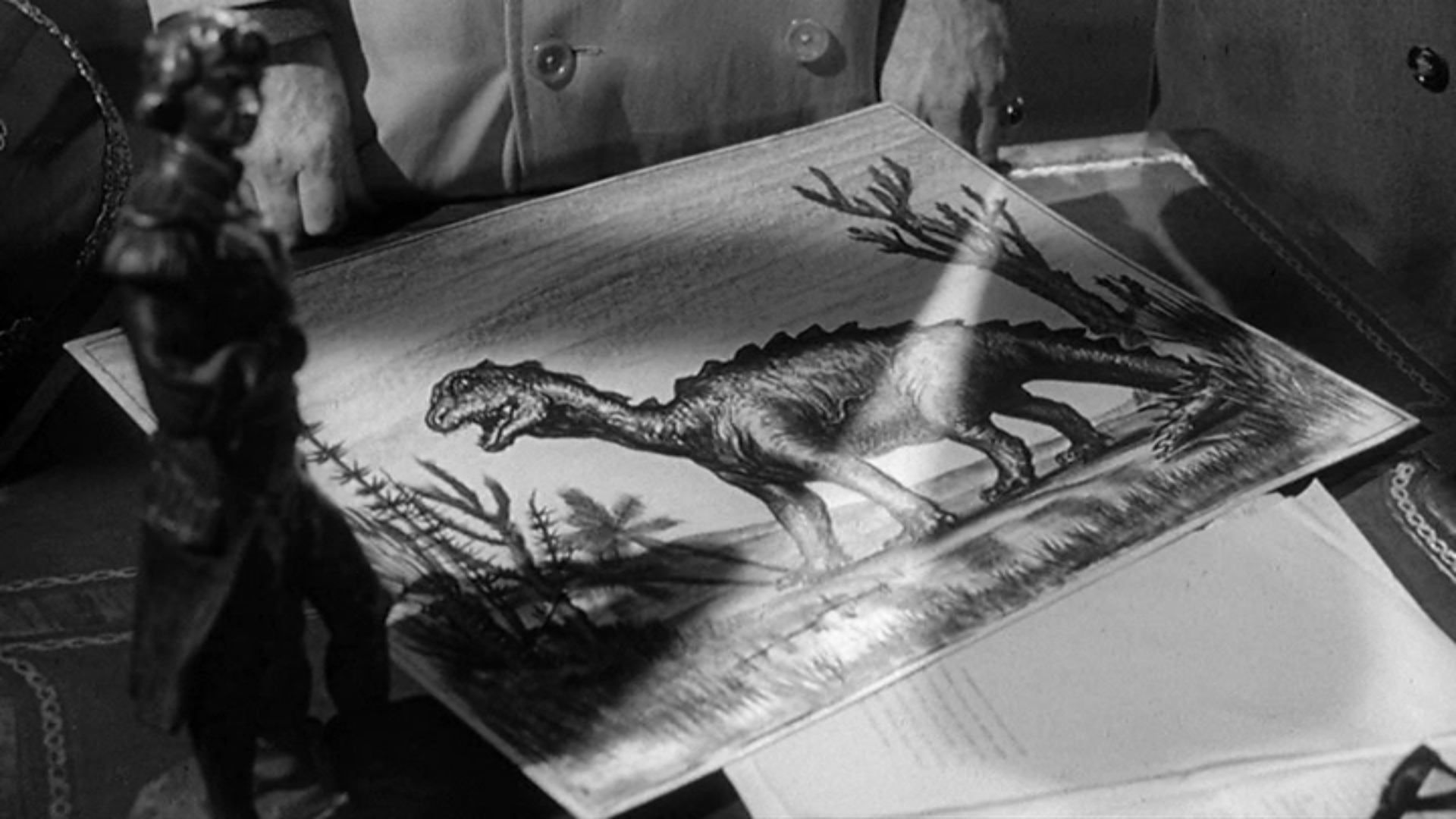
Similarities to Beast from 20,000 Fathoms are frequent, and if Internet rumors are true, intentional. Behemoth, the Sea Monster (the original title) starts with stock footage of a nuclear detonation. The expert immediately assumed the giant monster is from the Pacific, and then says that "they" always make for freshwater rivers to die, a gentle reference to the Beast. And it's quite clear that the frst person to run into kaiju are the fishermen. We've seen this in Beast From 20,000 Fathoms, Godzilla and Pacific Rim; the fishermen serve as the canaries for the terrors that come from the sea. Lourié also plays with the sketches of the Behemoth, as he did in Beast. The 'best guess' of the illustrator is very much like the Beast. Also similar to the previous film, the Behemoth is to be destroyed by an injection of radioactive material, in this case Radium delivered by torpedo. Like Godzilla, it breaks the surface one last time before sinking back into the depths.

New York got attacked by one of these.  Could it be one of them?

Giant Behemoth is not a strict remake. For example, Jack MacGowan as Professor Samson is about as far as you could get from tweedy Professor Elson in Beast from 20,000 Fathoms. Samson is young, nerdy and somewhat manic, excited by the possibility of a living dinosaur. He plays the Dr. Yamane role well, disappointed when it's clear the monster must be killed. He shares Dr. Elson's fate, destroyed by the monster he searches for.

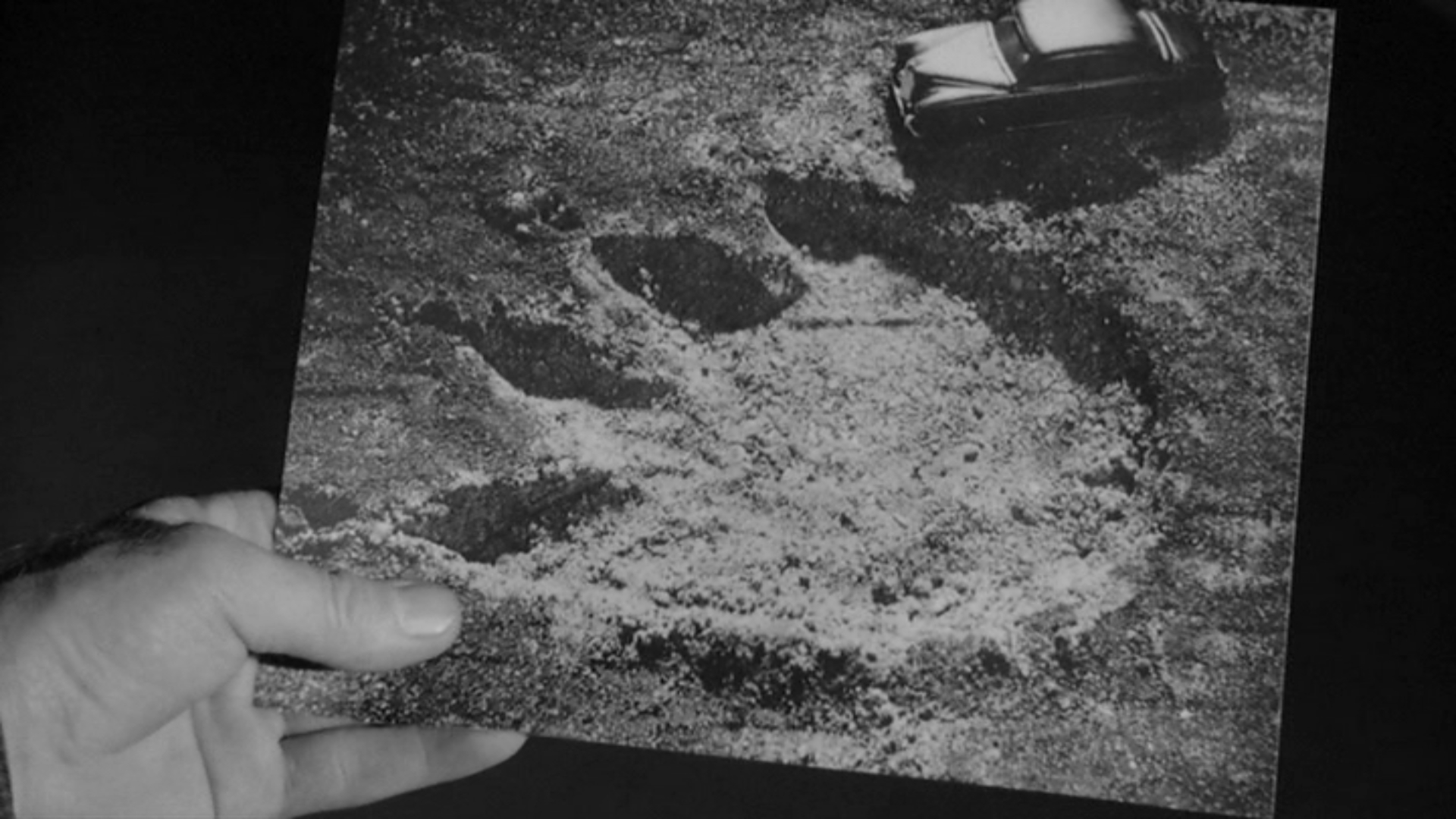
There are nods to other films. We get the footprint trope, and the Behemoth crashes through a bridge, although not Tower Bridge, as the brontosaur does in The Lost World. Gorgo, next in Lourié's trilogy, would demolish Tower Bridge.

This footprint.  Was Godzilla here?

This film is the last that will use stop-motion animatiopn to portray its monster. For whatever reason, stop motion fell out of favor for monster films, perhaps because of the perceived cost, or the time involved. Virtually every film after this will be suitimation, and there is a brief, unsuccessful flirtation with marionettes. With the exception of the Gamera franchise, this will be the last quadruped monster to thunders across the screen until the era of CG. Ironic, since stop-motion's greatest triumph was the human-like Kong.

A close-up of the model.

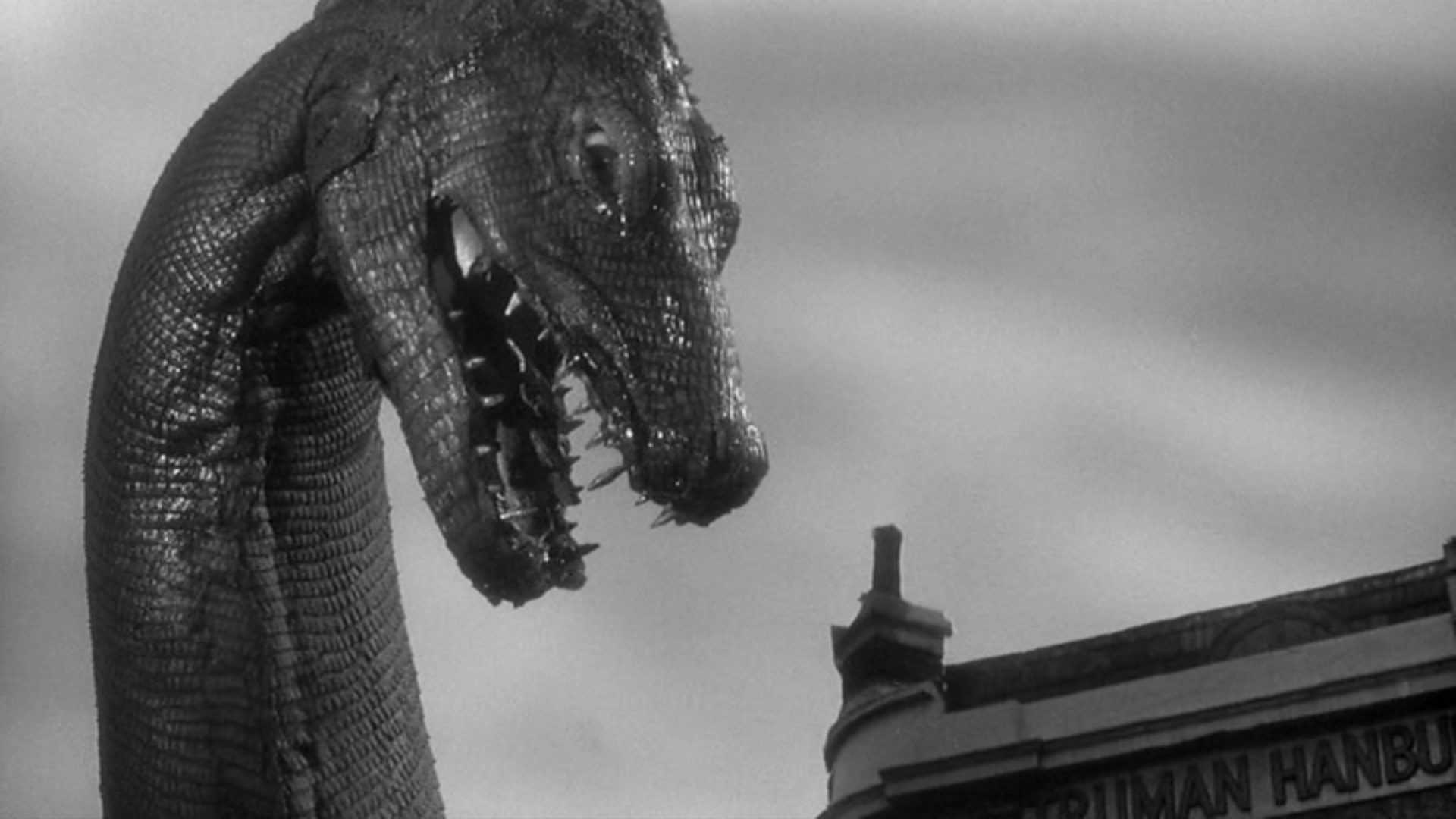
Ultimatly, Giant Behemoth isn't all that fascinating. It suffers in comparison, both in action and in the presentation of the titular beast, to Beast from 20,000 Fathoms. Behemoth is in essence a remake with less money and attention to detail. The model is less convincing, and we are much less sympathetic because Behemoth's character is less well-defined than either the Beast ro Godzilla.

Possibly the best shot of the Giant Behemoth?

Our next film is Lourié's final film as director, but the pinnacle of his giant monster trilogy. And our very first color film.

Saturday, July 13, 2013

Pacific Rim Initial View

Study the Kaiju, the key to victory.

Pacific Rim gets a monster-sised thumbs up. The film is entertaining, moves along briskly, and does a good job with the background and history. I left the movie wanting to know more about the world, and the history. Dozens of stories could be told in the background of the film.

Monster references abound. An ape-like Kaiju throws a Jaeger, the way Kong throws the tyrannosaur/Godzilla. One of the Kaiju has a Cloverfield vibe to it. There's a Rodanity to the giant, flying monster. And 'knifehead' has got to be a tribute to Gamera's foe Guiron. Each Kaiju has a very different look, but certain visual themes tie them together. They're good monsters. The fights are exciting and not overlong. There's something at stake with each, giving the audience a reason to root for the Jaegers. They also forward the plot, rather than stopping it.

There's a little bit of Cabin in the Woods inclusiveness of previous monster movies. Perhaps this is where all those mojsters that have attacked Japan have come from. It's also very much a Western, with incompetent, ineffective, and interfering politicians and rogue pilots taking their billion dollar Jaegers off mission.

I will totally be buying the big damn special edition for Christmas, and getting the tie-in books. It's a rich, well thought-out universe, and I'd like to spend some more time there.
Idris Elba was absolutely the right choice, and carries some merely acceptable performances along in his wake. The internationalism of the cast is pretty darn good. And an extra plus for respecting the science wonks. I liked the film a great deal, found it very satisfying. Go see it.

That said, a big razz to Fandango, which sold me two tickets to a showing that didn't exist. And although I thought I'd purchased tickets to the 3D IMAX version, I apparently hadn't. Won't make that mistake again.