Thursday, March 19, 2015

The Bitter End: Atlantic Rim

The people at Asylum Productions have embraced the term mockbuster, partially because it keeps them from being labelled rip-off artists. Atlantic Rim is a production intended to ride the coat-tails of Pacific Rim. Watching it, which is a chore, points out how rich in visual language and texture Del Toro's film is. How much depth there is in unspoken backstory, and how much he actually cared about this film. When I watch this, I am reminded of the Full Mon Production films: Kraa and Zarkorr. These were made without love, without a passion for the subject. They're quickies, churned out to make a few bucks, and then on to the next assignment.

Atlantic Rim had a budget of about half a million dollars; the same as Gareth Edwards' Monsters. It is so relentlessly cheap, in script and direction, that it looks cheaper than it is. Even such a cursory glance at kaiju film as the writers and directors took reveals that they know something about Kaiju film. True to its Kaiju roots. Stock footage of carrier groups to pad out the run time? Check. They could have learned a lot from Daiei, if they'd cared to study.
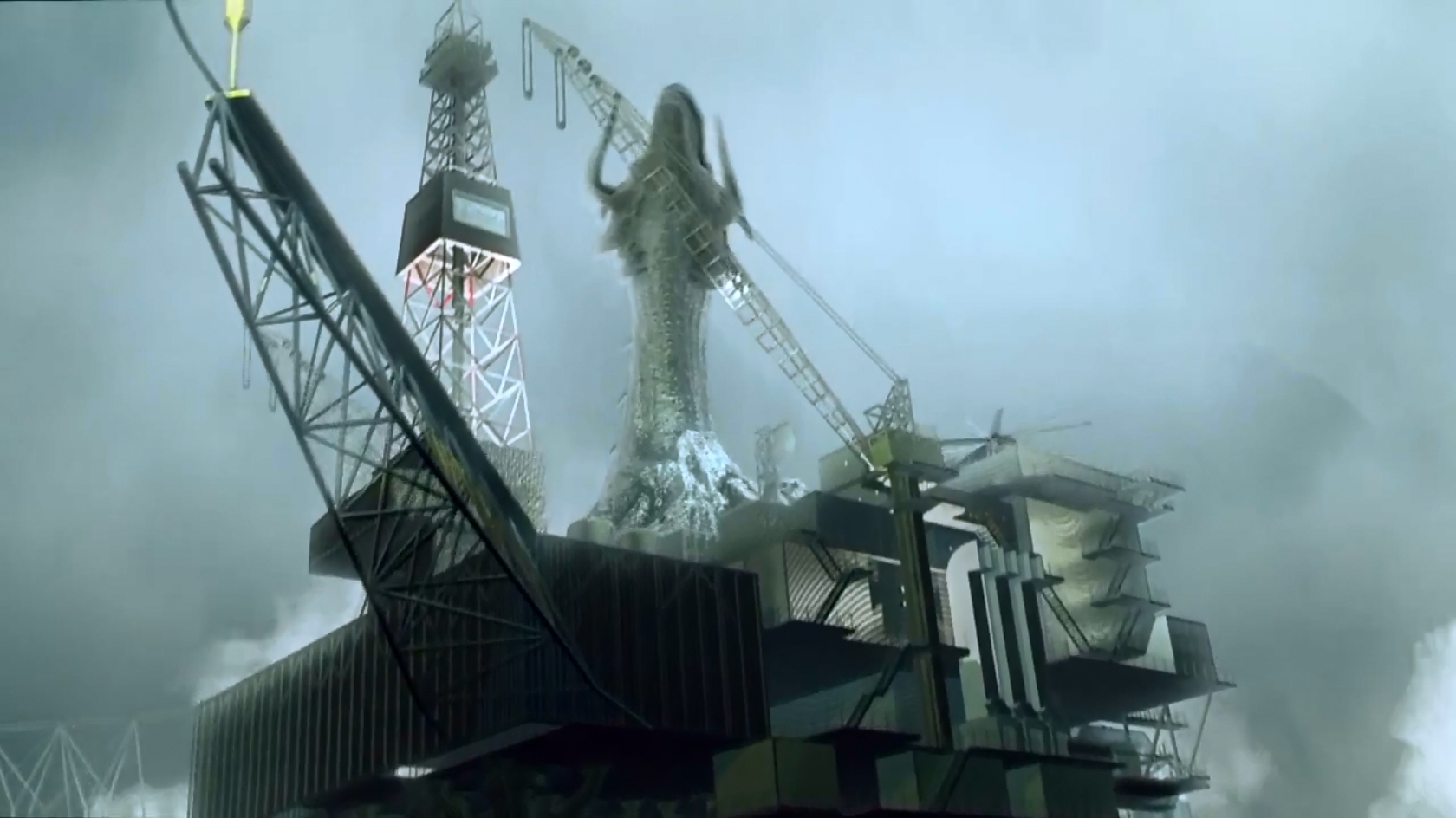
Aliens invade, Mankind fights back.

Like Godzilla, the creatures come from the sea. Because only the sea is large enough to conceal something this big. In this case, apparently, the sea is the Persian Gulf, according go the screen in the minisub. There's an oil rig, and it gets attacked by a giant monster from the sea. The script doesn't get much about 4th grade reading level. "An explosion would have registered on scientific readings." says the science advisor.
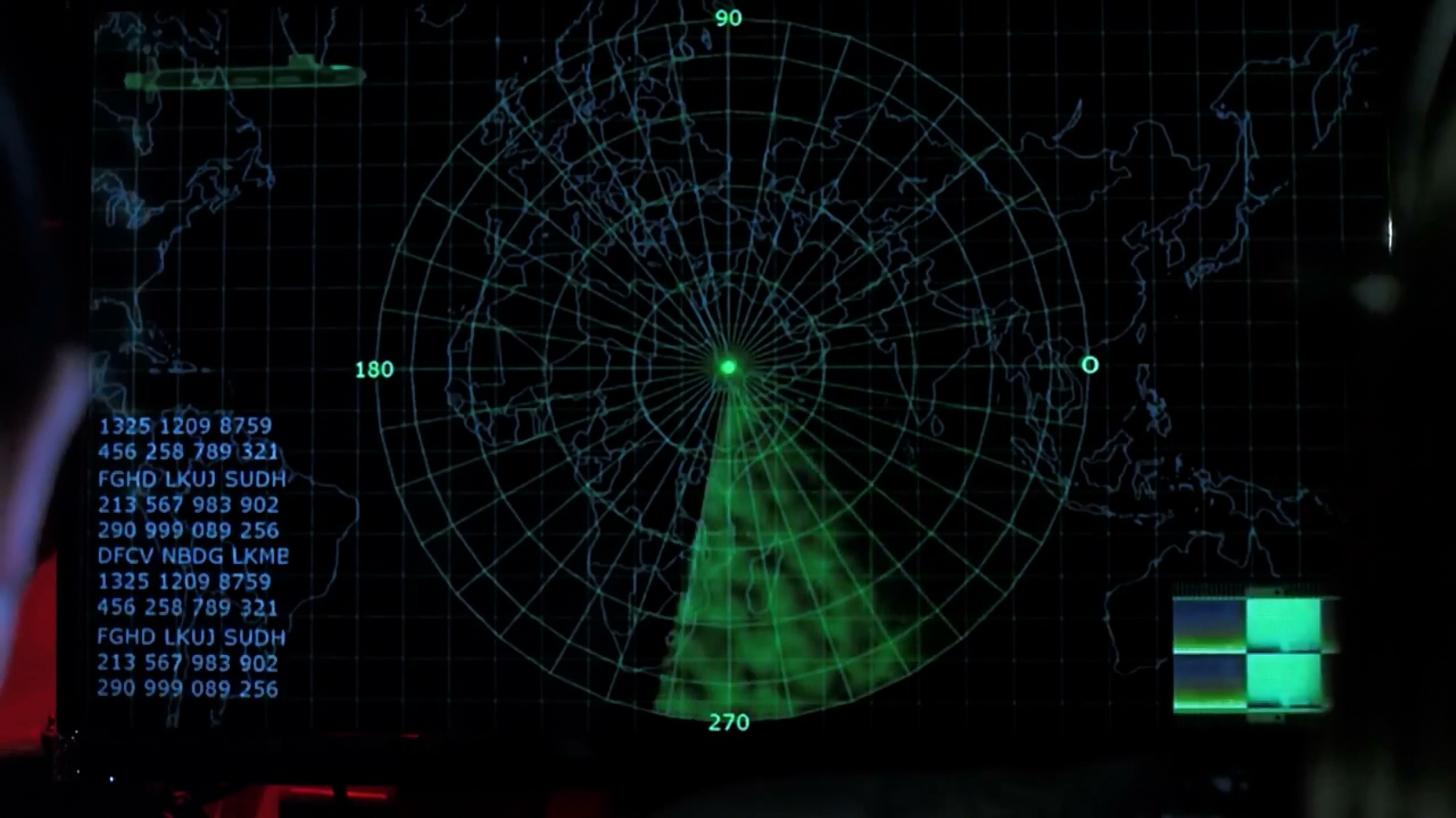
SONAR is detecting large landmasses, possibly Africa and Asia Minor.

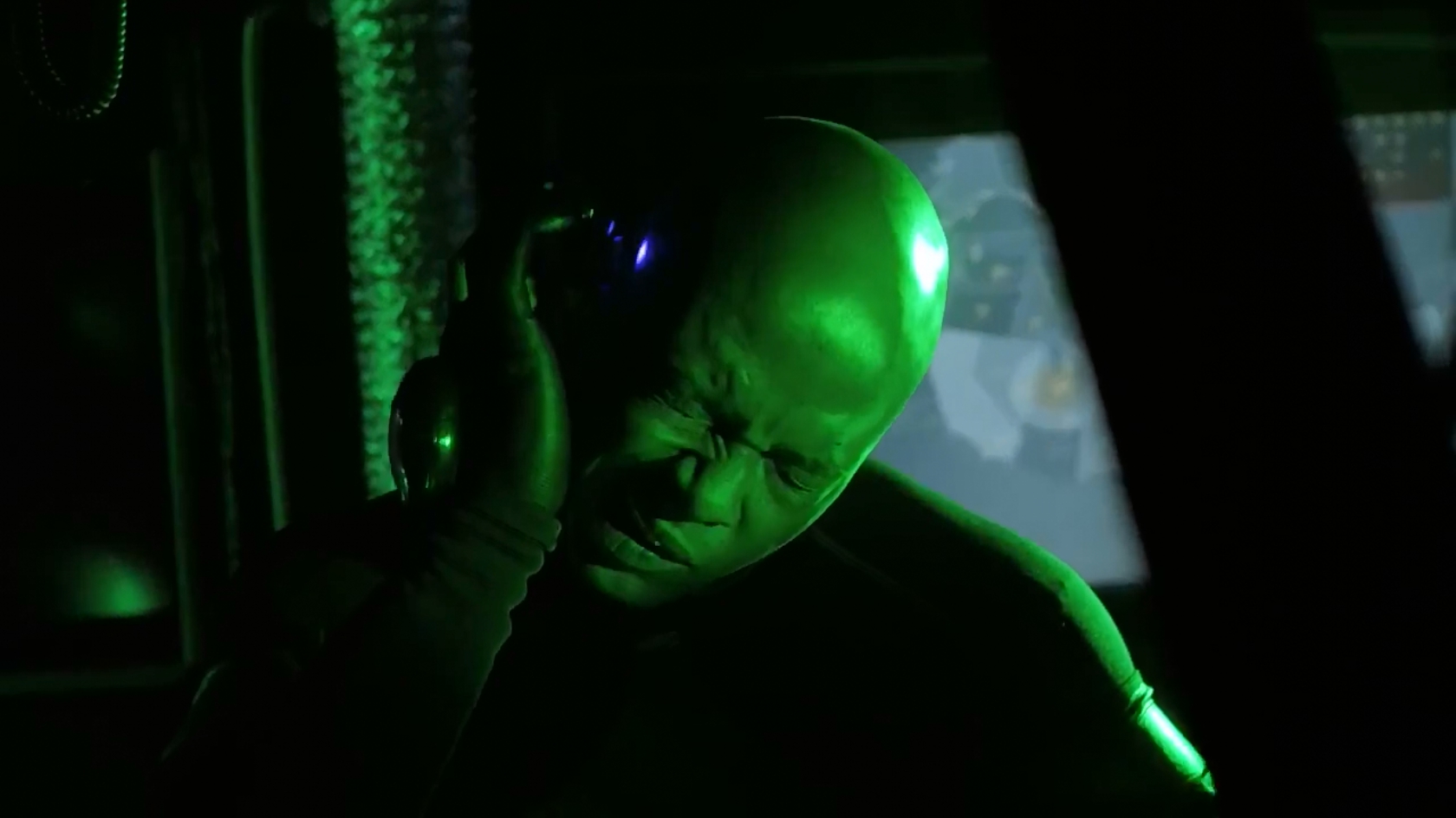
And there are our pilots. Entirely as unlikable of the characters in Cloverfield. The rogue, Red Watters, is an unpredictable loose cannon who has temper issues, and within three minutes of being introduced, is beating people up in an alley. There's also the girl, Tracey, and the other pilot, Jim, who seems like the only character who has ever seen the word restraint. Their call signs are red, blue, and green, which is the color of the lights in their cockpit. Although like Pacific Rim, they production team only built one cockpit, the only difference in Atlantic Rim is the color of the lights.
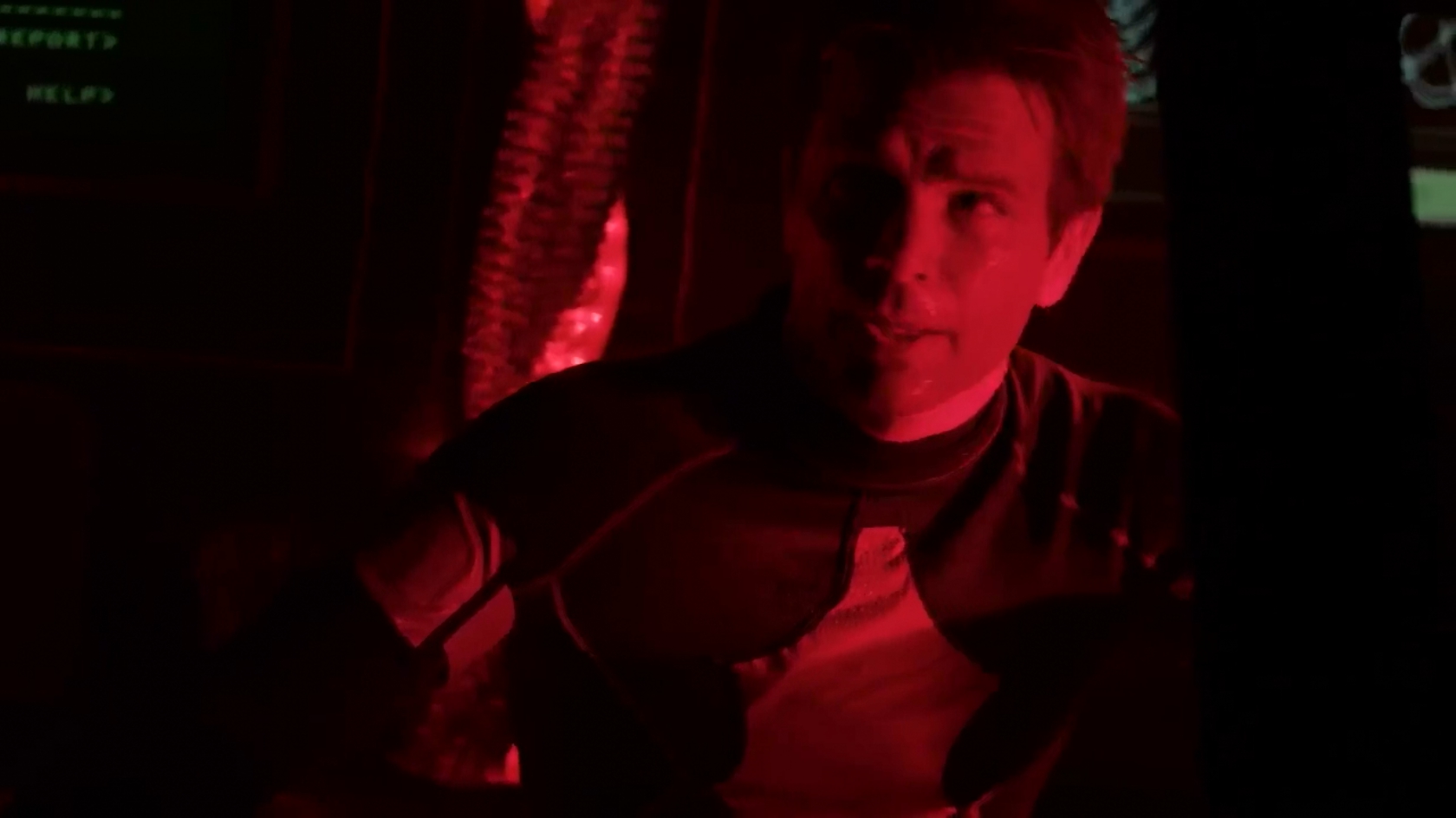
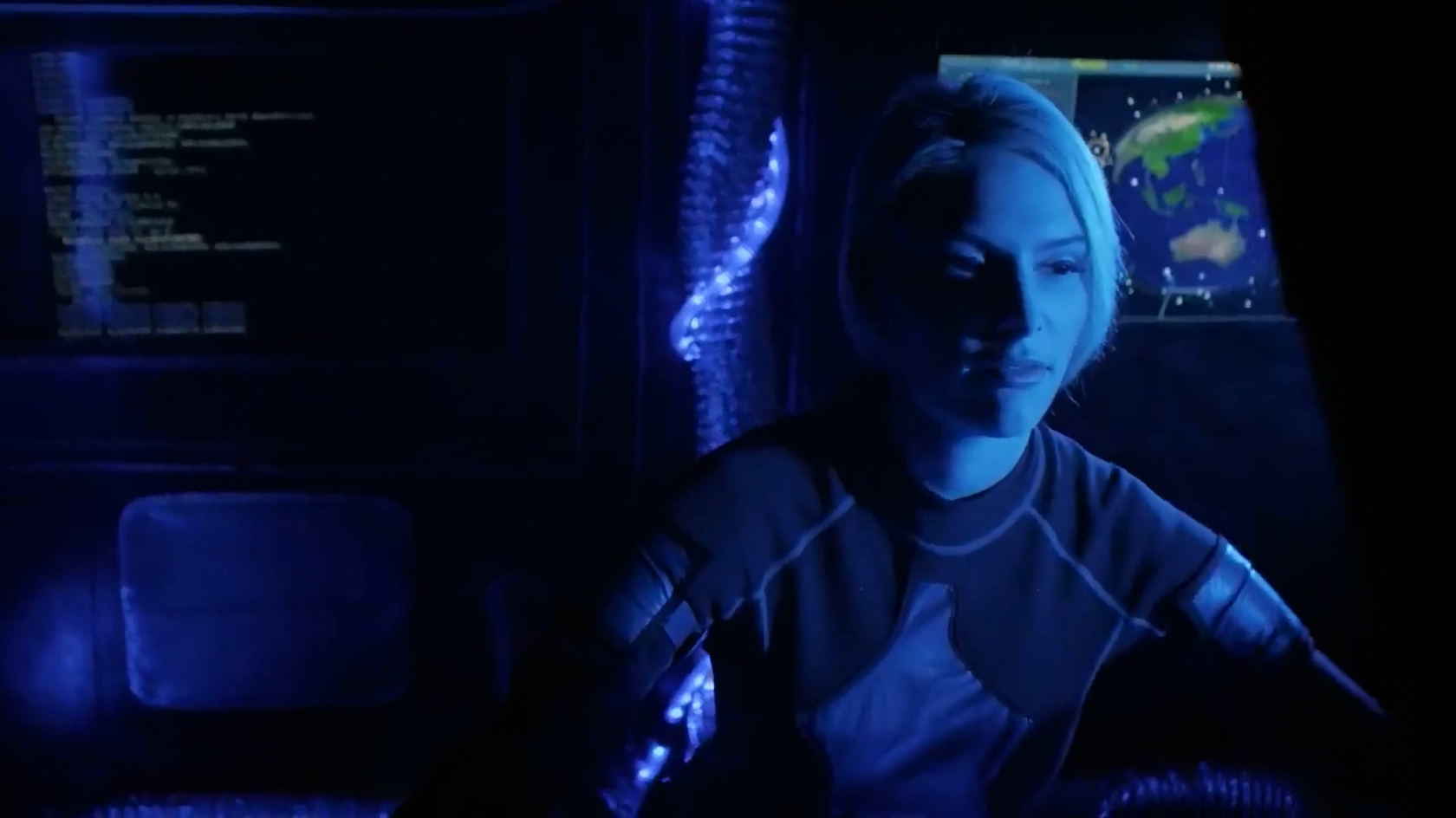
A loose cannon who's unpredictable and indispensible.

Yeah she sleeps with both of them.

And the brother doesn't get the LED string.

The plot has no stakes, no consequences. Blue's power goes out during the first dive, and I stare at the screen, really unaware of that this means. After some attempts at lengthening the completely manufactured drama, she gets it back up. This is a little bump in the long and interminable countdown of how deep they're going. It's an amazing six and a half minute sequence in which nothing relating to the plot or of any interest happens on screen. Six and a half minutes.

There's a fight, and it turns out that this wasn't the only monster, shades of Gorgo. The second monster (same model as the first monster) attacks, and the pilots scramble around the small airport, pretending it's a Navy base. They bomb the creature, wounding it. It slithers back into the ocean, everyone celebrates because they think they've destroyed it.
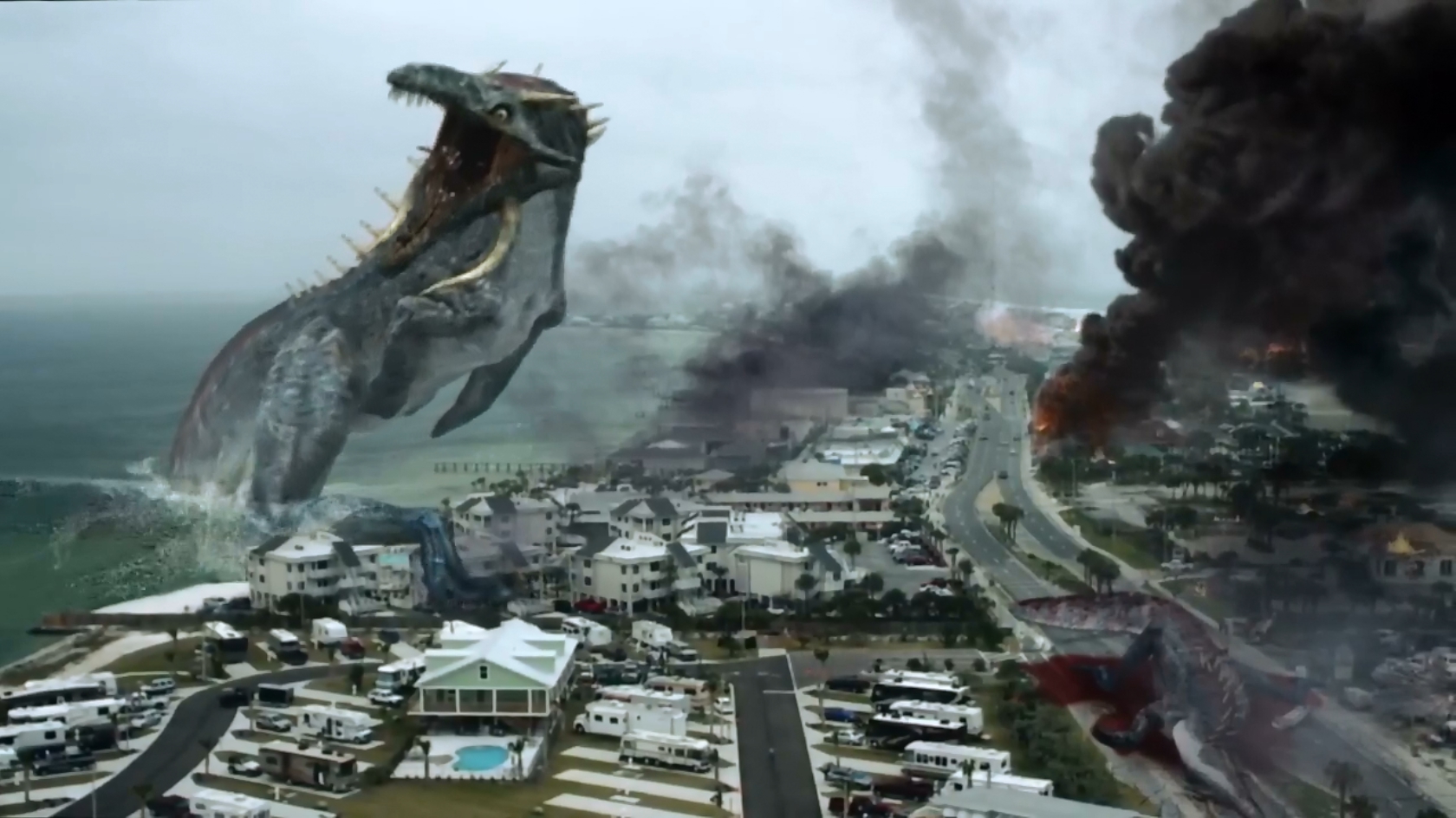
Did  mention the model sizeing is a problem?

Which brings us to a plot problem. If the creatures can be injured and destroyed by conventional weapons, why the hell are they re-deploying the Armada bots? Because the plot. Why does it taken less than a day to upgrade the bots? The plot. Because the bots now have weapons, jet packs, and a neural interface. Why does the creature attack New York when all the other attacks have been on the Gulf Coast? Because King Kong, Q the Winged Serpent, The Beast, Clover, and Godzilla have done it already. It even takes out the flatiron building. A fair portion of the last fight takes place at the George Washington Bridge, like Cloverfield.
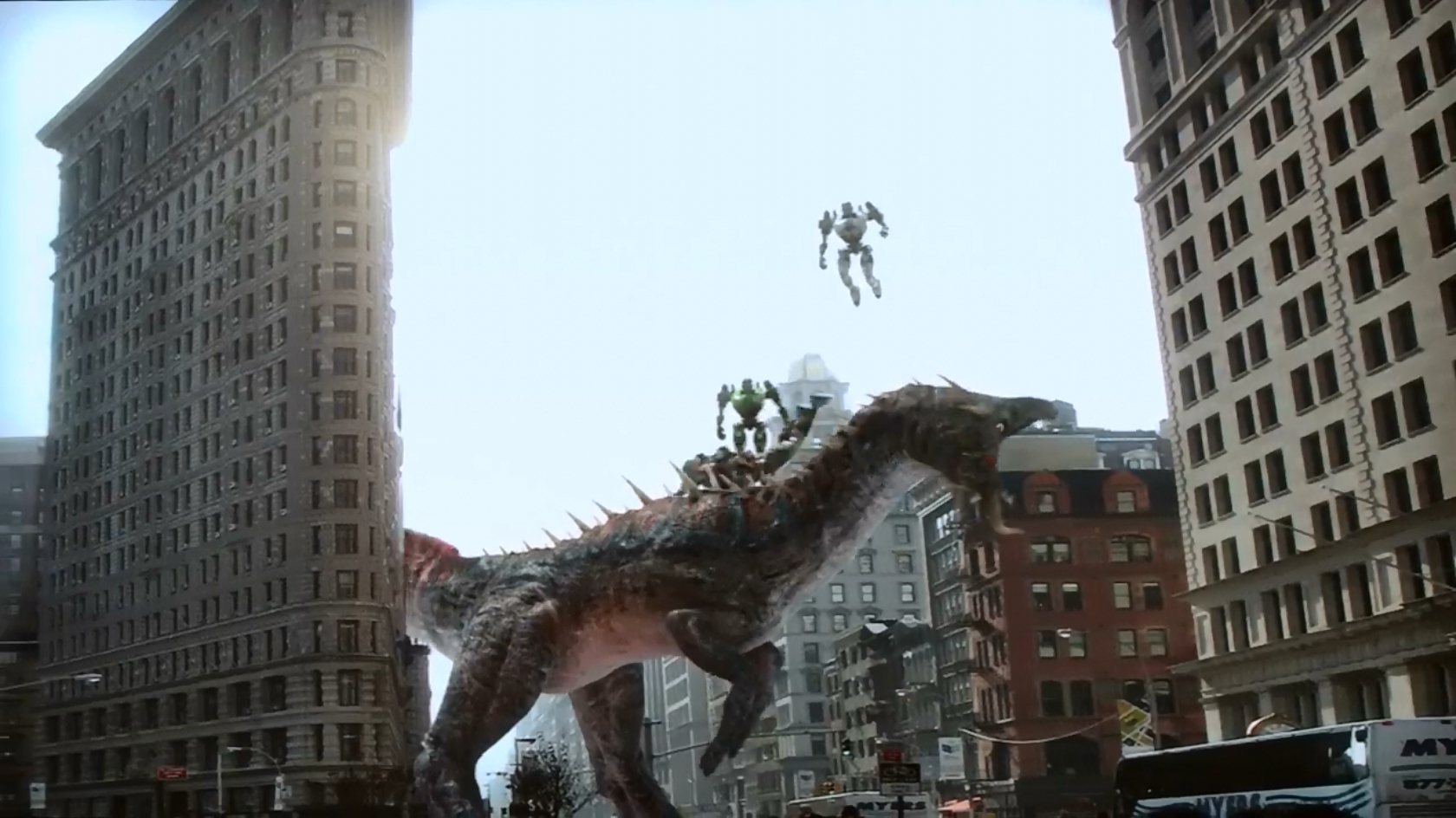
Hey! The Flatiron Building!

There's a Colonel who is really into dropping a bomb to destroy the monster. He draws a weapon on the Admiral. With his back to a pair of M-16-holding guards. They are not part of the plot, however, so they do nothing. I mean why didn't they just not put the guards in if they weren't going to do anything?
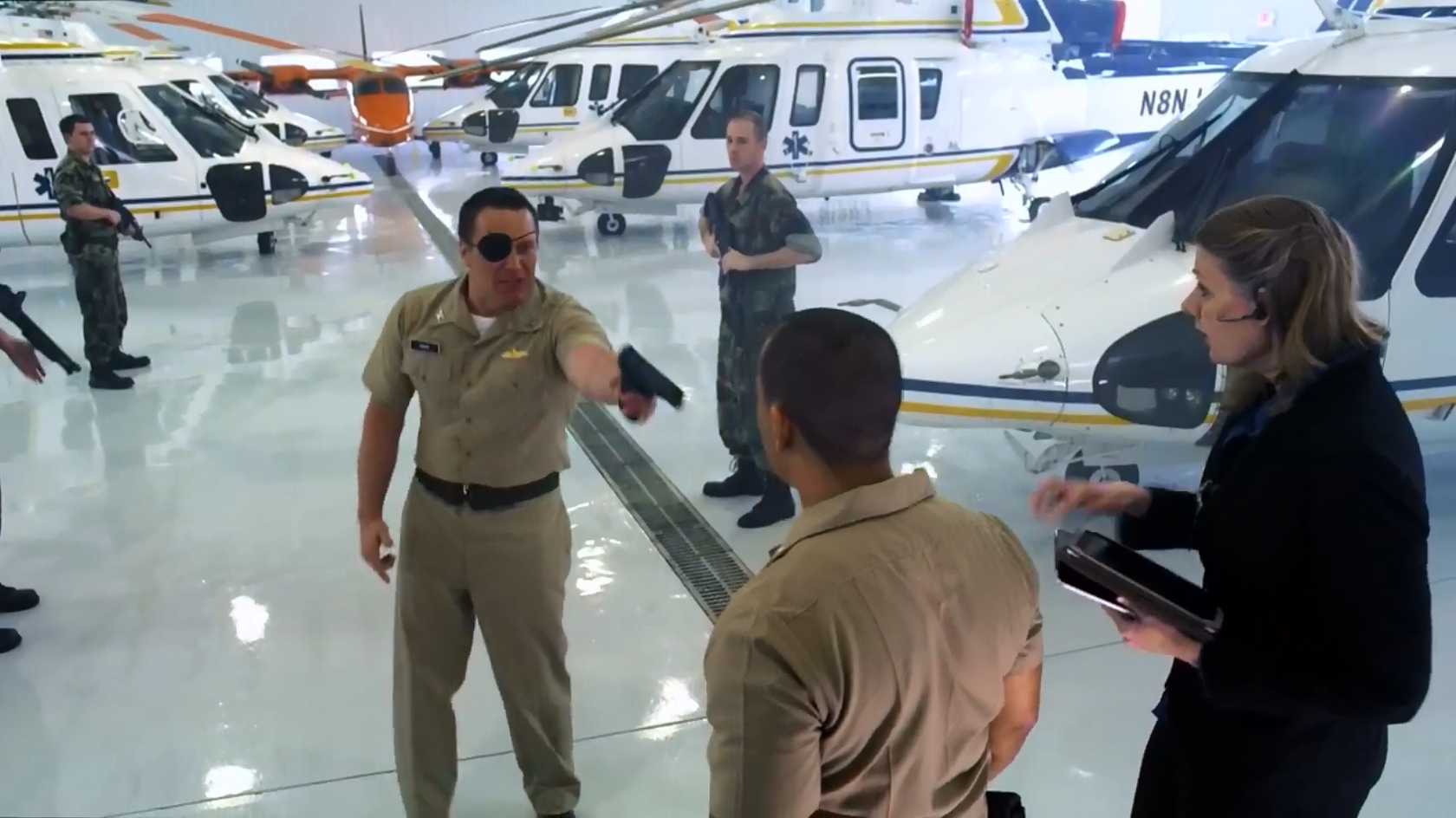
Hey guys wityh guns? Gonna do anything?

Red throws the monster into outer space, because the suits are escape-capable, and nukes it in orbit. Yay! Plot over.

Like a lot of the newer films, Cloverfield and Monsters, the creatures don't have names. They're just creatures. And unlike Pacific Rim, there's no real exploration as to where it might have come from. Even Cloverfield spend more time and effort on the creature's backstory. On the other hand, we have a lot of shots of Blue flailing around pretending to swing her sword.
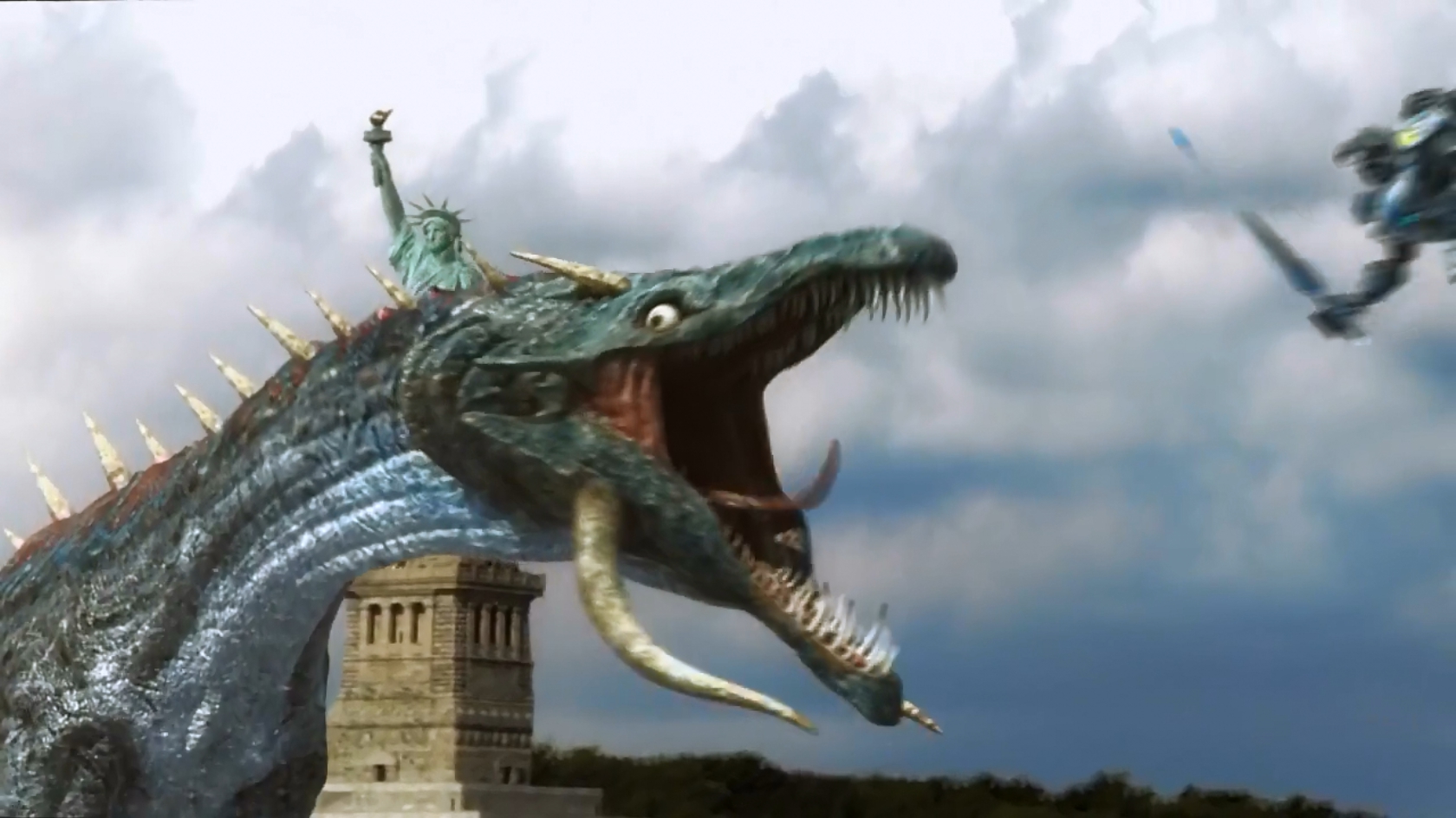
Monster goes rawr.

The film lacks charm. Or really any sort of positive characteristic. Full Moon Studios films were at least laughably bad. This film is so bad it's insulting. Asylum doesn't care. Have the chatacters repeat the same phrase four times in less than three minutes? Yeah! Totally irrelevant sideplots that serve no purpose other than eating up time? Shove a couple more in there! It's irritating tho realize that the producers at Asylum think this is a product that should be purchased and watched. I saw it for free, and I still feel ripped off. I don't even recommend it for people who love terrible films.
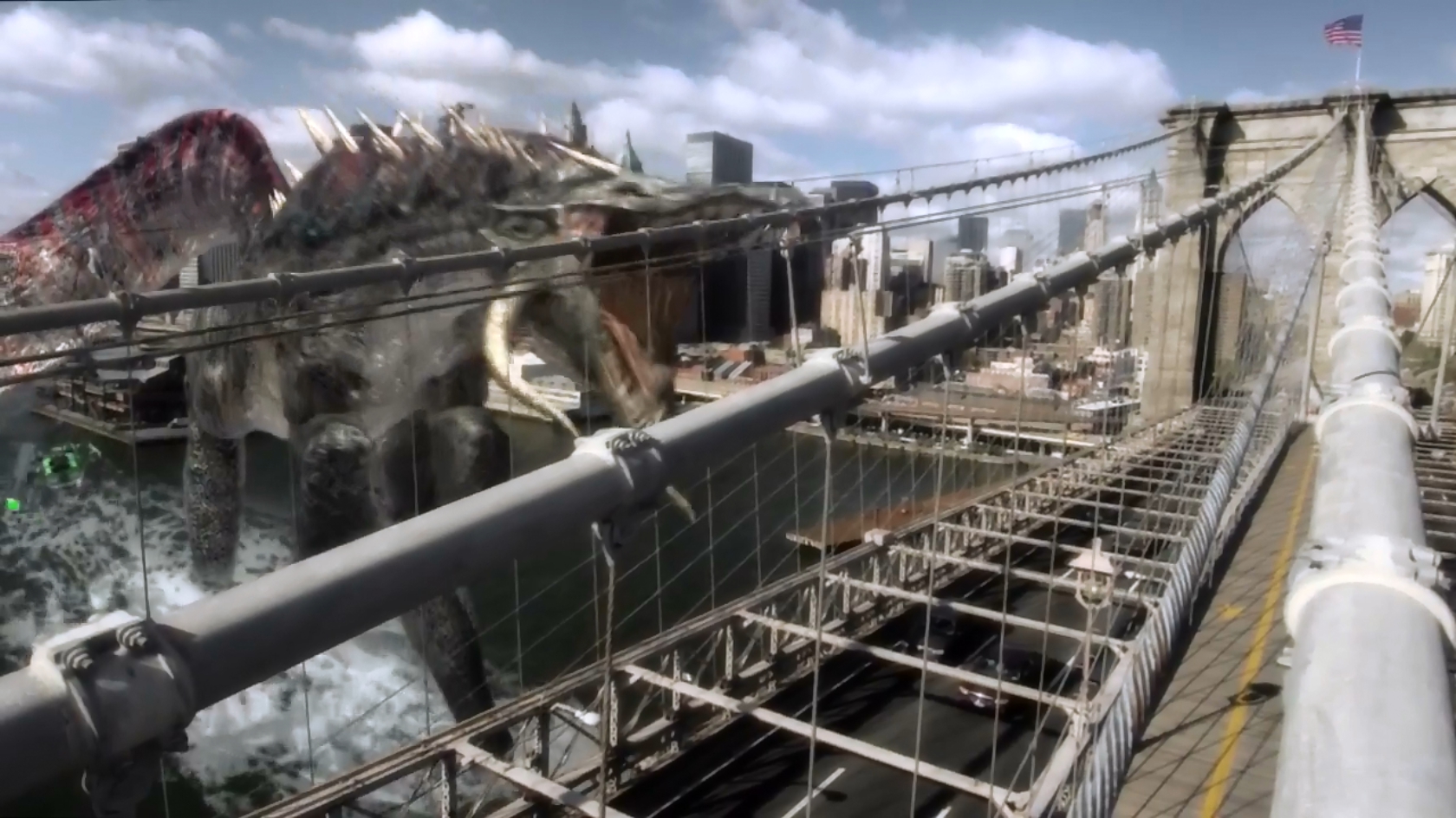
Hey! The Flatiron Building!

And this is, as the title says, the bitter end. I'm ending the weekly My Year of Monsters after eighty-nine films and nearly two years. I've looked at giant monster films from 1933 to 2014, cheap, good, bad, and historic. It's been fun. There will be other kaiju films, and I'll address them as they come up, adding them to the label. I am anticipating another Gamera project, now that the franchise is 50. The second Host film is due out sometime, and further in the future D-Wars; Mysteries of the Dragon, Skull Island, Toho's next Godzilla film, Pacific Rim 2, Earth Defense Widow, and the second Legendary Godzilla. In addition, there are a couple of films I'm going to go back and look at, such as the Italian cut Cozzilla, the influential Elliot and Rossio script that never got made. But I won't be doing this on a weekly basis any more.

Thanks for reading, I'll write more soon.

Saturday, March 14, 2015

What Terry Pratchett Meant to Me...

He never knew it, but Terry Pratchett was a profound influence on me. I admire his brilliance, his cutting insight into the nature of people, and his ability to put profound truths into simple words. For me, reading his books was not abou the funny, although the humor always went down easily. It was his insight.

When I realized that I did not believe in God, I was at a loss. What do we look to for direction in a Godless universe?

"There is no justice, there is just us." He wrote in Reaper Man. Let me unpack what that means to me. What does life without the promise of afterlife leave us with and what does it leave us without? If there is no God, then there is no final justice. After death, the virtuous will not be rewarded, unjust not punished. There will be no justice meeted out by something that is not human. There is only us. Only we can make the justice we seek. Only we can be the kindness we see in the world. No one else is responsible. We are.

In THUD! he wrote: "Beating people up in little rooms . . . he knew where that led. And if you did it for a good reason, you’d do it for a bad one. You couldn’t say “we’re the good guys” and do bad-guy things.". This is the most succinct critique of the two-faced side of American (and I assume other countries) politics. In the wake of 9/11, we justified outselves with the unspoken conclusion that our enemy was a savage, and that they would only understand savagery. That we were justified in breaking our own laws, and using ridiculously convoluted logic to demonstrate that we it was the right thing to do, convincing only those that wanted to be convinced. But Pratchett is of course, right. You can't call yourself the good guy and do the things you say only the bad guy does. Especially when those actions have been known for a long time to be ineffective in eliciting correct information. Further, the 'end justified the means' logic is corrosive. Once a person does something terrible for a good reason, it's easier for them to do again, even for a reason that is less pressing, or noble.
In Carpe Jugulum: "And sin, young man, is when you treat people as things. Including yourself." Treating people not as people is, of course, bad. And we do it every day. In my current job, I am often treated as a barrier between the person and the money they deserve, regardless of the condition of the item they wish to sell. They do not see me as John Goodrich, author, blogger, reader of books, the guy who cries at the Sarah McLaughlan song in Toy Story 2. They see me as an ATM that is failing to dispensing money. And in turn, I see them as junkheaps who are trying to pawn off crap because they are hard up for money. And this does neither of us any good, and does nobody any credit. It is easy to dismiss people, but everyone has an inner life, a sense of who they are, people they love, dreams and goals. When we do not treat each other as such, there is always friction.
In The Wee Free Men: "If you trust in yourself ... and believe in your dreams...and follow your star...you'll still get beaten by people who spent their time working hard and learning things and weren't so lazy." This is somthing I incorporate into every novel I write. Being creative is work. Nobody is actually Cinderella or Luke Skywalker, or Neo, chosen from birth to be awesome. Everything worth doing is work, and art is hard work.
The Egyptians built themselves gigantic tombs, hoping they would not be forgotten. Terry Pratchett labored long and hard to build momuments in peoples hearts. And in me, at least, he succeeded. Farewell.

Thursday, March 12, 2015

The Return of Nikkatsu: Death Kappa

The last time Japanese film studio Nikkatsu ventured into the kaiju business, it was to release Gappa the Triphidian Monster in 1967. Nikkatsu is primarly a producer of soft-core films. But I will say that Shûsuke Kaneko, director of the Heisei Gamera films and Godzilla, Mothra, King Ghidorah, Giant Monsters All-Out Attack, got started in the genre. And so finally, Nikkiatsu makes another kaiju outing with the 2010 film Death Kappa.

The film starts with a cheesey fifties-era discussion of the Kappa. Many early Godzilla films start this way as a way of preparing the audience to watch something from another culture. In the background, however, we hear the cries of obscure Kaiju. Titanosaurus from Ishiro Honda's Terror of Mechagodzilla is clearly heard, and I'm pretty sure Gigan is in there, too. So we know that this is a film aware of its kaiju roots, and this is borne out by the film itself.

Let me talk to you about Kappa and Cucumbers.

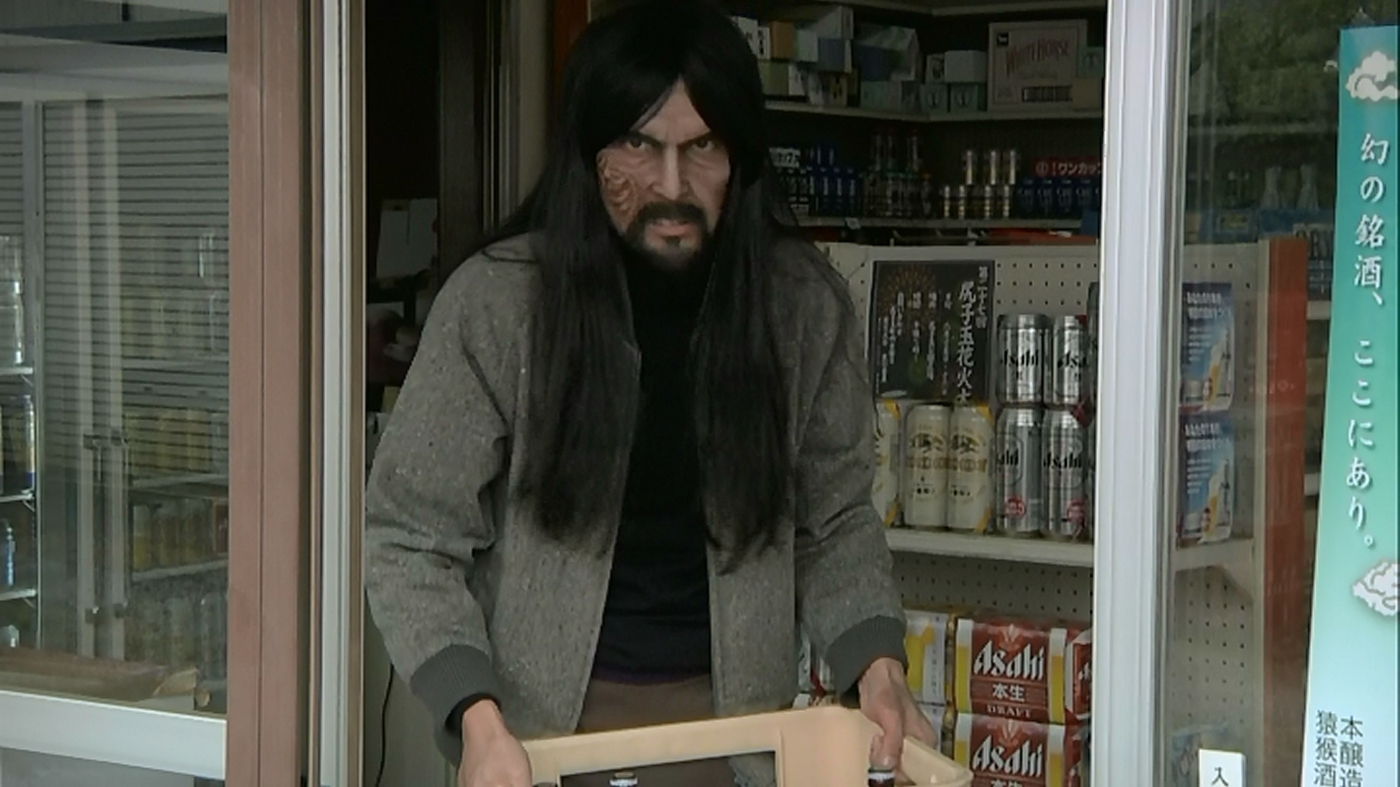
The plot is fairly basic. Kanako returns from Tokyo because she could not make it as a singer. Her home village, of course, holds Lovecraftian deformed people, reckless kids, mystical countryside secrets, such as a kappa. Oh, and a secret ultra-nationalst Japanese base.

People not from Tokyo are creepy.

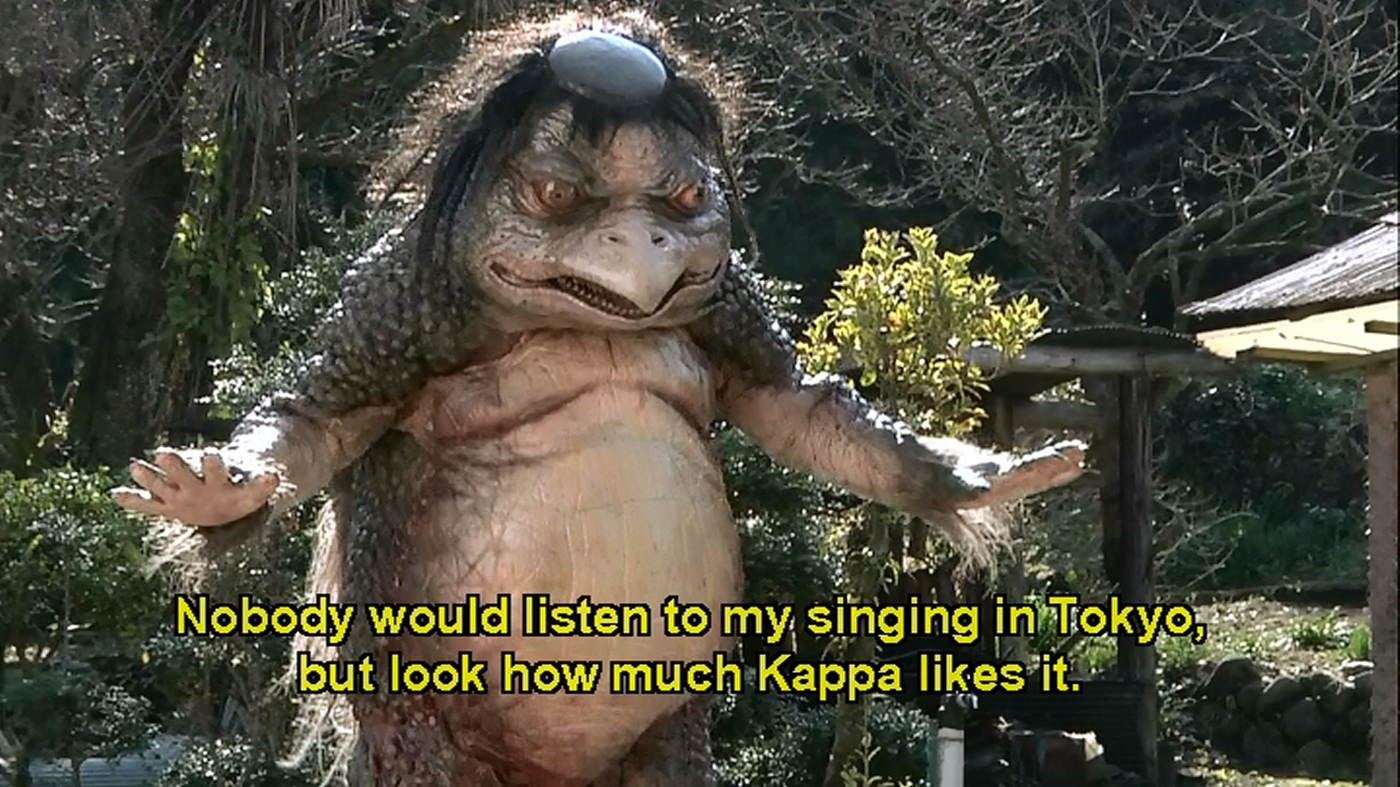
Grandma, who tends the Kappa shrine, is hit and killed by the reckless teenagers, so it's left to our lonely city girl to tend the shrine. The kappa starts off as just another spirit of justice. Human-sized, it takes care of the four in the car who killed Gran'ma, and dutifully eats the offered cucumbers. But our heroine Kanako's pop songs enchant it.

Kappa, mischevious but not malevolent spirit

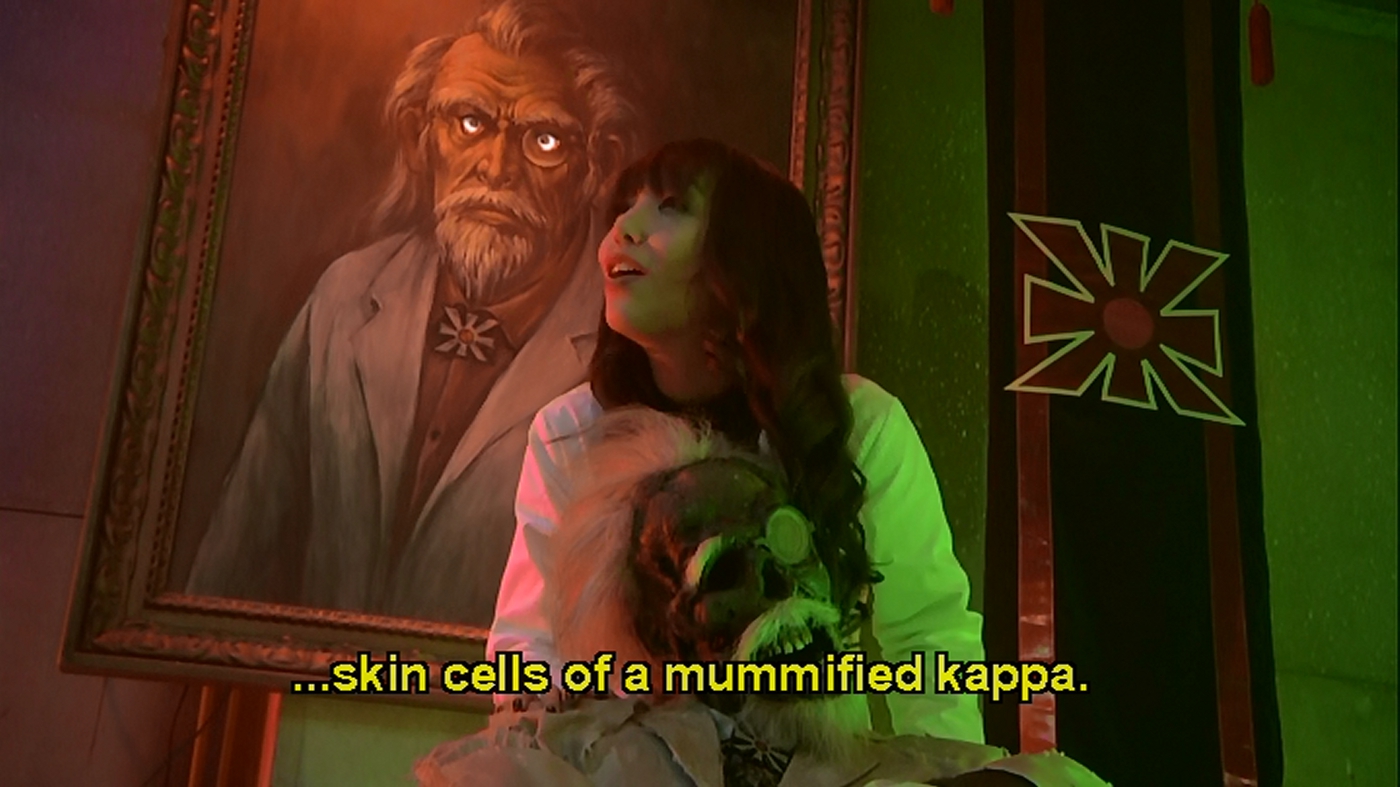
Kaneko is captured by the Ultra-nationalists, (again, shades of Ishiro Honda's Atragon) who dress a lot like Nazis. They are breeding a superior soldier from captured women and kappa. The project is being run by Yuriko, his sexy leather-and-boot clad granddaughter, who runs Grandpa's corpse around in a wheelchair everywhere she goes. Yeah, she's crazy. And she wears a teddy and garters under her lab coat.

Total crazypants.

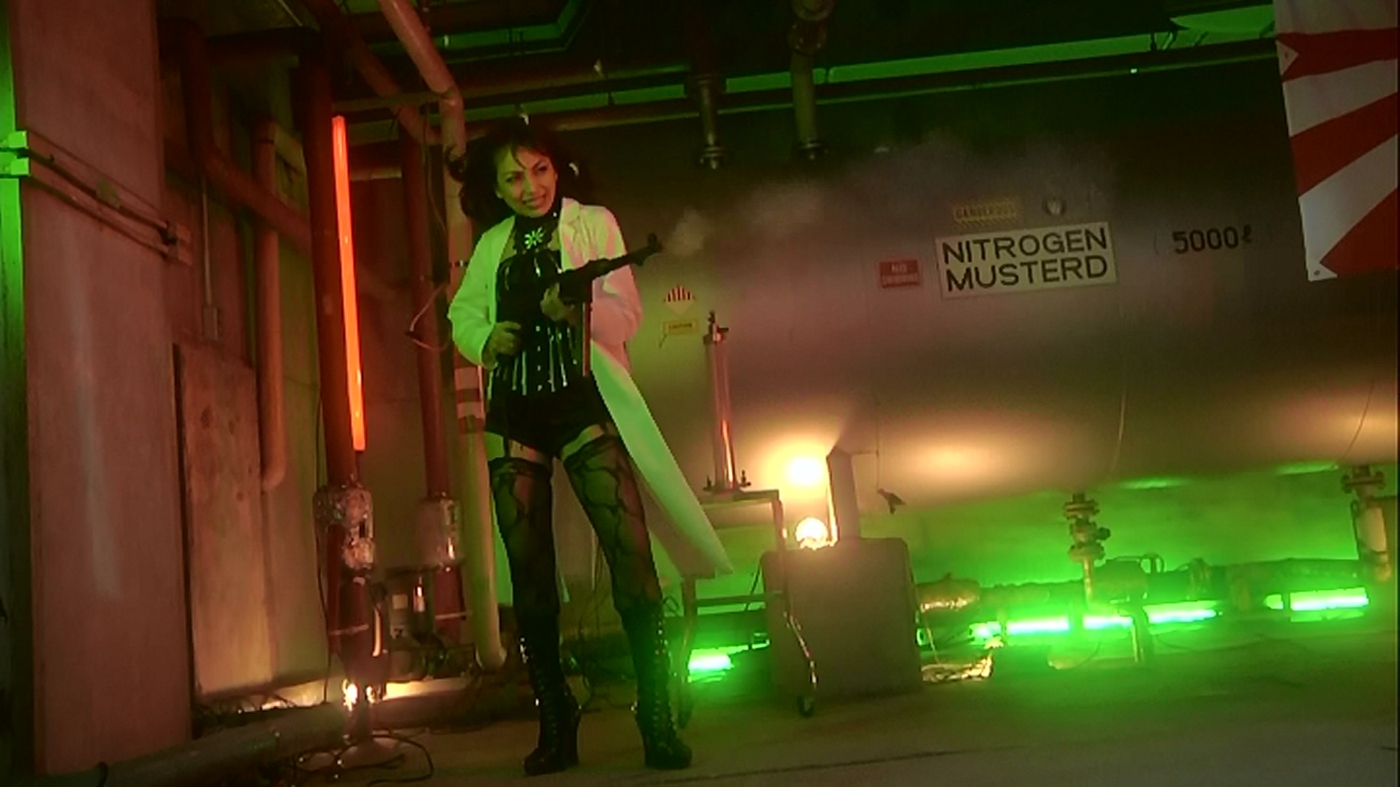
A lot of the scenes go on too long. How much do we need to see Yuriko pushing her grandfather around while Kanako tells her she's crazy? How long do we really need to see Yuriko spraying the underground base with machine-gun fire?

Total crazypants with machine gun.

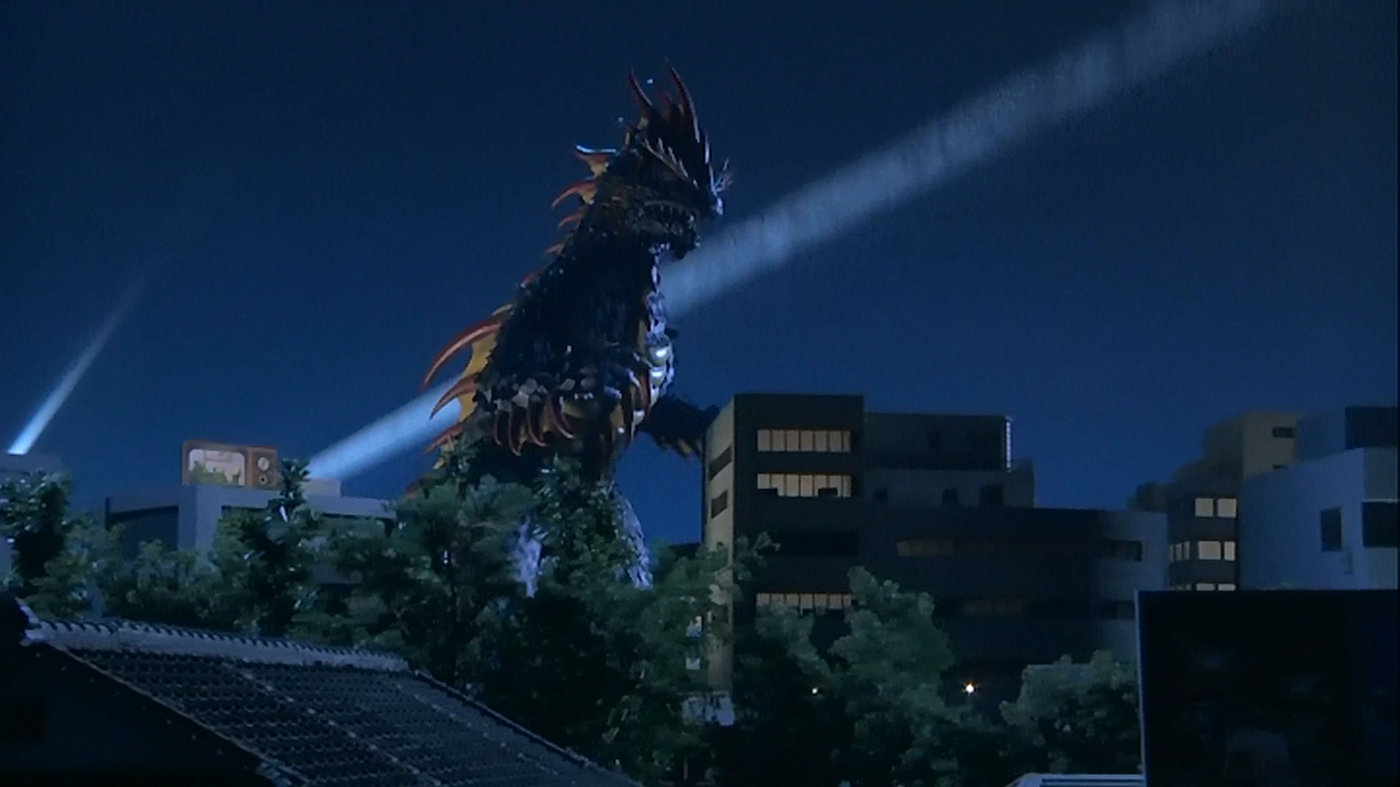
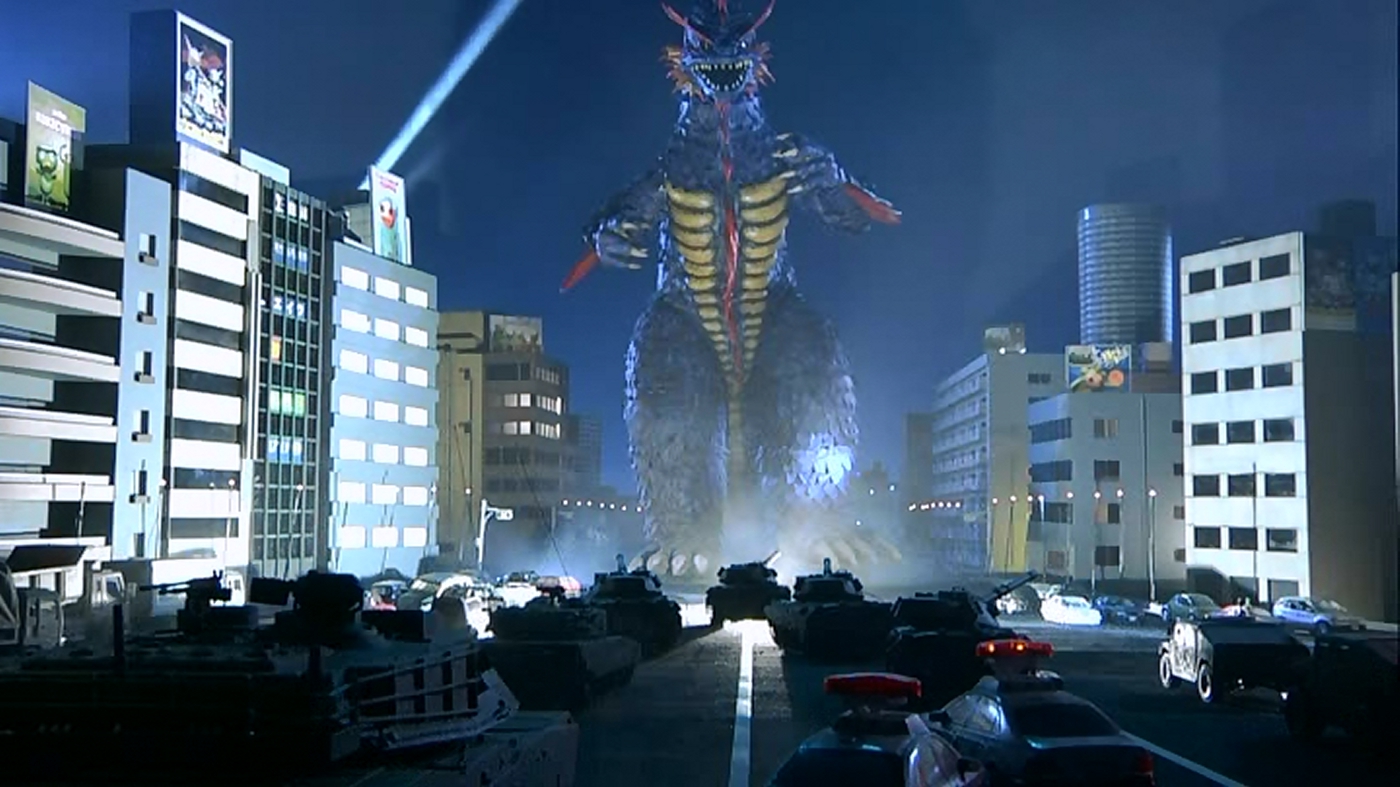
Anyway, Yuriko sets off a nuclear bomb which wipes the secret base out (thankfully) but also mutates something into a giant, city-wrecking monster. Hangyolas is blue, scaly, and reptilian. It also has a colorful red and yellow crest running down its back, clearly derived from Godzilla. The snout is shorter than Godzilla's, and it also has red spines or whiskers.

Enter Hangyolas.

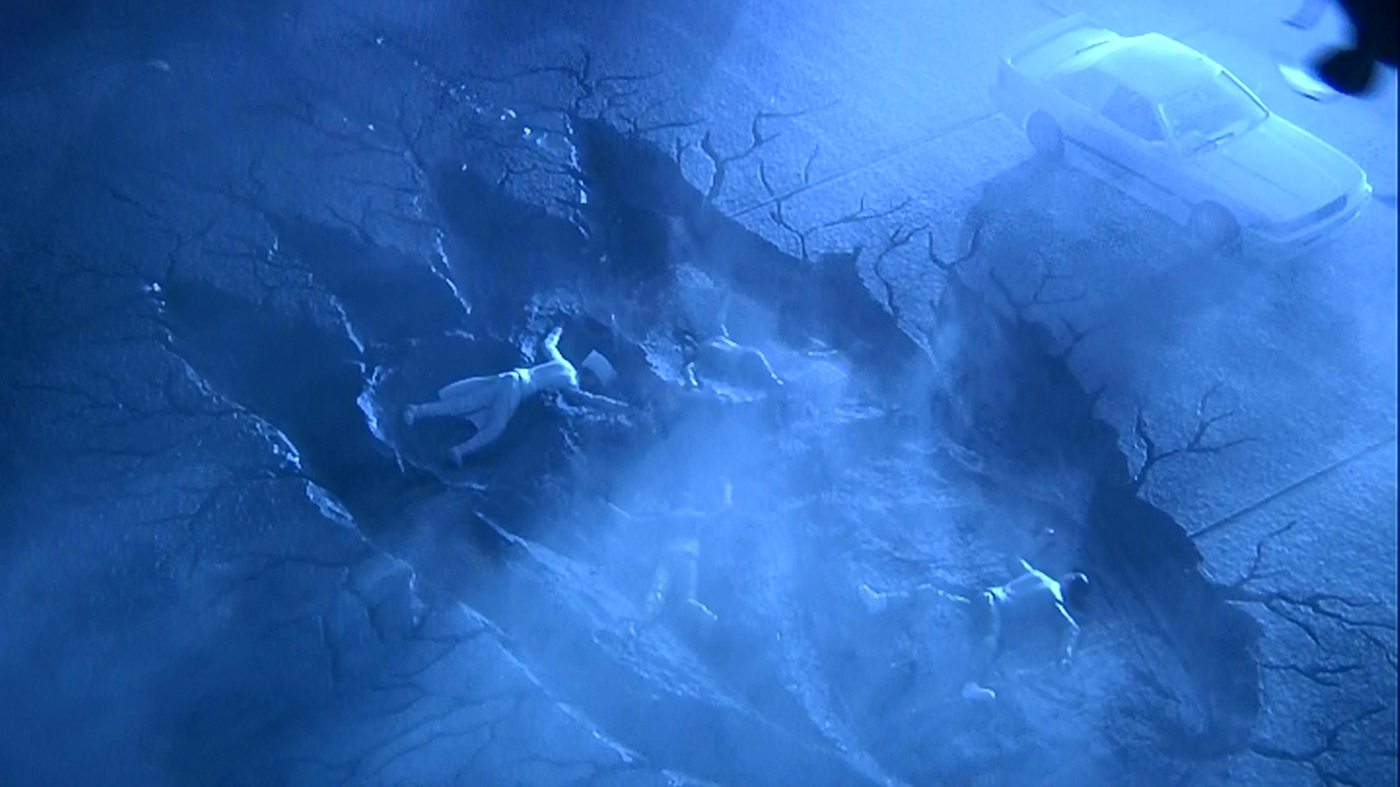
There are, of course, modern twists. A pair of guys on the street take a selfie with the monster behind them. We get the giant footprint, but this time, like 1933 King Kong, it (bloodlessly) squashes people. The Japanese cabinet, for reasons unknown, decides to name the monster Hangyolas. Still, at least we know what to call it.

Be4cause the footprint thing is still cool.

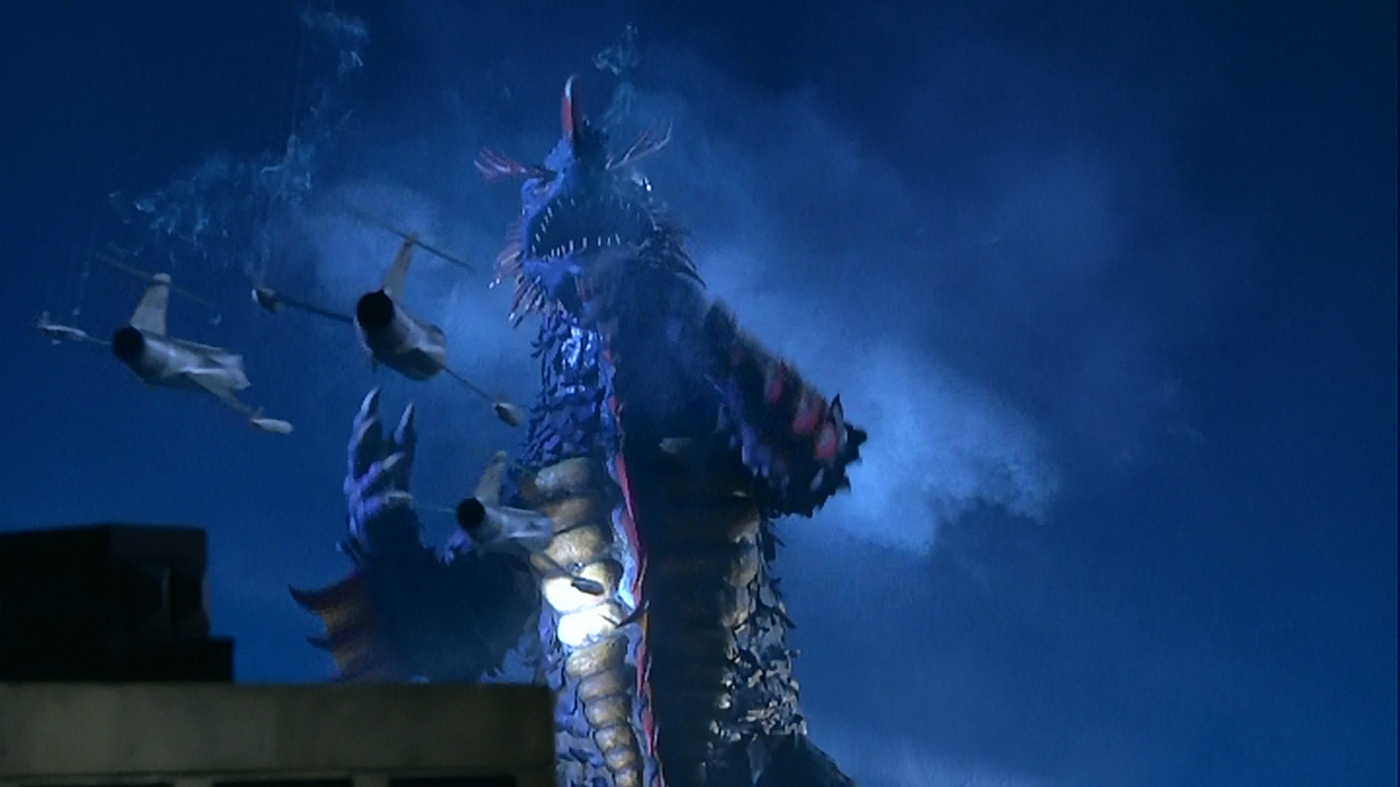
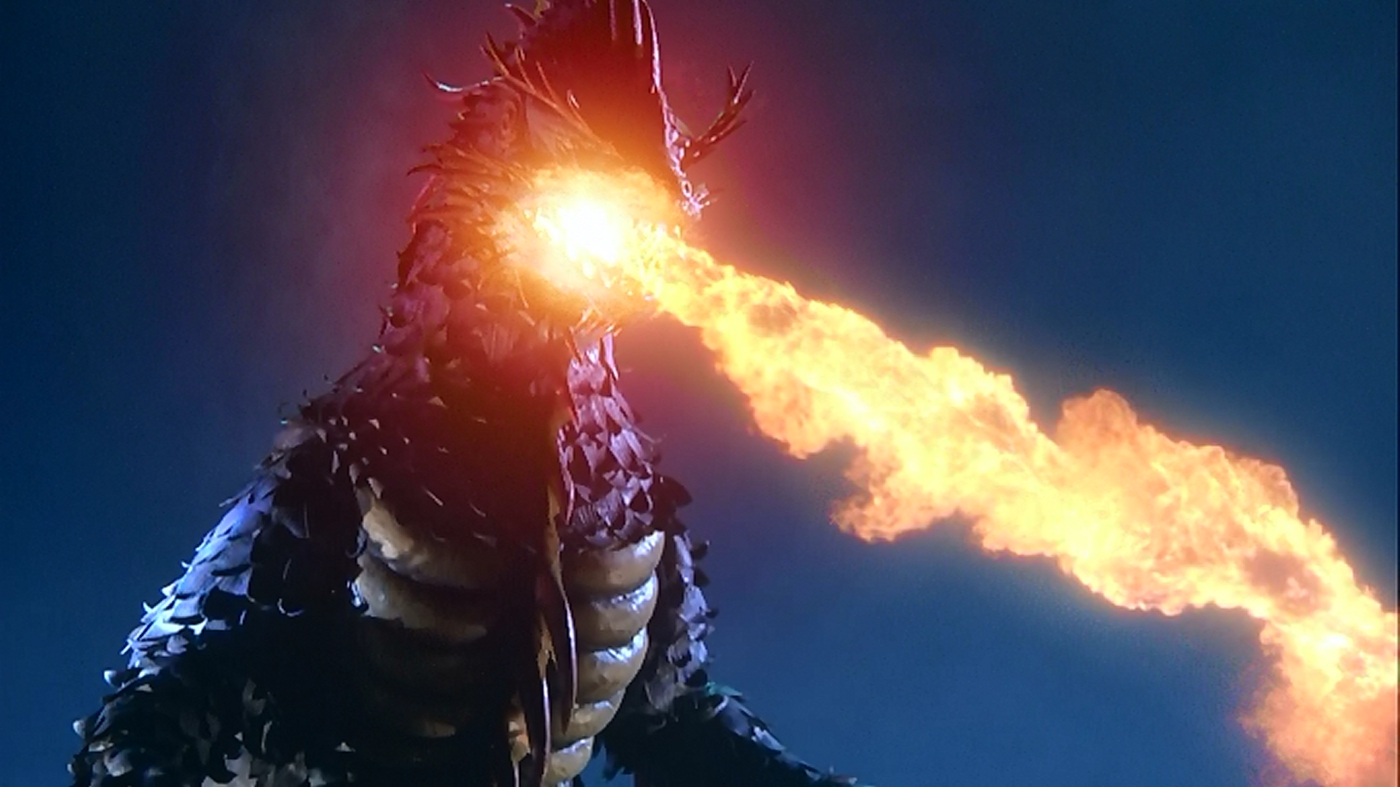
The Ultra-nationalists may have had a point. Although the military is deployed, they all lack the courage to actually open fire at the gigantic monstrosity. Ishiro Honda usually portrayed the military as there for show, rather than effectiveness, and Death Kappa takes that a step further, making them incapable of effective action. The aircraft deployed are F 104 Starfighers, last seen in Gamera vs Gyaos and Yonggary. Which is strange, because the tanks are modern, so it's just possible this is a subtle joke. Overall, the miniatures work is pretty good. The film makers are even confident enough to poke some fun at their own mniature work by showing us several shots where the wire holding up aircraft can be clearly seen. And of course Hangyolas has a fiery breath weapon. Because kaiju have breath weapons.

Look at those wires.

Although the miniatures scenes go on too long, clearly stretching the run time, this sequence I didn't mind. Hangyolas is an interesting-looking monster, the miniatures are well done. This is what I came to see. Although we don't see Hangyokas smash any buildings, possibly due to budgetary reasons. But the military has a secret weapon: an imitation of Eiji Tsuburaya's maser gun, the Gorgon Death Ray. It has a long neck and a projector that remains parallel to the ground. It's effective until Hangyolas fires its devastating breath weapon, and it all goes up in smoke and flame.

BOOM!

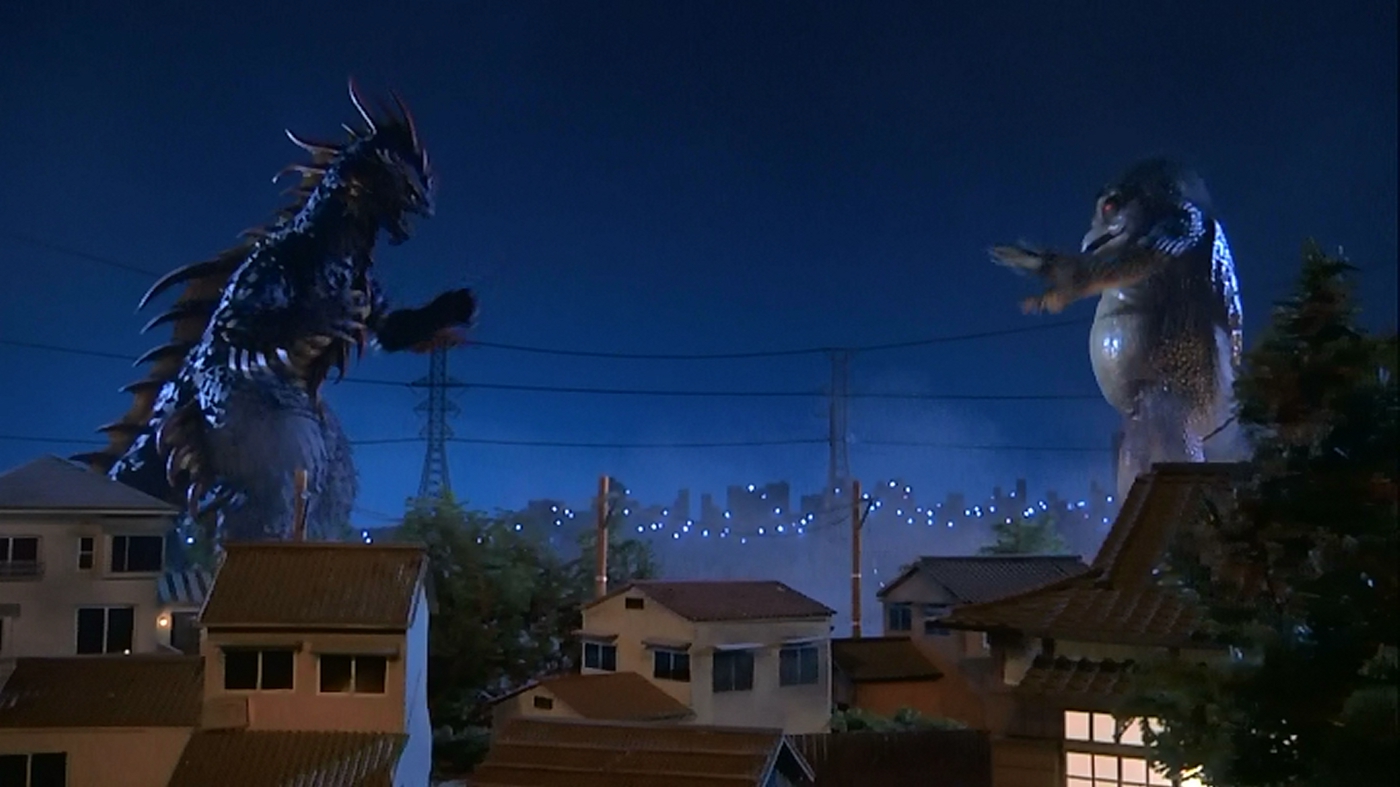
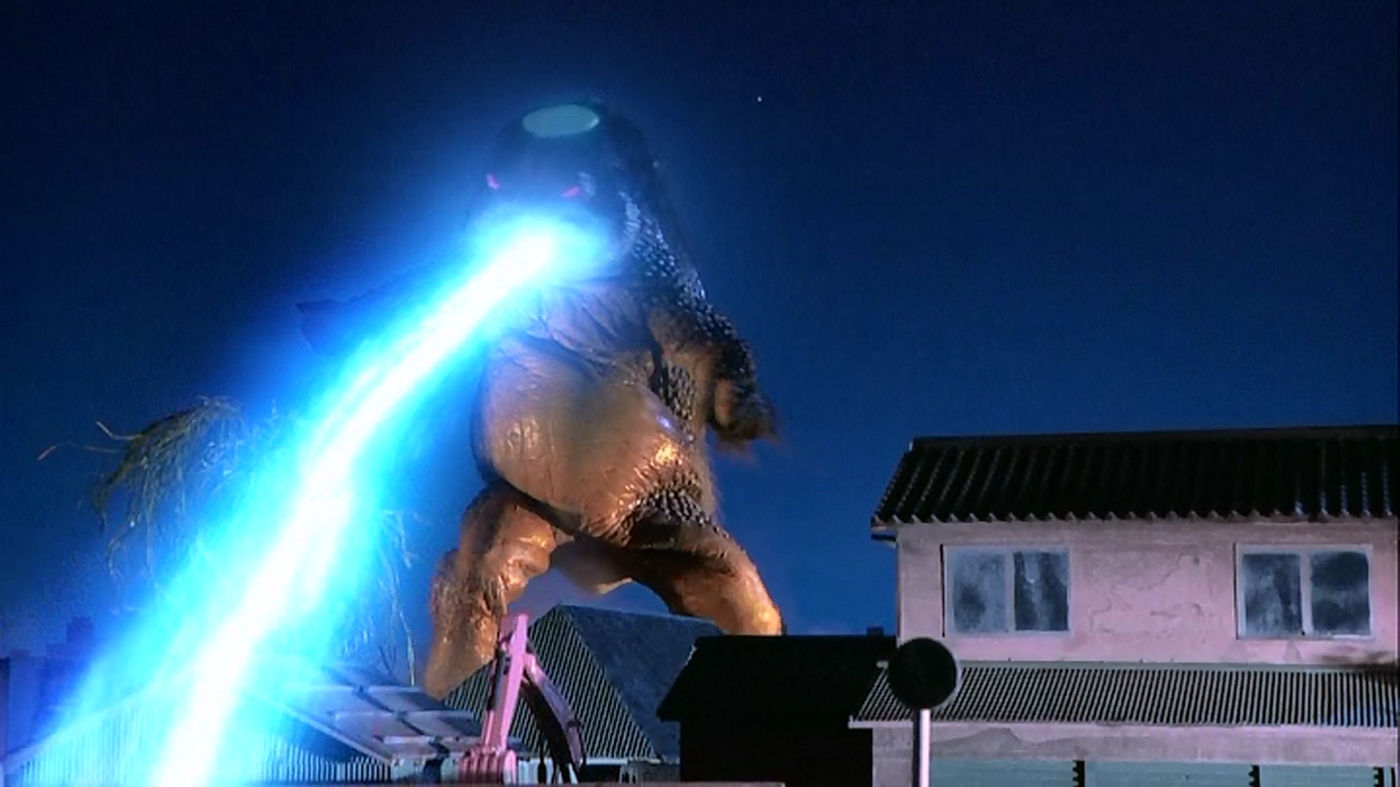
Luckily for humanity, The kappa has also been enlarged, presubaly by the radiation, and also has his own Godzilla-style breath weapon. It stops Hangyolas in an off-screen appearance very reimiscent of a scene in Godzilla vs Hedorah. And the monster wrestling begins. Death Kappa pulls off Hangyolas' tail, but the fight continues. I wonder if that's where Del Toro got the idea to cut off Otachi's tail and keep the fight going in Pacific Rim.

Ready? FIGHT!

Once Hangyolas is defeated, Death Kappa begins its own rampage. It can only be stopped by Kaneko , who has apparently survived the nuclear detonation of th Ultra-nationalist base. She sings to it, and it calms down. Death Kappa then retreats to the ocean.

Enter Hangyolas.

Death Kappa is best described as adolescent. The women in it are needlessly sexualized; the bad girls all show up in bikinis, Yuriko wears what looks like an uncomfortable teddy and stockings under her lab coat. The jokes are broad, the plot pretty flimsy. It feels similar to Monster X Strikes Back, an affectionate ribbing of the Kaiju genre. But the monster action, although heavily derived from wrestling, is pretty good, and the last major film to use suitmation. Hangyolas is a much more interesting monster than the Death Kappa, but it also has a lot more screen time. Death Kappa is also the last kaiju film made until Pacific Rim was released.

Enter Hangyolas.

Next week, the last of my weekly kaiju reviews. And it's a stinker.

Thursday, March 5, 2015

The Kaiju Road Trip: Monsters

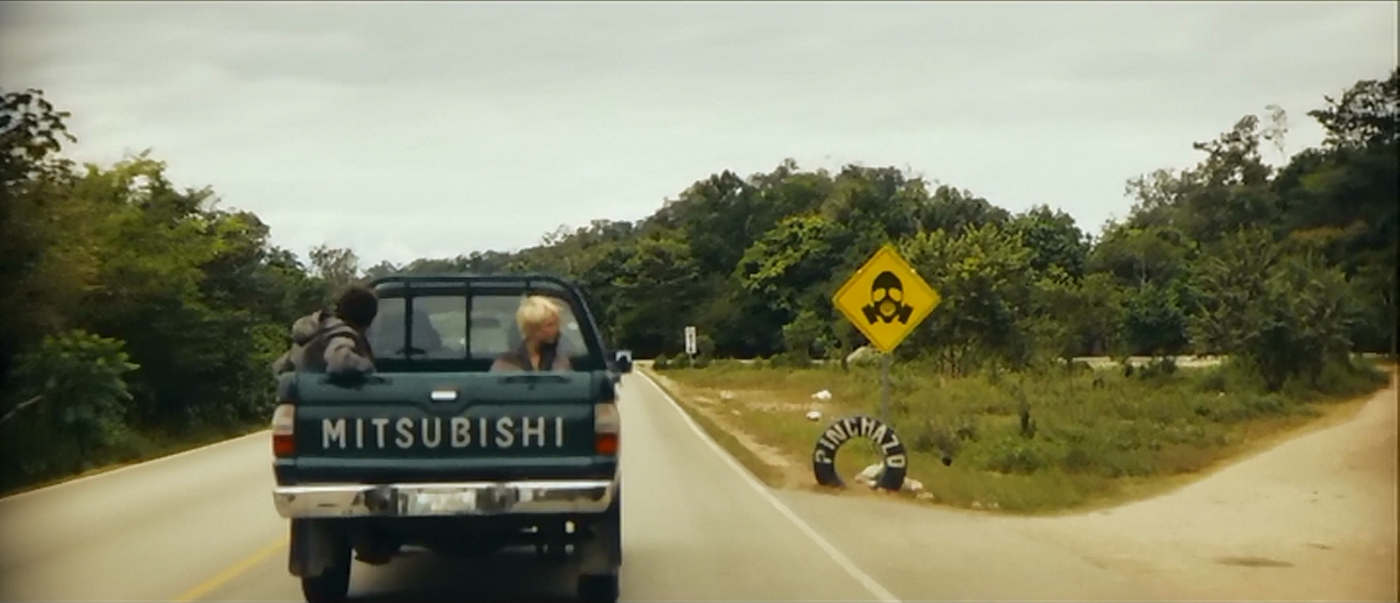
Gareth Edwards is better known for the not-terrible 2014 American Godzilla reboot. But he got the job with a film that is the polar opposite. Monsters is a 2010 film, written and directed by Edwards, on a budget of less than a million dollars. As more films are made with kaiju, other and newer approaches are being taken with them. Genre tropes are swapped. Monsters is fully a kaiju film, but like Demeking, it owes a lot more to another genre, in this case, the road trip film. Sam and Andrew are thrown together in Mexico and must overcome the difficulties on the road to their destination. Which that includes the northern section of Mexico which is now an 'infected zone' loaded with giant monsters.

Into the Infected Zone we go.

The film is shot in a very cinema verite style, similar to Cloverfield, and like Cloverfield, it concentrates on the humans in the midst of giant monsters. It does not, however, have the infamous shaky cam. Andrew is a photographer, and has been assigned to get Sam out of Mexico and back to the US by her father, Andrew's employer. She's engaged to someone else, and the two initially seem to have very little in common. An interesting note is that the stars, Scoot McNairy and Whitney Able, got married shortly after the film was shot.

The human protagonists, ladies and gentlemen.

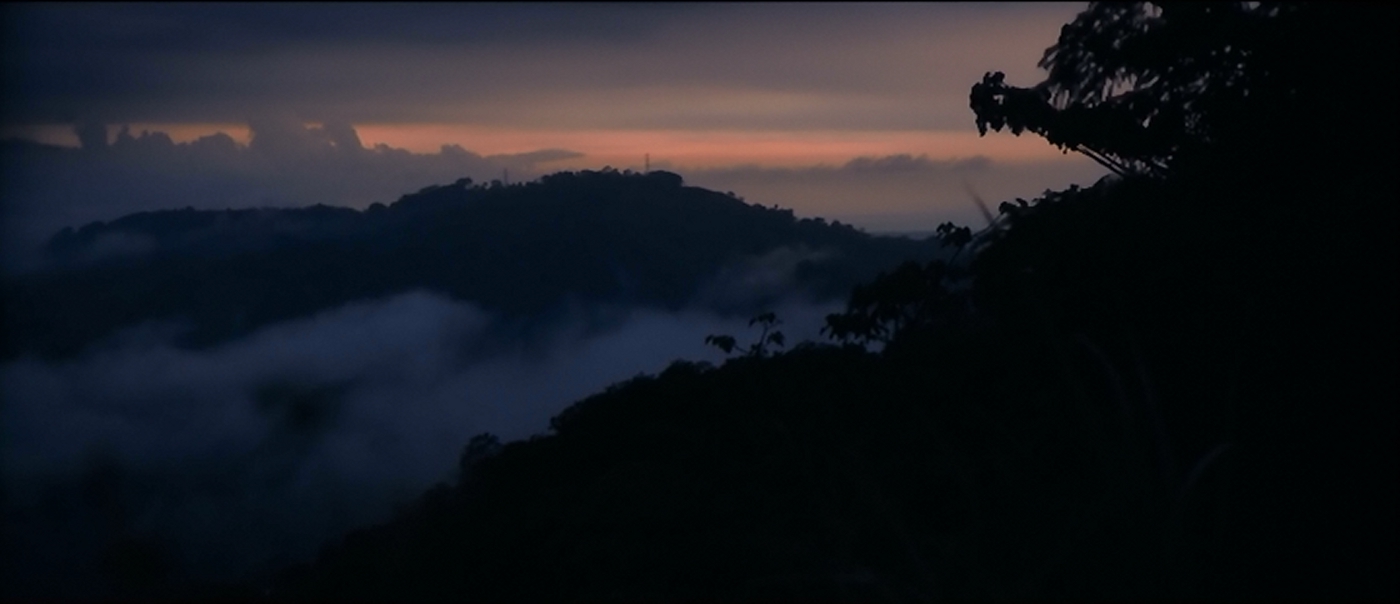
An unspoken co-stars of the film is the Central American countryside. It's beautiful, and because the film was made guerilla-style, a portion of the commentary is the crew reminiscing about the fascnating places they had visited, including Copper Canyon. The scenery is absolutely gorgeous, and nicely textured.

A beautiful morning in the Infected Zone.

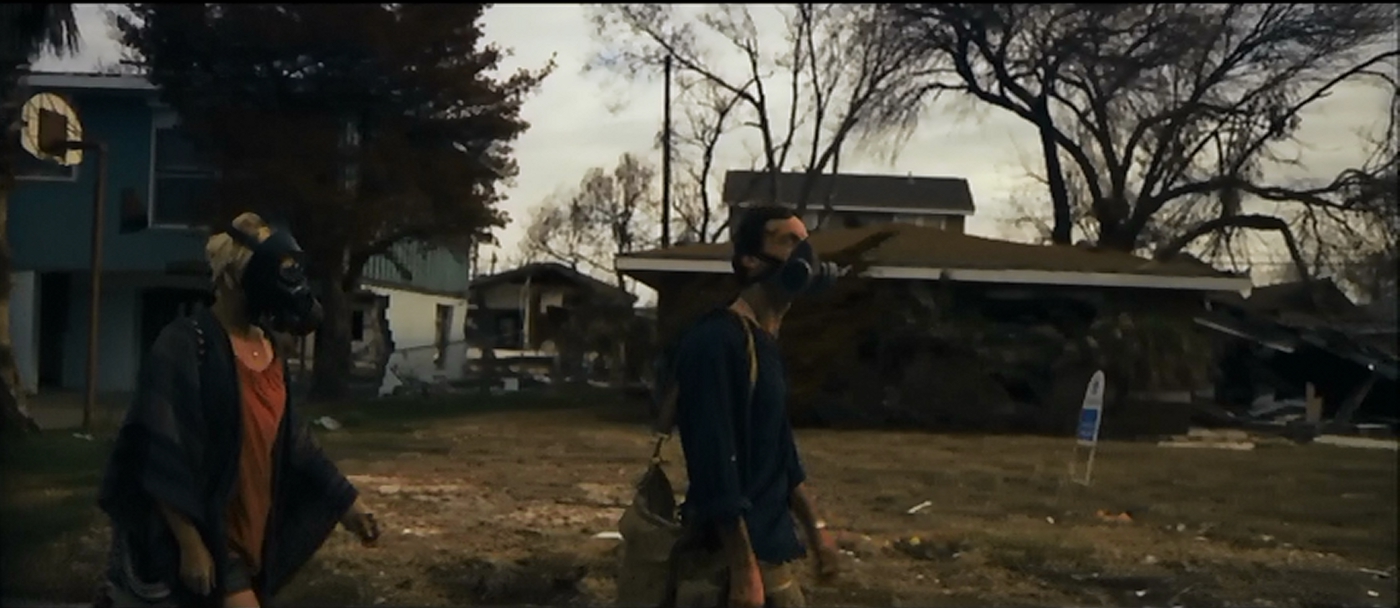
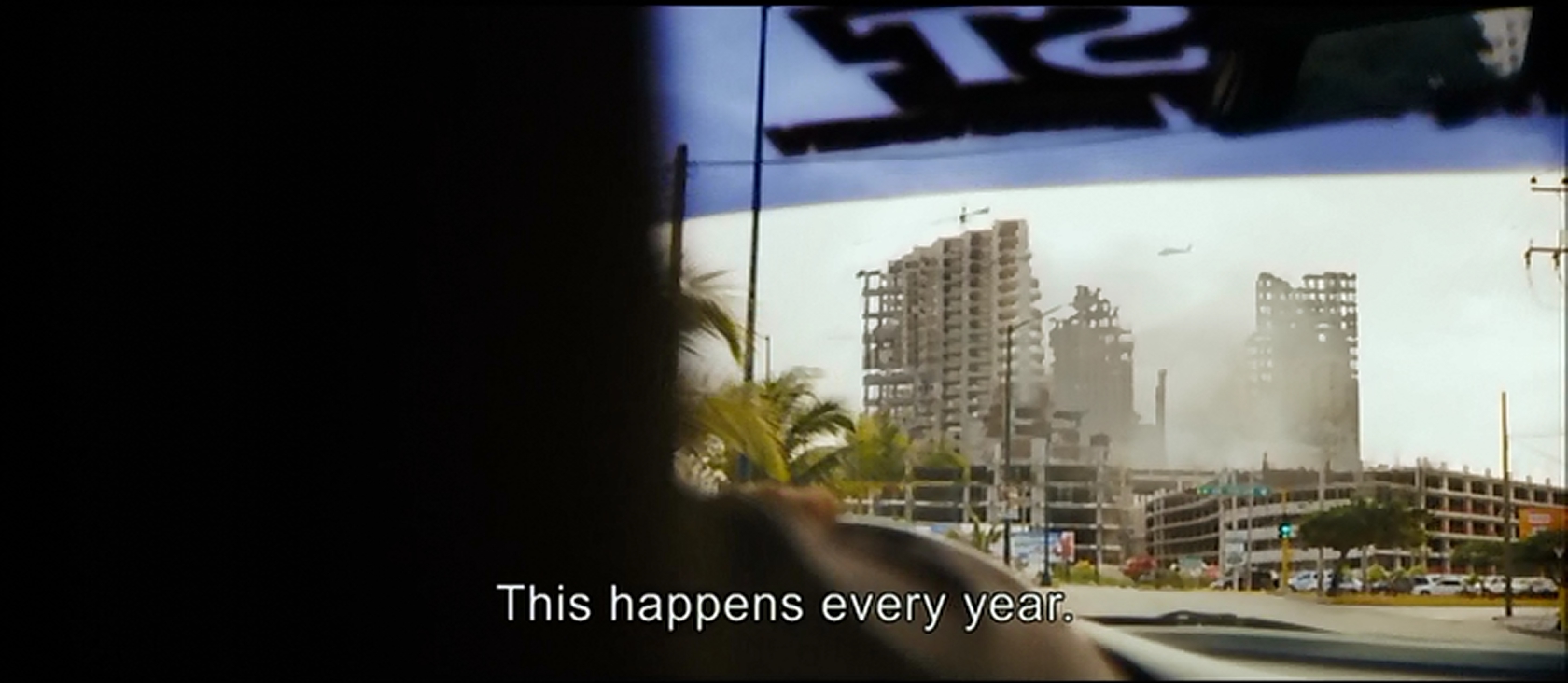
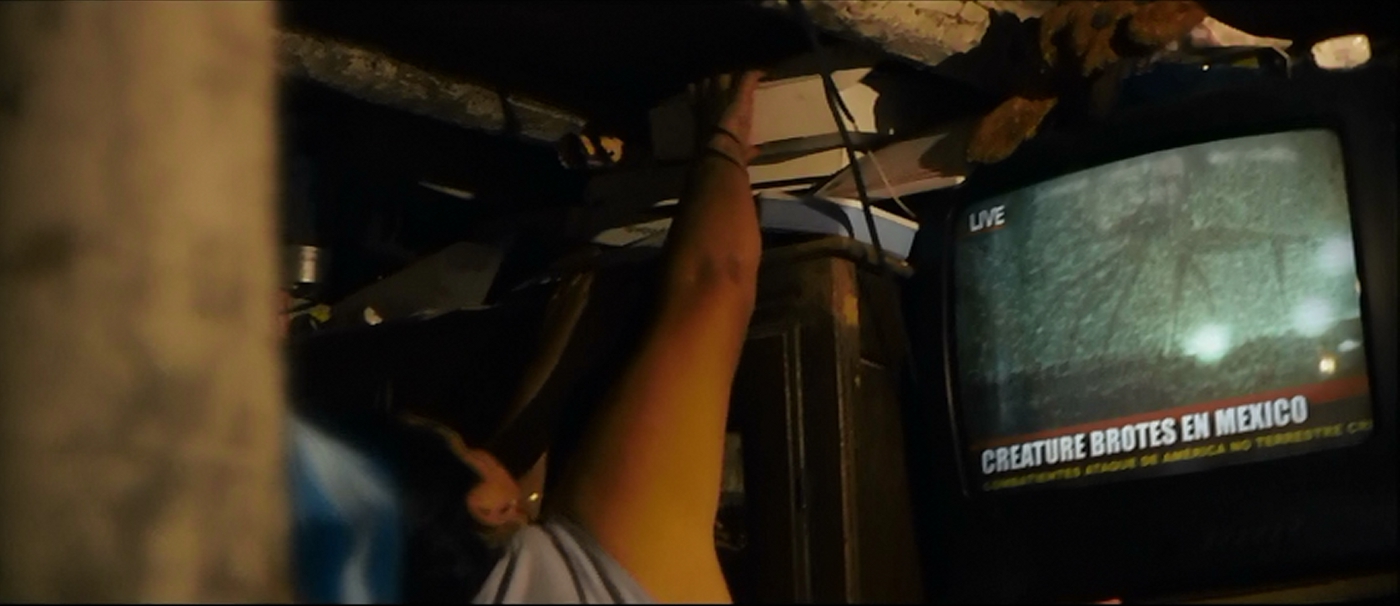
The subtle twist is that this is six yerars after the initial invasion. The monsters, unnamed in the film, are not new. They are a known quantity. Where usually we watch the monster trash buildings, in Monsters, we see the buildings already trashed. And some of these have been left damaged, and the people nearby make do or avoid them,. But there isn't enough money or political will to even tear then down. This establishes the atmosphere of the film beautifully, a future, not of despair, but where such things are accepted. This is not the hopeful Pacific Rim where humanity is fighting valiantly against the invaders. This is the future where we make a holding action, and try not to talk about it. But wherever there's a televisdion in the background, there's a news bulletin about the monsters. So while the monsters, which are never named, are not seen throughout most of the film, they are a constant presence.

I live here. Where else will I go?

Of course, the always-present television.

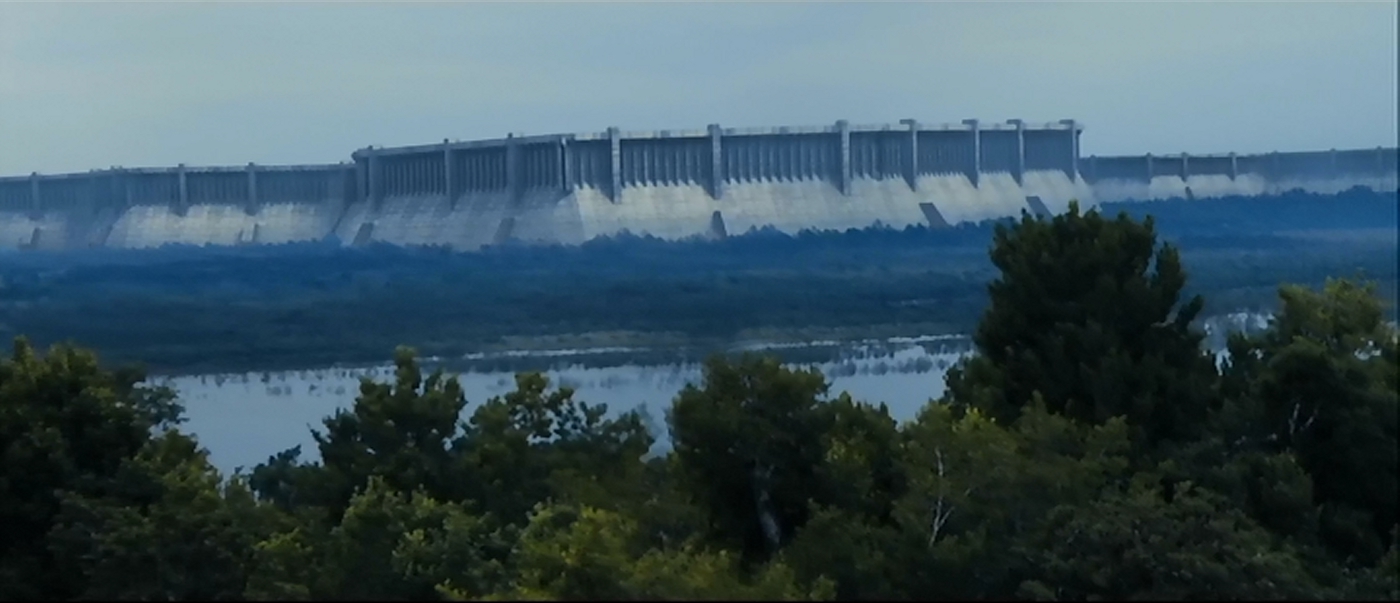
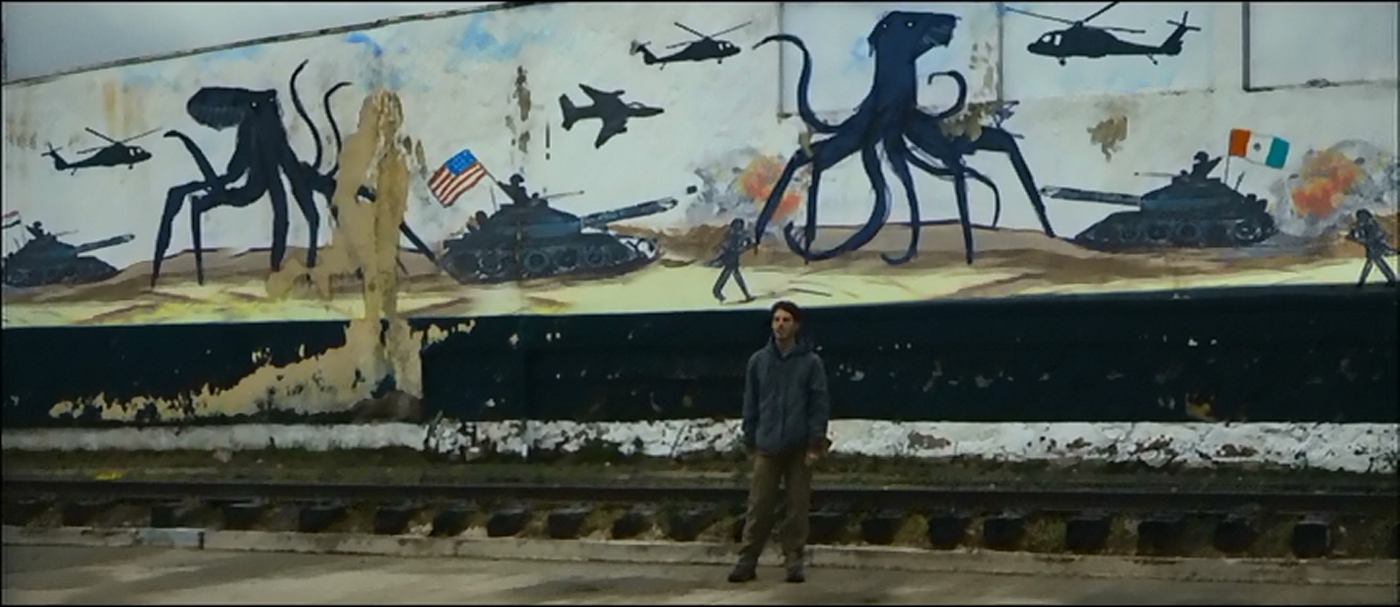
Once Sam and Andrew are in the Infected Zone, the tenor of the film changes. The creatures are constant menace. They are heard, the evidence of their presence is everywhere. Ruined buildings dot the countryside. Strange noises boom across the landscape. America has build a wall to keep the monsters out, an idea picked up by Pacific Rim and as effective as it is in that film.

The oh-so-effective wall.

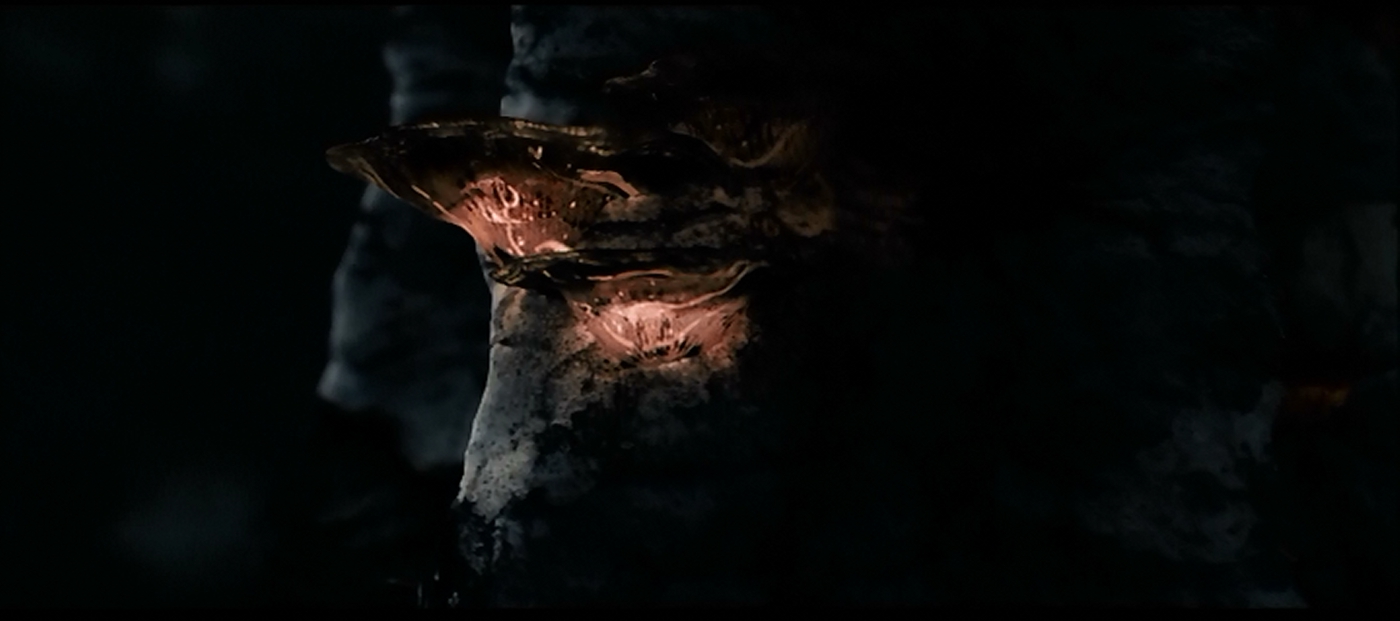
We also learn about the behavior of the creatures. They leave some sort of spoor, a form of reproduction, on the local trees. These light up, and give a beautifully otherworldly impression.

Extra magical mushrooms.

Of course, we don't get a good look at them until the end. In some ways, they are like Godzilla's MUTOs; they are large, and they are lookning to mate. Unlike the MUTOs, however, they seem ambibuous. The MUTOs are large and do not care about what they tread on. These creatures, on the other hand, do not. We do not see them trash any buildings. They carefully step around a gas station in the final sequence of the film. Is it possible that they are attacked only because they are large and frightening. In his commentary, Gareth states thast if you want to overanalyze the film (which is what I do), you can read into the film that the constant media barrage makes the creatures more aggressive than they are.

Of course, being scared is a logical conclusion.

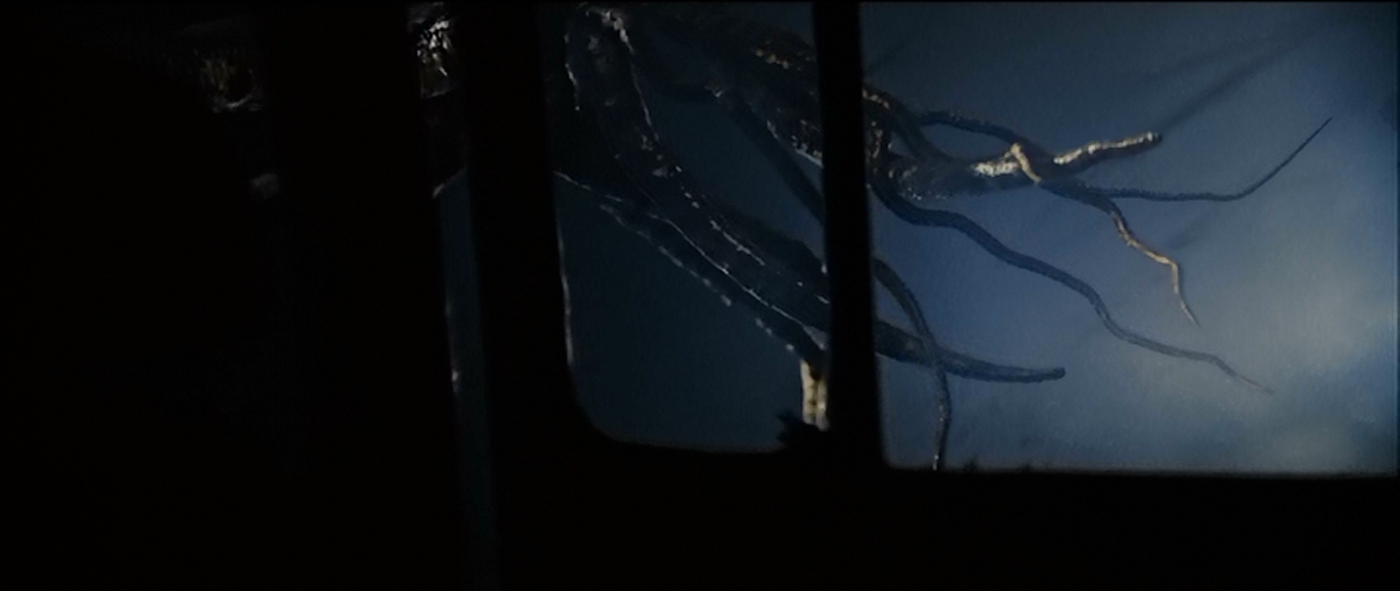
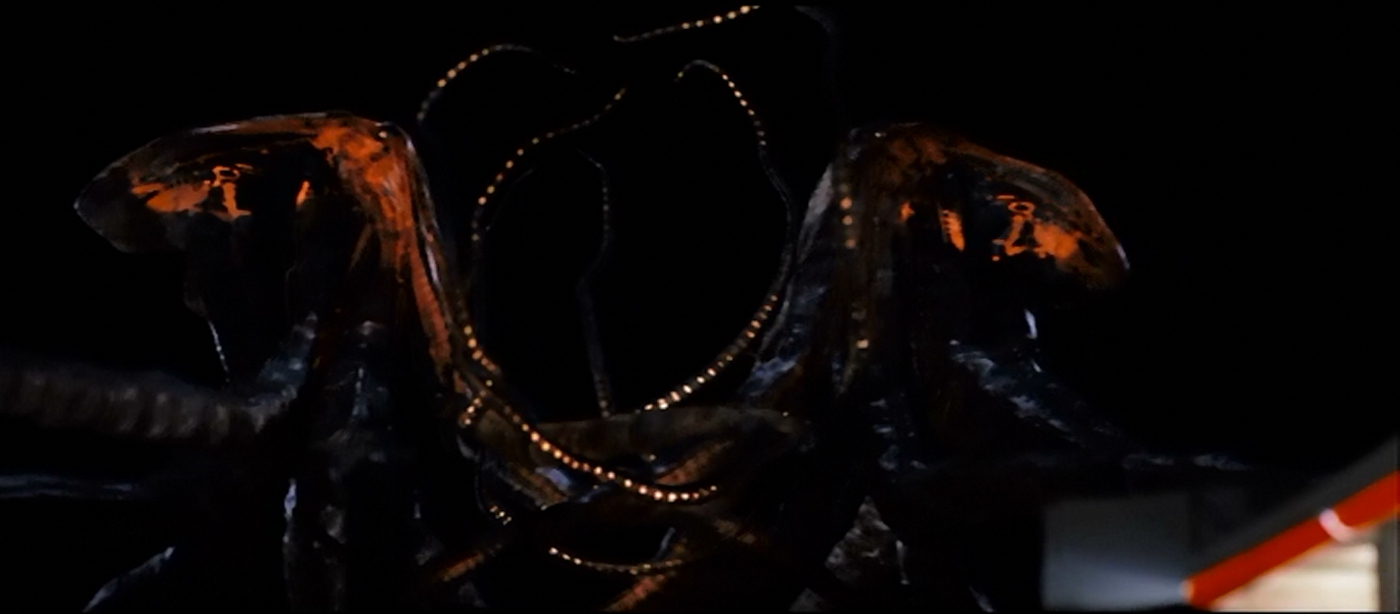
Still, the creatures are very cool looking, large internally bio-luminescent land octopi.

Hey sexy mama, wanna kill all humans?

Monsters is kind of light, but the performances are intersting, and the direction is interesting. Monsters is not the standard kaiju film, but it is an interesting meditation on kaiju-human relations.

One of my favorite images from Gareth Edwards' Monsters.

A sequel, Monsters 2 will be out this year, and it seems to be getting mixed reviews. The creatures seem different, so perhaps they are adapting in differnt locations. Hopefully, it will have a wide enough release that I'll get to see it in the theater. Next week, back to Japan!

Thursday, February 26, 2015

No Future: Demeking

Demeking the Sea Monster is sold as a kaiju film, but that's really stretching it. There is a giant, city-destroying monster involved, but it's seen for about as much time as Clover is. And like Cloverfield, and Monsters next year, this is more about people that the monster, or at least the prophecy of the monster, impacts than the monster itself. Demeking is really a story of a couple of disaffected people, with a ten minute kaiju sequence thrown in. Further, Demeking is referred to as a space monster in the film, not sea monster any more than Kraa the Sea Monster turned out to be.

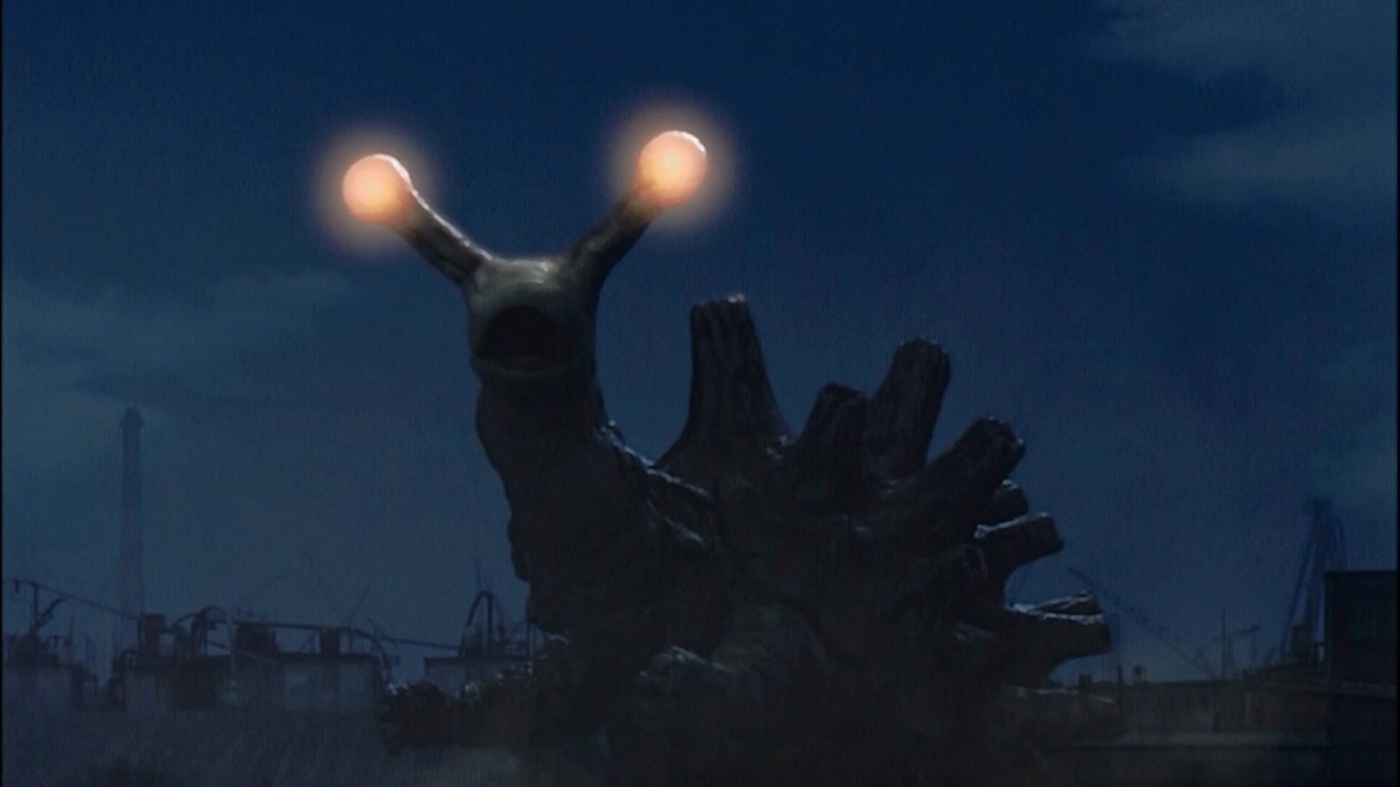
Demeking!

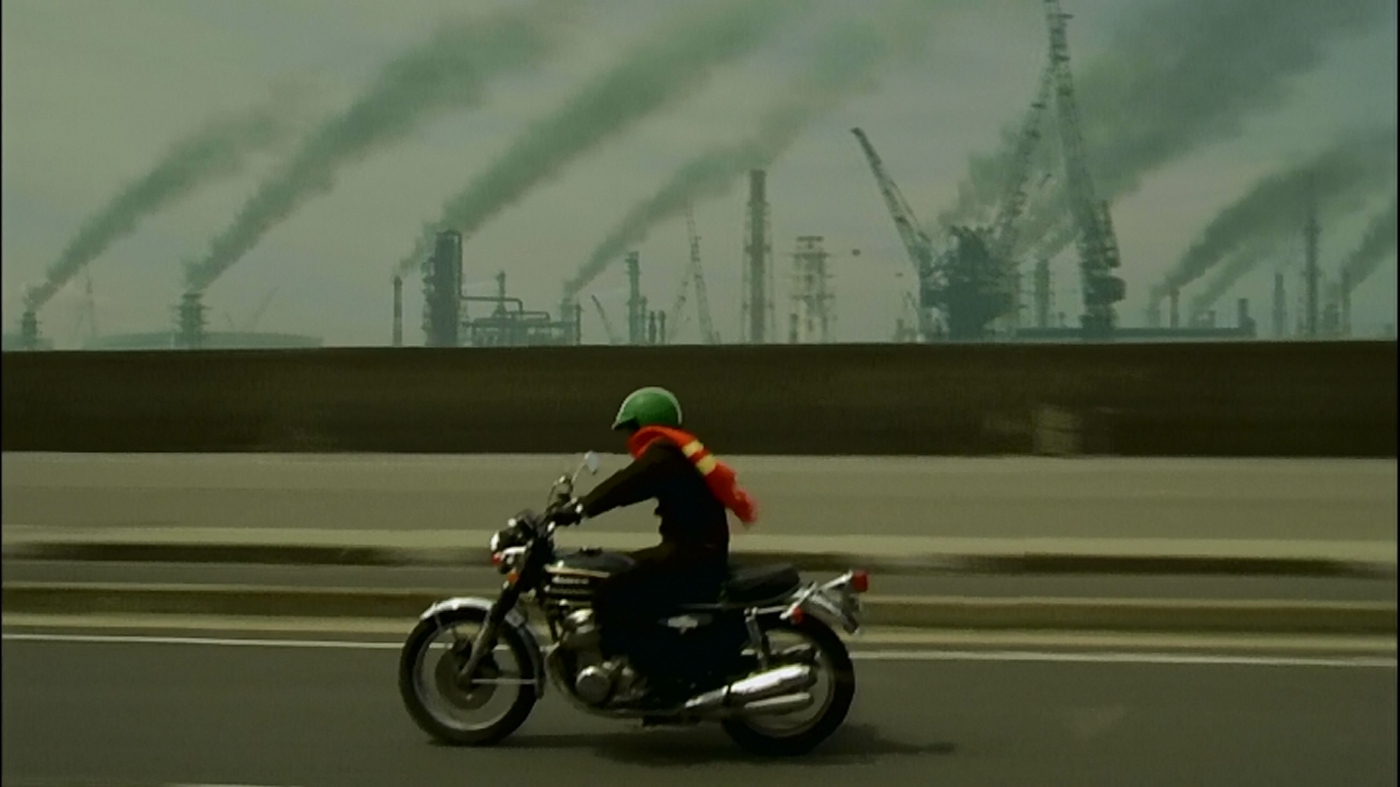
In the openning, Hachiya drives among a blighted industrial landscape similar to the one from All Monsters Attack. This gives the audience a sense of time. 1970, when Japan's industries were indifferent to pollution, the era when Godzilla vs Hedorah was made.

Remember when pollution was a family value?

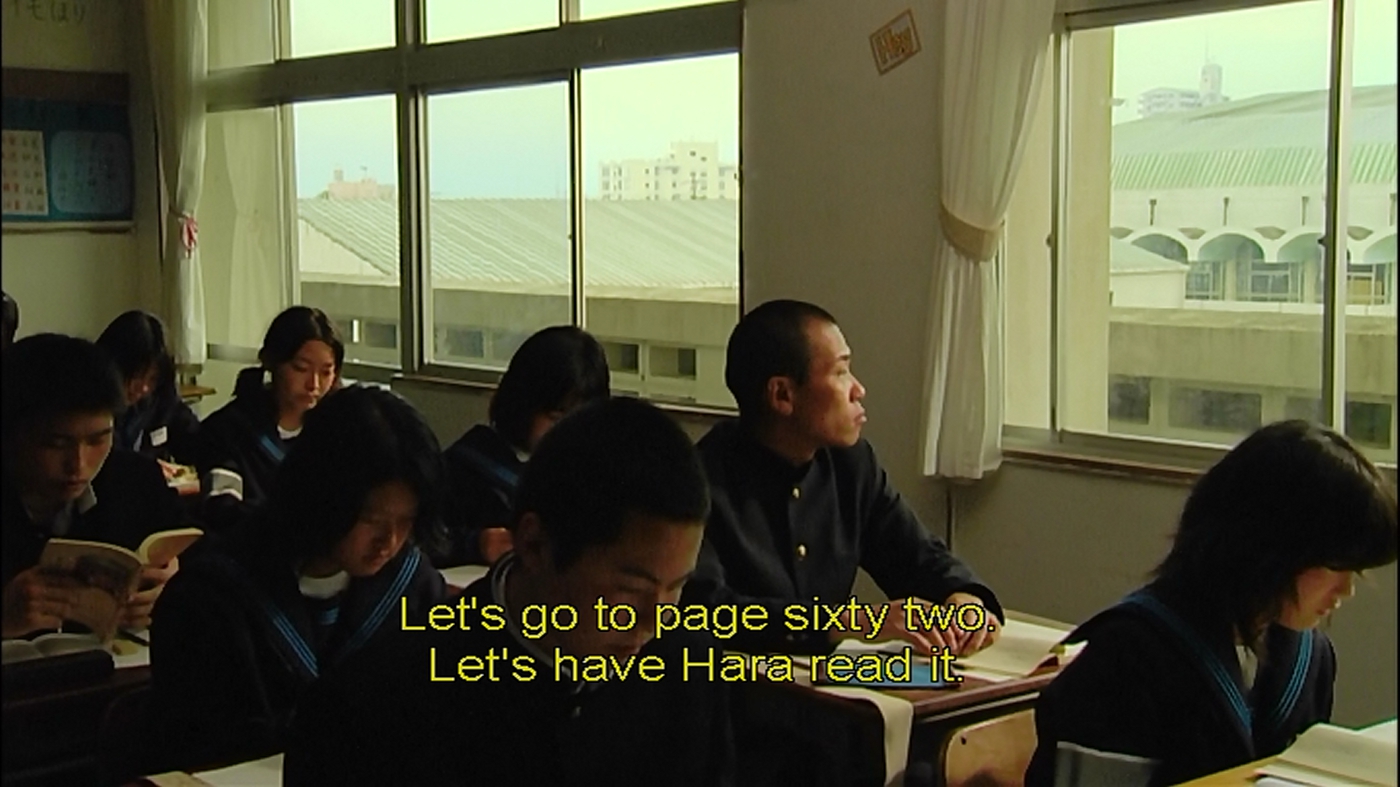
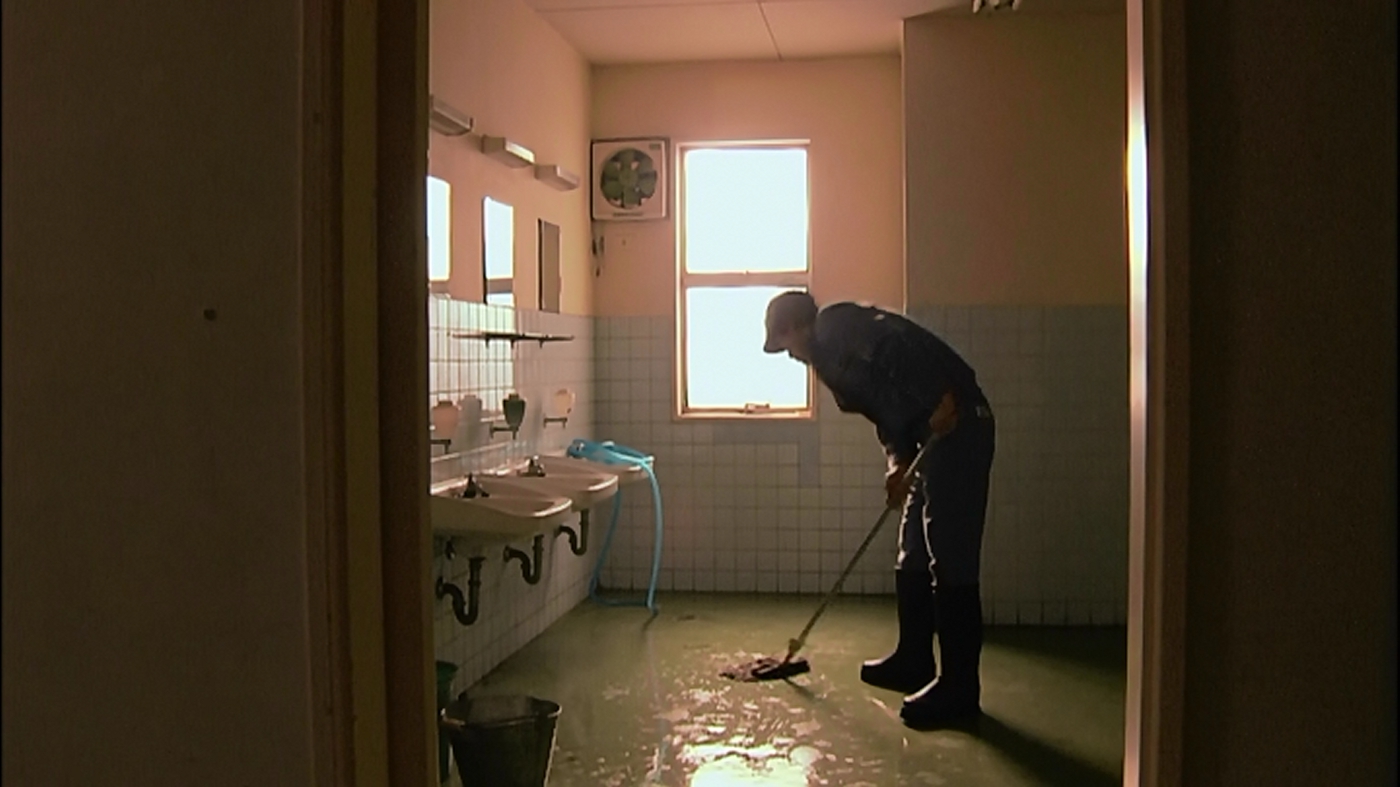
The majority of the action happens in 1970, when our protagonist, Kameoka, is in high school. Kameoka is socially awkward, dislikes school, and would rather hang out with his middle-school aged friends, forming the Tanoura Exploration Club. Anything to get away from his dreary reality. The film has some notes of Gamera the Brave, with the bored kids trying to make their own fun, but Gamera had more focus.

So, not the school type.

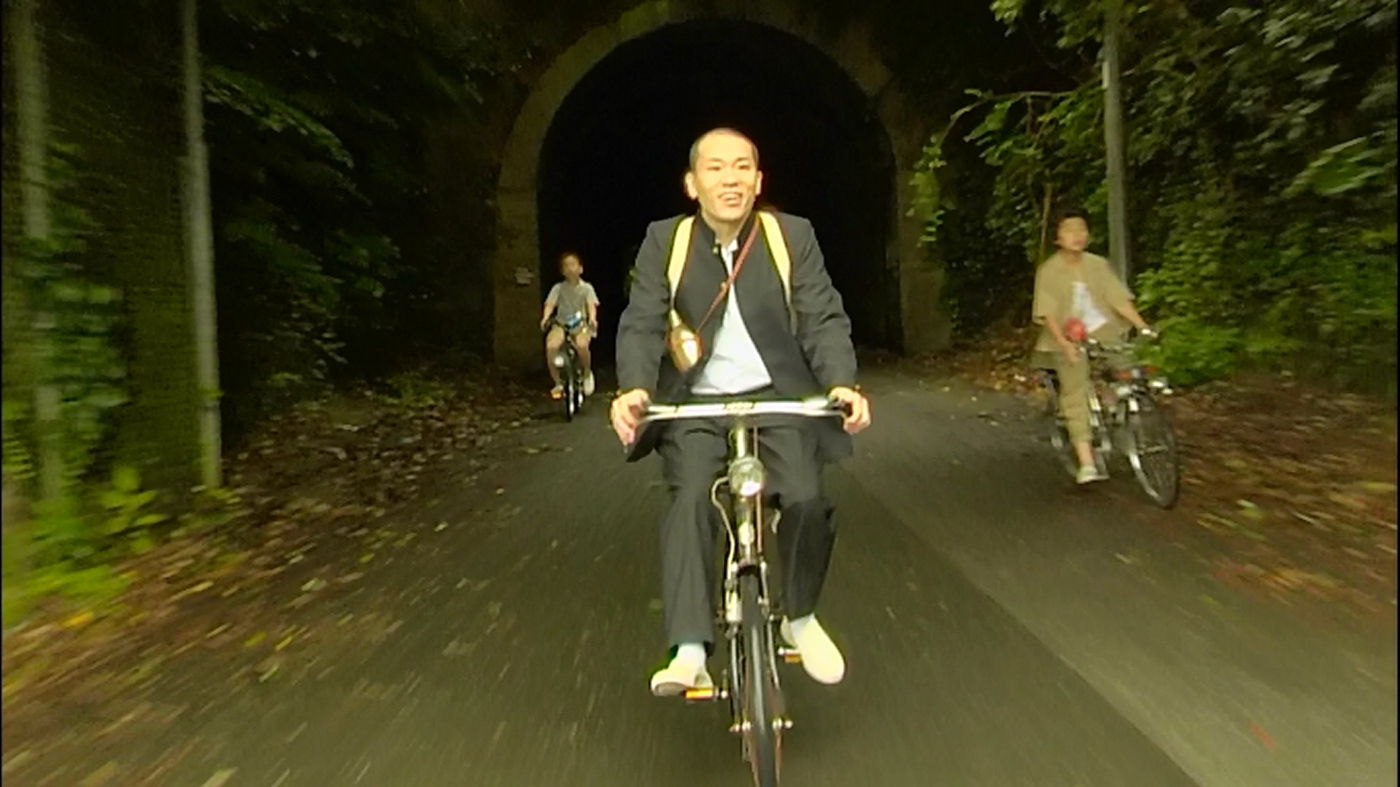
The town has a dreary little fun park, but it seems as listless as everything else. But When Kameoka meets Hachiya, Hachiya reveals that he has a desting. To fight Demeking. Hachiya could become the head of the club if he wanted it. He has a motorcycle. When he suddenly leaves for Tokyo, however, he leaves behind a treasure hunt for the boys. And suddenly, thre's magic in their lives. Something to investigate, something to to. Something unknown.

Out of the tunnel of boredom, into the sunlight of adventure.

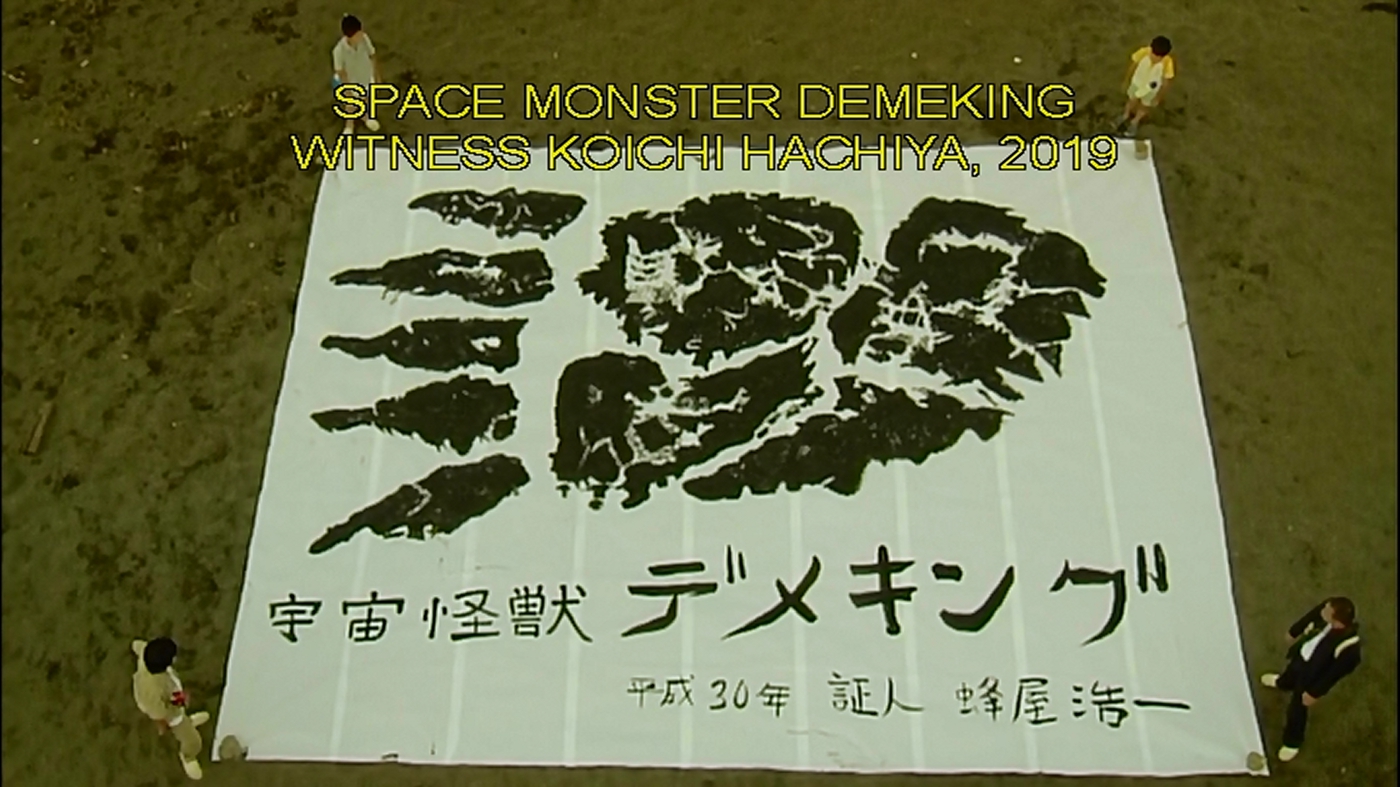
In the end, they come up with a large banner. When spread out on the beach, is says "Space Monster Demeking Witness Koichi Hachiya, 2019" With a large painting of a footprint, a clever subversion of the giant footprint trope that goes all the way back to the black and white King Kong.

Clever subversion of a kaiju trope, the monster's footprint.

It's difficult to portray boredom in a film without boring the audience. Demeking is mostly successful. The pace is leasurely, with many shots of the fun park's Ferris wheel turning lazily, and many scenes of Hachiya and Kameoka doing dull or repetitive things. Anyone coming expecting a giant monster trashing Japan is going to be sorely dissappointed, and the marketing of the film as a kaiju work doesn't help. I'd read a few reviews and knew what to expect, but someone who picks up the film because the tag line is "Terror Lies Beneath" is going to be sorely dissappointed.

It's about boredom, not being able to do what you want.

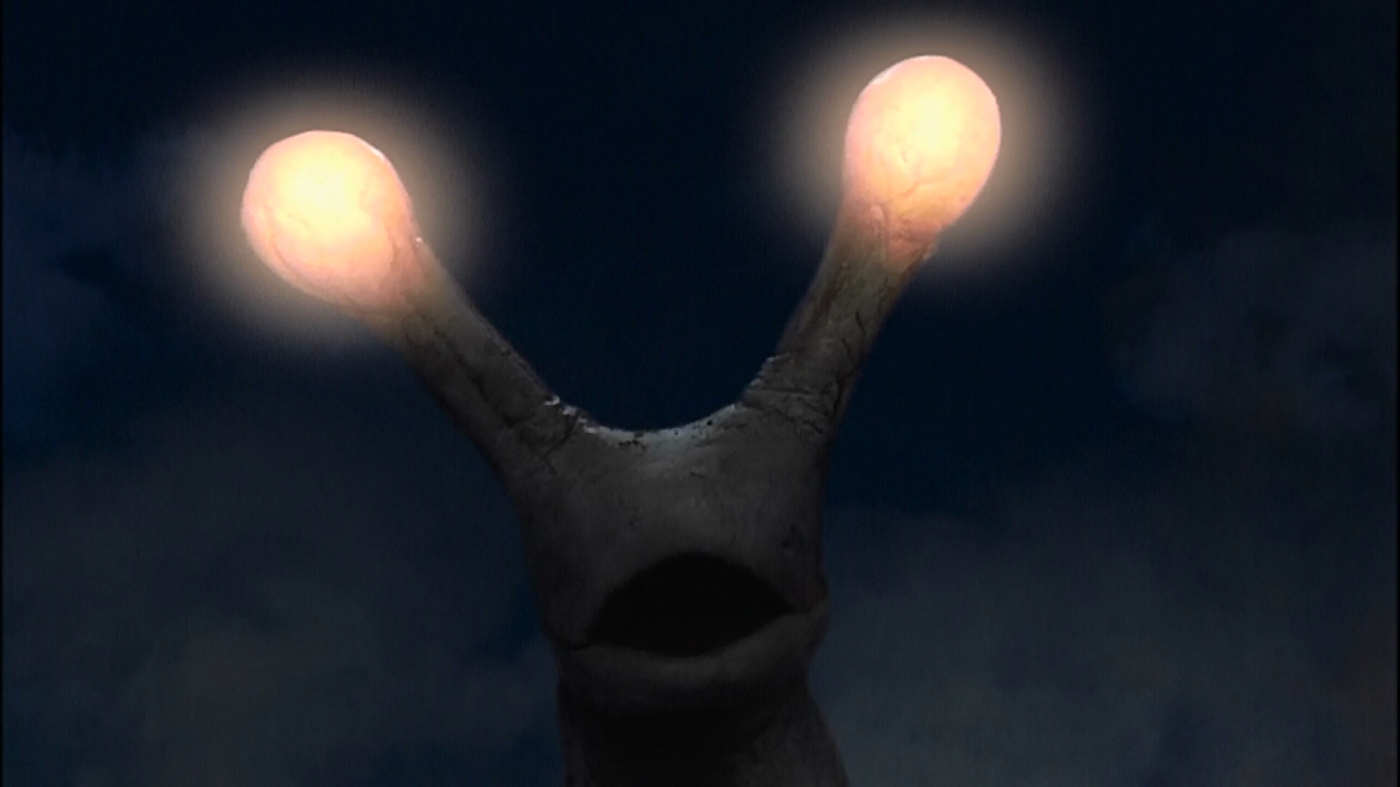
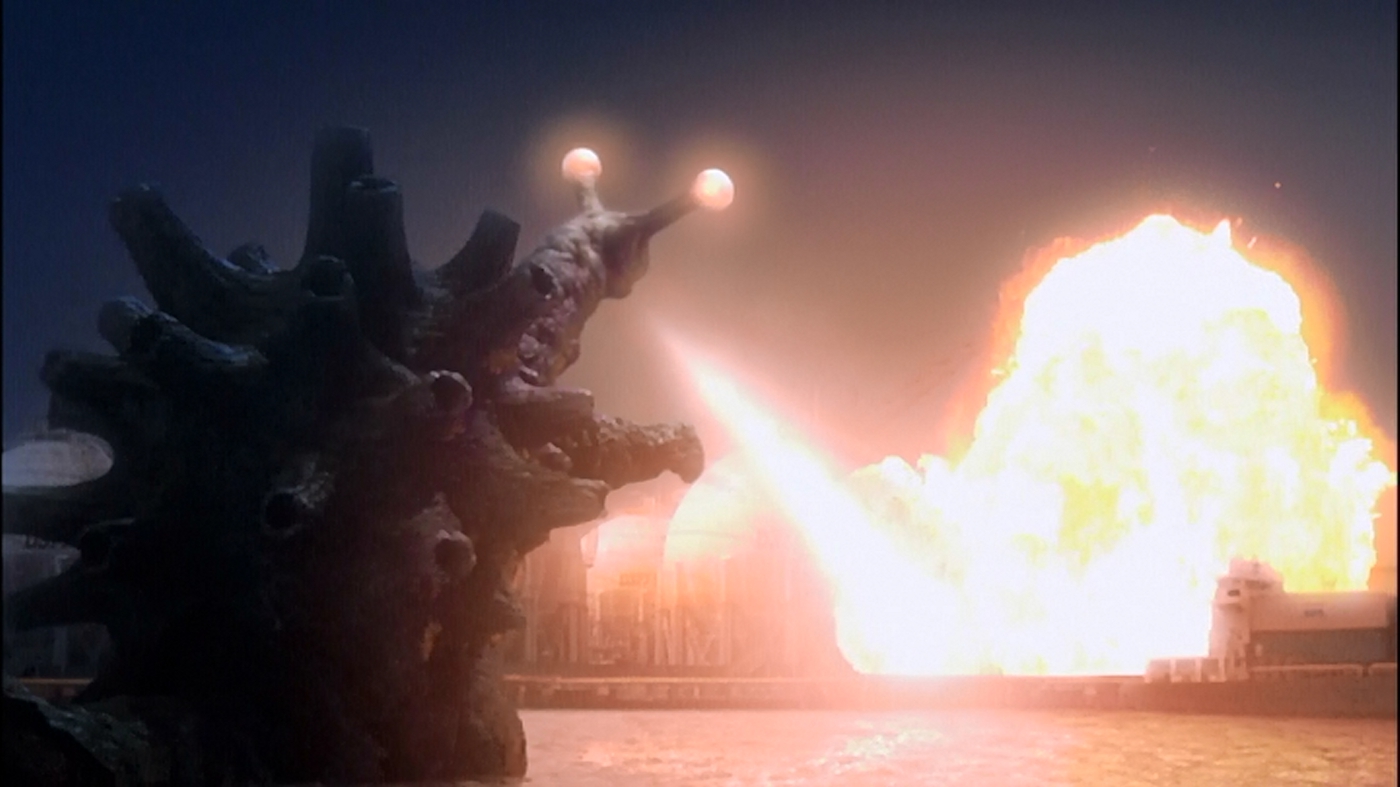
Demeking arrives, like Ghidorah, in a meteor. And I wonder if there isn't a certain amount of influence from King Ghidorah. Demeking is best described as a huge, walking snail with a barnacle cluster for a shell. It has a breath weapon, which it uses to destroy the oil refinery it landed in (shades of Gamera) because without another monster to fight, what else is there to do with a breath weapon?

Demeking blows up a refinery.

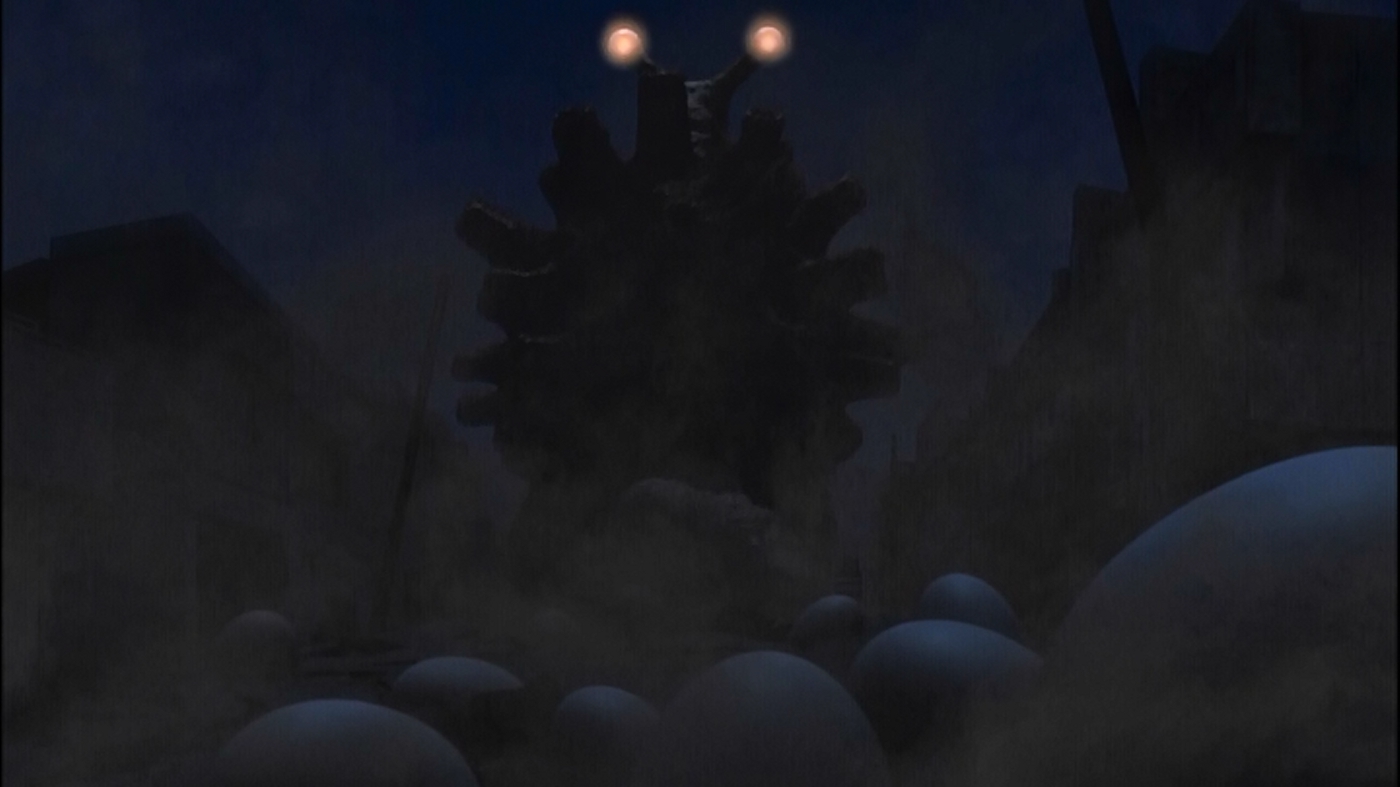
Demeking blazes a trail of destruction, and in its wake, it leaves dozens of eggs. Kameoka chases it down, confronts the creature, only to wake up. It was a dream.

Demeking leaving eggs behind it.

Two years later, Kameoka meets his buddies again. He is still in high school, but he's writing a novel about Hachiya and Demeking. In a piece of truth in fiction, he is more enthusiastic about telling people about it than he is in actually writing it. The last we see of it is Kameoka's empty desk. Has he given up? Or was the novel finished? Haochiya has taken several part-time jobs, but he's still dissaffeced and aimless, even though his father tries to get him to take his life seriously.

Demeking.

Demeking uses its kaiju in a very dfferent way than other films. The creature is more a subplot in the film, a dream Kameoka has. TV Topes calls this Rent-a-zilla, where the kaiju appears, but itn't the full focus of the film. The most famous example is probably the Stay-Puft marchmallow man from Ghostbusters. As it gets easier to put CG into films, it gets easier to introduce a kaiju this way. Unfortunately, the English marketing team seems to have latched onto this as the main feature of the film.

Thursday, February 19, 2015

Kaiju as Demo Reel: Geharha The Dark and Long-Haired Monster

Normally, I prepare myself for a kaiju film. I'll look it up on IMDB, TV Tropes and Wikipedia, so I have some idea of the background of the film. With Chohatsu Daikaiju Gehara, or Gehara: The Dark and Long-Haired Monster a 20-minute short from Kiyotaka Taguchi, I have basically no idea what I'm getting into. This is the debut directoral effort from Kiyotaka Taguchi, who has gone on to work on Ultraman Ginga and other Tokusatsu series.

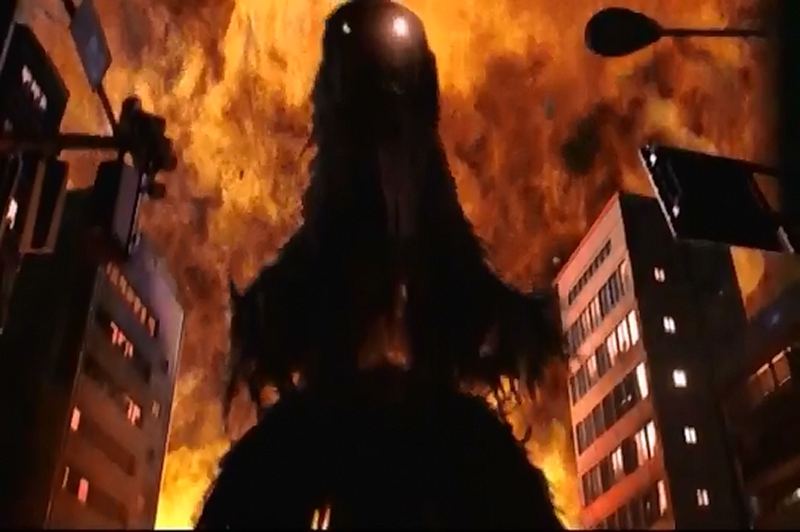
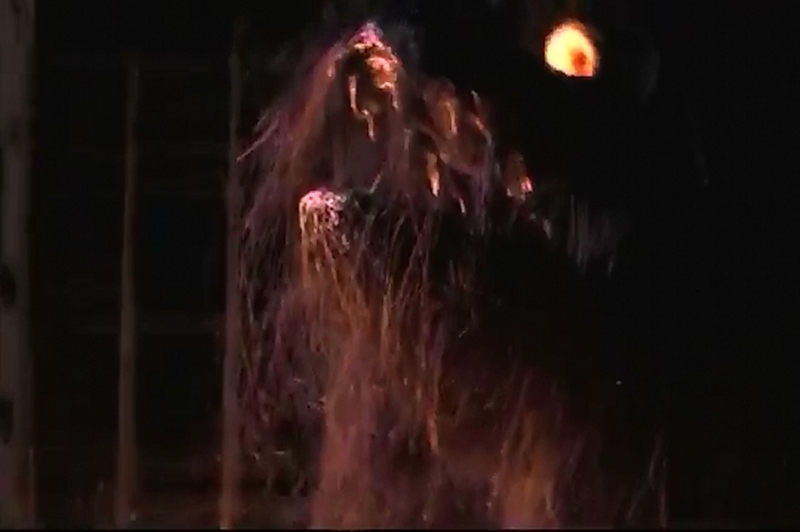
Geharha, with an uncharacteristic explosion behind him

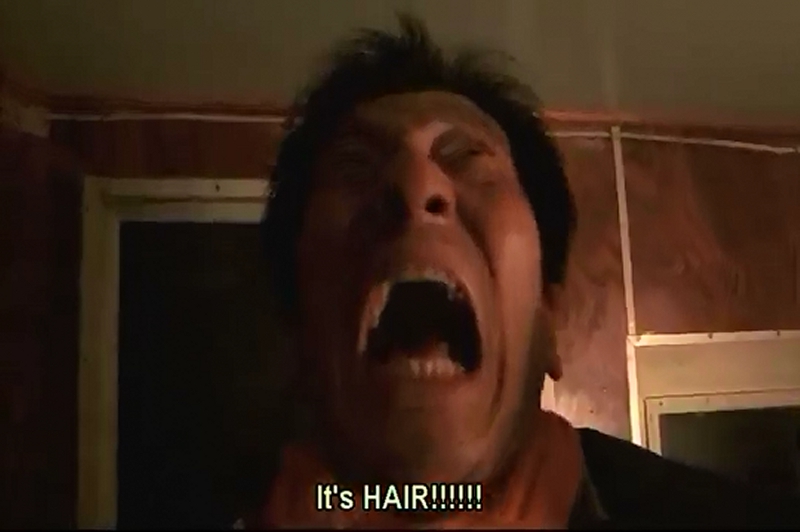
The opening is promising. The classic fisherman on a boat used in so many films, from Godzilla 1954 to Pacific Rim. Something is interfereing with the engines, and then something surfaces, and the sailors are pulled out of the cabin by HAIR! Yeah, this is going to be fun. We have already established what this film is in less than two minutes. The classic monster from the great unknown sea, and it's not going to be serious.

What terrifies men? HAIR!

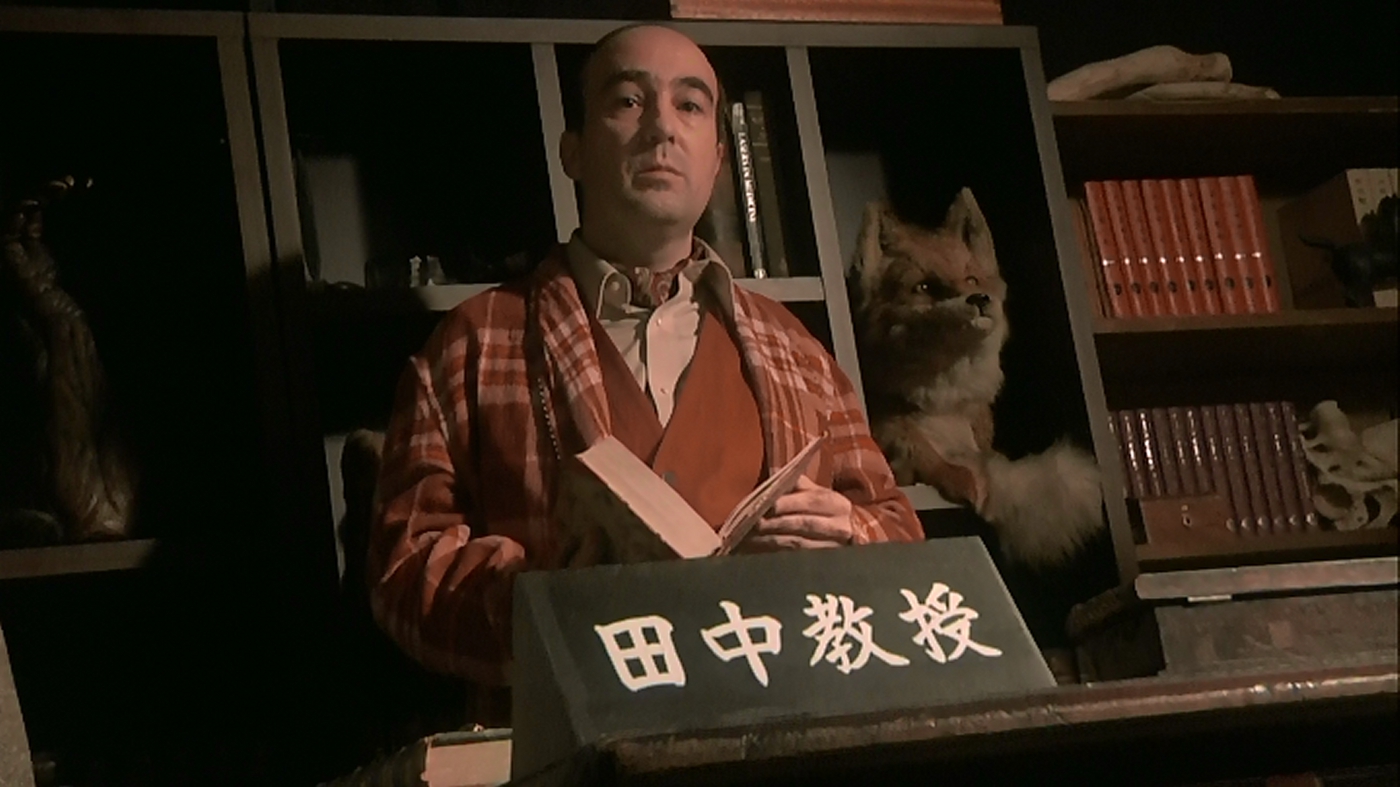
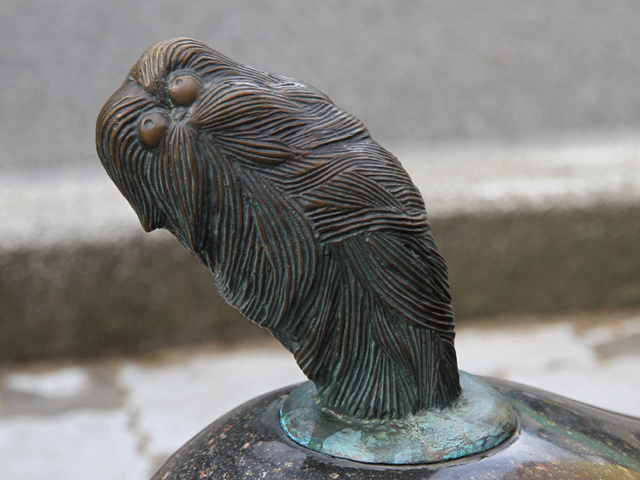
Hideo is a journalist, another kaiju film classic. He enconters an unspecified expert that says the monster might be a Keukegen. A little digging (by me) discovers that these are hairy spirits of Japanese folklore. A look into that discovers that Lik the Chinese and Hells, the Japanese have a lot of spirits.

The Keukegen Spirit. In bronze, apparently.

Our reporter goes to an odd shrine, putting me in mind of 2008's Monster X Strikes Back, to find out more about Geharha. It turns out that the great seal, which is implied to have imprisoned the Great Geharha, a plot device used in the first Reborth of Mothra film, has been broken.

What do you want, outlander?

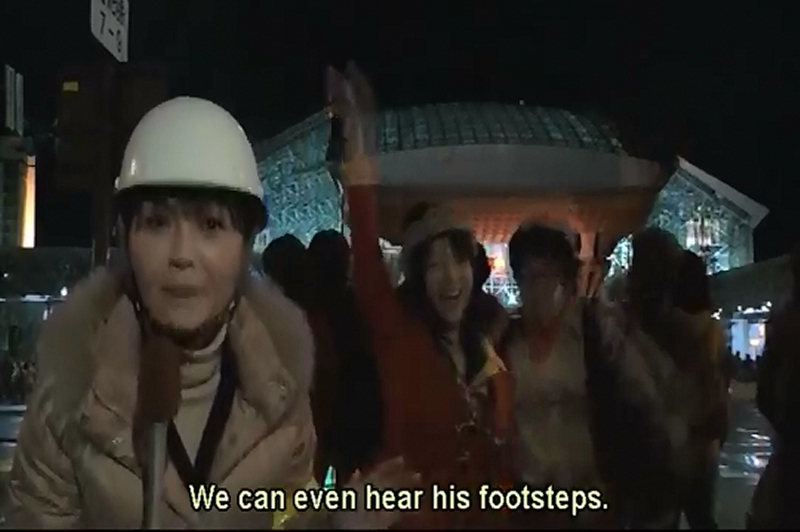
Film crews track Gaharha's movement towards urban area Kanazawa, which I don't think has ever been attacked by a kaiju before. As a reporter describes the approach of the monster, two goofy kids are seen jumping up and down in the background, clearly enjoying being on television, not really taking the approach of the monster seriously. This portrayal of kids as senseless reminds me of the relentless dances that infested the mid-sixties kaiju films such as Frankenstein vs Baragon, Ebrah, Horror of the Deep, and the first Gamera film. Kids these days. And those days.

Woah, there's a giant monst--hey are we live?

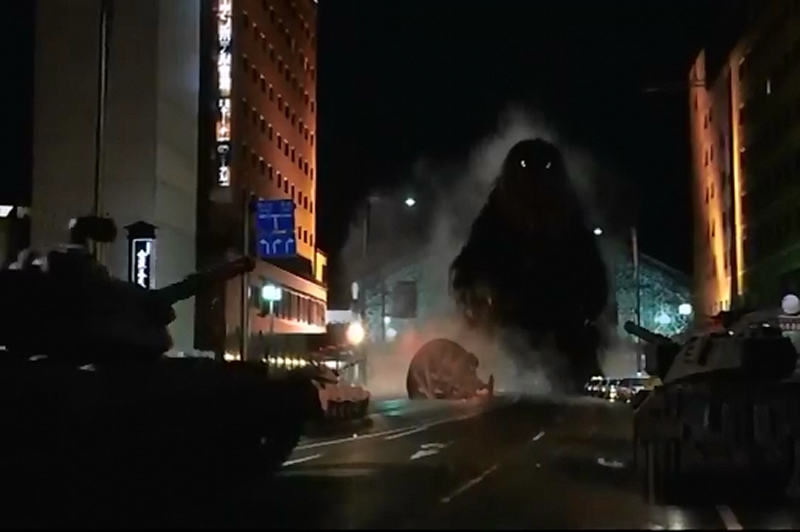
When attacked by the military, Geharha responds with a reek, which I suspect is like burning hair. With the military stymied, an inventor steps in, and deploys the Gas Vortical Device. Which, when we get a close look at it, is just a gigantic fan. But once its hair is blown back, the tanks can home on on a vulnerable spot no longer hidden by hair.

Menacing the way none but Hedorah is

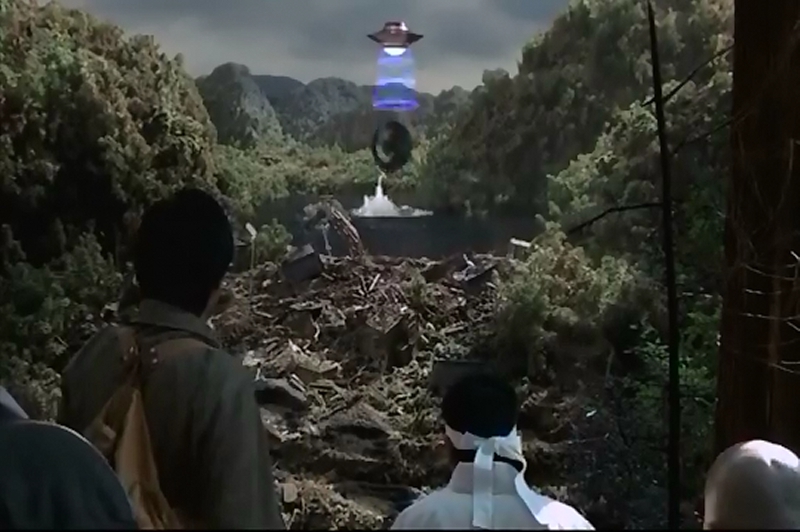
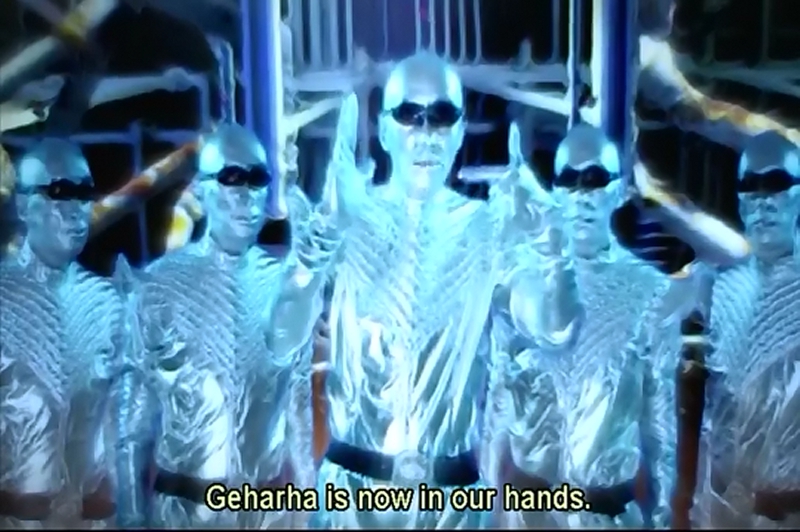
Geharha retreats to the mouintains, and falls into a lake. The End appears on screen, but then a UFO, similar to the ones from Invasion of Astro Monster uses a beam to pull Geharha out of the water, now clearly an homage to Invasin of Astro-Monster. Silver-clad aliens then theraten to use Geharha to destroy the world unless all humans will bown down to them.

So, not quite done yet...

We're going to take over the world and make you all wear shades.

What follows is a trailer for Gehara: Monster Martial Law, which looks brilliantly silly, with the aliens attempting to subjugate Earth. It loosk faster-paced, and has a lot of explosions.

What terrifies men? HAIR!

More than anything, Geharha: The Dark and Long-Haired Monster feels lke a demo reel for someone who wants to get into kaiju film. It's compact, getting in a large number of kaiju tropes in its twenty-minute running time, a whirlwind tour of such film. It wastes no time, but it doesn't introduce much that is new, either. The monster Geharha is new, but it doesn't do anything unusual. It rampages, and is defeated by a combination of the military and new sicence. There's little time to paint the human characters in anything but broad strokes. Still, it's effective for what it is, and clearly netted the director interest, because he's got work.

Next week: Growing up in the Seventies. And a Kaiju.