Friday, February 29, 2008

Just Another February 29th?

So you’ve survived the innocuous extra day that gets tacked onto February once (almost) every four years. Leap year is something most people don’t really think about. Which is kind of too bad. We’ve made it very easy to overlook something rather extraordinary—the fact that the rate at which our Earth revolves around the sun is not in precise agreement with our 24-hour day.

Early solutions to this observation were admittedly rickety. The pre-Julian Roman Calendar is as delightfully complex a calendar as you might find. Every other year, the short month of Intercalaris was inserted toward the end of a truncated February (most scholars agree) on a roughly alternating schedule as to whether Intercalaris was 23 or 24 days. Since the “standard” Roman year was 355 days, and the “special edition” year was 378 or 379, it averaged out reasonably well as long as someone paid close attention.

However, the office of the Pontifex Maximus, the most powerful priest in Rome, was in charge of a lot of things, including the calendar. Of course, if he was busy, say during a Civil War, or the Second Punic War, the Pontifex Maxiumus might not get around to properly assigning the year. Or it might be that the current Pontifex, an elected official, might want to assist his political cronies by making the transient month arrive sooner rather than later, extending their term in office.

Unsurprisingly, the calendar did not always work as simply as it seems in print. Julius Caesar, setting up reform and establishing the Julian calendar extended the year 46 BC to 445 days in order to bring the following year back into seasonal alignment. To do this, he inserted the usual Intercalaris in February, as well as another 23 days into November, and 22 more into December. After that, he established the familiar 365 day calendar with a leap year tacking an extra day onto February every four years.

In light of the Julian reform, the Roman Calendar looks cobbled together, but it was a calendar based on observation and constant attention. It worked as long as it was properly maintained. Like a lot of the side-projects of the high and mighty, time and attention were a problem. What Julius “Shakespeare wrote a play about me” Caesar did was to simplify the calendar so that anyone who knew the leap-year rule could make their own calendar, rather having it issue from a specific office every year.

And the Julian calendar worked pretty well for fifteen hundred years, but it hadn’t been worked out to enough decimal places to be eternal. In 1582, the Gregorian calendar (named for Pope Gregory XIII), instituted a new refinement. The Julian calendar declared that all years divisible by 4 were leap years. The Gregorian rule is a bit more complex, stating that every year that is divisible by four is a leap year, except for years divisible by 100. Centuries that are divisible by 400 are leap years. Thus 1600 was a Gregorian leap year, while 1800 was not. However, because the Julian calendar was now some ten days off meeting solar equinox with calendar equinox, ten days would have to be lopped off the current year of any country that adopted the Gregorian calendar.

And of course, European countries wanted to display their allegiance or defiance of the Pope and his newfangled calendar. So there is a lag of some 300 years during which Western Europe slowly converted to the Gregorian calendar. The Orthodox church still hasn’t, which is why Eastern Orthodox holidays are celebrated some twelve or thirteen days after Catholic and Protestant ones.

The delay among countries adopting the Gregorian calendar has resulted in some interesting quirks of calendary. For real giddy fun, consider that Shakespeare and Cervantes died on the same date (April 23, 1616), even though Cervantes predeceased Shakespeare by ten days. Spain was using the Gregorian calendar at that time, while Britain was using Julian.

So the apparent simplicity of the additional day of February that makes little impression on you has been the result of a lot of hard work, finagling, and political chicanery. There is absolutely nothing sinister about this. Unless you count in the fact that Feb 29 is Tim Powers’ birthday, which makes it just a touch suspicious.

Happy birthday, Tim.

Sunday, February 17, 2008

Mission: Networking!

Mood:


Mission Accomplished

I took Saturday and went to Boskone 45, Boston's largest and primarolty literary SF convention. There I met several Neconites and using information gleaned from them, crashed the New England Horror Writers' dinner. And I met (OK, met and remembered, because I've apparently met Jack before) Jack Haringa, who is cool, classy, a great conversationalist, and a also an appreciator of Muppets, Nick "I don't have to write, I'm a Stoker-Nominated author!" Kaufmann, Paul G. Tremblay, F. Brett Cox, who , it turns out, works at the same university my father used to, Lon Prater, and of course Nick Mamatas. I did a lot of networking, at least as far as I could shout down the table.


I'm interested in following the development of the latest horror award, the Shirley Jackson Awards, and not just because I've been to her house. Jackson is, however, the origin of the myth that we stone people to death in Bennington. This is a dirty lie—Jackson lived in North Bennington.


The collaboration between David Conyers and I has been sent off to the editor. I think it came out rather well, and am hoping that it gets into the anthology.

Tuesday, February 12, 2008

Sweet, Sweet, Publication

Mood:


Overly self-satisfied

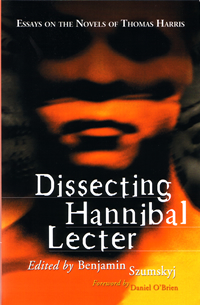
Dissecting Hannibal Lecter has come out, with my essay "Hannibal at the Lectern: A Textual Analysis of Dr. Hannibal Lecter's Character and Motivations in Thomas Harris's Red Dragon and Silence of the Lambs"


Thomas Harris's star was waned some since the enormous success of the book and film versions of Silence of the Lambs. But his signature character of cannibalistic psychiatrist Hannibal Lecter remains a fascinating one. Norman Bates is his father, Patrick Bateman and Dexter Morgan his literary descendants. But for me, it seemed that many people missed the point of Lecter. Consider this exchange from Silence of the Lambs, p. 277:

     "What does he do, this man you want?"
     "He kills —"
     Ah &mdash" [Dr. Lecter] said sharply, averting his face for a moment from her wrongheadedness. "That's incidental. What is the first and principal thing he does, what need does he serve by killing?"

Lecter applies this reasoning to Buffalo Bill, but what if we apply it to the good doctor?

There are also magnificent essays by ST Joshi, Davide Mana, Peter Messent, Philip Simpson, Robert Waugh, as well as editor Benjamin Szumskyj.

Sunday, February 10, 2008

Templecon was Fun!

Mood:

Havin' fun playin wiv mah bruvva

I had a good time playing with my brother at Templecon, a large east coast Warmachine convention. I didn't win any prizes, because my style of play, which is to not commit fully until the enemy makes a mistake then pounce on him, really isn't as consistently effective as having an well thought-out plan.

And I still have that competitive edge that makes losing a too-personal experience for me. I get that uncomfortable feeling in my stomach, and the face-too-tight sensation when I watch my opponent really gain the upper hand in a match. Although after six months of play, this has eased off a bit. I doubt it will ever actually stop bothering me, but I think repeated defeat in public will continue to erode that humiliating feeling of utter failure when I am beaten.

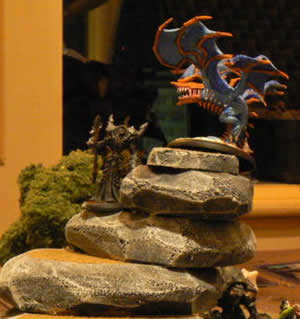
The games had many interesting moments, the most visual of which is below. My Iron Lich Asphyxious (in black) fighting a Seraph (in blue and orange) on a tall rocky pinnacle. Asphyxious did not actually kill the Seraph; he severely hurt it and threw it off the tower. It was the Slayer jack (at bottom right) that struck the killing blow.


Outside of the game itself, I'm enjoying painting Warmachine models (you can see some on my website). It takes a bit less talent than I had originally feared. And it's a good rest when I'm brain-tired from writing.

Sunday, January 27, 2008

Not Dead, Incapacitated, or Bored

January is usually that time of year when I attempt to withdraw from all human contact. After the relentless need to get stuff done before Christmas (several people didn't get presents who really deserved them, and for that my deepest apologies, and I'm running late on Ray Solberg's birthday), January is generally a time of staying in and feebly trying to catch up on correspondence. This year, I'm really sucking with the contacting people, so this post to reassure people that I am not dead, incapacitated, or bored.

I have so much stuff on my mental to-do list that I had to write it down in order to keep it straight. And nothing says "This will make a great blog post" like a list. The sad thing is that I'm probably reference this post as a to-do list for a couple of months. Here's what I have to do, as of 1/22/2008:

•  "Raw, New Things." This is my newsletter to the Esoteric Order of Dagon in which I review recent anthologies of Mythos short stories or novels. ~4,000 words. Done 1/24.

•  Tart up the Necromancer for Hire query letter. Which also includes a day trip to the library to find more literary agents who are amenable to fantasy submissions, as well as fantasy publishers who take unsolicited manuscripts.

•  Think up a better title (Are you there, Shakespeare? It's me, John) for the revision of "Sire" that I sweated over during most of January. Revise one more time and then send.

•  Complete and then revise collaborative story with David Conyers.

•  Revise "Death of the American Family Farm" and submit it to Space and Time magazine.

•  Write two stories for anthologies I've been invited into: A CSI Arkham story (and necessary research into police procedure and crime scene investigation), and one concerning anthropologists, and Greenland's Dorset culture.

•  Write story and submit it to Mythos Books' Cthulhu 2012 anthology.

•  Write questions to ask authors who were influenced by Robert Bloch, then write article on Robert Bloch's influence as a literary mentor.

•  I have not updated the Ultimate Hellblazer Index in six months.

•  Other stories that need to be written: "God of Chickens", "Almost Human", "Rather Short for an Angel", "A Certain Society of Concerned Citizens", "Captain Scar", "Beanie Babies", "Darwin's Cosh", "The Secret History of Earth", and "The Whiskey Tango File".

•  And at some point, I want to take six months and write a horror novel, Hag.

•  I owe a lot of people email.

My non-work, non-writing schedule for February looks like this:

Feb 1-3: Templecon. I spent the 26th painting up my bane knights so my Warmachine forces will look good on the table. I will not have time to paint and assemble my harrower.

Feb 10: A "Write Your Own Valentine" get-together with the SouthShire Roundtable.

Feb 15-17: Boskone. To add insult to injury, I am not the Guest of Honor, although the mass slaying of peeps could possibly make up for this.

Feb 19-21 I am having my niece and nephew over during Winter break. This begs the question of how the hell am I going to keep them from being bored? I think I could park Redhead Reader in front of the bookshelf and she'd be happy, but doing that for three entire days would be irresponsible. Her brother, Redhead Runner, I have even less clue about.

So hello to all of you out there! I am not dead, incapacitated, or bored! I love you all and can I start referring to you as my fandom?

Thursday, November 22, 2007

A Little Family Humor for You

There are people who say that New Englanders are a dour lot, but that's simply because outsiders don't understand "our" sense of humor. For example, my mother told me today what I'm supposed to put on my pie. Some people put a little blob of dough that looks like an apple or a blueberry, or whatever. Not my family.

If you have just made an apple pie, you put a big "T" on it, for "'Tis apple. If it's not, you mark it with a big "T". For "Tain't.

And so the long New England nights just fly.

Thursday, November 15, 2007

Now I can improve my writing and annoy the cats at the same time...

It's one of those things I've heard people talking about for a while. When you're done with a story, read it aloud to yourself.

It works. If you stumble on a sentence, it probably needs to be rewritten.

Kinda wished I'd listened to this before I finished the novel. Ah well, there will be time to revise it again later.

Sunday, November 11, 2007

By his dead smile I knew we stood in Hell.

It's 11/11, Armistice Day, or Veterans' Day, depending on your sense of history. So I present you with a poem by WWI soldier Wilfred Owens. To some, Dulce et Decormum Est is an old saw, something we studied in school. Personally, I've never been able to escape the hard imagery of the poem, the haunting despair, the vivid sense of the narrator's exhaustion, terror, endurance, and humanity in the face of the overwhelming.

Writing is memory, and there are something we need to remember, even if it's on a single day out of the year. World War One was an colossal, senseless mess in which some nineteen million soldiers were sent to their deaths for little or no gain, and perhaps ten million more civilians died. As an event, it overshadows the rest of the twentieth century. The Second World War and the Cold War, the two great conflicts that dominated world politics for the latter half of the twentieth century, both have their roots directly in the Great War.

Not that the author, Wilfred Owen can tell us this himself. He was killed a week before the war ended. It is said his mother received word just as the church bells rang out to celebrate the Armistice. Many poets died in the Great War, just as I must assume great politicians, scientists, surgeons, and inventors did. But we'll never know, because they died young.

On this Armistice Day, I reflect that should be more careful with peoples' lives.

Dulce et Decormum Est

Bent double, like old beggars under sacks,
Knock-kneed, coughing like hags, we cursed through sludge,
Till on the haunting flares we turned our backs
And towards our distant rest began to trudge.
Men marched asleep. Many had lost their boots
But limped on, blood-shod. All went lame; all blind;
Drunk with fatigue; deaf even to the hoots
Of tired, outstripped Five-Nines that dropped behind.

Gas! Gas! Quick, boys!–An ecstasy of fumbling,
Fitting the clumsy helmets just in time;
But someone still was yelling out and stumbling
And flound'ring like a man in fire or lime...
Dim, through the misty panes and thick green light,
As under a green sea, I saw him drowning.

In all my dreams, before my helpless sight,
He plunges at me, guttering, choking, drowning.

If in some smothering dreams you too could pace
Behind the wagon that we flung him in,
And watch the white eyes writhing in his face,
His hanging face, like a devil's sick of sin;
If you could hear, at every jolt, the blood
Come gargling from the froth-corrupted lungs,
Obscene as cancer, bitter as the cud
Of vile, incurable sores on innocent tongues,–
My friend, you would not tell with such high zest
To children ardent for some desperate glory,
The old Lie: Dulce et decorum est
Pro patria mori
.

Monday, November 5, 2007

Top 10 Great Things About World Fantasy Con 2007

World Fantasy Con was head-spinningly awesome. More writers and topics and editors and all-around delightful people than you could shake a wizard's wand at. I could go on to a hundred or more by being specific, but I'll just tease you with the top 10 great things about World Fantasy Con 2007:

10. Picking up a copy of Nick Mamatas’s Move Under Ground and then starting to set it back on the shelf, only to discover the author was standing behind me. I bought it, and he signed it. Nick remembered that I submitted “God of Chickens” to him without me having to prompt him, which I thought was pretty cool of him. Nick’s a neat guy to talk to.

9. The constant “Holy shit, Walter Jon Williams/ Charles Vess/ Kim Newman/ Lynn Abbey/ Tim Powers” moments as Walter Jon Williams/ Charles Vess/ Kim Newman/ Lynn Abbey/ Tim Powers and literally dozens of other familiar names walked by. It was extraordinarily difficult not to geek out at the parade of fantastic authors who have influenced, entertained and exhilarated me of the years, and I did not succeed every time. They were without exception polite, which cannot have been easy. I will try very hard to restrain my enthusiasm at the next convention, but at the same time, I want these people to know that their work is absolutely marvelous. I must find some balance.

8. William Jones. The man himself–he who bought my first story. We had a long conversation (long enough that the bookseller we were standing in front of shooed us away) about the publication process, what’s going on with Chaosium and Elder Signs Press, why short stories are a good thing, and what’s up next for us both. Awesome guy, and a very important conversation for me.

7. ST Joshi is a stunningly personable man. Those who have only read his commentaries simply cannot understand what an warm and delightful conversationalist he is.

6. The stories. When authors get together, they trade stories about writing and publishing. Like the one about the guy who got a rejection letter and posted a huge rant about it on his blog. A publisher who wanted to give him a three-book deal, looked him up, saw the rant, and decided he might be too difficult to work with. Note to self, be more polite when posting to blog.

5. F. Paul Wilson and Tom Monteleone’s stories. These guys are the veterans of the book trade, and they have a million and one stories, all of the fascinating. Any ending you can imagine to something that starts off with “So Peter Straub, Stephen King and I went out to find the sleeziest strip club in Ottowa” falls short of the actual story. I’m sorry, but it’s simply the truth.

4. Learning that Elizabeth Bear used to play in my CoC campaign! Yes, that Elizabeth Bear.

3. Gary Frank. The thing to do at a convention is to follow Gary around, because he goes some extremely interesting places. And while he does so, he talks a lot of sense about marketing yourself, convention etiquette, and generally how to work conventions to your advantage. Gary’s an old hand at cons, so his advice is useful and practical.

2. Wilum Pugmire. Wilum is so supportive and kind to this fledgling writer. He gave me at least two significant opportunities I would not have thought to take advantage of myself, and we indulged in some highly entertaining conversation. There's no one like Wilum. We've been corresponding for a year, and it was simply a joy to finally meet him.

1. Reading this from “Summation 2006: Horror Anthologies” by Ellen Datlow (p. lii-liii), in The Year’s Best Fantasy and Horror, 2007: "Arkham Tales, edited by William Jones (Chaosium), is, according to the editor’s introduction, the first anthology in which '. . . each story . . . is realized in Chaosium’s adaptation of the cosmic horror sub-genre.' In other words, if I understand correctly, each story is inspired directly by an actual aspect of the ‘Call of Cthulhu’ role-playing game published by Chaosium Press. Despite this, the stories do stand alone, and some do some nice riffs on the mythos, including those of C. J. Henderson, Brian M. Sammons, and John Goodrich.”