If there's anything that makes you feel like a part of the writers' community, it's getting an invitation from people whose work you respect. Over the past couple of months, I've received several invitations to submit to projects. It's a warm feeling.
Part of the reason I decided to write was because I like talking with them. I listened to Tim Powers speak at a book signing, and I knew that I wanted to have conversations with him and people like him. At NECON, I have spent wonderful hours talking about ideas with other writers. It's unimaginable fun to sit in a group of people who are throwing out ideas, with other people knocking them in utterly insane directions.
To my delight, I'm getting there. Hard work pays off, as does having the right phlebotomist.
Thursday, March 11, 2010


Sunday, February 28, 2010
Splinter Fleet Mordiggian: First Encounter
Warning: This is an ENORMOUS NERD POST!
The Imperium of Man has received reports of a heretofore unencountered strain of xeno, hereafter designated Splinter Fleet Mordiggian.
After three months of painting and learning the system, I put five hundred points of Tyranids on the table. And I enjoyed myself a great deal.
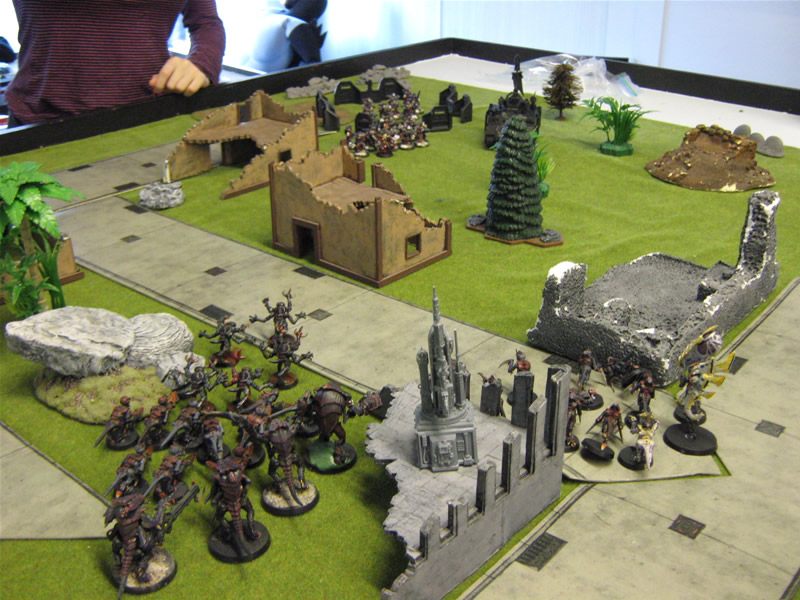
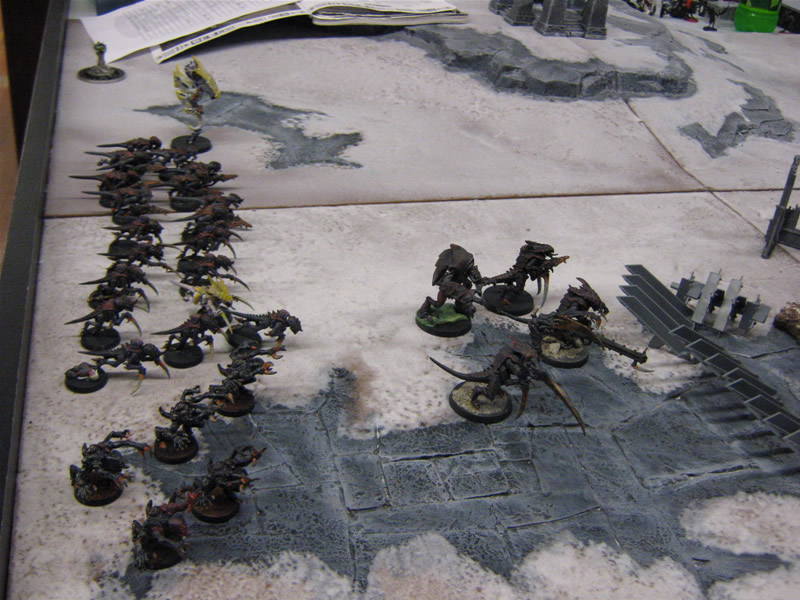
You're looking at 10 Termagants, 10 hormagaunts, 3 warriors, 1 zoanthrope, 5 genestealers, and a Crocodile Games Scarab Ogre standing in for my Tyranid Prime.
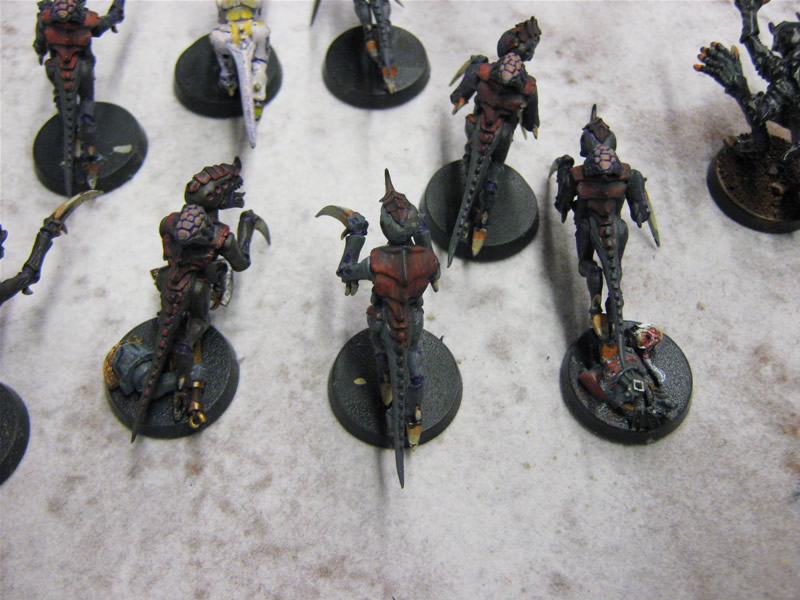
This picture shows a bit more of the detail of my paint scheme, which was inspired by Destroyah in Godzilla vs Destroyah. Also, the Santa Fe Good Taste Factory told me that no matter what I did, I had to kill Space Wolves. So a few of my bases have remnants of a Space Marine chapter, the Rune Bearers. The pieces are taken from a Space Wolves set. I got close to fifty heads on sprues, which will make excellent gristly trophies for a long time to come.
I was massacred in the first game because I had nothing to penetrate the armor of his Kans once my Zoanthrope was gone. In my second game I managed to pull out a tie against the Sisters of Battle in a very enjoyable and even game. I think I like Warhammer's declaration that some battles are not victories; it's entirely acceptable for neither side to win. God knows there have been enough inconclusive battles in history.
I'm enjoying Warhammer's feel. It's more of a wargame than Warmachine. Yes, the buy-in is significantly higher, but there's more a feeling of Clauswitz's "everything is more difficult in war" philosophy. When the dice roll, I calculate what should happen. But the dice (reality, fate, miscommunication, the incompetence of subcommanders, the ammunition got wet, etc...) tell me what did happen. I don't think the "fists full of dice" mechanic is particularly elegant, but it seems to insert an acceptable amount of random into the situation by dispersing it.
Warmachine, now that I've got the experience of two minis wargames, feels much more game-y, on the Gameist-Narrativist-Simualtionist spectrum. If you line up these three special abilities, you should be able to massacre the other guy's Warcaster. Warhammer tells you that you need the right tools that should take down the enemy (you really need armor piercing attacks against tanks, for example). Heroes are present, but they aren't the overwhelming power they are in Warmachine.
I had a good time.
The Imperium of Man has received reports of a heretofore unencountered strain of xeno, hereafter designated Splinter Fleet Mordiggian.
After three months of painting and learning the system, I put five hundred points of Tyranids on the table. And I enjoyed myself a great deal.
You're looking at 10 Termagants, 10 hormagaunts, 3 warriors, 1 zoanthrope, 5 genestealers, and a Crocodile Games Scarab Ogre standing in for my Tyranid Prime.
This picture shows a bit more of the detail of my paint scheme, which was inspired by Destroyah in Godzilla vs Destroyah. Also, the Santa Fe Good Taste Factory told me that no matter what I did, I had to kill Space Wolves. So a few of my bases have remnants of a Space Marine chapter, the Rune Bearers. The pieces are taken from a Space Wolves set. I got close to fifty heads on sprues, which will make excellent gristly trophies for a long time to come.
I was massacred in the first game because I had nothing to penetrate the armor of his Kans once my Zoanthrope was gone. In my second game I managed to pull out a tie against the Sisters of Battle in a very enjoyable and even game. I think I like Warhammer's declaration that some battles are not victories; it's entirely acceptable for neither side to win. God knows there have been enough inconclusive battles in history.
I'm enjoying Warhammer's feel. It's more of a wargame than Warmachine. Yes, the buy-in is significantly higher, but there's more a feeling of Clauswitz's "everything is more difficult in war" philosophy. When the dice roll, I calculate what should happen. But the dice (reality, fate, miscommunication, the incompetence of subcommanders, the ammunition got wet, etc...) tell me what did happen. I don't think the "fists full of dice" mechanic is particularly elegant, but it seems to insert an acceptable amount of random into the situation by dispersing it.
Warmachine, now that I've got the experience of two minis wargames, feels much more game-y, on the Gameist-Narrativist-Simualtionist spectrum. If you line up these three special abilities, you should be able to massacre the other guy's Warcaster. Warhammer tells you that you need the right tools that should take down the enemy (you really need armor piercing attacks against tanks, for example). Heroes are present, but they aren't the overwhelming power they are in Warmachine.
I had a good time.
Friday, February 26, 2010
Huh...
I think my career as a photographer has started.

One of the joys of owning my own website is that I can peek behind the curtain and look at the mechanics. In this case, you're looking at the amount of bandwidth used by qusoor.com. It includes a rundown of how many times a particular page has been referenced, and where data is being sent. It's kind of interesting... about eight years ago, I discovered that Anton LaVey's daughter had linked to the Ultimate Hellblazer Index from her site.
Because I'm on a great server, I've got a lot of bandwidth that I don't use, so I'm pretty lenient about people who use my photos. But every now and then I check out the list to see who's using what. And if I don't approve, or some is heavily using my pictures, I'll put up an unpleasant image. If you're going to show a lot of people an image, at least have the decency to use your own bandwidth. My photo of Sting, for example, is surprisingly popular.
This morning, as I was looking through my links, I came across this little leach. I guess he likes my photography. Yeah, there's a difference between using it for free and actually paying for it, but I guess my photo was evocative enough that it suited his purposes.
One of the joys of owning my own website is that I can peek behind the curtain and look at the mechanics. In this case, you're looking at the amount of bandwidth used by qusoor.com. It includes a rundown of how many times a particular page has been referenced, and where data is being sent. It's kind of interesting... about eight years ago, I discovered that Anton LaVey's daughter had linked to the Ultimate Hellblazer Index from her site.
Because I'm on a great server, I've got a lot of bandwidth that I don't use, so I'm pretty lenient about people who use my photos. But every now and then I check out the list to see who's using what. And if I don't approve, or some is heavily using my pictures, I'll put up an unpleasant image. If you're going to show a lot of people an image, at least have the decency to use your own bandwidth. My photo of Sting, for example, is surprisingly popular.
This morning, as I was looking through my links, I came across this little leach. I guess he likes my photography. Yeah, there's a difference between using it for free and actually paying for it, but I guess my photo was evocative enough that it suited his purposes.
Thursday, February 25, 2010
What I've been waiting for... the Bloom Box
From Walter Jon Williams' Blog:
The Bloom Box is an in-house power generator. If I read the article right, it uses fuel and oxygen to cerate emission-less power. I've been waiting for something like this since my father (who worked at a power utility) told me what a fuel cell was, some thirty years ago.
He also said (my father is very smart) was that "utilities are interested in more than just electrical power." And from watching PG&E's antics for close to a decade, he wasn't wrong. So keep an eye on the Bloom Box. This will be a massive decentralizing influence if it works half as well as advertised.
Although it's touted as an emission-less energy source, it's not a fuel-less energy source. We won't be able to replace the amount of petrolium fuel America consumes with biofuel. There simply isn't enough arible land. But I would like to see the efficiency numbers; how many coal-burning power plants will we be able to take off-line if these suckers work?
And how soon before they're small enough to stick in a car?
The Bloom Box is an in-house power generator. If I read the article right, it uses fuel and oxygen to cerate emission-less power. I've been waiting for something like this since my father (who worked at a power utility) told me what a fuel cell was, some thirty years ago.
He also said (my father is very smart) was that "utilities are interested in more than just electrical power." And from watching PG&E's antics for close to a decade, he wasn't wrong. So keep an eye on the Bloom Box. This will be a massive decentralizing influence if it works half as well as advertised.
Although it's touted as an emission-less energy source, it's not a fuel-less energy source. We won't be able to replace the amount of petrolium fuel America consumes with biofuel. There simply isn't enough arible land. But I would like to see the efficiency numbers; how many coal-burning power plants will we be able to take off-line if these suckers work?
And how soon before they're small enough to stick in a car?
Monday, February 15, 2010
Fear my Camera Skillz!
A quick video by Iren Bear concerning Templecon. I was the camera man for this, and provided an occasional still, some of which you will recognize from my previous entry.
Thursday, February 11, 2010
Templecon 2010
I went to Templecon 2010 last weekend. This year, the convention was less exclusively about Warmachine (although there was still a lot of Warmachine). It had also moved venue to something that wasn't seven floors above ground, which made moving equipment and bulky packs stuffed with miniatures a lot easier.
The main event was Warmachine. And there was a LOT of it.
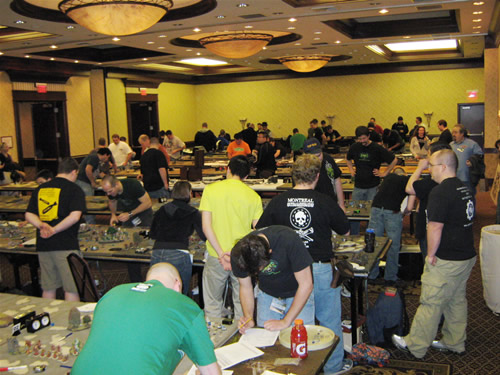
I never personally saw all the tables being played, but that is a load of tables, and that's a lot of people playing.
Other games were present in the periphery: Monsterpocalypse, Warhammer Fantasy, 40,000, Heavy Gear (I'd play if I could field all hovertanks. Yes, I'm an enormous Hammer's Slammers geek) and and Flames of War. I took this picture because it was the absolute epitome of the Flames of War game for me: A gentleman in a French cap playing a guy wearing a sweatshirt with a German Tiger Tank on it.
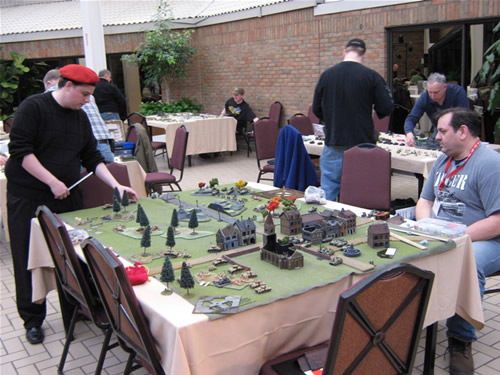
That is what Flames of War is all about.
I did not play. I've lost my taste for Warmachine. But I hung around the scenario table my brother set, called "Incoming!" which distributed dice, T-shirts, and artillery fire to anyone who wanted some. "Incoming!" proved popular, because it was well set up, and run, as well as providing an extra dimension to the experience it doesn't usually have: sound.
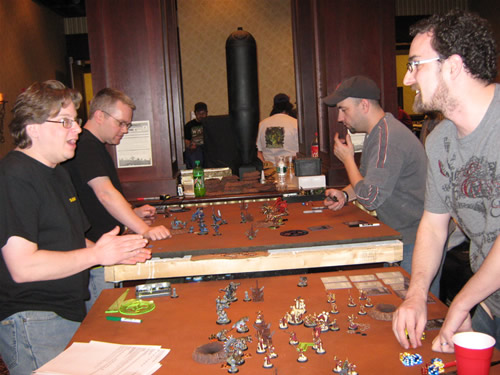
This is Tristan and George playing on the "Incoming!" table. Note the stacks of craters piled up at the base of the big, black bomb (they look like hamburger patties), just waiting to be used.
As always, many of the figures were gorgeously painted. I find that painting is an enjoyable aspect of the hobby, and it makes the force on the table look good.
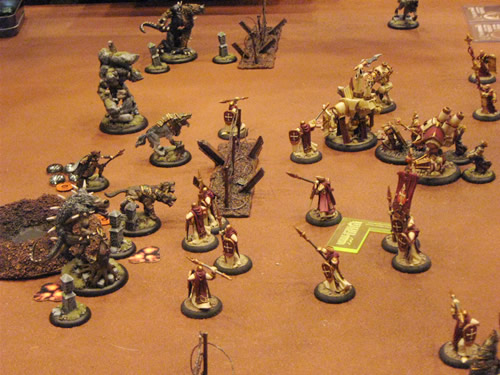
Makes the table look smart and engaging.
In order to attract a more diverse crowd, Templecon's theme this year was retro-futurism. Warmachine has long had a steampunk theme, and this year there were a fair number of steampunk costumers about. I regret missing the burlesque dancers.
I also spent time with writer C. J. Henderson. CJ has appeared in every notable anthology I've appeared in, and was writer guest of honor this year. We had some good chats; like me, he's deeply into Lovecraft, and even ran a Call of Cthulhu game (My character, predictably, was eaten).
So a good time, and I drank enough water to not get dehydrated in the dry motel air.
The main event was Warmachine. And there was a LOT of it.
I never personally saw all the tables being played, but that is a load of tables, and that's a lot of people playing.
Other games were present in the periphery: Monsterpocalypse, Warhammer Fantasy, 40,000, Heavy Gear (I'd play if I could field all hovertanks. Yes, I'm an enormous Hammer's Slammers geek) and and Flames of War. I took this picture because it was the absolute epitome of the Flames of War game for me: A gentleman in a French cap playing a guy wearing a sweatshirt with a German Tiger Tank on it.
That is what Flames of War is all about.
I did not play. I've lost my taste for Warmachine. But I hung around the scenario table my brother set, called "Incoming!" which distributed dice, T-shirts, and artillery fire to anyone who wanted some. "Incoming!" proved popular, because it was well set up, and run, as well as providing an extra dimension to the experience it doesn't usually have: sound.
This is Tristan and George playing on the "Incoming!" table. Note the stacks of craters piled up at the base of the big, black bomb (they look like hamburger patties), just waiting to be used.
As always, many of the figures were gorgeously painted. I find that painting is an enjoyable aspect of the hobby, and it makes the force on the table look good.
Makes the table look smart and engaging.
In order to attract a more diverse crowd, Templecon's theme this year was retro-futurism. Warmachine has long had a steampunk theme, and this year there were a fair number of steampunk costumers about. I regret missing the burlesque dancers.
I also spent time with writer C. J. Henderson. CJ has appeared in every notable anthology I've appeared in, and was writer guest of honor this year. We had some good chats; like me, he's deeply into Lovecraft, and even ran a Call of Cthulhu game (My character, predictably, was eaten).
So a good time, and I drank enough water to not get dehydrated in the dry motel air.
Tuesday, February 9, 2010
Good Words on My Work
Anderson Feldt has a blog, pleasantly called Literary Vivisection. At the end of least year, he read and discussed Arkham Tales
He posts specific reactions to nine of the seventeen stories, including mine. His style is minimalist, but this may be my favorite discussion of “Arkham Rain” yet:
“Arkham rain”, by John Goodrich. Rape, body alteration, dark legacies and darker choices to be made. Fantastic.
Hey Anderson, want a copy of Cthulhu Unbound?
He posts specific reactions to nine of the seventeen stories, including mine. His style is minimalist, but this may be my favorite discussion of “Arkham Rain” yet:
“Arkham rain”, by John Goodrich. Rape, body alteration, dark legacies and darker choices to be made. Fantastic.
Hey Anderson, want a copy of Cthulhu Unbound?
Sunday, January 31, 2010
Ars Brevis
For a change of pace, I helped out with a local ice sculpture contest on Saturday. Have I ever carved ice before? Heck no! But the Geek Bar sponsored it, and a friend asked for volunteers. We didn't win (that went to the guy who brought power tools), but I think we did pretty well.
As you look at these pictures, it should be noted that I spend a total of an hour working this, while the Primary Artists worked more than four hours each. So any glory I get is pretty much riding on their frozen coat-tails. Some people weren't quite sure what it was (working in a clear medium is more difficult than it appears), so I carved the name of the ship in the hull. I think that helped people figure it out.
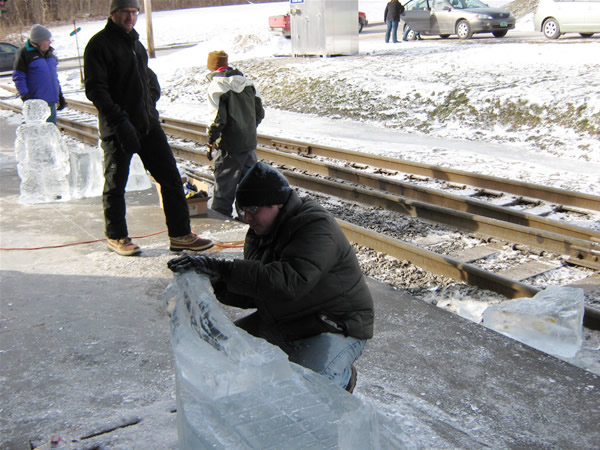
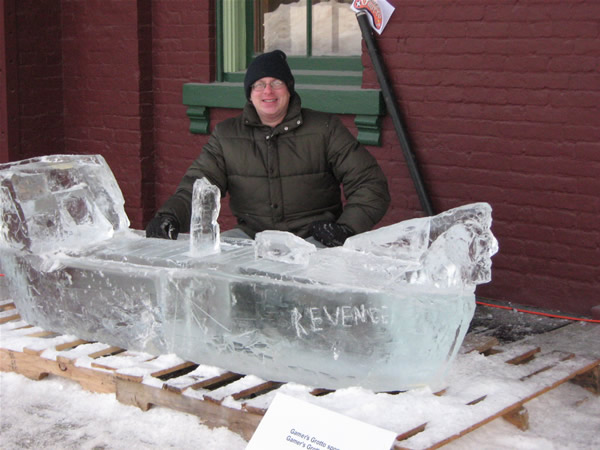
As you look at these pictures, it should be noted that I spend a total of an hour working this, while the Primary Artists worked more than four hours each. So any glory I get is pretty much riding on their frozen coat-tails. Some people weren't quite sure what it was (working in a clear medium is more difficult than it appears), so I carved the name of the ship in the hull. I think that helped people figure it out.
Thursday, January 28, 2010
Monday, January 11, 2010
Pyramid Texts
Adventures with pyramids, who could say no?
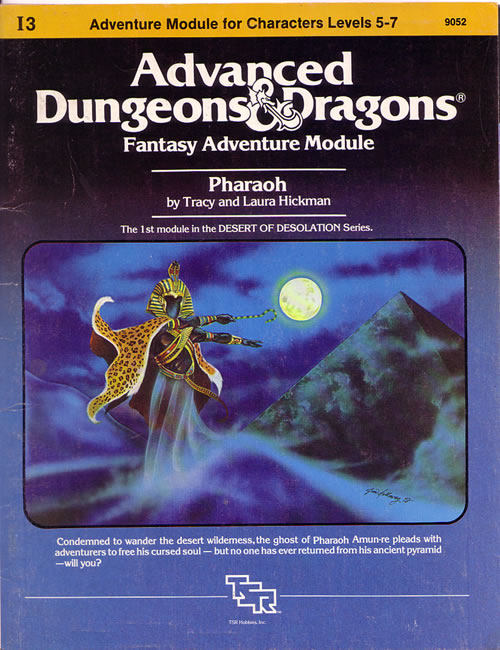 Pyramid is an early adventure for the first edition of Dungeons and Dragons. It's a good adventure with many solid ideas, and, rather unusually for a D&D adventure, an sense of humor. The adventurers are begged by the ghost of the pharaoh Amun-Re to rob his magically-trapped tomb. There's a lot going on inside, including excavation by spoon, and Amun-Re's remaining priesthood, which still lurks in the pyramid itself.
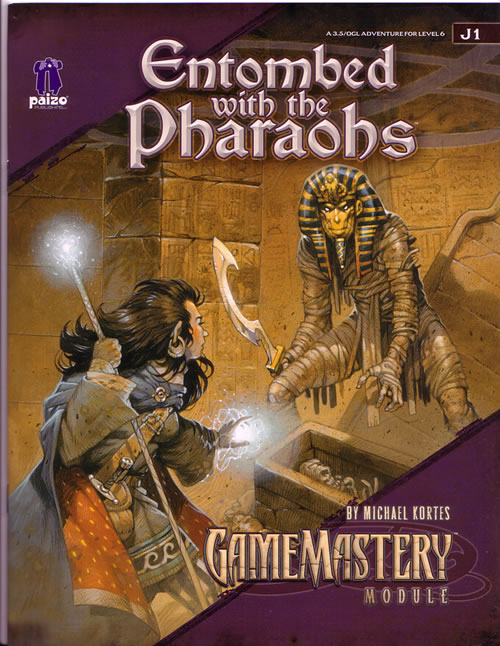 I was very excited to hear that Paizo's Pathfinder game was going to include a close parallel to Egypt called Osirion. One of the first adventures they put out involving Osirion was J1, Entombed with the Pharaohs. Adventure structure has changed a great deal since Pyramid was put out. The adventurers expect to be interested in the adventure, not placed at the edge of a desert thanks to actions they had no say in. So there's background, a bunch of stuff that happens before the party even gets to the pyramid, which affects what happens when they're in the pyramid. Quite notable is that the adventure does not stop when the tomb-raiding does. There are hints and riddles of things that may come to pass in the campaign, if the Game Master wishes. It's a nice way to layer on experience, allowing the literary device of foreshadowing in the campaign. yes, I am one of those snobby players who thinks that virtually any literary device can be used to enhance play in an RPG scenario.
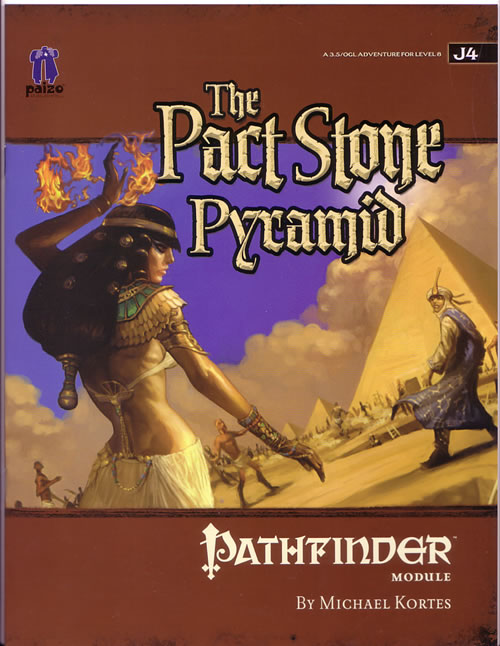 Paizo's follow-up has several structural similarities and some very interesting differences from Kortes' first pyramid adventure. Again with the wacky magical traps (and I like wacky magical traps), but there is a logic to these, because this pyramid was meant to be accessed from time to time. As such, it's got a very different feel from the previous two adventures. Also like Entombed with the Pharaohs, there is a breaking of the walls, a hint at something in the scenario that is beyond the confines of the adventure.
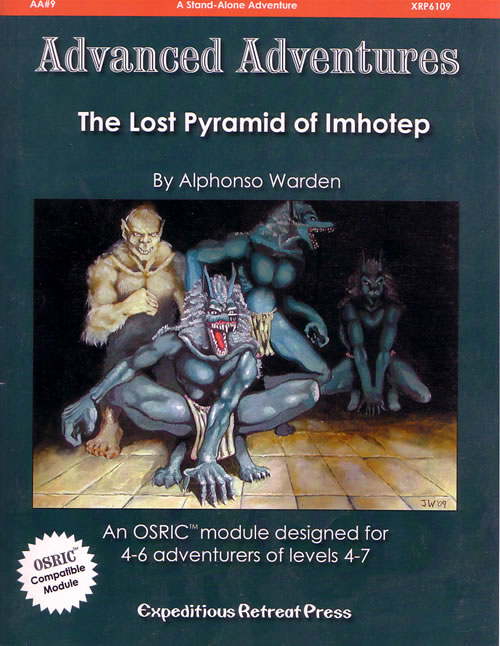 It was kind of a shock to read The Lost Pyramid of Imhotep and realize how like the majority of first edition D&D scenarios it was. It's a dungeon crawl; go in, kill the monsters, avoid the traps. There's a lack of description that I find is good for the immersion experience. The monsters, complex traps, and other immediate goals are well described, but there's a flatness to it that leaves me cold.
Pyramid is an early adventure for the first edition of Dungeons and Dragons. It's a good adventure with many solid ideas, and, rather unusually for a D&D adventure, an sense of humor. The adventurers are begged by the ghost of the pharaoh Amun-Re to rob his magically-trapped tomb. There's a lot going on inside, including excavation by spoon, and Amun-Re's remaining priesthood, which still lurks in the pyramid itself. I was very excited to hear that Paizo's Pathfinder game was going to include a close parallel to Egypt called Osirion. One of the first adventures they put out involving Osirion was J1, Entombed with the Pharaohs. Adventure structure has changed a great deal since Pyramid was put out. The adventurers expect to be interested in the adventure, not placed at the edge of a desert thanks to actions they had no say in. So there's background, a bunch of stuff that happens before the party even gets to the pyramid, which affects what happens when they're in the pyramid. Quite notable is that the adventure does not stop when the tomb-raiding does. There are hints and riddles of things that may come to pass in the campaign, if the Game Master wishes. It's a nice way to layer on experience, allowing the literary device of foreshadowing in the campaign. yes, I am one of those snobby players who thinks that virtually any literary device can be used to enhance play in an RPG scenario. Paizo's follow-up has several structural similarities and some very interesting differences from Kortes' first pyramid adventure. Again with the wacky magical traps (and I like wacky magical traps), but there is a logic to these, because this pyramid was meant to be accessed from time to time. As such, it's got a very different feel from the previous two adventures. Also like Entombed with the Pharaohs, there is a breaking of the walls, a hint at something in the scenario that is beyond the confines of the adventure. It was kind of a shock to read The Lost Pyramid of Imhotep and realize how like the majority of first edition D&D scenarios it was. It's a dungeon crawl; go in, kill the monsters, avoid the traps. There's a lack of description that I find is good for the immersion experience. The monsters, complex traps, and other immediate goals are well described, but there's a flatness to it that leaves me cold.
Subscribe to:
Posts (Atom)