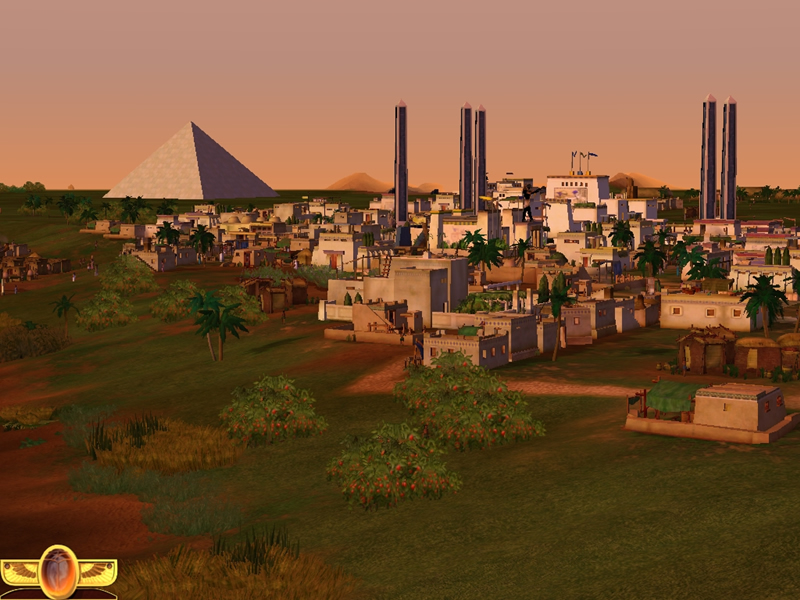
The Imperium of Man has received reports of a heretofore unencountered strain of xeno, hereafter designated Splinter Fleet Mordiggian.
After three months of painting and learning the system, I put five hundred points of Tyranids on the table. And I enjoyed myself a great deal.
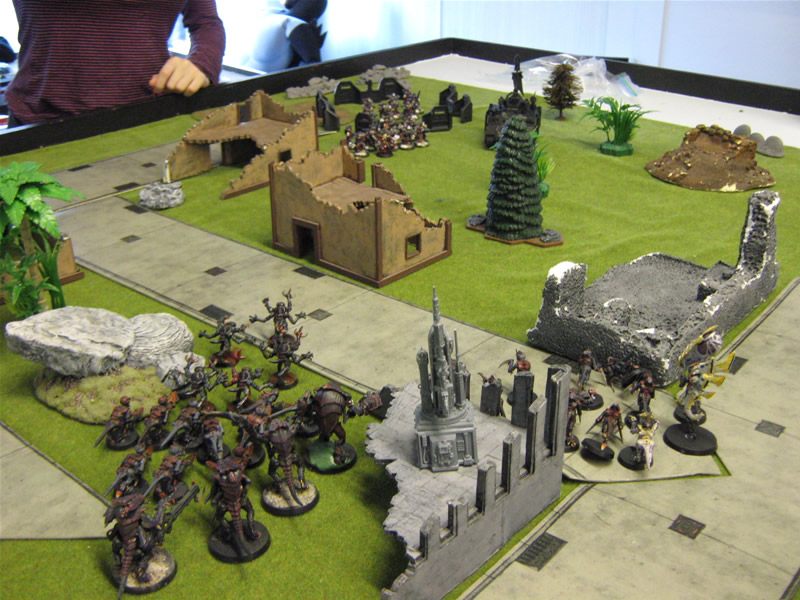
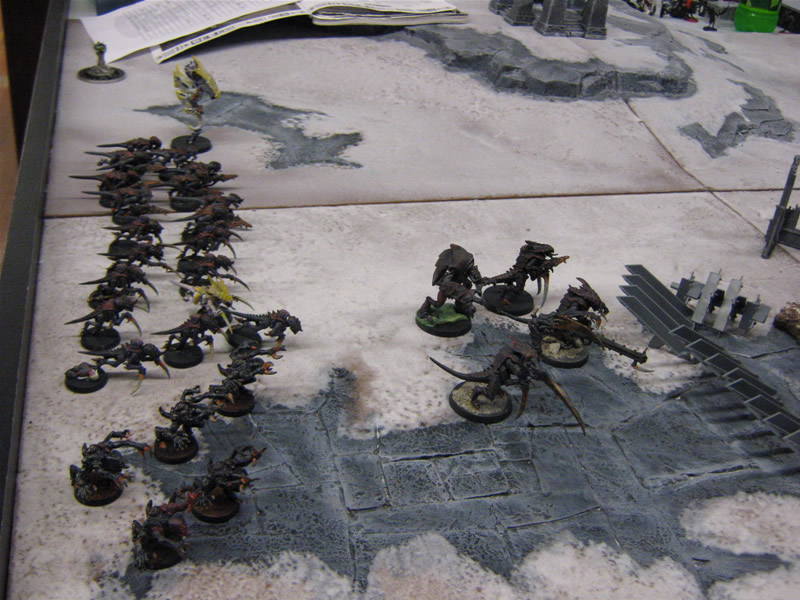
You're looking at 10 Termagants, 10 hormagaunts, 3 warriors, 1 zoanthrope, 5 genestealers, and a Crocodile Games Scarab Ogre standing in for my Tyranid Prime.
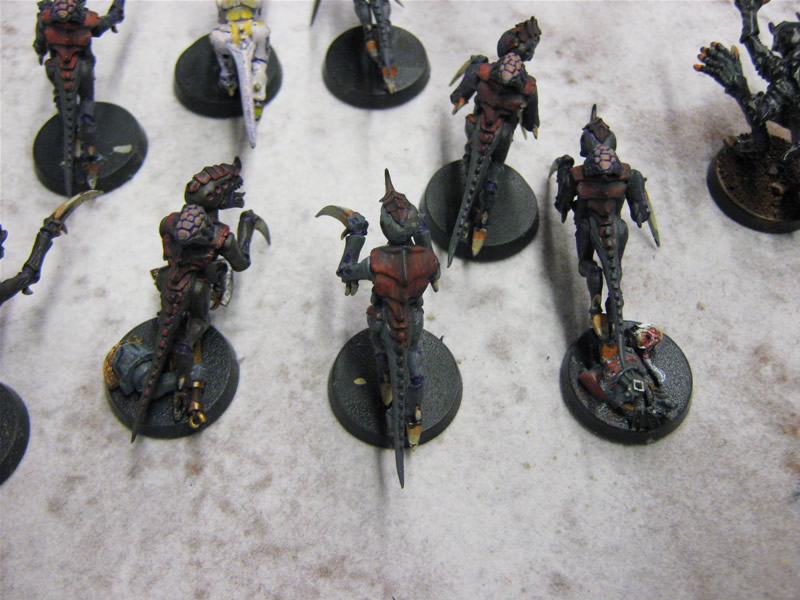
This picture shows a bit more of the detail of my paint scheme, which was inspired by Destroyah in Godzilla vs Destroyah. Also, the Santa Fe Good Taste Factory told me that no matter what I did, I had to kill Space Wolves. So a few of my bases have remnants of a Space Marine chapter, the Rune Bearers. The pieces are taken from a Space Wolves set. I got close to fifty heads on sprues, which will make excellent gristly trophies for a long time to come.
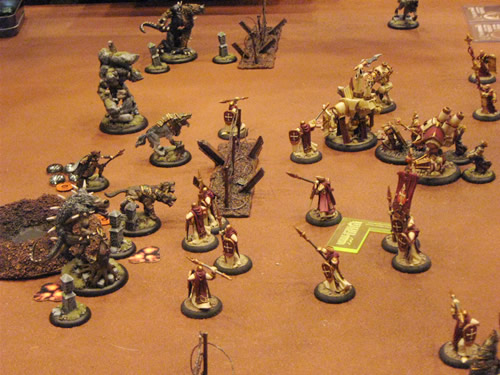
I was massacred in the first game because I had nothing to penetrate the armor of his Kans once my Zoanthrope was gone. In my second game I managed to pull out a tie against the Sisters of Battle in a very enjoyable and even game. I think I like Warhammer's declaration that some battles are not victories; it's entirely acceptable for neither side to win. God knows there have been enough inconclusive battles in history.
I'm enjoying Warhammer's feel. It's more of a wargame than Warmachine. Yes, the buy-in is significantly higher, but there's more a feeling of Clauswitz's "everything is more difficult in war" philosophy. When the dice roll, I calculate what should happen. But the dice (reality, fate, miscommunication, the incompetence of subcommanders, the ammunition got wet, etc...) tell me what did happen. I don't think the "fists full of dice" mechanic is particularly elegant, but it seems to insert an acceptable amount of random into the situation by dispersing it.
Warmachine, now that I've got the experience of two minis wargames, feels much more game-y, on the Gameist-Narrativist-Simualtionist spectrum. If you line up these three special abilities, you should be able to massacre the other guy's Warcaster. Warhammer tells you that you need the right tools that should take down the enemy (you really need armor piercing attacks against tanks, for example). Heroes are present, but they aren't the overwhelming power they are in Warmachine.
I had a good time.




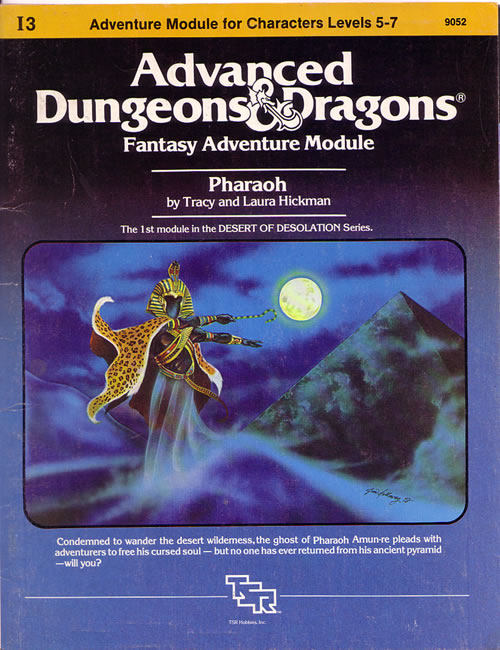 Pyramid is an early adventure for the first edition of Dungeons and Dragons. It's a good adventure with many solid ideas, and, rather unusually for a D&D adventure, an sense of humor. The adventurers are begged by the ghost of the pharaoh Amun-Re to rob his magically-trapped tomb. There's a lot going on inside, including excavation by spoon, and Amun-Re's remaining priesthood, which still lurks in the pyramid itself.
 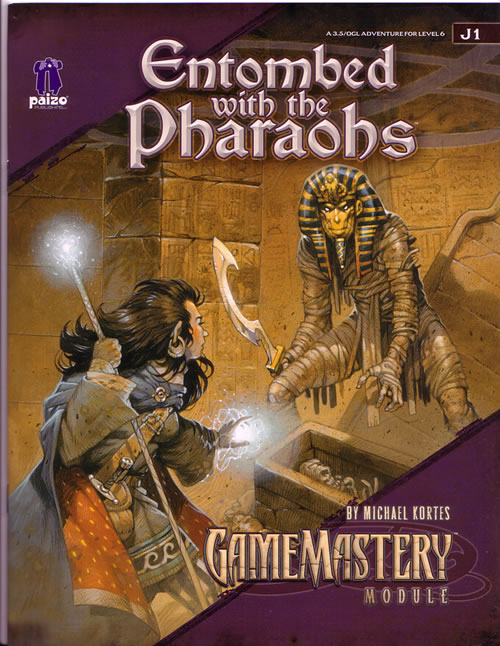 I was very excited to hear that Paizo's Pathfinder game was going to include a close parallel to Egypt called Osirion. One of the first adventures they put out involving Osirion was J1, Entombed with the Pharaohs. Adventure structure has changed a great deal since Pyramid was put out. The adventurers expect to be interested in the adventure, not placed at the edge of a desert thanks to actions they had no say in. So there's background, a bunch of stuff that happens before the party even gets to the pyramid, which affects what happens when they're in the pyramid. Quite notable is that the adventure does not stop when the tomb-raiding does. There are hints and riddles of things that may come to pass in the campaign, if the Game Master wishes. It's a nice way to layer on experience, allowing the literary device of foreshadowing in the campaign. yes, I am one of those snobby players who thinks that virtually any literary device can be used to enhance play in an RPG scenario.
 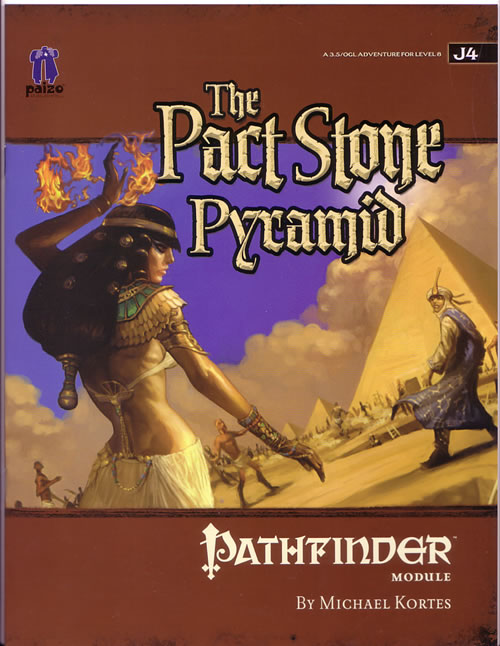 Paizo's follow-up has several structural similarities and some very interesting differences from Kortes' first pyramid adventure. Again with the wacky magical traps (and I like wacky magical traps), but there is a logic to these, because this pyramid was meant to be accessed from time to time. As such, it's got a very different feel from the previous two adventures. Also like Entombed with the Pharaohs, there is a breaking of the walls, a hint at something in the scenario that is beyond the confines of the adventure.
 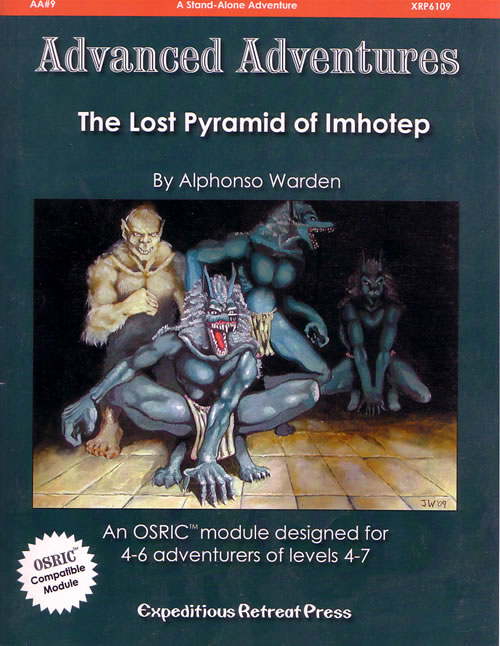 It was kind of a shock to read The Lost Pyramid of Imhotep and realize how like the majority of first edition D&D scenarios it was. It's a dungeon crawl; go in, kill the monsters, avoid the traps. There's a lack of description that I find is good for the immersion experience. The monsters, complex traps, and other immediate goals are well described, but there's a flatness to it that leaves me cold.